Posts tagged as:

book cover (small)I am pleased to announce the release of my latest book, “Permissionless Innovation: The Continuing Case for Comprehensive Technological Freedom.” It’s a short manifesto (just under 100 pages) that condenses — and attempts to make more accessible — arguments that I have developed in various law review articles, working papers, and blog posts over the past few years. I have two goals with this book.

First, I attempt to show how the central fault line in almost all modern technology policy debates revolves around “the permission question,” which asks: Must the creators of new technologies seek the blessing of public officials before they develop and deploy their innovations? How that question is answered depends on the disposition one adopts toward new inventions. Two conflicting attitudes are evident.

One disposition is known as the “precautionary principle.” Generally speaking, it refers to the belief that new innovations should be curtailed or disallowed until their developers can prove that they will not cause any harms to individuals, groups, specific entities, cultural norms, or various existing laws, norms, or traditions.

The other vision can be labeled “permissionless innovation.” It refers to the notion that experimentation with new technologies and business models should generally be permitted by default. Unless a compelling case can be made that a new invention will bring serious harm to society, innovation should be allowed to continue unabated and problems, if they develop at all, can be addressed later.

I argue that we are witnessing a grand clash of visions between these two mindsets today in almost all major technology policy discussions today. Continue reading →


Jack Schinasi discusses his recent working paper, Practicing Privacy Online: Examining Data Protection Regulations Through Google’s Global Expansion published in the Columbia Journal of Transnational Law. Schinasi takes an in-depth look at how online privacy laws differ across the world’s biggest Internet markets — specifically the United States, the European Union and China. Schinasi discusses how we exchange data for services and whether users are aware they’re making this exchange. And, if not, should intermediaries like Google be mandated to make its data tracking more apparent? Or should we better educate Internet users about data sharing and privacy? Schinasi also covers whether privacy laws currently in place in the US and EU are effective, what types of privacy concerns necessitate regulation in these markets, and whether we’ll see China take online privacy more seriously in the future.

Download

Related Links

GMLR coverI’m pleased to announce the release of my latest law review article, “A Framework for Benefit-Cost Analysis in Digital Privacy Debates.” It appears in the new edition of the George Mason University Law Review. (Vol. 20, No. 4, Summer 2013)

This is the second of two complimentary law review articles I am releasing this year dealing with privacy policy. The first, “The Pursuit of Privacy in a World Where Information Control is Failing,” was published in Vol. 36 of the Harvard Journal of Law & Public Policy this Spring. (FYI: Both articles focus on privacy claims made against private actors — namely, efforts to limit private data collection — and not on privacy rights against governments.)

My new article on benefit-cost analysis in privacy debates makes a seemingly contradictory argument: benefit-cost analysis (“BCA”) is extremely challenging in online child safety and digital privacy debates, yet it remains essential that analysts and policymakers attempt to conduct such reviews. While we will never be able to perfectly determine either the benefits or costs of online safety or privacy controls, the very act of conducting a regulatory impact analysis (“RIA”) will help us to better understand the trade-offs associated with various regulatory proposals. Continue reading →

Timothy Ravich, a board certified aviation lawyer in private practice and an adjunct professor of law at the Florida International University School of Law and the University of Miami School of Law, discusses the future of unmanned aerial system (UAS), also known as drones.

Ravich defines what UAVs are, what they do, and what their potential non-military uses are. He explains that UAV operations have outpaced the law in that they are not sufficiently supported by a dedicated and enforceable regime of rules, regulations, and standards respecting their integration into the national airspace.

Ravich goes on to explain that Congress has mandated the FAA to integrate UAS into the national airspace by 2015, and explains the challenges the agency faces. Among the novel issues domestic drone use raises are questions about trespass, liability, and privacy.

Download

Related Links

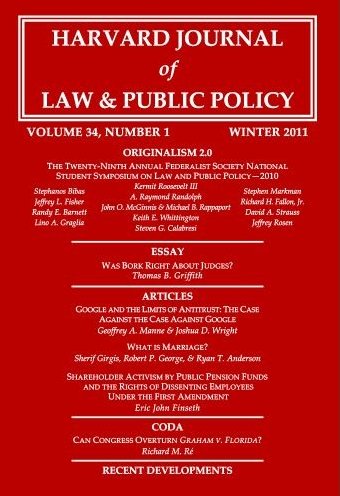
HJLPP coverI’m excited to announce the release of my latest law review article, “The Pursuit of Privacy in a World Where Information Control is Failing,” which appears in the next edition (vol. 36) of the Harvard Journal of Law & Public Policy. This is the first of two complimentary law review articles that I will be releasing this year dealing with privacy policy. The second, which will be published later this summer by the George Mason University Law Review, is entitled, “A Framework for Benefit-Cost Analysis in Digital Privacy Debates.” (FYI: Both articles focus on privacy claims made against private actors — namely, efforts to limit private data collection — and not on privacy rights against governments.)

The new Harvard Journal article is divided into three major sections. Part I focuses on some of normative challenges we face when discussing privacy and argues that there may never be a widely accepted, coherent legal standard for privacy rights or harms here in the United States. It also explores the tensions between expanded privacy regulation and online free speech. Part II turns to the many enforcement challenges that are often ignored when privacy policies are being proposed or formulated and argues that legislative and regulatory efforts aimed at protecting privacy must now be seen as an increasingly intractable information control problem. Most of the problems policymakers and average individuals face when it comes to controlling the flow of private information online are similar to the challenges they face when trying to control the free flow of digitalized bits in other information policy contexts, such as online safety, cybersecurity, and digital copyright.

If the effectiveness of law and regulation is limited by the normative considerations discussed in Part I and the practical enforcement complications discussed in Part II, what alternatives remain to assist privacy-sensitive individuals? I address that question in Part III of the paper and argue that the approach America has adopted to deal with concerns about objectionable online speech and child safety offers a path forward on the privacy front as well. Continue reading →

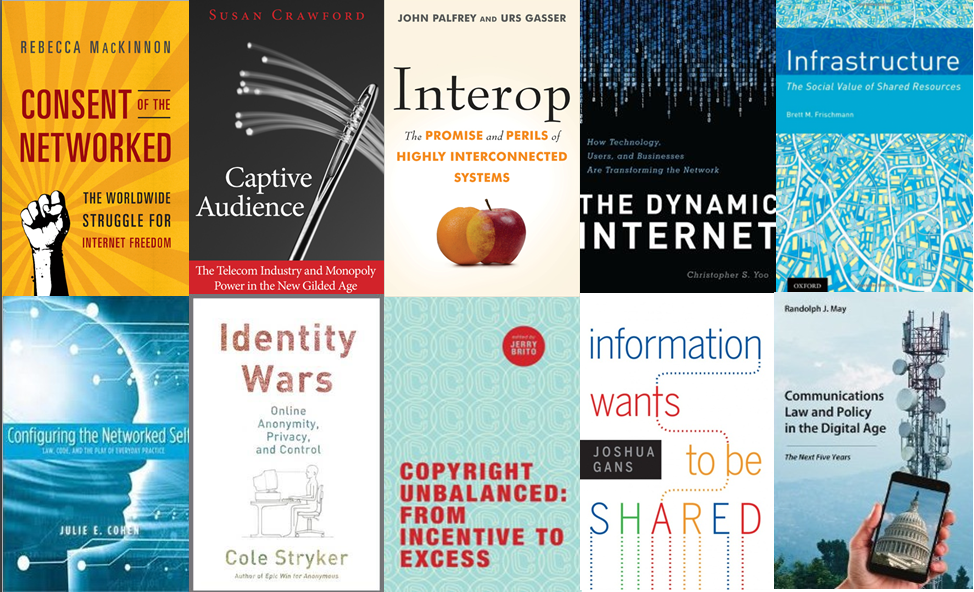
The number of major cyberlaw and information tech policy books being published annually continues to grow at an astonishing pace, so much so that I have lost the ability to read and review all of them. In past years, I put together end-of-year lists of important info-tech policy books (here are the lists for 2008, 2009, 2010, and 2011) and I was fairly confident I had read just about everything of importance that was out there (at least that was available in the U.S.). But last year that became a real struggle for me and this year it became an impossibility. A decade ago, there was merely a trickle of Internet policy books coming out each year. Then the trickle turned into a steady stream. Now it has turned into a flood. Thus, I’ve had to become far more selective about what is on my reading list. (This is also because the volume of journal articles about info-tech policy matters has increased exponentially at the same time.)

So, here’s what I’m going to do. I’m going to discuss what I regard to be the five most important titles of 2012, briefly summarize a half dozen others that I’ve read, and then I’m just going to list the rest of the books out there. I’ve read most of them but I have placed an asterisk next to the ones I haven’t.  Please let me know what titles I have missed so that I can add them to the list. (Incidentally, here’s my compendium of all the major tech policy books from the 2000s and here’s the running list of all my book reviews.)

Continue reading →

In my last post, I discussed an outstanding new paper from Ronald Cass on “Antitrust for High-Tech and Low: Regulation, Innovation, and Risk .” As I noted, it’s one of the best things I’ve ever read about the relationship between antitrust regulation and the modern information economy. That got me thinking about what other papers on this topic that I might recommend to others. So, for what it’s worth, here are the 12 papers that have most influenced my own thinking on the issue. (If you have other suggestions for what belongs on the list, let me know. No reason to keep it limited to just 12.)

  1. J. Gregory Sidak & David J. Teece, “Dynamic Competition in Antitrust Law,” 5 Journal of Competition Law & Economics (2009).
  2. Geoffrey A. Manne &  Joshua D. Wright, “Innovation and the Limits of Antitrust,” 6 Journal of Competition Law & Economics, (2010): 153
  3. Joshua D. Wright, “Antitrust, Multi-Dimensional Competition, and Innovation: Do We Have an Antitrust-Relevant Theory of Competition Now?” (August 2009).
  4. Daniel F. Spulber, “Unlocking Technology: Antitrust and Innovation,” 4(4) Journal of Competition Law & Economics, (2008): 915.
  5. Ronald Cass, “Antitrust for High-Tech and Low: Regulation, Innovation, and Risk ,” 9(2) Journal of Law, Economics and Policy, Forthcoming (Spring 2012)
  6. Richard Posner, “Antitrust in the New Economy,” 68 Antitrust Law Journal, (2001).
  7. Stan J. Liebowitz & Stephen E. Margolis,”Path Dependence, Lock-in, and History,” 11(1) Journal of Law, Economics and Organization, (April 1995): 205-26.
  8. Robert Crandall and Charles Jackson, “Antitrust in High-Tech Industries,” Technology Policy Institute (December 2010).
  9. Bruce Owen, “Antitrust and Vertical Integration in ‘New Economy’ Industries,” Technology Policy Institute (November 2010).
  10. Douglas H. Ginsburg & Joshua D. Wright, “Dynamic Analysis and the Limits of Antitrust Institutions,” 78 (1) Antitrust Law Journal (2012): 1-21.
  11. Thomas Hazlett, David Teece, Leonard Waverman, “Walled Garden Rivalry: The Creation of Mobile Network Ecosystems,” George Mason University Law and Economics Research Paper Series, (November 21, 2011), No. 11-50.
  12. David S. Evans, “The Antitrust Economics of Two Sided Markets.”

The fine folks at George Mason University School of Law’s Henry G. Manne Program in Law & Economics Studies have put together another stellar agenda and lineup of speakers for their Second Annual Conference on Competition, Search & Social Media. The event will be held at GMU’s School of Law on Wednesday, May 16th from 8:00 A.M. to 5:00 P.M. Panel topics are listed as follows:

PANEL 1:  Antitrust and Platform Competition in Search and Social Media (This panel will discuss issues involving market definition, network effects, and dynamic considerations when analyzing search and social media platform competition.)

PANEL 2:  Search, Duties to Deal, and Essential Facilities (This panel will explore the extent to which search engines should be viewed as utilities, and whether they may have a legal duty to assist their rivals under the essential facilities doctrine as it survives after Trinko and Linkline.)

PANEL 3:  The Interface Between Privacy and Competitive Analysis in Search and Social Media (This panel will explore the extent to which privacy should be germane to antitrust analysis of online search and social networks, including whether privacy can be viewed as a dimension of quality and the extent to which privacy regulation may affect competition.)

PANEL 4:  Are There Workable Remedies for “Search Engine Bias”? (This panel will discuss economic, legal (including First Amendment), and practical issues surrounding potential remedies to allegedly “biased” search engine results.)

I’m honored to have been asked to moderate the second panel since it focuses on an issue I’ve been given a lot of thought to lately. (See my recent working paper, “The Perils of Classifying Social Media Platforms as Public Utilities.“)

Seriously, you’d be hard-pressed to find a better set of speakers on these topics. Check them all out here, where you can also RSVP if you’re interested.

[Note: This post is updated regularly as I discover relevant old or new material.]

“Regulatory capture” occurs when special interests co-opt policymakers or political bodies — regulatory agencies, in particular — to further their own ends.  Capture theory is closely related to the “rent-seeking” and “political failure” theories developed by the public choice school of economics.  Another term for regulatory capture is “client politics,” which according to James Q. Wilson, “occurs when most or all of the benefits of a program go to some single, reasonably small interest (and industry, profession, or locality) but most or all of the costs will be borne by a large number of people (for example, all taxpayers).”  (James Q. Wilson, Bureaucracy, 1989, at 76).

While capture theory cannot explain all regulatory policies or developments, it does provide an explanation for the actions of political actors with dismaying regularity.  Because regulatory capture theory conflicts mightily with romanticized notions of “independent” regulatory agencies or “scientific” bureaucracy, it often evokes a visceral reaction and a fair bit of denialism.  (See, for example, the reaction of New Republic’s Jonathan Chait to Will Wilkinson’s recent Economist column about the prevalence of corporatism in our modern political system.)  Yet, countless studies have shown that regulatory capture has been at work in various arenas: transportation and telecommunications; energy and environmental policy; farming and financial services; and many others.

I thought it might be useful to build a compendium of quotes from various economists and political scientists who have studied the regulatory process throughout history and identified regulatory capture or client politics as a major problem.  I would greatly appreciate having others suggest additional quotes and studies to add to this list since I plan to update it frequently and eventually work all of this into a future paper or book. [ Note: I have updated this compendium over a dozen times since the original post, so please check back for updates.]

The following list is chronological and begins, surprisingly, with the thoughts of progressive hero Woodrow Wilson…

Continue reading →

The details of Tyler Clementi’s case are slowly revealing themselves. He was the Rutgers University freshman whose sex life was exposed on the Internet when fellow students Dharun Ravi and Molly Wei placed a webcam in his dorm room, transmitting the images that it captured in real time on the Internet. Shortly thereafter, Clementi committed suicide.

Whether Ravi and Wei acted out of anti-gay animus, titillation about Clementi’s sexual orientation, or simply titillation about sex, their actions were utterly outrageous, offensive, and outside of the bounds of decency. Moreover, according to Middlesex County, New Jersey prosecutors, they were illegal. Ravi and Wei have been charged with invasion of privacy.

This is what invasion of privacy looks like. It’s the outrageous, offensive, truly galling revelation of private facts like what happened in this case. Over the last 120 years, common law tort doctrine has evolved to find that people have a right not to suffer such invasions. New Jersey has apparently enshrined that right in a criminal statute.

The story illustrates how quaint are some of the privacy “invasions” we often discuss, such as the tracking of people’s web surfing by advertising networks. That information is not generally revealed in any meaningful way. It is simply being used to serve tailored ads.

This event also illustrates how privacy law is functioning in our society. It’s functioning fairly well. Law, of course, is supposed to reflect deeply held norms. Privacy norms—like the norm against exposing someone’s sexual activity without consent—are widely shared, so that the laws backing up those norms are rarely violated.

It is probably a common error to believe that law is “working” when it is exercised fairly often, fines and penalties being doled it with some routine. Holders of this view see law—more accurately, legislation—as a tool for shaping society, of course. Many of them would like to end the societal debate about online privacy, establishing a “uniform national privacy standard.” But nobody knows what that standard should be. The more often legal actions are brought against online service providers, the stronger is the signal that online privacy norms are unsettled. That privacy debate continues, and it should.

It is not debatable that what Ravi and Wei did to Tyler Clementi was profoundly wrong. That was a privacy invasion.