Congress has become a less important player in the field of technology policy. Why did that happen, and what are the ramifications for technological governance efforts going forward?
I’ve spent almost 30 years covering technology policy. There was a time in my life when I spent almost all my time as a policy analyst preoccupied with developments in the federal legislative arena. I lived in the trenches of Capitol Hill and interacted with lawmakers and their staff morning, noon, and night.
In recent years, however, I have spent very little time focused on the Legislative Branch because it has effectively become a non-actor on technology policy. It is not that congressional lawmakers stopped caring about tech policy. Interest actually remains quite high—perhaps higher than ever before. Congress also continues to introduce lots of bills, host plenty of hearings, and issue mountains of press releases related to tech policy issues.
Nonetheless, all that interest and activity has not really translated into much important legislation. Continue reading →
I recently posted an essay over at The Bridge about “The Pacing Problem and the Future of Technology Regulation.” In it, I explain why the pacing problem—the notion that technological innovation is increasingly outpacing the ability of laws and regulations to keep up—“is becoming the great equalizer in debates over technological governance because it forces governments to rethink their approach to the regulation of many sectors and technologies.”
In this follow-up article, I wanted to expand upon some of the themes developed in that essay and discuss how they relate to two other important concepts: the “Collingridge Dilemma” and technological determinism. In doing so, I will build on material that is included in a forthcoming law review article I have co-authored with Jennifer Skees, Ryan Hagemann (“Soft Law for Hard Problems: The Governance of Emerging Technologies in an Uncertain Future”) as well as a book I am finishing up on the growth of “evasive entrepreneurialism” and “technological civil disobedience.”
Recapping the Nature of the Pacing Problem
First, let us quickly recap that nature of “the pacing problem.” I believe Larry Downes did the best job explaining the “problem” in his 2009 book on
The Laws of Disruption. Downes argued that “technology changes exponentially, but social, economic, and legal systems change incrementally” and that this “law” was becoming “a simple but unavoidable principle of modern life.” Continue reading →
What happens when technological innovation outpaces the ability of laws and regulations to keep up?
This phenomenon is known as “the pacing problem,” and it has profound ramifications for the governance of emerging technologies. Indeed, the pacing problem is becoming the great equalizer in debates over technological governance because it forces governments to rethink their approach to the regulation of many sectors and technologies.
The Innovation Cornucopia
Had Rip Van Winkle woken up his famous nap today, he’d be shocked by all the changes around him. At-home genetics tests, personal drones, driverless cars, lab-grown meats, and 3D-printed prosthetic limbs are just some of the amazing innovations that would boggle his mind. New devices and services are flying at us so rapidly that we sometimes forget that most did not even exist a short time ago. Continue reading →
My professional life is dedicated to researching the public policy implications of various emerging technologies. Of the many issues and sectors that I cover, none are more interesting or important than advanced medical innovation. After all, new health care technologies offer the greatest hope for improving human welfare and longevity. Consequently, the public policies that govern these technologies and sectors will have an important bearing on just how much life-enriching or life-saving medical innovation we actually get going forward.
Few people are doing better reporting on the intersection of advanced technology and medicine — as well as the effects of regulation on those fields — than my Mercatus Center colleague Jordan Reimschisel. In a very short period of time, Jordan has completely immersed himself in these complex, cutting-edge topics and produced a remarkable body of work discussing how, in his words, “technology can merge with medicine to democratize medical decision making, empower patients to participate in the treatment process, and promote better health outcomes for more patients at lower and lower costs.” He gets deep into the weeds of the various technologies he writes about as well as the legal, ethical, and economic issues surrounding each topic.
I encouraged him to start an ongoing compendium of his work on these topics so that we could continue to highlight his research, some of which I have been honored to co-author with him. I have listed his current catalog down below, but jump over to this Medium page he set up and bookmark it for future reference. This is some truly outstanding work and I am excited to see where he goes next with topics as wide-ranging as “biohackerspaces,” democratized or “personalized” medicine, advanced genetic testing and editing techniques, and the future of the FDA in an age of rapid change.
Give Jordan a follow on Twitter (@jtreimschisel) and make sure to follow his Medium page for his dispatches from the front lines of the debate over advanced medical innovation and its regulation.
The future of emerging technology policy will be influenced increasingly by the interplay of three interrelated trends: “innovation arbitrage,” “technological civil disobedience,” and “spontaneous private deregulation.” Those terms can be briefly defined as follows:
“Innovation arbitrage” refers to the idea that innovators can, and will with increasingly regularity, move to those jurisdictions that provide a legal and regulatory environment more hospitable to entrepreneurial activity. Just as capital now fluidly moves around the globe seeking out more friendly regulatory treatment, the same is increasingly true for innovations. And this will also play out domestically as innovators seek to play state and local governments off each other in search of some sort of competitive advantage.
“Technological civil disobedience” represents the refusal of innovators (individuals, groups, or even corporations) or consumers to obey technology-specific laws or regulations because they find them offensive, confusing, time-consuming, expensive, or perhaps just annoying and irrelevant. New technological devices and platforms are making it easier than ever for the public to openly defy (or perhaps just ignore) rules that limit their freedom to create or use modern technologies.
“Spontaneous private deregulation” can be thought of as de facto rather than the de jure elimination of traditional laws and regulations owing to a combination of rapid technological change as well the potential threat of innovation arbitrage and technological civil disobedience. In other words, many laws and regulations aren’t being formally removed from the books, but they are being made largely irrelevant by some combination of those factors. “Benign or otherwise, spontaneous deregulation is happening increasingly rapidly and in ever more industries,” noted Benjamin Edelman and Damien Geradin in a Harvard Business Reviewarticle on the phenomenon.[1]
In this essay, I want to briefly highlight how, over the course of just the past month, a single company has offered us a powerful example of how both global innovation arbitrage and technological civil disobedience—
or at least the threat thereof—might become a more prevalent feature of discussions about the governance of emerging technologies. And, in the process, that could lead to at least the partial spontaneous deregulation of certain sectors or technologies. Finally, I will discuss how this might affect technological governance more generally and accelerate the movement toward so-called “soft law” governance mechanisms as an alternative to traditional regulatory approaches. Continue reading →
On Tuesday, UN Secretary-General Ban Ki-Moon delivered an address to the UN Security Council “on the Non-Proliferation of Weapons of Mass Destruction.” He made many of the same arguments he and his predecessors have articulated before regarding the need for the Security Council “to develop further initiatives to bring about a world free of weapons of mass destruction.” In particular, he was focused on the great harm that could come about from the use of chemical, biological and nuclear weapons. “Vicious non-state actors that target civilians for carnage are actively seeking chemical, biological and nuclear weapons,” the Secretary-General noted. A stepped-up disarmament agenda is needed, he argued, “to prevent the human, environmental and existential destruction these weapons can cause . . . by eradicating them once and for all.”
The UN has created several multilateral mechanisms to pursue those objectives, including the Nuclear Non-Proliferation Treaty, the Chemical Weapons Convention, and the Biological Weapons Convention. Progress on these fronts has always been slow and limited, however. The Secretary-General observed that nuclear non-proliferation efforts have recently “descended into fractious deadlock,” but the effectiveness of those and similar UN-led efforts have long been challenged by the dual realities of (1) rapid ongoing technological change that has made WMDs more ubiquitous than ever, plus (2) a general lack of teeth in UN treaties and accords to do much to slow those advances, especially among non-signatories.
Despite those challenges, the Secretary-General is right to remain vigilant about the horrors of chemical, biological and nuclear attacks. But what was interesting about this address is that the Secretary-General continued on to discuss his concerns about a rising class of emerging technologies, which we usually don’t hear mentioned in the same breath as those traditional “weapons of mass destruction”: Continue reading →
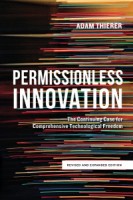
I am pleased to announce the release of the second edition of my book, Permissionless Innovation: The Continuing Case for Comprehensive Technological Freedom. As with the first edition, the book represents a short manifesto that condenses — and attempts to make more accessible — arguments that I have developed in various law review articles, working papers, and blog posts over the past few years. The book attempts to accomplish two major goals.
First, I attempt to show how the central fault line in almost all modern technology policy debates revolves around “the permission question,” which asks:
Must the creators of new technologies seek the blessing of public officials before they develop and deploy their innovations? How that question is answered depends on the disposition one adopts toward new inventions. Two conflicting attitudes are evident.
One disposition is known as the “precautionary principle.” Generally speaking, it refers to the belief that new innovations should be curtailed or disallowed until their developers can prove that they will not cause any harms to individuals, groups, specific entities, cultural norms, or various existing laws, norms, or traditions.
The other vision can be labeled “permissionless innovation.” It refers to the notion that experimentation with new technologies and business models should generally be permitted by default. Unless a compelling case can be made that a new invention will bring serious harm to society, innovation should be allowed to continue unabated and problems, if they develop at all, can be addressed later.
I argue that we are witnessing a grand clash of visions between these two mindsets today in almost all major technology policy discussions today. Continue reading →
On Thursday, it was my great pleasure to participate in a Washington Legal Foundation (WLF) event on “Online Privacy Regulation: The Challenge of Defining Harm.” The entire event video can be found on YouTube here, but down below I pasted the clip of just my remarks. Other speakers at the event included: FTC Commissioner Maureen K. Ohlhausen, Commissioner; John B. Morris, Jr., the Associate Administrator and Director of Internet Policy athe U.S. Department of Commerce’s National Telecommunications and Information Administration; and Katherine Armstrong, Counsel at the law firm of Hogan Lovells. Glenn Lammi of the WLF moderated the session.
My remarks drew upon a few recent law review articles I have published relating digital privacy debates to previous debates over free speech and online child safety issues. (Here are those articles: 1, 2, 3).
If there are two general principles that unify my recent work on technology policy and innovation issues, they would be as follows. To the maximum extent possible:
We should avoid preemptive and precautionary-based regulatory regimes for new innovation. Instead, our policy default should be innovation allowed (or “permissionless innovation”) and innovators should be considered “innocent until proven guilty” (unless, that is, a thorough benefit-cost analysis has been conducted that documents the clear need for immediate preemptive restraints).
We should avoid rigid, “top-down” technology-specific or sector-specific regulatory regimes and/or regulatory agencies and instead opt for a broader array of more flexible, “bottom-up” solutions (education, empowerment, social norms, self-regulation, public pressure, etc.) as well as reliance on existing legal systems and standards (torts, product liability, contracts, property rights, etc.).
Weaver argues that new robot technology “is going to develop fast, almost certainly faster than we can legislate it. That’s why we need to get ahead of it now.” In order to preemptively address concerns about new technologies such as driverless cars or commercial drones, “we need to legislate early and often,” Weaver says. Stated differently, Weaver is proposing “precautionary principle”-based regulation of these technologies. The precautionary principle generally refers to the belief that new innovations should be curtailed or disallowed until their developers can prove that they will not cause any harms to individuals, groups, specific entities, cultural norms, or various existing laws, norms, or traditions.
Calo argues that we need “the establishment of a new federal agency to deal with the novel experiences and harms robotics enables” since there exists “distinct but related challenges that would benefit from being examined and treated together.” These issues, he says, “require special expertise to understand and may require investment and coordination to thrive.
I’ll address both Weaver and Calo’s proposals in turn. Continue reading →
My latest law review article is entitled, “Privacy Law’s Precautionary Principle Problem,” and it appears in Vol. 66, No. 2 of the Maine Law Review. You can download the article on my Mercatus Center page, on the Maine Law Review website, or via SSRN. Here’s the abstract for the article:
Privacy law today faces two interrelated problems. The first is an
information control problem. Like so many other fields of modern cyberlaw—intellectual property, online safety, cybersecurity, etc.—privacy law is being challenged by intractable Information Age realities. Specifically, it is easier than ever before for information to circulate freely and harder than ever to bottle it up once it is released.
This has not slowed efforts to fashion new rules aimed at bottling up those information flows. If anything, the pace of privacy-related regulatory proposals has been steadily increasing in recent years even as these information control challenges multiply.
This has led to privacy law’s second major problem:
the precautionary principle problem. The precautionary principle generally holds that new innovations should be curbed or even forbidden until they are proven safe. Fashioning privacy rules based on precautionary principle reasoning necessitates prophylactic regulation that makes new forms of digital innovation guilty until proven innocent.
This puts privacy law on a collision course with the general freedom to innovate that has thus far powered the Internet revolution, and privacy law threatens to limit innovations consumers have come to expect or even raise prices for services consumers currently receive free of charge. As a result, even if new regulations are pursued or imposed, there will likely be formidable push-back not just from affected industries but also from their consumers.
In light of both these information control and precautionary principle problems, new approaches to privacy protection are necessary. Continue reading →
The Technology Liberation Front is the tech policy blog dedicated to keeping politicians' hands off the 'net and everything else related to technology. Learn more about TLF →




 The Technology Liberation Front is the tech policy blog dedicated to keeping politicians' hands off the 'net and everything else related to technology.