Posts tagged as:

Attendees at the State of the ‘Net conference will be thrilled to know that Larry Downes will be making an encore performance Wednesday afternoon, January 23rd, in the Rayburn House Office Building. The noontime briefing is entitled “A Rational Response to the Privacy ‘Crisis’.” It’s appropriately named because he’ll be discussing ideas from his recent Cato policy analysis: “A Rational Response to the Privacy ‘Crisis’.”

We don’t expect news reports to exhibit the tightest legal reasoning, of course, but Sunday’s New York Times story on location privacy made a runny omelet of some important legal issues relating to privacy.

The starting point is United States v. Jones, a case the Supreme Court decided last January. The Court held that government agents violated the Fourth Amendment when they attached a GPS tracking device to a vehicle without a warrant and used it to determine the location of a suspect for four weeks. Location information can be revealing.

“Some advocacy groups view location tracking by mobile apps and ad networks as a parallel, warrantless commercial intrusion,” says the story. A location privacy bill forthcoming from Senator Al Franken (D-MN) “suggests that consumers may eventually gain some rights over their own digital footprints.”

Jones was about government agents—their freedom of action specifically disabled by the Fourth Amendment—invading a recognized property right (in one’s car) to gather data. There is little analogy to location tracking by mobile devices, apps, and networks, which are privately provided, voluntarily adopted, and which violate no recognized right. Indeed, their tracking provides various consumer benefits. The Times piece equivocates between the government’s failure to get a legally required search warrant in Jones and uses of data that some may feel “unwarranted,” in the sense of being “uncalled for under the circumstances.”

The first line of Larry Downes’ new Cato Policy Analysis, “A Rational Response to the Privacy ‘Crisis’,” could have been written for the Times‘ sloppy analogy:

“What passes today as a ‘debate’ over privacy lacks agreed-upon terms of reference, rational arguments, or concrete goals,” Downes says. The paper examines how the “creepy factor” permeates privacy debates rather than crisp thinking and clear-headed examination.

It’s not that location tracking doesn’t generate legitimate privacy concerns. It does. People don’t know how location information is collected and used. They don’t always know how to stop its collection. And the future consequence of location information collected today is unclear. But the capacity of private actors to harm individuals with location data is limited. Their incentive to do so is even smaller. And avoiding location tracking is simply done (at significant costs to convenience).

As Downes’ piece illustrates, we’ve seen this kind of debate before, and we’ll see it again: A particular innovation spurs privacy concerns and a backlash (whipped by legislators and regulators). A negotiation between consumers and industry, facilitated by the news media, advocates, and a variety of other actors, produces the way forward. As often as not, the way forward is a partial or complete embrace of the technology and its benefits. Plenty of times, the threat never materializes ( see pervasive RFID).

Downes explores the legal explanation for what happens when consumers adopt new technologies that use personal information to produce custom content and services—this question of “rights over … digital footprints.” He finds that licensing is the best explanation for what is happening. When consumers use the many online services available to them, they license data that they might otherwise control.

The legal framework Downes puts forward sets the stage for iterative, contract-based development of rules for how data may be used in the information economy. It cuts against top-down dictates like Franken’s proposal to regulate future technologies today, knowing so little of how technology or society will develop.

Ultimately, no legislature can resolve the deep and conflicted cultural issues playing out in the privacy debate. Downes characterizes that debate as revealed tension between Americans’ Davey Crockett side—the privacy-protective frontiersmen—and our collective Puritanism. We are participants in and parts of a very watchful society.

It’s worth a read, Larry Downes’s “A Rational Response to the Privacy ‘Crisis’.”

A reporter recently interviewed me for a story and asked a terrific question: Why is it that business model disruption and creative destruction seem to have sped up in recent times?  My guess — and excuse me if this seems too obvious — is that it must have something to do with the very nature of intangible, digital technologies of the new economy versus the tangible, analog technologies of the old economy. That is, in markets built largely upon binary code, the pace and nature of change becomes relentlessly hyper-Schumpeterian precisely because digital technologies and platforms are more easily disintermediated and leap-frogged than earlier tangible technologies and platforms were.  And so we get creative destruction on steroids.

Consider, for example, what constituted a “social networking site” in the old days versus today. Our old social networking sites and services in the past were town squares, parks, school parking lots, shopping malls, as well as media like newspapers, magazines, and even the mail. When we socially networked in those environments, we were creatures of our fixed, “real-space” environments as well as their many natural constraints. Disrupting, replacing, or even replicating those environments, technologies, or platforms was a monumental undertaking precisely because of the enormous costs associated with doing so. Continue reading →

I’ve reviewed many tech policy books here over the years, but have only found myself in agreement with a couple of titles. One of my favorites is “The Laws of Disruption” by fellow TLF co-blogger Larry Downes.  [My short review is here]  Larry does a terrific job documenting the technological forces (or “laws” as he calls them) that our reshaping the modern economy.

The fundamental law of disruption he identifies is: ” Technology changes exponentially, but social, economic, and legal systems change incrementally.” Downes says this law is “a simple but unavoidable principle of modern life” and that it will have profound implications for the way businesses, government, and culture evolve going forward. “As the gap between the old world and the new gets wider,” he argues, “conflicts between social, economic, political, and legal systems” will intensify and “nothing can stop the chaos that will follow.”  He’s exactly right and I’ll be elaborating on that “law” in more detail in a new paper with Jerry Brito as well as in my next book, which I’m finishing up currently.

Anyway, with Larry’s “law” in mind, I couldn’t help but laugh out loud when I was reading this Reuter‘s summary of a recent editorial from the People’s Daily, the main newspaper of China’s ruling Communist Party. The commentary lambasted the Internet, social networking technologies, and online culture. It contained this gem of quote that proves the Chinese government has a firm grasp of the Law of Disruption: “We have failed to take into sufficient account just how much the Internet is a double-edged sword, and have a problem of allowing technology to advance while administration and regulation lag.” Continue reading →

Over this past week, a lot of people were making hay over this recent ReadWriteWeb story, “Facebook’s Zuckerberg Says The Age of Privacy is Over.” Seems that some people were taking issue with Facebook founder Mark Zuckerberg’s suggestion that Facebook’s recent site policy changes, which generally encouraged more sharing or information, were in line with public expectations.  Most people put words in Zuckerberg’s mouth and accused him of saying that “privacy is over” or that he claimed he “is a prophet,” neither of which he actually said.  But let’s ignore the fact that some people made stuff up and get back to the point: What set people off about Facebook’s recent site changes and Zuckerberg’s rationalization of them?

I think it goes back to the fact that a lot of people want to have their cake and eat it too. “It is the paradox of the cyber era,” notes Washington Post columnist Michael Gerson: We are “a nation of exhibitionists demanding privacy.”  Indeed, that’s true, but there’s a good reason why this so-called “privacy paradox” exists. As Larry Downes, author of the brilliant new book, The Laws of Disruption, argues:

People value their privacy, but then go out of their way to give it up. There’s nothing paradoxical about it. We do value privacy. It’s just that we’re willing to trade it for services we value even more. Consumers intuitively look at the information being requested and decide whether the value they receive for disclosing it is worth the cost of their privacy. (p. 80)

That’s exactly right. When confronted with real world choices about privacy and information sharing, we often are willing to accept some trade-offs in exchange for something of value. But when we are asked about this process we are loathe to admit that we would willingly engage in such privacy-for-services trade-offs even if we do it every day of our lives.  As Michael Arrington of TechCrunch rightly points out:

Continue reading →

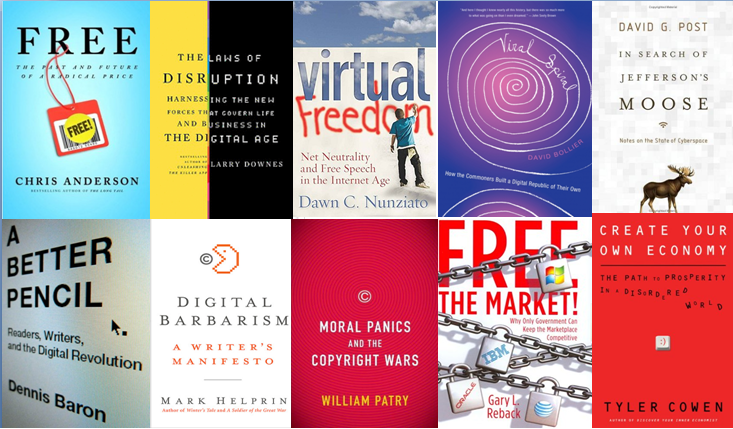
2009 was not as big of a year for Internet and information technology (“info-tech”) policy books as 2008 was, but there were still some notable titles released that offered interesting perspectives about the future of the Net and the impact the Digital Revolution is having on our lives, culture, and economy.  So, like last year, I figured I would throw together my list of the 10 most important info-tech policy books of the year.

book covers collage 2009First, let me repeat a few of the same caveats and disclaimers that I set forth last year.  What qualifies as an “important” info-tech policy book? Simply put, it’s a title that many people are currently discussing and that we will likely be referencing for many years to come.  However, I want to be clear that merely because a book appears on my list it does not necessarily mean I agree with everything said in it. In fact, as was the case in previous years, I found much with which to disagree in my picks for the most important books of 2009 and I find that the cyber-libertarianism I subscribe to has very few fans out there.

Another caveat: Narrowly-focused titles lose a few points on my list. For example, if a book deals mostly with privacy issues, copyright law, or antitrust policy, it does not exactly qualify as the same sort of “tech policy book” as other titles found on this list since it is a narrow exploration of just one set of issues with a bearing on technology policy.

With those caveats in mind, here are my choices for the Most Important Info-Tech Policy Books of 2009. Continue reading →