Online child safety — especially the fear of predators lurking on social networking sites (SNS) — continues to spur calls by state and federal lawmakers for regulation. At first, some federal lawmakers advocated outright bans on SNS in schools and libraries via the Deleting Online Predators Act (DOPA). Meanwhile, state and local lawmakers — specifically state Attorneys General (AGs) — have been even more vociferous in their calls for regulation in the form of mandatory age verification for social networking sites, which would cover a broad swath of online sites and activities according to their definitions of SNS. But the question that ultimately gets lost in this debate is: Just how much risk do social networking sites really pose for teens? Which risks are real and which are overblown? And what’s the best way to deal with the risks that we find to be legitimate?
 Nancy Willard devotes her life to answering those questions. Willard is one of America’s leading experts on online safety and risk prevention. She runs the Center for Safe and Responsible Internet Use and she is the author of two outstanding books, Cyberbullying and Cyberthreats and Cyber-Safe Kids, Cyber-Savvy Teens. In my opinion, Willard’s general approach to online child safety is the most enlightened, level-headed, and likely to be effective. That’s because Willard focuses on putting fears in perspective, identifying the actual risks that kids face online, and devising sensible strategies to deal with risks and problems as they are discovered. Her approach is holistic and built upon sound data, targeted risk-identification strategies, and time-tested education and mentoring methods. For my money, it’s the most sensible approach to online safety issues. In fact, when other parents ask me for “just one thing” to read on the topic, I usually recommend Willard’s work — especially her amazing book Cyber-Safe Kids, Cyber-Savvy Teens. And her background in early childhood education, special education for “at risk” children with emotional and behavior difficulties, as well as experience in computer law, means she is uniquely suited to be analyzing these issues. In sum, this is woman we should all be closely listening to on these issues.
Recently, Willard has been responding to criticisms that state AGs have leveled against the Internet Safety Technical Task Force (ISTTF) and its final report. [Disclaimer: I was a member of the ISTTF.] I’ve already outlined the ISTTF’s work at length here, but the three key takeaways from the report were that:
- the risk of predation on social network sites has been over-stated; the data suggest that cyber-bullying is the bigger problem on SNS;
- there is no silver-bullet technical solution to online child safety concerns, and mandatory age verification, in particular, would not make kids safer online but could even create bigger problems in the long-run;
- education and empowerment are the real keys to keeping kids safer online.
Continue reading →
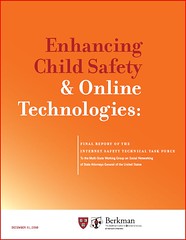 The Internet Safety Technical Task Force (ISTTF), which was formed a year ago to study online safety concerns and technologies, today issued its final report to the U.S. Attorneys General who authorized its creation. It was a great honor for me to serve as a member of the ISTTF and I believe this Task Force and its report represent a major step forward in the discussion about online child safety in this country.
The ISTTF was very ably chaired by John Palfrey, co-director of Harvard University’s Berkman Center for Internet & Society, and I just want to express my profound thanks here to John and his team at Harvard for doing a great job herding cats and overseeing a very challenging process. I encourage everyone to examine the full ISTTF report and all the submissions, presentations, and academic literature that we collected. [It’s all here.] It was a comprehensive undertaking that left no stone unturned.
Importantly, the ISTTF convened (1) a Research Advisory Board (RAB),which brought together some of the best and brightest academic researchers in the field of child safety and child development and (2) a Technical Advisory Board (TAB), which included some of America’s leading technologists, who reviewed child safety technologies submitted to the ISTTF. I strongly recommend you closely examine the RAB literature review and TAB assessment of technologies because those reports provide very detailed assessments of the issues. They both represent amazing achievements in their respective arenas.
There are a couple of key takeaways from the ISTTF’s research and final 278-page report that I want to highlight here. Most importantly, like past blue-ribbon commissions that have studied this issue, the ISTTF has generally concluded
there is no silver-bullet technical solution to online child safety concerns. The better way forward is a “layered approach” to online child protection. Here’s how we put it on page 6 of the final report:
The Task Force remains optimistic about the development of technologies to enhance protections for minors online and to support institutions and individuals involved in protecting minors, but cautions against overreliance on technology in isolation or on a single technological approach. Technology can play a helpful role, but there is no one technological solution or specific combination of technological solutions to the problem of online safety for minors. Instead, a combination of technologies, in concert with parental oversight, education, social services, law enforcement, and sound policies by social network sites and service providers may assist in addressing specific problems that minors face online. All stakeholders must continue to work in a cooperative and collaborative manner, sharing information and ideas to achieve the common goal of making the Internet as safe as possible for minors.
Continue reading →
Today’s USA Today features a debate between the editors and me on the question of the impact media has on children and what should be done about it. Their editorial argues that “Today’s mass media penetrate deeply and quietly, inflicting real damage on young children, an increasing body of research shows.” Specifically, they are referring to a new study commissioned by Common Sense Media (CSM), which claims that a review of 173 studies shows “that a strong correlation exists between greater exposure and adverse health outcomes.”
In my response entitled “Don’t Scapegoat Media,” which appears in its entirety down below the fold, I argue that “Media have long been a convenient scapegoat for the woes of the world,” and that we must be careful not to assume correlation equals causation when surveying the impact of media on kids. After all, I argue, “how do [those studies] account for the other variables that influence youth development, including broken homes, bad parents, socioeconomic status, troubled peer relations, poor schools and so on? And how is media exposure weighted relative to these other influences? Is a beer ad really as much of a negative influence as an alcoholic parent?” Again, read my entire response below. [Of course, even if one assumes some media has an impact on some kids, there are plenty of ways for parents and guardians to take control over the media in their lives, as I have shown in my big book on the subject.]
I was also quoted in this Washington Post article about the new CSM study on Tuesday.
Continue reading →
In a big post two months ago entitled “Age Verification Debate Continues; Schools Now at Center of Discussion,” I noted that there has been an important shift in the age verification debate: Schools and school records are increasingly being viewed as the primary mechanism to facilitate online identity authentication transactions. I pointed out that this raises two very serious questions: Do we want schools to serve as DMVs for our children? And, do we want more school records or information about our kids being accessed or put online?
Brad Stone of the
New York Times has just posted an important article with relevance to this debate. In it, he points out that:
performing so-called age verification for children is fraught with challenges. The kinds of publicly available data that Web companies use to confirm the identities of adults, like their credit card or Social Security numbers, are either not available for minors or are restricted by federal privacy laws. Nevertheless, over the last year, at least two dozen companies have sprung up with systems they claim will solve the problem. Surprisingly, their work is proving controversial and even downright unpopular among the very people who spend their days worrying about the well-being of children on the Web.
Child-safety activists charge that some of the age-verification firms want to help Internet companies tailor ads for children. They say these firms are substituting one exaggerated threat — the menace of online sex predators — with a far more pervasive danger from online marketers like junk food and toy companies that will rush to advertise to children if they are told revealing details about the users.
Continue reading →
My friend Larry Magid, one of America’s leading Internet safety experts, has an outstanding column over at the Yahoo Kids “Connected Parent” site entitled “Is the Internet as Dangerous as Drunk Driving?” In it, he discusses the surprising results of a recent survey of 1,000 moms of teenagers commissioned by McAfee and conducted by Harris Interactive which found that “about two-thirds of mothers of teens in the United States are just as, or more, concerned about their teenagers’ online safety, such as from threatening emails or solicitation by online sexual predators, as they are about drunk driving (62 per cent) and experimenting with drugs (65 per cent).”
Like Larry, I was a bit shocked that so many mothers would equate online safety with the dangers of drunk driving. After all, as Larry proves, the relative risks aren’t even close:
While moms have good reason to be concerned about how their teens use the Internet, online dangers pale compared to the risks of drunk driving. In 2007, 6,552 people were killed in auto accidents involving young drivers (16-20), according to the National Highway Transportation Safety Administration (NHTSA). In 2006, nearly a fifth (18%) of the 7,643 15- to 20-year-old drivers involved in fatal traffic crashes had a blood had a blood alcohol concentration of .08 or higher.
Perception of Internet danger has been heightened thanks to the TV show “To Catch a Predator” and inaccurate reports such as “one in five children have been sexually solicited by a predator.” That statistic is a misquote from a 2000 study by the Crimes Against Children Research Center. The data (which, based on a 2005 follow-up study was revised to one in seven) is based on a survey that asked teens if they had in the last year received an unwanted sexual solicitation.
But many (possibly most) of those solicitations were from other teens, not from adult predators. What’s more most recipients didn’t view them as serious or threatening, “almost all youth handled the solicitations easily and effectively” and “extremely few youth (two out of 1500 interviewed) were actually sexually victimized by someone they met online,” reported the authors of the study. Other studies have shown that “the stereotype of the Internet child molester who uses trickery and violence to assault children is largely inaccurate” (Wolak, Finkelhor & Mitchell, 2004). In a survey of law enforcement investigators of Internet sex crimes, it was reported that only 5% of offenders pretended to be teens when trying to meet potential victims online.
Those of us who work on Internet policy issues need to do a better job of helping the press and public put online safety risks in proper perspective. Misguided Internet legislation is often premised upon irrational or conjectural fears. Unfortunately, a lot of average moms have been swayed by misperceptions, many of which have been driven by the press or public interest groups that favor more regulation of the Net.
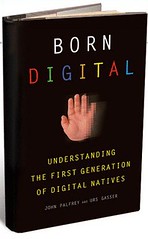 Earlier this year, I mentioned an outstanding book that John Palfrey of the Berkman Center for Internet & Society at Harvard Law School co-edited entitled Access Denied: The Practice and Policy of Global Internet Filtering. It’s an excellent resource for anyone studying the methods governments are (unfortunately) using to stifle online expression across the globe. It’s one of the most important technology policy books of the year.
Well, it looks like John Palfrey will have a second title on this year’s “Best Tech Books” list. I’ve just finished his new book with his Berkman Center colleague Urs Gasser, Born Digital: Understanding the First Generation of Digital Natives, and it is definitely worthy of your attention. In my book review posted today on the City Journal’s website, I argue that “Palfrey and Gasser’s fine early history of this generation serves as a starting point for any conversation about how to mentor the children of the Web.” It’s a comprehensive and very even-handed discussion about a variety of concerns or Internet pathologies, including: online safety, personal privacy, copyright piracy, offensive content, classroom learning, and much more.
My
City Journal review is down below, but in coming weeks I will be posting some additional thoughts about some specific things in the book worthy of more attention (including a few things I disagreed with). Overall, I’d say Born Digital is a close runner-up in the race for “Tech Book of the Year,” closely trailing Jonathan Zittrain’s Future of the Internet and How to Stop It (which I have reviewed multiple times) and Nick Carr’s The Big Switch. But I found far more to agree with in Born Digital than I did in those two books. Highly recommended.
Continue reading →

 The Technology Liberation Front is the tech policy blog dedicated to keeping politicians' hands off the 'net and everything else related to technology.