 OnGuardOnline.gov is a project of a dozen federal agencies and several private child safety organizations who have collaborated to create a website which “provides practical tips from the federal government and the technology industry to help you be on guard against Internet fraud, secure your computer, and protect your personal information.” The Federal Trade Commission (FTC) is particularly instrumental in maintaining and promoting the site but it works closely with those other agencies and organizations to craft messages and programs.
OnGuardOnline has just released a terrific new online safety resource called
Net Cetera: Chatting with Kids about Being Online. This 54-page document is an outstanding resource for parents. The report’s advice and recommendations are spot on across the board and I particularly want to highlight the important section right at the front of the document entitled, “Talk to Your Kids.” It begins: “The best way to protect your kids online? Talk to them. Research suggests that when children want important information, most rely on their parents.” Quite right. And the NetCetra report goes on to offer the following excellent advice:
- Start early. After all, even toddlers see their parents use all kinds of devices. As soon as your child is using a computer, a cell phone or any mobile device, it’s time to talk to them about online behavior, safety, and security. As a parent, you have the opportunity to talk to your kid about what’s important before anyone else does.
- Create an honest, open environment. Kids look to their parents to help guide them. Be supportive and positive. Listening and taking their feelings into account helps keep conversation afloat. You may not have all the answers, and being honest about that can go a long way.
Continue reading →
Playboy’s newly released 2009 College Sex Survey found that 49% of college students admitted to “Sexting” (having sent or received sexually explicit messages and pictures via cell phones). A survey conducted a year ago by the National Campaign to Prevent Teen and Unplanned Pregnancy and CosmoGirl.com found that 20% of teens (13-19) and 33% young adults (20-26) have “sent/posted nude or seminude pictures or video of themselves.” Together, these two studies give us a sense of just how prevalent sexting is.
Since nude photos of minors under 18 can be considered “child” pornography even if taken and shared voluntarily by the minor, there’s a very real possibility that minors will be prosecuted for common (if inappropriate) interactions with their peers under laws that were intended to prevent adults from exploiting children sexually. This is serious stuff indeed when one considers the dire consequences of being convicted not just of a felony, but a “sex offense.” Depending on state law, “sexters” put on a sex offender registry may spend the rest of their lives on sex registries as social pariahs with difficulty in finding a job, housing, being banned from using “social networking sites,” etc.
The study conducted last year offered some excellent advice for teens, young adults, and their parents. Perhaps we ought to spend more time focused on education than on criminalization. The tips are worth repeating here. First, for teens and kids: “Five Things to Think about Before Pressing Send:” Continue reading →
Today I was invited to the Federal Communications Commission (FCC) to testify at one of the agency’s Broadband Working Group workshops. This particular workshop was on “Broadband Consumer Context,” which focused on “a range of challenges and opportunities as the internet becomes a focal point for commercial transactions, social networking, and a host of activities pertaining to information gathering and exchange.”
I was asked to address the issue of whether there is a relationship between online safety concerns and broadband uptake. In my testimony, I noted that, in my 15 years of research in this area, I have never unearthed any substantive empirical evidence suggesting a correlation between parental concerns about online activity and overall household broadband uptake. I have seen occasional anecdotal news stories discussing the concerns some parents have had about their kids online that led them to reject online connectivity, but these stories have been exceedingly rare (and I haven’t seen any in recent memory).
I also argued that I did not think it at all surprising that such anecdotes are harder to find, or that empirical evidence on this front seems non-existent. I argued that there were four logical explanations for why parental concerns about online safety haven’t “moved the broadband needle” much in the negative direction:
- Not every home has children present
- Parents use a variety of household media rules to control media & Internet usage
- A vibrant marketplace of parental control technologies exists
- Likely that most parents believe that the benefits of broadband outweigh the potential downsides
For all the details on each of those, read my entire testimony or check out the presentation embedded below that I made to the FCC today. Continue reading →
 Sometimes the most revealing conversations about policy issues happen with our loved ones at the breakfast table. Although loyal TLF readers may remember my partner Michael as my “Posterboy for Advertising’s Pro-Consumer Quid Pro Quo,” he doesn’t usually get into the policy issues I cover. But this morning, we fell into a conversation about the bitterly contentious issue of marketing to kids:
Michael: Growing up in South Korea, on a military base, we didn’t have any commercials on television. We had three channels and all they showed was public service announcements.
Sounds like paradise for anti-advertising zealots like Jeff Chester and the media reformistas who want to re-create the old media scarcity in the name of “media democracy“! Anyway:
We moved back to the U.S. when I was nine, and suddenly, during all my favorite cartoons, there were ads for toys. It was exciting—and more than a little bit overwhelming! It wasn’t just that I wanted these toys; it was that felt this incredible sense of urgency: I thought we had to go get the toys right now or they’d be gone!
What did Rousseau call his innocent man, the Noble Savage? That’s what we were: The noble savage, coming into this world of sophisticated toy advertisements.
But it didn’t take long for me to get over this initial bewilderment. My parents explained to me that we didn’t really have to go to the store
right away. (They also explained to me that I couldn’t haggle with the staff at Toys ‘R Us the same way I’d haggled with street vendors back in Korea—something that utterly mystified the staff.) After one trip to Toys Toys ‘R Us, I got the toys I wanted most and, over the next few months, realized that they weren’t anywhere near as exciting as I had imagined.
After that, I enjoyed the toy ads on TV, but I lost interest in many of the toys I already had, preferring to create my own toys or play outside.
I explained that advertising of toys to kids has long been the
cause celebre of anti-advertising crusaders:
Michael: But kids are acquisitive, too! How are they supposed to know about the latest toys if you can’t advertise to them? And what’s the big deal, anyway? I got used to toy ads and I think most kids would, too. The thing that’s different is incentive programs at stores.
Continue reading →
I like this new document about guarding your online reputation that has just been jointly published by Reputation Defender and the Internet Keep Safe Coalition (iKeepSafe). They list these “3 Key Tips for Parents” for how to deal with concerns about their children’s online safety, privacy, and reputation:
1. Keep Current with Technology: Talk to teachers about what forms of Internet safety tools they implement in computer labs and technology classes, consider these safety tools for home use, and stay up-to-date on the capabilities of any mobile devices your child may have.
2. Keep Communicating with Your Kids: Find out who your child talks to online, educate your kids about the permanence of any “digital footprints” they leave behind, limit the use of social networks, and make it a habit to engage your kids in critical conversation—the more you talk to your kids about their online usage, the more they will learn to use digital products in a safe and healthy manner.
3. Keep Checking Your Kid’s Internet Activity: Keep computers in a central public location, check your child’s browsing histories, and limit your child’s computer time—there’s a whole world of outdoor and offline activities where they should be involved!
All good advice. I especially like their focus on getting parents to communicate early and often with their kids. It’s something I have beat the drum about quite a bit in my own work on the subject. Continue reading →
 I’m not sure how I missed this, but someone just pointed out to me that in late July, the city of Amherst, NY, “failed to approve a game license for [Chuck E. Cheese’s] the kids-themed food and entertainment venue… citing concerns about violent video games and bad behavior by patrons that require police intervention.” That is according to this article by Sandra Tan in The Buffalo News. Tan reports that the Amherst Town Board deadlocked 3-3 when considering the license for Chuck E. Cheese’s, apparently meaning that the pizza and arcade hot spot for kids will no longer be able to offer games at their Amherst venue. According to her article, game content considerations drove the move:
Council Member Shelly Schratz said she was disturbed by several “action-packed shoot-and-kill games” that were accessible to children as young as 4. “When I see 6-year-olds, 8-year-olds playing those games, when all the time we’re opening the paper and seeing those stories on youth violence, do we need those games to make money?” she said. Schratz was one of three board members who voted against renewing the establishment’s game room license, which is necessary for the business to legally run its arcade games, a major draw for families that patronize the chain’s 500-plus locations from coast to coast.
I find the actions of Amherst in this case to be quite troubling. Here are a few quick thoughts about this incident: Continue reading →
Maine has just enacted a law severely restricting marketing to kids: the Act To Prevent Predatory Marketing Practices against Minors, summarized by Covington & Burling. Adam and I released a major paper in June about such laws: COPPA 2.0: The New Battle over Privacy, Age Verification, Online Safety & Free Speech. Maine is following the lead of several other states that have tried to expand the Children’s Online Privacy Protection Act (COPPA) of 1998 to cover nost just kids under 13 but adolescents as well and potentially all social networking sites. We discussed at length the problems such laws create, particularly the possibility that large numbers of adults would, for the first time, be subject to age verification mandates before accessing (or participating in) the growing range of sites with social networking capabilities. This, in turn, would significantly “chill” free speech online by undermining anonymity.
Like COPPA 2.0 proposals in New Jersey (simply extending COPPA to cover adolescents) and Illinois (applying COPPA to most social networking sites), the Maine law tries to build on COPPA’s “verifiable parental consent” requirement for the 13-17 audience as well as those under 13.
On the one hand, the Maine law goes much further than these other COPPA 2.0 proposals. While the original bill was limited to the Internet and wireless communications, the final bill’s scope applies to all communications. The bill also covers “health-related” information (HRI) as well as “personal information” (PI). On the other hand, the Maine law is thus somewhat narrower than other COPPA 2.0 proposals and COPPA itself in that it applies only to “marketing or advertising products, goods or services.” While COPPA is commonly misunderstood to cover only marketing, it actually covers essentially any “collection” (broadly defined) of personal information from kids for any purpose—including merely giving kids access to communications functionality that might let them share personal information with other users (even if the site itself is not “collecting” that information in the commonly understood sense).
Continue reading →
 The Senate Commerce Committee held a hearing yesterday where a number of Senators as well as Julius Genachowski, the new Chairman of the Federal Communications Commission, did a lot of fretting about the state of the modern children’s television programming marketplace. According to the Wall Street Journal, Senate Commerce Committee Chairman Jay Rockefeller (D-WV):
suggested that a “little red button” be required on TVs so that a child could push the button to find out how a show is rated. Democratic Sen. Mark Pryor of Arkansas agreed that a red button might help since parents often have difficulties figuring out which shows are appropriate for their children to watch.
Well, I have some good news for the Senators: There are already quite a few little buttons on every remote control made today, and at least one of those buttons can pull up an on-screen guide to get more program info! (Another of them can turn the TV off!) Moreover, the ratings for just about every program already appear at the beginning of each show, and sometimes in between. And you can find out plenty more online about every TV show under the sun if you care to look. So, I’m not sure what that fuss is all about, and we certainly don’t need to mandate “little red buttons” on every TV set when program information can be found in so many other ways.
What is more troubling about all the hand-wringing taking place at the hearing, as well as the talk of reopening the Children’s Television Act of 1990 to potentially impose more content mandates on video programmers and distributors, is that: (1) there doesn’t seem to be much appreciation for just how much wonderful children’s programming is out there today compared to the past, and (2) there doesn’t seem to be much recognition of the serious First Amendment issues at stake when government gets involved in the messy business of regulating video programming.
Continue reading →
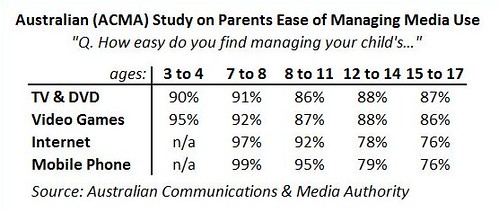
An interesting new survey has just been released by the Australian Communications and Media Authority (ACMA), which is the rough equivalent of the Federal Communications Commission here in the U.S., but with somewhat broader authority. ACMA’a latest report is entitled Use of Electronic Media and Communications: Early Childhood to Teenage Years and it takes a look at media technology usage among Australian youngsters in 5 age groupings (3 to 4 years of age, 7 to 8, 8 to 11, 12 to 14, and 15 to 17).
The survey also asked Australian parents “How easy do you find managing your child’s ___ use.” They asked that question for four different media or communications technologies: TV & DVD; video games; Internet; and mobile devices. They results, summarized in the table below, were quite interesting and seem to indicate that Australian parents find it much easier to manage their children’s media use than some of their elected leaders imagine.
Continue reading →
I’ve just had a new article published by the American Legislative Exchange Council (ALEC) in which I make the case against “techno-panics,” which refers to public and political crusades against the use of new media or technologies by the young. The article is entitled “Parents, Kids & Policymakers in the Digital Age: Safeguarding Against ‘Techno-Panics‘” and it appears in the July 2009 Inside ALEC newsletter. This is something I have spent a lot of time writing about here in recent years (See 1, 2, 3, 4, 5) and I finally got around to putting it altogether in a concise essay here. I have pasted the full text below. [And I just want to send a shout-out to my friend Anne Collier of Net Family News.org, whose work on this topic has been very influential on my thinking.]
“Parents, Kids & Policymakers in the Digital Age: Safeguarding Against ‘Techno-Panics‘”
by Adam Thierer
A cursory review of the history of media and communications technologies reveals a reoccurring cycle of “techno-panics” — public and political crusades against the use of new media or technologies by the young. From the waltz to rock-and-roll to rap music, from movies to comic books to video games, from radio and television to the Internet and social networking websites, every new media format or technology has spawned a fresh debate about the potential negative effects they might have on kids.
Inevitably, fueled by media sensationalism and various activist groups, these social and cultural debates quickly become political debates. Indeed, each of the media technologies or outlets mentioned above was either regulated or threatened with regulation at some point in its history. And the cycle continues today. During recent sessions of Congress, countless hearings were held and bills introduced on a wide variety of media and content-related issues. These proposals dealt with broadcast television and radio programming, cable and satellite television content, video games, the Internet, social networking sites, and much more. State policymakers, especially state Attorneys General (AGs), have also joined in such crusades on occasion. The recent push by AGs for mandatory age verification for all social networking sites is merely the latest example.
What is perhaps most ironic about these techno-panics is how quickly yesterday’s boogeyman becomes tomorrow’s accepted medium, even as the new villains replace old ones. For example, the children of the 1950s and 60s were told that Elvis’s hip shakes and the rock-and-roll revolution would make them all the tools of the devil. They grew up fine and became parents themselves, but then promptly began demonizing rap music and video games in the ‘80s and ‘90s. And now those aging Pac Man-era parents are worried sick about their kids being abducted by predators lurking on MySpace and Facebook. We shouldn’t be surprised if, a decade or two from now, today’s Internet generation will be decrying the dangers of virtual reality.
Continue reading →

 The Technology Liberation Front is the tech policy blog dedicated to keeping politicians' hands off the 'net and everything else related to technology.