I’m keeping tabs on who filed “major” comments (more than a 10-15 pages) in the Federal Communications Commission’s “Future of Media” proceeding (GN Docket No. 10-25). As I noted last week, The Progress & Freedom Foundation submitted almost 80 pages of comments (single-spaced!) in the matter, so it’s something I care deeply about and will be tracking closely going forward.
Incidentally, the general consensus of those who filed (especially if you count “minor” comments) is fairly overwhelming:
Bring on Big Government! Seriously, I only found a handful of comments that object strenuously to government meddling in media markets or that raised concerns about the potential for the State’s increasing involvement in the journalism profession. Even many of the affected industries appear to be suffering from a bit of Stockholm syndrome here. Most of them just play up the good things they are doing but barely utter a peep about the dangers of federal encroachment into the affairs of the Press.
Anyway, for those of you who care to track the gradual federalization of media and journalism, I think what you see below is a fairly comprehensive listing of the major filings submitted thus far in the FCC’s “Future of Media” proceeding. I’ll try to add more as I find them. You might also want to track what was filed in the Federal Trade Commission’s workshops on “How Will Journalism Survive the Internet Age.” Finally, if you care to learn more of this issue, I’m hosting an event on the morning of May 20th to discuss these issues in more detail.
Continue reading →
The Progress & Freedom Foundation today filed comments in the Federal Communication Commission’s (FCC) “Future of Media” proceeding. Berin Szoka, Ken Ferree, and I urged the FCC to “reject Chicken Little-esque calls for extreme media ‘reform’ solutions,” and counseled policymakers to move cautiously so that media reform can be “organic and bottom-up, not driven by heavy-handed, top-down industrial policies for the press.”
Our 79-page filing covers a wide range of ideas being examined by Washington policymakers to help struggling media outlets and unemployed journalists, or to expand public media / “public interest” content and regulation. Among the major issues explored in our filing:
- First Amendment concerns implicated by government subsidies;
- The pitfalls of imposing new “public interest” obligations on media operators;
- How advertising restrictions could harm the provision of media and news;
- Taxes, fees and other regulations to be avoided;
- The limited role in reform that public media subsidies can play; and
- Positive steps government could take.
We note that as “With many operators struggling to cope with intensifying competition, digitization, declining advertising budgets, and fragmenting audiences, some pundits and policymakers are wondering what the ‘future of media’ entails. The answer: Nobody knows.” While this uncertainty has put concerned policymakers at the ready to “help” the press, we warn that: “There is great danger in rash government intervention.” Instead, policymakers should be “careful to not inhibit potentially advantageous marketplace developments, even if some are highly disruptive.” Marketplace meddling, or government attempts to tinker with private media business models in the hopes that something new and better can be created, are misguided. Moreover, “Our constitutional traditions warn against it, history suggests it would be unwise, and practical impediments render such meddling largely unworkable, anyway.”
Continue reading →
Thought you all might be interested in this upcoming PFF event on “Can Government Help Save the Press?” It will take place on Thursday, May 20, 2010 from 8:30 a.m. – 12:00 p.m. in the International Gateway Room, Mezzanine Level of the Ronald Reagan Building on 1300 Pennsylvania Ave, N.W. here in DC. This event will consider the FCC’s “Future of Media” proceeding (comments are due this Friday) and debate what role the government should play (if any) in sustaining struggling media enterprises, “saving journalism,” or promoting more “public media” or “public interest” content. [You can find all our essays about this here.]
The event will feature a keynote address by
Ellen P. Goodman of the FCC’s Future of Media team. Ellen is one of the sharpest minds in the media policy universe today, and a real asset to the FCC team. She is a Distinguished Visiting Scholar at the FCC, a Research Fellow at American University’s Center for Social Media, and a Visiting Scholar at the University of Pennsylvania’s Annenberg School of Communications. She is also a Professor at Rutgers University School of Law at Camden, specializing in information law and policy. She has spoken before a wide range of audiences around the world on media policy issues, has consulted with the U.S. government on communications policy, and served as an advisor to President Obama’s presidential campaign and transition team.
After Ellen Goodman brings us up to speed with where the FCC’s Future of Media process stands, we’ll hear from a diverse panel of experts that I am still busy assembling. But so far it includes
Charlie Firestone of the Aspen Institute, who will be on hand to discuss the work he’s been doing with the Knight Commission on this front. I’ve also invited a rep from the Newspaper Association of America to come and talk about the diversity of new media monetization models that they have been aggregating. (Check out the appendix of their outstanding FTC filing last Nov.) And Kurt Wimmer of Covington & Burling, who represents broadcasters among others, will talk about the need for regulatory flexibility / forbearance, especially on ownership issues. Again, more panelists to come. But please sign up now!
PFF today released the fifth installment in our ongoing series on “The Wrong Way to Reinvent Media.” This series of papers explores various tax and regulatory proposals that would have government play an expanded role in supporting the press, journalism, or other media content. In the latest essay, Berin Szoka, Ken Ferree, and I discuss proposals for direct subsidies for failing media outlets and out-of-work journalists.
We argue taxpayer support for failing outlets and unemployed journalists implicates significant First Amendment concerns. On the whole, subsidies can make “journalists and media operators more dependent upon the State; compromise press independence and diminish public trust in the free press; and result in government discrimination in the politically inescapable dilemma of determining eligibility for subsidies.” Such an agenda would also entail huge cost to taxpayers—initially about $35 billion per year according to advocates—and would represent “a massive wealth transfer from one class of speakers to another…”
We warn that calls for seemingly beneficent bailouts “to save” the media and journalism may actually be driven by those who have something more nefarious in mind: a “post-corporate” world shorn of media capitalists, and “such radicalism must be rejected if we hope to sustain a truly free press and uphold America’s proud tradition of keeping a high and tight wall of separation between Press and State.”
The ideas within these and other essays in the series will be worked into a major PFF filing in the Federal Communications Commission’s (FCC) proceeding on the “Future of Media” on May 7. The paper may be viewed online here and I’ve attached it down below in a Scribd reader.
Continue reading →
As I’ve mentioned here previously, PFF has been rolling out a new series of essays examining proposals that would have the government play a greater role in sustaining struggling media enterprises, “saving journalism,” or promoting more “public interest” content. We’re releasing these as we get ready to submit a big filing in the FCC’s “Future of Media” proceeding (deadline is May 7th). Here’s a podcast Berin Szoka and I did providing an overview of the series and what the FCC is doing.
In the first installment of the series, Berin and I critiqued an old idea that’s suddenly gained new currency: taxing media devices or distribution systems to fund media content. In the second installment, I took a hard look at proposals to impose fees on broadcast spectrum licenses and channeling the proceeds to a “public square channel” or some other type of public media or “public interest” content.
In our latest essay, “The Wrong Way to Reinvent Media, Part 3: Media Vouchers,” Berin and I consider whether it is possible to steer citizens toward so-called “hard news” and get them to financially support it through the use of “news vouchers” or “public interest vouchers”? We argue that using the tax code to “nudge” people to support media — while less problematic than direct subsidies for the press — will likely raise serious issues regarding eligibility and be prone to political meddling. Moreover, it’s unlikely the scheme will actually encourage people to direct more resources to hard news but instead just become a method of subsidizing other content they already consume.
I’ve attached the entire essay down below.
Continue reading →
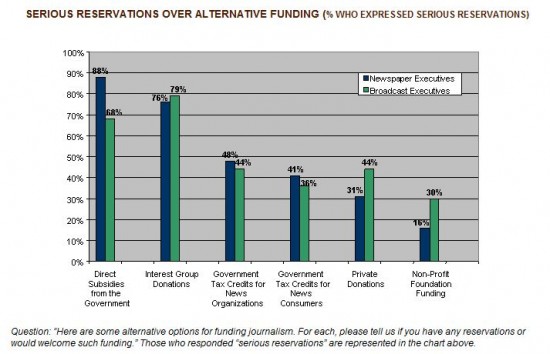
Good to see so many media industry executives expressing skepticism about the idea of government subsidies for the press. Danny Glover brought to my attention this new survey by the Pew Research Center’s Project for Excellence in Journalism in association with the American Society of News Editors (ASNE) and the Radio Television Digital News Association (RTDNA). It revealed that, “Fully 75% of all news executives surveyed—and 88% of newspaper executives—said they had ‘serious reservations,’ or the highest level of concern, about direct subsidies from the government.” A smaller percentage (only 46%) had serious reservations about tax credits for news organizations, then again, only 13% said they “would welcome such funding” and just 6% said they were “enthusiastic” about it.
This is encouraging news as many government officials at the FCC, FTC, and in Congress are currently considering whether government should steps to prop up failing media entities or promote certainly types of content. Berin Szoka and I have been working on a series of essays about the wrong ways to go about reinventing media [see Part 1, Part 2] and plan several more installments leading up to a big filing in the FCC’s “Future of Media” proceeding (the deadline is May 7th).
Here’s a chart from the Pew survey illustrating funding alternatives and the percentage who had “serious reservations” about each option:
Steve Forbes has an entertaining essay out today about the agenda of Free Press and its founder, the Marxist media scholar Robert McChesney. Forbes notes that McChesney has expressed a great deal of sympathy for the Venezuelan dictator Hugo Chavez and has even defended some of his tactics to control the press. This leads to his fear that McChesney and Free Press will convince the Obama Administration to use similar tactics here in the U.S.:
Once the federal government starts subsidizing our own free press, how long until the feds start revoking broadcast licenses of government opponents and bringing pesky reporters up on charges of say, “corruption” or “subversion”? According to McChesney and the Free Press folks, it apparently can’t happen soon enough.
To be fair, I haven’t heard anyone from Free Press defending Hugo Chavez or his tactics. But I do wonder why the organization continues to associate itself with such a radioactive figure like Mr. McChesney. After all, Forbes isn’t making up anything about McChesney, who is an outspoken, and self-described, Marxist media theorist. McChesney really has expressed sympathy for Chavez and said that, “If [Venezuelan broadcaster] RCTV were broadcasting in the United States, its license would have been revoked years ago. In fact its owners would likely have been tried for criminal offenses, including treason.” Far more troubling are Mr. McChesney’s views regarding how to reform media going forward, which I’ve documented in past essays in more detail. (See, “Free Press, Robert McChesney & the “Struggle” for Media,” “What the Media Reformistas Really Want,” and “Socializing Media in Order to Save It,.”) One need look no further than this lengthy interview with McChesney that appeared in an online newsletter called “The Bullet” produced by the Canada-based “Socialist Project.”
The whole thing is quite troubling to read, but here are a couple of jaw-droppers that make it clear just how radical Mr. McChesney’s worldview and agenda are:
Continue reading →
By Adam Thierer & Berin Szoka
As we mentioned yesterday, in a new series of essays, we will be examining proposals being put forward today that would have the government play a greater role in sustaining struggling media enterprises, “saving journalism,” or promoting more “public interest” content. With many traditional media operators struggling, and questions being raised about how journalism in particular will be supported in the future, Washington policymakers are currently considering what role government can and should play in helping media providers reinvent themselves in the face of tumultuous technological change wrought by the Digital Revolution. We will be releasing 6 or 7 essays on this topic leading up to our big filing in the FCC’s “Future of Media” proceeding (deadline is May 7th).
In the first installment of our series, we will critique an old idea that’s suddenly gained new currency: taxing media devices or distribution systems to fund media content. We argue that such media income redistribution is fundamentally inconsistent with American press traditions, highly problematic under the First Amendment, difficult to implement in a world of media abundance and platform convergence, and likely to cause serious negative side effects. Bottom line: Don’t tax our iPhones or broadband to subsidize media!
We’ve attached the entire text of the piece below. (Installment #2, on broadcast spectrum taxes to subsidize public media, will be released next week.)
Continue reading →
By Adam Thierer & Berin Szoka
In a series of upcoming essays, we will be examining proposals being put forward today that would have the government play a greater role in sustaining struggling media enterprises, “saving journalism,” or promoting more “public interest” content. The reason we’re working up this multi-part series is because, with many traditional media operators struggling, and questions being raised about how journalism in particular will be supported in the future, Washington policymakers are currently considering what role government can and should play in helping media providers reinvent themselves in the face of tumultuous technological change wrought by the Digital Revolution.
For example, the Federal Communications Commission (FCC) recently kicked off a new “Future of Media” effort with a workshop on “Serving the Public Interest in the Digital Era.” (The filing deadline for the FCC’s “Future of Media” proceeding is May 7th). Likewise, the Federal Trade Commission (FTC) has hosted two workshops asking “How Will Journalism Survive the Internet Age?” Meanwhile, the Senate has already held hearings about “the future of journalism,” and Senator Benjamin L. Cardin (D-MD) recently introduced the “Newspaper Revitalization Act,” which would allow newspapers to become tax-exempt non-profits in an effort to help them stay afloat.
Thus, in light of Washington’s sudden interest in the future of media and journalism, we will be taking a hard look at several issues and proposals that are being floated today, including:
- Taxes on media devices, mobile phones, or broadband bills to channel money to media enterprises / content;
- Taxes / fees on broadcasters to funnel support to their public sector competitors or to public interest programs;
- “News vouchers” or “public interest vouchers” that would encourage citizens to channel support to media providers;
- Taxes on private advertising to subsidize non-commercial / public media content;
- Expanded postal subsidies for media mail; and
- Targeted welfare programs for out-of-work journalists or corporate welfare in the form of bailouts for failing media enterprises.
You won’t be surprised to hear that we are generally quite skeptical of most of these ideas, but we promise to give each one serious consideration. We’ll kick things off tomorrow with our essay on why taxing media devices or distribution systems to fund media content is not a particularly good idea.
Can we steer people toward hard news — and get them to financially support it — through the use of “news vouchers” or “public interest vouchers”? That’s the subject of this latest installment in my ongoing series on proposals to have the government play a greater role in the media sector in the name of sustaining struggling enterprises or “saving journalism.”
As I mentioned here previously, last week I testified at the FCC’s first “Future of Media” workshop on “Serving the Public Interest in the Digital Era.” (@3:29 mark of video). It was a great pleasure to testify alongside the all-star cast there that day, which included the always-provocative Jeff Jarvis of the CUNY Graduate School of Journalism. He delivered some very entertaining remarks and vociferously pushed back against many of the ideas that others were suggesting about “saving journalism.” Jeff is a very optimistic guy–far more optimistic than me, in fact–about the prospect that new media and citizen journalism will help fill whatever void is left by the death of many traditional media operators and institutions. He had a lively exchange with Srinandan Kasi, Vice President, General Counsel and Secretary of the Associated Press, that is worth watching (somewhere after the 5-hour mark on the video).
Nonetheless, Jarvis is a enough of a realist to know that it has
always been difficult to find resources to fund hard news, which he creatively refers to as “broccoli journalism.” This is what is keeping the FCC, the FTC (workshop today), and many media worrywarts up at night; the fear that as traditional financing mechanisms falter (advertising, classifieds, subscription revenues, etc) many traditional news-gathering efforts and institutions will disappear. Of course, while it is certainly true we are in the midst of a gut-wrenching media revolution with a great deal of creative destruction taking place, it is equally true that exciting new media business models and opportunities are developing. We shouldn’t over look that, as I argued here and here.
Anyway, a lot of different proposals are being put forth by scholars and policymakers to find new ways to finance news-gathering or “save journalism.” One of the ideas that has been gaining some steam as of late is the idea of crafting a “public interest voucher” or what Robert W. McChesney & John Nichols, authors of the new book The Death and Life of American Journalism, call a “Citizenship News Voucher.” And McChesney discussed this idea in more detail when he spoke at today’s FTC event on saving journalism. Continue reading →

 The Technology Liberation Front is the tech policy blog dedicated to keeping politicians' hands off the 'net and everything else related to technology.
List of Major Comments in FCC “Future of Media” Proceeding
by Adam Thierer on May 10, 2010 · 8 comments
I’m keeping tabs on who filed “major” comments (more than a 10-15 pages) in the Federal Communications Commission’s “Future of Media” proceeding (GN Docket No. 10-25). As I noted last week, The Progress & Freedom Foundation submitted almost 80 pages of comments (single-spaced!) in the matter, so it’s something I care deeply about and will be tracking closely going forward.
Incidentally, the general consensus of those who filed (especially if you count “minor” comments) is fairly overwhelming: Bring on Big Government! Seriously, I only found a handful of comments that object strenuously to government meddling in media markets or that raised concerns about the potential for the State’s increasing involvement in the journalism profession. Even many of the affected industries appear to be suffering from a bit of Stockholm syndrome here. Most of them just play up the good things they are doing but barely utter a peep about the dangers of federal encroachment into the affairs of the Press.
Anyway, for those of you who care to track the gradual federalization of media and journalism, I think what you see below is a fairly comprehensive listing of the major filings submitted thus far in the FCC’s “Future of Media” proceeding. I’ll try to add more as I find them. You might also want to track what was filed in the Federal Trade Commission’s workshops on “How Will Journalism Survive the Internet Age.” Finally, if you care to learn more of this issue, I’m hosting an event on the morning of May 20th to discuss these issues in more detail.
Continue reading →