It’s been a big year for tech policy books. Several important titles were released in 2008 that offer interesting perspectives about the future of the Internet and the impact digital technologies are having on our lives, culture, and economy. Back in September, I compared some of the most popular technology policy books of the past five years and tried to group them into two camps: “Internet optimists” vs. “Internet pessimists.” That post generated a great deal of discussion and I plan on expanding it into a longer article soon. In this post, however, I will merely list what I regard as the most important technology policy books of the past year.
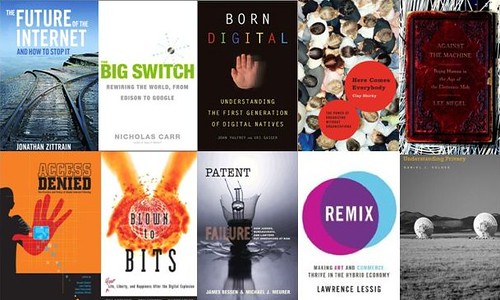
What qualifies as an “important” tech policy book? Basically, it’s a title that many people in this field are currently discussing and that we will likely be talking about for many years to come. I want to make it clear, however, that merely because a book appears on this list it does not necessarily mean I agree with everything said in it. In fact, I found much with which to disagree in my picks for the two most important books of 2008, as well as many of the other books on the list. [Moreover, after reading all these books, I am more convinced than ever that libertarians are badly losing the intellectual battle of ideas over Internet issues and digital technology policy. There’s just very few people defending a “Hands-Off-the-Net” approach anymore. But that’s a subject for another day!]
Another caveat: Narrowly focused titles lose a few points on my list. For example, as was the case in past years, a number of important IP-related books have come out this year. If a book deals exclusively with copyright or patent issues, it does not exactly qualify as the same sort of “tech policy book” as other titles found on this list since it is a narrow exploration of just one set of issues that have a bearing on digital technology policy. The same could be said of a book that deals exclusively with privacy policy, like Solove’s
Understanding Privacy. It’s an important book with implications for the future of tech policy, but I demoted it a bit because of its narrow focus.
With those caveats in mind, here are my Top 10 Most Important Tech Policy Books of 2008 (and please let me know about your picks for book of the year):
Continue reading →
“Hasn’t Steve Jobs learned anything in the last 30 years?” asks Farhad Manjoo of Slate in an interesting piece about “The Cell Phone Wars” currently raging between Apple’s iPhone and the Google’s new G1, Android-based phone. Manjoo wonders if whether Steve Jobs remembers what happen the last time he closed up a platform: “because Apple closed its platform, it was IBM, Dell, HP, and especially Microsoft that reaped the benefits of Apple’s innovations.” Thus, if Jobs didn’t learn his lesson, will he now with the iPhone? Manjoo continues:
Well, maybe he has—and maybe he’s betting that these days, “openness” is overrated. For one thing, an open platform is much more technically complex than a closed one. Your Windows computer crashes more often than your Mac computer because—among many other reasons—Windows has to accommodate a wider variety of hardware. Dell’s machines use different hard drives and graphics cards and memory chips than Gateway’s, and they’re both different from Lenovo’s. The Mac OS, meanwhile, has to work on just a small range of Apple’s rigorously tested internal components—which is part of the reason it can run so smoothly. And why is your PC glutted with viruses and spyware? The same openness that makes a platform attractive to legitimate developers makes it a target for illegitimate ones.
I discussed these issues in greater detail in my essay on”Apple, Openness, and the Zittrain Thesis” and in a follow-up essay about how the Apple iPhone 2.0 was cracked in mere hours. My point in these and other essays is that the whole “open vs. closed” dichotomy is greatly overplayed. Each has its benefits and drawbacks, but there is no reason we need to make a false choice between the two for the sake of “the future of the Net” or anything like that.
In fact, the hybrid world we live in — full of a wide variety of open and proprietary platforms, networks, and solutions — presents us with the best of all worlds. As I argued in my original review of Jonathan Zittrain’s book, “Hybrid solutions often make a great deal of sense. They offer creative opportunities within certain confines in an attempt to balance openness and stability.” It’s a sign of great progress that we now have different open vs. closed models that appeal to different types of users. It’s a false choice to imagine that we need to choose between these various models.
Continue reading →
 Sorry if it seems like I am beating a dead horse here, but the folks at the City Journal asked me a pen a review of Jonathan Zittrain’s new book, The Future of the Internet and How to Stop It. Faithful readers here will no doubt remember that I have already penned a review of the book and several follow-up essays. (Part 1, 2, 3, 4). I swear I am not picking on Jonathan, but his book is probably the most important technology policy book of the year–Nick Carr’s Big Switch would be a close second–and deserves attention. Specifically, I think it deserves attention because I believe that Jonathan’s provocative thesis is wildly out of touch with reality. As I state in the City Journal review of his book:
[C]ontrary to what Zittrain would have us believe, reports of the Internet’s death have been greatly exaggerated. […] Not only is the Net not dying, but there are signs that digital generativity and online openness are thriving as never before. […]
Essentially, Zittrain creates a false choice regarding the digital future we face. He doesn’t seem to believe that a hybrid future is possible or desirable. In reality, however, we can have a world full of some tethered appliances or even semi-closed networks that also includes generative gadgets and open networks. After all, millions of us love our iPhones and TiVos, but we also take full advantage of the countless other open networks and devices at our disposal. […]
Continue reading →
 Channeling Jonathan Zittrain, Alex Curtis of Public Knowledge continues his incessant ranting against Apple and the iPhone for supposedly not being open enough and, therefore, somehow harming consumers and 3rd party developers. In his essay today about the supposed evils of the iPhone App Store, he accuses Apple of an “1984 kind of total control.”
Hmmm, let’s see… Apple creates a great new product that is so insanely sexy and innovative that even Apple-haters like me are forced to admit that it is the most brilliant tech gadget of the decade. Millions of people have flocked to Apple stores, stood in lines so long that you’d think they were giving away free pot and floor bongs inside, and then voluntarily handed over seemingly all their disposable monthly income to get their hands on one of these things.
OK, so how is this like
1984 again? Is evil Steve Jobs forcing the masses to buy this product? Of course not. So it strikes me that we can easily dispense with analogies to a book about coercive, totalitarian government control like 1984.
And if all this anti-iPhone ranting is just about the degree of control that Steve Jobs and Apple exercise over product add-ons then hey, I’ve got an easy answer for you: go get a different phone!
Continue reading →

Well, I actually didn’t exactly get a chance to say quite enough for this to qualify as much of a “debate,” but I was brought in roughly a half hour into this WBUR (Boston NPR affiliate) radio show featuring Jonathan Zittrain, author of the recently released: The Future of the Internet–And How to Stop It. Jonathan was kind enough to suggest to the producers that I might make a good respondent to push back a bit in opposition to the thesis set forth in his new book.
Jonathan starts about 6 minutes into the show and they bring me in around 29 minutes in. Although I only got about 10 minutes to push back, I thought the show’s host Tom Ashbrook did an excellent job raising many of the same questions I do in my 3-part review (Part 1, 2, 3) of Jonathan’s provocative book.
In the show, I stress the same basic points I made in those reviews: (1) he seems to be over-stating things quite a bit in saying that the old “generative” Internet is “dying”; and in doing so, (2) he creates a false choice of possible futures from which we must choose. What I mean by false choice is that Jonathan doesn’t seem to believe a hybrid future is possible or desirable. I see no reason why we can’t have the best of both worlds–-a world full of plenty of tethered appliances, but also plenty of generativity and openness.
If you’re interested, listen in.
I swear I’m not trying to pick on Jonathan Zittrain, but I continue to find examples that create problems for his thesis from The Future of the Internet–And How to Stop It that the whole world is going to hell because of the rise of what he contemptuously calls “sterile, tethered devices.” Again, in his provocative book, Zittrain argues that, for a variety of reasons, the glorious days of the generative, open Internet and general-purpose PCs are supposedly giving way to closed networks and closed devices. In my lengthy review of his book, I argued that Zittrain was over-stating things and creating a false choice of possible futures from which we must choose. I see no reason why we can’t have the best of both worlds–a world full of plenty of tethered appliances, but also plenty of generativity and openness. In a follow-up essay, I pointed out how Apple’s products create a particular problem for Zittrain’s thesis because even though they are “sterile and tethered,” there is no doubt that the company’s approach has produced some wonderful results. As I said..
Personally… I prefer all those “general purpose” devices that Zittrain lionizes. But, again, we can have both. Let Steve Jobs be a control freak and keep those walls around Apple’s digital garden high and tight if he wants. There are plenty of other wide open gardens for the rest of us to play in.
In my original review, I briefly mentioned another problem for the Zittrain thesis: old people! I was reminded about this when I was reading this
New York Times article today entitled, “At a Certain Age, Simplicity Sells in High-Tech Gadgets,” by Alina Tugend. Tugend argues:
Continue reading →
[Note: You might want to first read my review of Jonathan Zittrain’s book to give this essay some context.]
Jonathan Zittrain must have been smiling as he read Leander Kahney’s excellent Wired cover story this month, “How Apple Got Everything Right By Doing Everything Wrong.” In a sense, the article vindicates Zittrain’s thesis in The Future of the Internet–And How to Stop It.
 Again, in his provocative book, Zittrain argues that, for a variety of reasons, the glorious days of the generative, open Internet and general-purpose PCs are supposedly giving way to closed networks and a world of what he contemptuously calls “sterile, tethered devices.” And Apple products such as the iPhone, the iPod, and iTunes serve as prime examples of the troubling world that await us. And Kahney’s article confirms that Apple is every bit as closed and insular as Zittrain suggests. Kahney nicely contrasts Apple with Google, a company that “embraces openness,” trusts “the wisdom of crowds,” and has its famous “Don’t be evil” philosophy:
It’s ironic, then, that one of the Valley’s most successful companies ignored all of these tenets. Google and Apple may have a friendly relationship — Google CEO Eric Schmidt sits on Apple’s board, after all — but by Google’s definition, Apple is irredeemably evil, behaving more like an old-fashioned industrial titan than a different-thinking business of the future. Apple operates with a level of secrecy that makes Thomas Pynchon look like Paris Hilton. It locks consumers into a proprietary ecosystem. And as for treating employees like gods? Yeah, Apple doesn’t do that either.
Continue reading →
Jonathan Zittrain, who is affiliated with Oxford University and Harvard’s Berkman Center, recently released a provocatively titled book: The Future of the Internet–And How to Stop It. It’s an interesting read and I recommend you pick it up despite what I’ll say about it in a moment. (Incidentally, if you ever have a chance to hear Jonathan speak, I highly recommend you do so. He is, bar none, the most entertaining tech policy geek in the world. Imagine Dennis Miller with a cyberlaw degree.)
Jonathan’s book contrasts two different paradigms that he argues could define the Net’s future: The “generative” Net versus what he refers to as a world of “tethered, sterile appliances.” By “generative” he means technologies or networks that invite or allow tinkering and all sorts of creative uses. Think general-purpose personal computers and the traditional “best efforts” Internet. “Tethered, sterile appliances” by contrast, are technologies or networks that discourage or disallow tinkering. Basically, “take it or leave it” proprietary devices like Apple’s iPhone or the TiVo, or online walled gardens like the old AOL and current cell phone networks.
Jonathan’s thesis is that, for a variety of reasons [viruses, Spam, identify theft, etc], we run the risk of seeing the glorious days of the generative, open Net give way to more tethered devices and closed networks. He states:
Continue reading →

 The Technology Liberation Front is the tech policy blog dedicated to keeping politicians' hands off the 'net and everything else related to technology.