The Cato Unbound online debate about the 10th anniversary of Lawrence Lessig’s Code and Other Laws of Cyberspace continues today with my response to Declan McCullagh’s opening essay, “What Larry Didn’t Get,” as well as Jonathan Zittrain’s follow-up.
In my response, “Code, Pessimism, and the Illusion of ‘Perfect Control,'” I begin by arguing that:
The problem with peddling tales of a pending techno-apocalypse is that, at some point, you may have to account for your prophecies — or false prophecies as the case may be. Hence, the problem for Lawrence Lessig ten years after the publication of his seminal book, Code and Other Laws of Cyberspace.
I go on to argue that:
Lessig’s lugubrious predictions proved largely unwarranted. Code has not become the great regulator of markets or enslaver of man; it has been a liberator of both. Indeed, the story of the past digital decade has been the exact opposite of the one Lessig envisioned in Code.
After providing several examples of just how wrong Lessig’s predictions were, I then ask:
[W]hy have Lessig’s predictions proven so off the mark? Lessig failed to appreciate that markets are evolutionary and dynamic, and when those markets are built upon code, the pace and nature of change becomes unrelenting and utterly unpredictable. With the exception of some of the problems identified above, a largely unfettered cyberspace has left digital denizens better off in terms of the information they can access as well as the goods and services from which they can choose. Oh, and did I mention it’s all pretty much free-of-charge? Say what you want about our cyber-existence, but you can’t argue with the price!
Continue reading →
I’ve been hammering Jonathan Zittrain pretty hard here over the past year for the thesis he sets forth in The Future of the Internet and How to Stop It that digital “generativity” is at risk today. The reason I have been doing so is because all signs point in the exact opposite direction, and more so with each passing day. Contrary to Jonathan’s fear that the Internet and digital technologies are growing more closed, tethered, and sterile, I have argued that the facts on the ground show us how the world is actually becoming far more open, untethered, and innovative. And that’s true even for the technology that Jonathan singles out in the book for special scorn — the iPhone.
Consider David Pogue’s post today on the
New York Times‘ technology blog today entitled “So Many iPhone Apps, So Little Time.” Pogue reports that:
there are now 15,000 programs available on the App Store, and so many more are flooding in that Apple’s army of screeners can’t even keep up. I keep meaning to write a thoughtful, thorough roundup of the very best of these amazing programs, but every day that I don’t do it, the job becomes more daunting.
[…]
Apple, which runs the store, keeps 30 percent of each sale. Even so, Ocarina [an application Pogue discusses in his essay] demonstrates that a programmer can make a staggering amount of money from the iPhone store. It’s a crazy new software model that I don’t remember seeing anywhere else. It’s not a boxed software program for $600, or even a shareware program you download for $25. It’s a buck a copy.
The beauty here is that at these prices, there’s very little risk in trying something out. How many software programs have you bought for your Mac or PC? Two? Four? Well, the average iPhone owner may wind up installing 10, 20 or 30 programs. In all, according to Apple, iPhone owners have downloaded 500 million copies of these programs. Half a billion–since last July.
There’s a lot of gloom in the tech industry (and every industry, for that matter). But even when the economy is crashing down around us, there’s still amazing power in a single good idea. And the one on display here–pricing software so low that millions of people buy it without batting an eye–is turning a few clever programmers into millionaires.
I ask you: Does this sound like a world that is growing less generative, as Zittrain argues? Because it sure doesn’t sound like it to me. Moreover, if you still don’t think the iPhone is open enough, then there’s always a simple solution to that: just buy another phone!
Sid Rosenzweig, who recently joined PFF to study patent issues, has a very thoughtful piece about Apple’s new patent on the multi-touch interface on the iPhone, which ends as follows:
It is striking how protection for user interfaces has changed over the years. It is not clear that patent protection for user interfaces is a step in the right direction, even for iconic breakthroughs in interfaces such as for the iPhone and iPod Touch. The 300 diagrams in this Apple patent call to mind the 189 graphical user-interface elements of the Apple v. Microsoft copyright infringement case from the early 1990s. The Apple v. Microsoft case prevented Apple from obtaining the protection on the overall look-and-feel of its software, and instead treated as discrete each element of the user interface. This patent, and others like it, purport to cover the combination of several elements — here the web scrolling with the photo-album browsing — and not the discrete elements themselves. With the Apple v. Microsoft case largely having thrown copyright out the window, and with trade dress protection excluding functional elements, patents are really the only option for companies like Apple, until and unless another solution is found.
Jason Kuznicki of the Cato Institute is asking some very sharp questions about Jonathan Zittrain’s book The Future of the Internet and How to Stop. He’s echoing a lot of the same concerns and criticisms I have raised here many times before about how overblown Zittrain’s fears are regarding the supposed death of digital generativity and online openness. Kuznicki argues:
First, the example he uses is far from perfect. The Internet abounds with descriptions of iPhone hacks, many of them well-documented and remarkably successful. The menacing control exists, but it’s often a paper tiger. And although Apple didn’t originally publish an iPhone software development kit, it does now. So which one is it? Is the iPhone still not hacky enough? Or should we find another, better example? But the hacking community delights in finding supposedly uncrackable devices, and in cracking them — often within days of release. Offhand, I can’t think of a single recently released Internet-enabled device that someone hasn’t hacked. (Another of Zittrain’s purported bad examples, the Xbox 360, supports an avid hacking community, albeit with far less support from Microsoft. It isn’t a community for everyone, but then, hacking isn’t for everyone. Neither is macrame.)
Continue reading →
When people ask me why I do what I do for a living — and, more specifically, why I focus all my attention on digital media and technology policy — I often respond by showing them the new gadgets or software I am playing with at any given time. I just love digital technology. I am swimming in a sea of digital gadgets, consumer electronics, online applications, computing software, video games, and all sorts of cyber-stuff.
Anyway, even though this is a technology
policy blog, I sometimes highlight new digital toys or applications that have changed my life for the better. As the year winds down, therefore, I thought I would share with you five technologies that improved my life and productivity in 2008. I’d also love to hear from all of you about the technologies that you fell in love with this year in case I might have missed them. Here’s my list:
#1) Naturally Speaking 10:
 Thanks to Nate Anderson’s outstanding review over at Ars Technica, I finally made the plunge and bought Dragon Naturally Speaking 10 earlier this month. Wow, what a life-changer. I had played around with an earlier version of this market-leading speech recognition technology and found it somewhat clunky and unreliable. But Ver. 10, has ironed out almost all the old problems and become an incredibly sophisticated piece of software in the process. I love the way I can use simple voice commands to navigate menus in Microsoft Word and in Firefox. Perhaps best of all, I can dictate random rants into a pocket recording device and then upload them to Naturally Speaking (via a USB connection) and have them instantly transcribed. I’m even composing blog entries like this using it! Only problem is inserting HTML code; that’s still a hassle. Also, I find that switching from one input device to another definitely affects the quality of the transcription. Once you “train” Naturally Speaking using one device, it makes sense to stick with it. It’s not just the quality of the microphone; it’s also the proximity to your mouth that makes a difference. Regardless, this is one great product and, best of all, it’s should help save my rapidly-aging hands from becoming prematurely arthritic! All those years of video games and keyboards have taken their toll.
Continue reading →
Thanks to Nate Anderson’s outstanding review over at Ars Technica, I finally made the plunge and bought Dragon Naturally Speaking 10 earlier this month. Wow, what a life-changer. I had played around with an earlier version of this market-leading speech recognition technology and found it somewhat clunky and unreliable. But Ver. 10, has ironed out almost all the old problems and become an incredibly sophisticated piece of software in the process. I love the way I can use simple voice commands to navigate menus in Microsoft Word and in Firefox. Perhaps best of all, I can dictate random rants into a pocket recording device and then upload them to Naturally Speaking (via a USB connection) and have them instantly transcribed. I’m even composing blog entries like this using it! Only problem is inserting HTML code; that’s still a hassle. Also, I find that switching from one input device to another definitely affects the quality of the transcription. Once you “train” Naturally Speaking using one device, it makes sense to stick with it. It’s not just the quality of the microphone; it’s also the proximity to your mouth that makes a difference. Regardless, this is one great product and, best of all, it’s should help save my rapidly-aging hands from becoming prematurely arthritic! All those years of video games and keyboards have taken their toll.
Continue reading →
During my recent debate with Jonathan Zittrain about his book The Future of the Internet, I argued that there was just no way to bottle up digital generativity and that he had little to fear in terms of the future of the Net or digital devices being “sterile, tethered,” and closed. I noted that the iPhone — which Jonathan paints as the villain in his drama — is the perfect example of how people will make a device more generative even when the manufacturers didn’t originally plan for it or allow it. I went so far as to joke that there were countless ways to hack your iPhone now, so much so that I wouldn’t be surprised if one day soon our iPhones would be taking out the trash and mowing our lawns!
Well, I was engaging in a bit of hyperbole there, but I
am consistently amazed by what people can make their digital devices do. Witness the fact that some enterprising soul has found a way to turn the iPhone into a flute! Better yet, they have trained a group to play “Stairway to Heaven” using that application!! It’s enough to make one wonder: How long before someone converts the iPhone into a bong?
[
Uttered to JZ in my best stoner voice…] “Seriously, dude, generativity is alive and well. Now chill, and pass the iBong.”
http://www.youtube.com/v/kfrONZjakRY&color1=0xb1b1b1&color2=0xcfcfcf&fs=1
http://www.youtube.com/v/RhCJq7EAJJA&color1=0xb1b1b1&color2=0xcfcfcf&hl=en&fs=1
“Hasn’t Steve Jobs learned anything in the last 30 years?” asks Farhad Manjoo of Slate in an interesting piece about “The Cell Phone Wars” currently raging between Apple’s iPhone and the Google’s new G1, Android-based phone. Manjoo wonders if whether Steve Jobs remembers what happen the last time he closed up a platform: “because Apple closed its platform, it was IBM, Dell, HP, and especially Microsoft that reaped the benefits of Apple’s innovations.” Thus, if Jobs didn’t learn his lesson, will he now with the iPhone? Manjoo continues:
Well, maybe he has—and maybe he’s betting that these days, “openness” is overrated. For one thing, an open platform is much more technically complex than a closed one. Your Windows computer crashes more often than your Mac computer because—among many other reasons—Windows has to accommodate a wider variety of hardware. Dell’s machines use different hard drives and graphics cards and memory chips than Gateway’s, and they’re both different from Lenovo’s. The Mac OS, meanwhile, has to work on just a small range of Apple’s rigorously tested internal components—which is part of the reason it can run so smoothly. And why is your PC glutted with viruses and spyware? The same openness that makes a platform attractive to legitimate developers makes it a target for illegitimate ones.
I discussed these issues in greater detail in my essay on”Apple, Openness, and the Zittrain Thesis” and in a follow-up essay about how the Apple iPhone 2.0 was cracked in mere hours. My point in these and other essays is that the whole “open vs. closed” dichotomy is greatly overplayed. Each has its benefits and drawbacks, but there is no reason we need to make a false choice between the two for the sake of “the future of the Net” or anything like that.
In fact, the hybrid world we live in — full of a wide variety of open and proprietary platforms, networks, and solutions — presents us with the best of all worlds. As I argued in my original review of Jonathan Zittrain’s book, “Hybrid solutions often make a great deal of sense. They offer creative opportunities within certain confines in an attempt to balance openness and stability.” It’s a sign of great progress that we now have different open vs. closed models that appeal to different types of users. It’s a false choice to imagine that we need to choose between these various models.
Continue reading →
 Sorry if it seems like I am beating a dead horse here, but the folks at the City Journal asked me a pen a review of Jonathan Zittrain’s new book, The Future of the Internet and How to Stop It. Faithful readers here will no doubt remember that I have already penned a review of the book and several follow-up essays. (Part 1, 2, 3, 4). I swear I am not picking on Jonathan, but his book is probably the most important technology policy book of the year–Nick Carr’s Big Switch would be a close second–and deserves attention. Specifically, I think it deserves attention because I believe that Jonathan’s provocative thesis is wildly out of touch with reality. As I state in the City Journal review of his book:
[C]ontrary to what Zittrain would have us believe, reports of the Internet’s death have been greatly exaggerated. […] Not only is the Net not dying, but there are signs that digital generativity and online openness are thriving as never before. […]
Essentially, Zittrain creates a false choice regarding the digital future we face. He doesn’t seem to believe that a hybrid future is possible or desirable. In reality, however, we can have a world full of some tethered appliances or even semi-closed networks that also includes generative gadgets and open networks. After all, millions of us love our iPhones and TiVos, but we also take full advantage of the countless other open networks and devices at our disposal. […]
Continue reading →
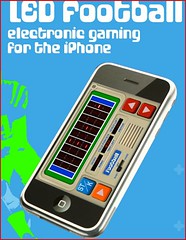
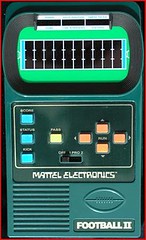
 I was a HUGE fan of Mattel handheld games back in the late 70s, and I played “Football I” and “Football II” for countless hours with friends. And now you can get it on the iPhone!
Sure it’s probably still primitive as hell — you could only run the ball in Football I ! — but I bet it’s still a lot of fun.
I still have the old Football II handheld at my house and have been trying to teach my kids how to play it. (Colleco’s handheld Football game was actually better but I don’t have that one anymore). My kids don’t quite get the fun in frantically mashing buttons to move little red LED hashes across the screen. They are spoiled I tell you!
The Battlestar Galactica game was just awesome too. Video games have come a long, long way since then, but these old handheld games were addictive in their own right.
 Channeling Jonathan Zittrain, Alex Curtis of Public Knowledge continues his incessant ranting against Apple and the iPhone for supposedly not being open enough and, therefore, somehow harming consumers and 3rd party developers. In his essay today about the supposed evils of the iPhone App Store, he accuses Apple of an “1984 kind of total control.”
Hmmm, let’s see… Apple creates a great new product that is so insanely sexy and innovative that even Apple-haters like me are forced to admit that it is the most brilliant tech gadget of the decade. Millions of people have flocked to Apple stores, stood in lines so long that you’d think they were giving away free pot and floor bongs inside, and then voluntarily handed over seemingly all their disposable monthly income to get their hands on one of these things.
OK, so how is this like
1984 again? Is evil Steve Jobs forcing the masses to buy this product? Of course not. So it strikes me that we can easily dispense with analogies to a book about coercive, totalitarian government control like 1984.
And if all this anti-iPhone ranting is just about the degree of control that Steve Jobs and Apple exercise over product add-ons then hey, I’ve got an easy answer for you: go get a different phone!
Continue reading →

 The Technology Liberation Front is the tech policy blog dedicated to keeping politicians' hands off the 'net and everything else related to technology.