Posts tagged as:

The English language is public domain (the language itself, not everything said with it). So it’s worthless, right? No dollars change hands when people use it. Perhaps it could be made worth something if someone were to own it. The owner could charge a license fee to people who use English, making substantial revenue on this suddenly valuable language.

Congress can take works in the public domain and make intellectual property of them according to the Tenth Circuit Court of Appeals in a case that approved Congress “restoring” public domain works to copyrighted status. (The case is Golan v. Holder, and the Supreme Court has granted certiorari.)

But would we really be better off if the English language were given a dollar value through the mechanism of ownership and licensing? No. What is now a costless positive-externality machine would turn into a profit-center for one lucky owner. The society would not be better off, just that owner. If we had to pay for a language, we would regard that as a cost.

In a similar vein, Mike Masnick at TechDirt indulges the somewhat tongue-in-cheek observation that Microsoft costs the world economy $500 billion by accumulating to itself that would have gone to other things. It’s a sort of Broken Window fallacy for intellectual property: the idea that creating ownership of intellectual goods creates value. What is not seen when intellectual property is withheld from the public domain is the unpaid uses that might have been made of it.

Now, Microsoft has reaped wonderful benefits from its intellectual creations because it has bestowed wonderful benefits on societies across the globe. But might it have provided all these benefits for slightly less reward, leaving more money with consumers for their preferred uses?

This is all a way of challenging the mental habit of assuming that dollars are equal to value. In the area of intellectual property (whether or not protected by federal statutes), things that have no effect on the economy (because they’re in the public domain) may have huge value. Things privately owned because of intellectual property law may have less value than they should, even though their owners collect lots of money.

Should ISPs be barred under net neutrality from discriminating against illegal content? Not according to the FCC’s draft net neutrality rule, which defines efforts by ISPs to curb the “transfer of unlawful content” as reasonable network management. This exemption is meant to ensure providers have the freedom to filter or block unlawful content like malicious traffic, obscene files, and copyright-infringing data.

EFF and Public Knowledge (PK), both strong advocates of net neutrality, are not happy about the copyright infringement exemption. The groups have urged the FCC to reconsider what they describe as the “copyright loophole,” arguing that copyright filters amount to “poorly designed fishing nets.”

EFF’s and PK’s concerns about copyright filtering aren’t unreasonable. While filtering technology has come a long way over the last few years, it remains a fairly crude instrument for curbing piracy and suffers from false positives. That’s because it’s remarkably difficult to accurately distinguish between unauthorized copyrighted works and similar non-infringing files. And because filters generally flag unauthorized copies on an automated basis without human intervention, even when filters get it right, they often disrupt legal, non-infringing uses of copyrighted material like fair use.

Despite copyright filtering technology’s imperfections, however, outlawing it is the wrong approach. At its core, ISP copyright filtering represents a purely private, voluntary method of dealing with the great intellectual property challenge. This is exactly the sort of approach advocates of limited government should embrace. As Adam and Wayne argued back in 2001:

To lessen the reliance on traditional copyright protections, policymakers should ensure that government regulations don’t stand in the way of private efforts to protect intellectual property.

Continue reading →

According to the Threat Level blog, the Obama Administration has declared the text of a proposed Anti-Counterfeiting Trade Agreement a national security secret.

Thing is . . . it can’t be. And that would also be contrary to Obama administration policy.

I’ve been hammering Jonathan Zittrain pretty hard here over the past year for the thesis he sets forth in The Future of the Internet and How to Stop It that digital “generativity” is at risk today. The reason I have been doing so is because all signs point in the exact opposite direction, and more so with each passing day. Contrary to Jonathan’s fear that the Internet and digital technologies are growing more closed, tethered, and sterile, I have argued that the facts on the ground show us how the world is actually becoming far more open, untethered, and innovative.  And that’s true even for the technology that Jonathan singles out in the book for special scorn — the iPhone.

Consider David Pogue’s post today on the New York Times‘ technology blog today entitled “So Many iPhone Apps, So Little Time.” Pogue reports that:

there are now 15,000 programs available on the App Store, and so many more are flooding in that Apple’s army of screeners can’t even keep up. I keep meaning to write a thoughtful, thorough roundup of the very best of these amazing programs, but every day that I don’t do it, the job becomes more daunting. […] Apple, which runs the store, keeps 30 percent of each sale. Even so, Ocarina [an application Pogue discusses in his essay] demonstrates that a programmer can make a staggering amount of money from the iPhone store. It’s a crazy new software model that I don’t remember seeing anywhere else. It’s not a boxed software program for $600, or even a shareware program you download for $25. It’s a buck a copy. The beauty here is that at these prices, there’s very little risk in trying something out. How many software programs have you bought for your Mac or PC? Two? Four? Well, the average iPhone owner may wind up installing 10, 20 or 30 programs. In all, according to Apple, iPhone owners have downloaded 500 million copies of these programs. Half a billion–since last July. There’s a lot of gloom in the tech industry (and every industry, for that matter). But even when the economy is crashing down around us, there’s still amazing power in a single good idea. And the one on display here–pricing software so low that millions of people buy it without batting an eye–is turning a few clever programmers into millionaires.

I ask you: Does this sound like a world that is growing less generative, as Zittrain argues? Because it sure doesn’t sound like it to me.  Moreover, if you still don’t think the iPhone is open enough, then there’s always a simple solution to that: just buy another phone!

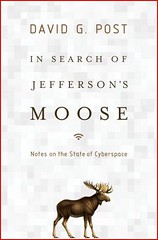
Post Jeffersons MooseI used to have a (semi-crazy) uncle who typically began conversations with lame jokes or bad riddles. This sounds like one he might have used had he lived long enough: What do Thomas Jefferson, a moose, and cyberspace have in common?

The answer to that question can be found in a new book, In Search of Jefferson’s Moose: Notes on the State of Cyberspace, by David G. Post, a Professor of Law at Temple University. Post, who teaches IP and cyberspace law at Temple, is widely regarded as one of the intellectual fathers of the “Internet exceptionalist” school of thinking about cyberlaw.  Basically, Post sees this place we call “cyberspace” as something truly new, unique, and potentially worthy of some special consideration, or even somewhat different ground rules than we apply in meatspace. More on that in a bit.

[ Full disclosure: Post’s work was quite influential on my own thinking during the late 1990s, so much so that when I joined the Cato Institute in 2000, one of the first things I did was invite David to become an adjunct scholar with Cato. He graciously accepted and remains a Cato adjunct scholar today. Incidentally, Cato is hosting a book forum for him on February 4th that I encourage you to attend or watch online. Anyway, it’s always difficult to be perfectly objective when you know and admire someone, but I will try to do so here.]

Post’s book is essentially an extended love letter — to both cyberspace and Jefferson. Problem is, as Post even admits at the end, it’s tough to know which subject this book is suppose to teach us more about. The book loses focus at times — especially in the first 100 pages — as Post meanders between historical tidbits of Jefferson’s life and thinking and what it all means for cyberspace. But the early focus is on TJ.  Thus, those who pick up the book expecting to be immediately immersed in cyber-policy discussions may be a bit disappointed at first.  As a fellow Jefferson fanatic, however, I found all this history terrifically entertaining, whether it was the story of Jefferson’s Plow and his other agricultural inventions and insights, TJ’s unique interest in science (including cryptography), or that big moose of his.

OK, so what’s the deal with the moose? When TJ was serving as a minister to France in in the late 1780s, at considerable expense to himself, he had the complete skeleton, skin and horns of a massive American moose shipped to the lobby of his Paris hotel. Basically, Jefferson wanted to make a bold statement to his French hosts about this New World he came from and wake them up to the fact that some very exciting things were happening over there that they should be paying attention to. That’s one hell of way to make a statement!

Continue reading →

My piece about the U.S. Chamber of Commerce event last Friday on U.S. intellectual property attachés giving a report, and taking a hard line, on the enforcement of U.S. intellectual property, overseas, is now live on ip-watch.org.

Here’s the first couple of paragraphs:

WASHINGTON, DC – Nations ranging from Brazil to Brunei to Russia are failing to properly protect the intellectual property assets of US companies and others, and international organisations are not doing enough to stop it, seven IP attachés to the US Foreign and Commercial Service lamented recently.

Meanwhile, an industry group issued detailed recommendations for the incoming Obama administration’s changes to the US Patent and Trademark Office.

The problems in other nations extend from Brazil’s failure to issue patents for commercially significant inventions by US inventors, to an almost-complete piracy-based economy in Brunei, to an only-modest drop in the rate of Russian piracy from 65 percent to 58 percent.

The attachés, speaking at an event organised by the US Chamber of Commerce and its recently beefed-up Global Intellectual Property Center (GIPC), blasted the record of familiar intellectual property trouble zones like Brunei, Thailand and Russia.

But the problems extend to the attitudes and omissions of major trading partners like Brazil, India and even well-developed European nations, said the attachés.

[more at http://www.ip-watch.org/weblog/index.php?p=1387….]

I attended the Federal Trade Commission hearing about the state of intellectual property on Friday, and wrote a piece about the event, “With US Patent Overhaul Dead, Agencies Ponder Changes As Industry Debates Role Of ‘Trolls’.”

The piece appeared in ip-watch.org, the excellent Geneva-based publication run by my friend and former colleague William New. Those of you who aren’t familiar yet with ip-watch.org should definitely begin following it: it’s a must-read for practitioners, advocates and activists concerned about all forms of intellectual property.

The Federal Trade Commission has announced that it will hold “a series of public hearings beginning on December 5, 2008, in Washington, D.C., to explore the evolving market for intellectual property (IP).”

It’s timely, then, that we will be having a forum Monday on a provocative book whose thesis is the title: Against Intellectual Monopoly. Co-author Michele Boldrin will present the book, and Rob Atkinson of the Information Technology and Innovation Foundation will critique it.

Highlighting one of the issues at Monday’s forum, the Arts+Labs blog points to Atkinson’s testimony about the value of American intellectual property on the export market. Over 50 percent of U.S. exports depend on some form of IP protection, according to Rob Atkinson.

It’ll be a good, interesting discussion. Register here now.

Arts+Labs, a new coalition “committed to a better, safer internet that works for both artists and consumers,” has written up Friday’s Cato Institute book forum on The Crime of Reason on their ArtLab blog. Author Robert B. Laughlin of Stanford University will present his book, then we’ll have comments from Tom Sydnor of the Progress and Freedom Foundation.

I’ve gotten a glimpse at the slides Dr. Laughlin will be using, and this Nobel laureate in physics also turns out to be something of an artist.

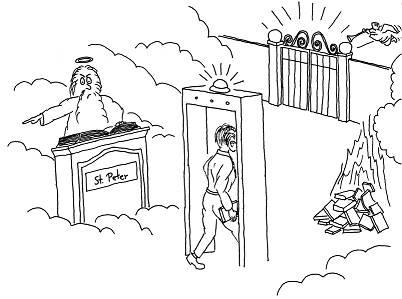
Join us Friday to learn what this drawing is all about.

If you find the title of this post provocative, you’ll be interested in a Cato Institute book forum on Friday, October 10th.

In The Crime of Reason, Nobel laureate in physics Robert Laughlin argues that intellectual property laws and government security demands threaten the development of new knowledge. Without change, we risk bequeathing our heirs a world where knowledge is criminalized and our intellectual tradition of unfettered inquiry is lost.

The event should be a fascinating inquiry into the role of information and information rules in our society. Thomas Syndor of the Progress & Freedom Foundation will comment. I’ll be your humble moderator. It’s noon on Friday, October 10th, at the Cato Institute, 1000 Massachusetts Avenue, NW, Washington, D.C. Luncheon to follow.

You can register for the event here.