Posts tagged as:

[Cross-posted from Medium.]

James Pethokousis of AEI interviews me about the current miserable state of modern science fiction, which is just dripping with dystopian dread in every movie, show, and book plot. How does all the techno-apocalyptica affect societal and political attitudes about innovation broadly and emerging technologies in particular. Our discussion builds on my recent a recent Discourse article, “How Science Fiction Dystopianism Shapes the Debate over AI & Robotics.” [Pasted down below.] Swing on over to Jim’s “Faster, Please” newsletter and hear what Jim and I have to say. And, for a bonus question, Jim asked me is we doing a good job of inspiring kids to have a sense of wonder and to take risks. I have some serious concerns that we are falling short on that front.

Continue reading →

[Cross-posted from Medium]

There are two general types of technological governance that can be used to address challenges associated with artificial intelligence (AI) and computational sciences more generally. We can think of these as “on the ground” (bottom-up, informal “soft law”) governance mechanisms versus “on the books” (top-down, formal “hard law”) governance mechanisms.

Unfortunately, heated debates about the latter type of governance often divert attention from the many ways in which the former can (or already does) help us address many of the challenges associated with emerging technologies like AI, machine learning, and robotics. It is important that we think harder about how to optimize these decentralized soft law governance mechanisms today, especially as traditional hard law methods are increasingly strained by the relentless pace of technological change and ongoing dysfunctionalism in the legislative and regulatory arenas.

Continue reading →

[last updated 4/3/2025 – Check my Medium page for latest posts]

This a running list of all the essays and reports I’ve already rolled out on the governance of artificial intelligence (AI), machine learning (ML), and robotics. Why have I decided to spend so much time on this issue? Because this will become the most important technological revolution of our lifetimes. Every segment of the economy will be touched in some fashion by AI, ML, robotics, and the power of computational science. It should be equally clear that public policy will be radically transformed along the way.

Eventually, all policy will involve AI policy and computational considerations. As AI “eats the world,” it eats the world of public policy along with it. The stakes here are profound for individuals, economies, and nations. As a result, AI policy will be the most important technology policy fight of the next decade, and perhaps next quarter century. Those who are passionate about the freedom to innovate need to prepare to meet the challenge as proposals to regulate AI proliferate.

There are many socio-technical concerns surrounding algorithmic systems that deserve serious consideration and appropriate governance steps to ensure that these systems are beneficial to society. However, there is an equally compelling public interest in ensuring that AI innovations are developed and made widely available to help improve human well-being across many dimensions. And that’s the case that I’ll be dedicating my life to making in coming years.

Here’s the list of what I’ve done so far. I will continue to update this as new material is released: Continue reading →

I’m finishing up my next book, which is tentatively titled, “A Flexible Governance Framework for Artificial Intelligence.” I thought I’d offer a brief preview here in the hope of connecting with others who care about innovation in this space and are also interested in helping to address these policy issues going forward.

The goal of my book is to highlight the ways in which artificial intelligence (AI) machine learning (ML), robotics, and the power of computational science are set to transform the world—and the world of public policy—in profound ways. As with all my previous books and research products, my goal in this book includes both empirical and normative components. The first objective is to highlight the tensions between emerging technologies and the public policies that govern them. The second is to offer a defense of a specific governance stance toward emerging technologies intended to ensure we can enjoy the fruits of algorithmic innovation.

AI is a transformational technology that is general-purpose and dual-use. AI and ML also build on top of other important technologies—computing, microprocessors, the internet, high-speed broadband networks, and data storage/processing systems—and they will become the building blocks for a great many other innovations going forward. This means that, eventually, all policy will involve AI policy and computational considerations at some level. It will become the most important technology policy issue here and abroad going forward.

The global race for AI supremacy has important implications for competitive advantage and other geopolitical issues. This is why nations are focusing increasing attention on what they need to do to ensure they are prepared for this next major technological revolution. Public policy attitudes and defaults toward innovative activities will have an important influence on these outcomes.

In my book, I argue that, if the United States hopes to maintain a global leadership position in AI, ML, and robotics, public policy should be guided by two objectives:

  1. Maximize the potential for innovation, entrepreneurialism, investment, and worker opportunities by seeking to ensure that firms and other organizations are prepared to compete at a global scale for talent and capital and that the domestic workforce is properly prepared to meet the same global challenges.
  2. Develop a flexible governance framework to address various ethical concerns about AI development or use to ensure these technologies benefit humanity, but work to accomplish this goal without undermining the goals set forth in the first objective.

The book primarily addresses the second of these priorities because getting the governance framework for AI right significantly improves the chances of successfully accomplishing the first goal of ensuring that the United States remains a leading global AI innovator. Continue reading →

Continue reading →

Profectus is an excellent new online magazine featuring essays and interviews on the intersection of academic literature, public policy, civilizational progress, and human flourishing. The Spring 2022 edition of the magazine features a “Progress Roundtable” in which six different scholars were asked to contribute their thoughts on three general questions:
  1. What is progress?
  2. What are the most significant barriers holding back further progress?
  3. If those challenges can be overcome, what does the world look like in 50 years?

I was honored to be asked by Clay Routledge to contribute answers to those questions alongside others, including: Steven Pinker (Harvard University), Jason Crawford (Roots of Progress), Matt Clancy (Institute for Progress), Marian Tupy (Human​Progress​.org), James Pethokoukis (AEI). I encourage you to jump over the roundtable and read all their excellent responses. I’ve included my answers down below:

Continue reading →

[This is a draft of a section of a forthcoming study on “A Flexible Governance Framework for Artificial Intelligence,” which I hope to complete shortly. I welcome feedback. I have also cross-posted this essay at Medium.]

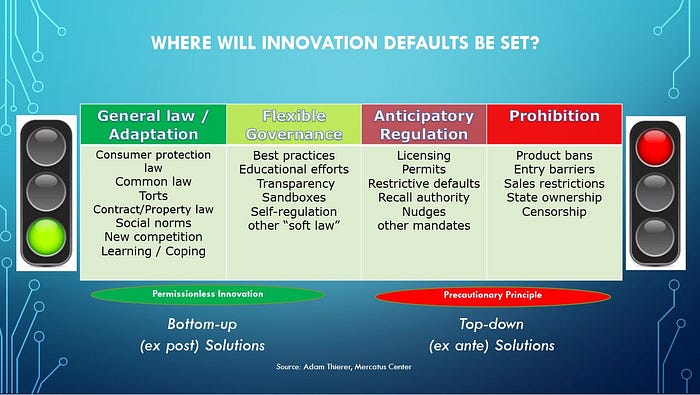
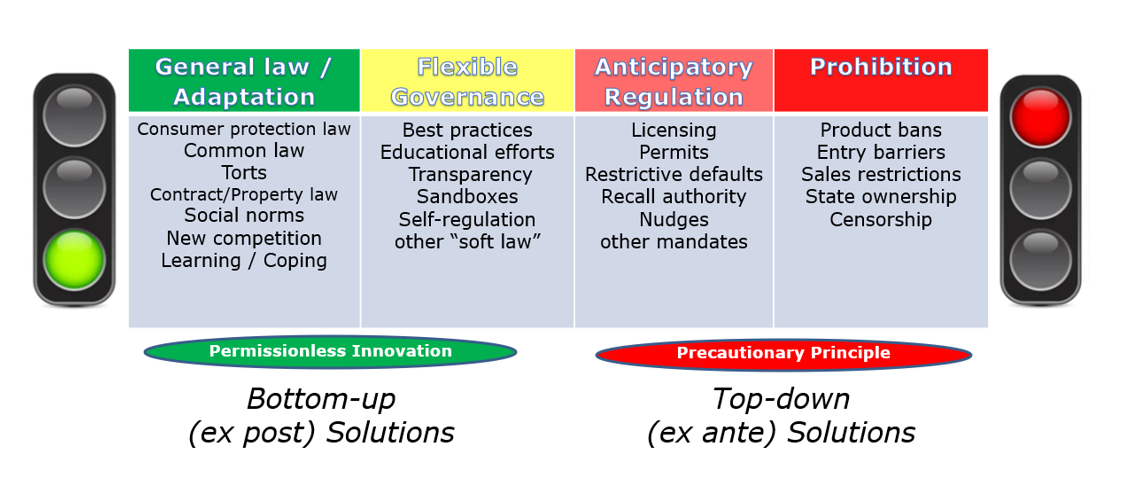
Debates about how to embed ethics and best practices into AI product design is where the question of public policy defaults becomes important. To the extent AI design becomes the subject of legal or regulatory decision-making, a choice must be made between two general approaches: the precautionary principle or the proactionary principle.[1] While there are many hybrid governance approaches in between these two poles, the crucial issue is whether the initial legal default for AI technologies will be set closer to the red light of the precautionary principle (i.e., permissioned innovation) or to the green light of the proactionary principle (i.e., (permissionless innovation). Each governance default will be discussed.

Continue reading →

Just FYI, the James Madison Institute will be hosting its “2022 Tech and Innovation Summit” on Thursday, September 15 and Friday, September 16 in Coral Gables, Florida. I’m honored to be included among the roster of speakers announced so far, which includes:

  • Ajit Pai, Former Chairman of the Federal Communications Commission
  • Adam Thierer, the Mercatus Center at George Mason University
  • Will Duffield, Cato Institute
  • Utah State Representative Cory Maloy
  • Dane Ishihara, Director of Utah’s Office of Regulatory Relief

Registration info is here.

As I note in my latest regular column for The Hill, it seems like everyone these days is talking about the importance of America “building again.” For example, take a look at this compendium of essays I put together where scholars and pundits have been making the case for “building again” in various ways and contexts. It would seem that the phrase is on everyone’s lips. “These calls include many priorities,” I note, “but what unifies them is the belief that the nation needs to develop new innovations and industries to improve worker opportunities, economic growth and U.S. global competitive standing.”

What I fear, however, is that “building again” has become more of a convenient catch line than anything else. It seems like few people are willing to spell out exactly what it will take to get that started. My new column suggests that the most important place to start is “to cut back the thicket of red tape and stifling bureaucratic procedures that limit the productiveness of the American workforce.” I cite recent reports and data documenting the enormous burden that regulatory accumulation imposes on American innovators and workers. I then discuss how to get reforms started at all levels of government to get the problem under control and help us start building again in earnest. Jump over to The Hill to read the entire essay.