Senator Marco Rubio is right on immigration. In his remarks regarding the immigration bill passed by the Senate last week, Rubio noted that immigration is an American story.
For over two hundred years now, they have come. . . . From Ireland and Poland, from Germany and France. From Mexico and Cuba, they have come. They have come because in the land of their birth, their dreams were bigger than their opportunities.
As Jack Kemp so famously said, “We are a nation of immigrants.” From the Native Americans who crossed the land bridge over what is now the Bering Strait to the apex of European immigration in the early 20th Century (when 13.5 million immigrants were living in the United States), America has always been the land of opportunity. Continue reading →
David Garcia, post doctoral researcher at the Swiss Federal Institute of Technology and co-author of Social Resilience in Online Communities: The Autopsy of Friendster, discusses the concept of social resilience and how online communities, like Facebook and Friendster, withstand changes in their environment.
Garcia’s paper examines one of the first online social networking sites, Friendster, and analyzes its post-mortem data to learn why users abandoned it.
Garcia goes on to explain how opportunity cost and cost benefit analysis can affect a user’s decision whether or not to remain in an online community.
Download
Related Links
In mid-April, the Federal Trade Commission (FTC) requested comments regarding “the consumer privacy and security issues posed by the growing connectivity of consumer devices, such as cars, appliances, and medical devices” or the so-called “Internet of Things.” This is in anticipation of a November 21 public workshop that the FTC will be hosting on the same issue.
These issues are finally starting to catch the attention of the public and policymakers alike with the rise of wearable computing, remote home automation and monitoring technologies, smart grids, autonomous vehicles and intelligent traffic systems, and so on. The Internet of Things represents the next great wave of Internet innovation, but it also represents the next great battleground in the field of Internet policy.
I filed comments with the FTC today in this proceeding and made a few simple points about why they should proceed cautiously here. A summary of my filing follows. Continue reading →
My colleague Eli Dourado brought to my attention this XKCD comic and when tweeting it out yesterday he made the comment that “Half of tech policy is dealing with these people”:
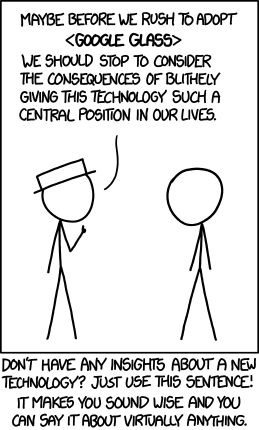
The comic and Eli’s comment may be a bit snarky, but something about it rang true to me because while conducting research on the impact of new information technologies on society I often come across books, columns, blog posts, editorials, and tweets that can basically be summed up with the line from that comic: “we should stop to consider the consequences of [this new technology] before we …” Or, equally common is the line: “we need to have a conversation about [this new technology] before we…”
But what does that really mean? Certainly “having a conversation” about the impact of a new technology on society is important. But what is the nature of that “conversation”? How is it conducted? How do we know when it is going on or when it is over? Continue reading →
W. Patrick McCray, author of The Visioneers: How a Group of Elite Scientists Pursued Space Colonies, Nanotechnologies, and a Limitless Future, tells the story of these modern utopians who predicted that their technologies could transform society as humans mastered the ability to create new worlds.
Believing that the term “futurist” was too broad, McCray coined the term visioneers to describe those who not only had ambitious visions for future technology, but who carried out detailed and extensive scientific and engineering work to bring those visions into fruition, and who actively worked to promote their ideas to a wider public.
McCray focuses on the works of Gerard O’Neil and Eric Drexler, detailing their early contributions as visioneers and their continuing impact particularly in the fields of space colonization and nanotechnology. He also identifies modern-day visioneers and their work.
Download
Related Links
Alex Tabarrok, author of the ebook Launching The Innovation Renaissance: A New Path to Bring Smart Ideas to Market Fast discusses America’s declining growth rate in total factor productivity, what this means for the future of innovation, and what can be done to improve the situation.
Accroding to Tabarrok, patents, which were designed to promote the progress of science and the useful arts, have instead become weapons in a war for competitive advantage with innovation as collateral damage. College, once a foundation for innovation, has been oversold. And regulations, passed with the best of intentions, have spread like kudzu and now impede progress to everyone’s detriment. Tabarrok outs forth simple reforms in each of these areas and also explains the role immigration plays in innovation and national productivity.
Download
Related Links
Today I’ll be testifying at a Senate Commerce Committee hearing on online privacy and commercial data collection issues. In my remarks, I make three primary points:
- First, no matter how well-intentioned, restrictions on data collection could negatively impact the competitiveness of America’s digital economy, as well as consumer choice.
- Second, it is unwise to place too much faith in any single, silver-bullet solution to privacy, including “Do Not Track,” because such schemes are easily evaded or defeated and often fail to live up to their billing.
- Finally, with those two points in mind, we should look to alternative and less costly approaches to protecting privacy that rely on education, empowerment, and targeted enforcement of existing laws. Serious and lasting long-term privacy protection requires a layered, multifaceted approach incorporating many solutions.
The testimony also contains 4 appendices elaborating on some of these themes.
Down below, I’ve embedded my testimony, a list of 10 recent essays I’ve penned on these topics, and a video in which I explain “How I Think about Privacy” (which was taped last summer at an event up at the University of Maine’s Center for Law and Innovation). Finally, the best summary of my work on these issues can be found in this recent Harvard Journal of Law & Public Policy article, “The Pursuit of Privacy in a World Where Information Control is Failing.” (This is the first of two complimentary law review articles I will be releasing this year dealing with privacy policy. The second, which will be published early this summer by the George Mason University Law Review, is entitled, “A Framework for Benefit-Cost Analysis in Digital Privacy Debates.”) Continue reading →
Paul J. Heald, professor of law at the University of Illinois Urbana-Champaign, discusses his new paper “Do Bad Things Happen When Works Enter the Public Domain? Empirical Tests of Copyright Term Extension.”
The international debate over copyright term extension for existing works turns on the validity of three empirical assertions about what happens to works when they fall into the public domain. Heald discusses a study he carried out with Christopher Buccafusco that found that all three assertions are suspect. In the study, they show that audio books made from public domain bestsellers are significantly more available than those made from copyrighted bestsellers. They also demonstrate that recordings of public domain and copyrighted books are of equal quality.
Since copyrighted works will once again begin to fall into the public domain starting in 2018, Heald says, it’s likely that content owners will ask Congress for yet another term extension. He argues that his empirical findings suggest it should not be granted.
Download
Related Links
Marc Hochstein, Executive Editor of American Banker, a leading media outlet covering the banking and financial services community, discusses bitcoin.
According to Hochstein, bitcoin has made its name as a digital currency, but the truly revolutionary aspect of the technology is its dual function as a payment system competing against companies like PayPal and Western Union. While bitcoin has been in the news for its soaring exchange rate lately, Hochstein says the actual price of bitcoin is really only relevant for speculators in the short-term; in the long-term, however, the anonymous, decentralized nature of bitcoin has far-reaching implications.
Hochstein goes on to talk about the new market in bitcoin futures and some of bitcoin’s weaknesses—including the volatility of the bitcoin market.
Download
Related Links
Joshua Gans, professor of Strategic Management at the University of Toronto’s Rotman School of Management and author of the new book Information Wants to be Shared, discusses modern media economics, including how books, movies, music, and news will be supported in the future.
Gans argues that sharing enhances most information’s value. He also explains that the business models of traditional media companies, gatekeepers who have relied on scarcity and control, have collapsed in the face of new technologies. Equally important, he argues that sharing can revive moribund, threatened industries even as he examines platforms that have, almost accidentally, thrived in this new environment.
Download
Related Links

 The Technology Liberation Front is the tech policy blog dedicated to keeping politicians' hands off the 'net and everything else related to technology.