Evan Selinger, a super-sharp philosopher of technology up at the Rochester Institute of Technology, is always alerting me to interesting new essays and articles and this week he brought another important piece to my attention. It’s a short new article by Arturo Casadevall, Don Howard, and Michael J. Imperiale, entitled, “The Apocalypse as a Rhetorical Device in the Influenza Virus Gain-of-Function Debate.” The essay touches on something near and dear to my own heart: the misuse of rhetoric in debates over the risk trade-offs associated with new technology and inventions. Casadevall, Howard, and Imperiale seek to “focus on the rhetorical devices used in the debate [over infectious disease experiments] with the hope that an analysis of how the arguments are being framed can help the discussion.”
They note that “humans are notoriously poor at assessing future benefits and risks” and that this makes many people susceptible to rhetorical ploys based on the artificial inflation of risks. Their particular focus in this essay is the debate over so-called “gain-of-function” (GOF) experiments involving influenza virus, but what they have to say here about how rhetoric is being misused in that field is equally applicable to many other fields of science and the policy debates surrounding various issues. The last two paragraphs of their essay are masterful and deserve everyone’s attention: Continue reading →
Last week, it was my pleasure to speak at a Cato Institute event on “The End of Transit and the Beginning of the New Mobility: Policy Implications of Self-Driving Cars.” I followed Cato Institute Senior Fellow Randal O’Toole and Marc Scribner, a Research Fellow at the Competitive Enterprise Institute. They provided a broad and quite excellent overview of all the major issues at play in the debate over driverless cars. I highly recommend you read the excellent papers that Randal and Marc have published on these issues.
My role on the panel was to do a deeper dive into the privacy and security implications of not just the autonomous vehicles of our future, but also the intelligent vehicle technologies of the present. I discussed these issues in greater detail in my recent Mercatus Center working paper, “Removing Roadblocks to Intelligent Vehicles and Driverless Cars,” which was co-authored with Ryan Hagemann. (That article will appear in a forthcoming edition of the Wake Forest Journal of Law & Policy.) I’ve embedded the video of the event down below (my remarks begin at the 38:15 mark) as well as my speaking notes. Again, please consult the longer paper for details.
Continue reading →
 If you want a devastating portrait of how well-intentioned regulation sometimes has profoundly deleterious unintended consequences, look no further than the Federal Aviation Administration’s (FAA) current ban on commercial drones in domestic airspace. As Jack Nicas reports in a story in today’s Wall Street Journal (“Regulation Clips Wings of U.S. Drone Makers“), the FAA’s heavy-handed regulatory regime is stifling America’s ability to innovate in this space and remain competitive internationally. As Nicas notes:
as unmanned aircraft enter private industry—for purposes as varied as filming movies, inspecting wind farms and herding cattle—many U.S. drone entrepreneurs are finding it hard to get off the ground, even as rivals in Europe, Canada, Australia and China are taking off.
The reason, according to interviews with two-dozen drone makers, sellers and users across the world: regulation. The FAA has banned all but a handful of private-sector drones in the U.S. while it completes rules for them, expected in the next several years. That policy has stifled the U.S. drone market and driven operators underground, where it is difficult to find funding, insurance and customers.
Outside the U.S., relatively accommodating policies have fueled a commercial-drone boom. Foreign drone makers have fed those markets, while U.S. export rules have generally kept many American manufacturers from serving them.
Of course, the FAA simply responds that they are looking out for the safety of the skies and that we shouldn’t blame them. Continue reading →
The sharing economy is growing faster than ever and becoming a hot policy topic these days. I’ve been fielding a lot of media calls lately about the nature of the sharing economy and how it should be regulated. (See latest clip below from the Stossel show on Fox Business Network.) Thus, I sketched out some general thoughts about the issue and thought I would share them here, along with some helpful additional reading I have come across while researching the issue. I’d welcome comments on this outline as well as suggestions for additional reading. (Note: I’ve also embedded some useful images from Jeremiah Owyang of Crowd Companies.)
1)
Just because policymakers claim that regulation is meant to protect consumers does not mean it actually does so.
- Cronyism/ Rent-seeking: Regulation is often “captured” by powerful and politically well-connected incumbents and used to their own benefit. (+ Lobbying activity creates deadweight losses for society.)
- Innovation-killing: Regulations become a formidable barrier to new innovation, entry, and entrepreneurism.
- Unintended consequences: Instead of resulting in lower prices & better service, the opposite often happens: Higher prices & lower quality service. (Example: Painting all cabs same color destroying branding & ability to differentiate).
Continue reading →
If there are two general principles that unify my recent work on technology policy and innovation issues, they would be as follows. To the maximum extent possible:
- We should avoid preemptive and precautionary-based regulatory regimes for new innovation. Instead, our policy default should be innovation allowed (or “permissionless innovation”) and innovators should be considered “innocent until proven guilty” (unless, that is, a thorough benefit-cost analysis has been conducted that documents the clear need for immediate preemptive restraints).
- We should avoid rigid, “top-down” technology-specific or sector-specific regulatory regimes and/or regulatory agencies and instead opt for a broader array of more flexible, “bottom-up” solutions (education, empowerment, social norms, self-regulation, public pressure, etc.) as well as reliance on existing legal systems and standards (torts, product liability, contracts, property rights, etc.).
I was very interested, therefore, to come across two new essays that make opposing arguments and proposals. The first is this recent
Slate oped by John Frank Weaver, “We Need to Pass Legislation on Artificial Intelligence Early and Often.” The second is Ryan Calo’s new Brookings Institution white paper, “The Case for a Federal Robotics Commission.”
Weaver argues that new robot technology “is going to develop fast, almost certainly faster than we can legislate it. That’s why we need to get ahead of it now.” In order to preemptively address concerns about new technologies such as driverless cars or commercial drones, “we need to legislate early and often,” Weaver says. Stated differently, Weaver is proposing “precautionary principle”-based regulation of these technologies. The precautionary principle generally refers to the belief that new innovations should be curtailed or disallowed until their developers can prove that they will not cause any harms to individuals, groups, specific entities, cultural norms, or various existing laws, norms, or traditions.
Calo argues that we need “the establishment of a new federal agency to deal with the novel experiences and harms robotics enables” since there exists “distinct but related challenges that would benefit from being examined and treated together.” These issues, he says, “require special expertise to understand and may require investment and coordination to thrive.
I’ll address both Weaver and Calo’s proposals in turn. Continue reading →
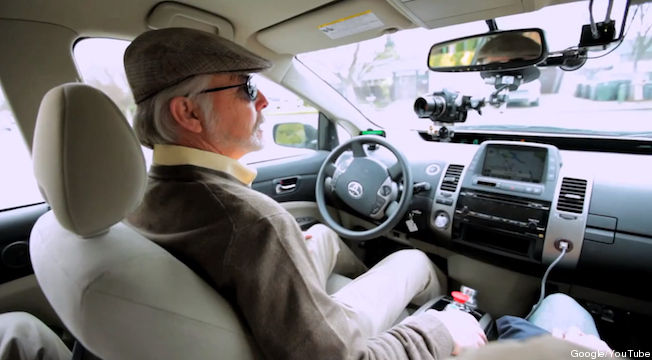 I’m pleased to announce that the Mercatus Center at George Mason University has just released my latest working paper, “Removing Roadblocks to Intelligent Vehicles and Driverless Cars.” This paper, which was co-authored with Ryan Hagemann, has been accepted for publication in a forthcoming edition of the Wake Forest Journal of Law & Policy.
In the paper, Hagemann and I explore the growing market for both “connected car” technologies as well as autonomous (or “driverless”) vehicle technology. We argue that intelligent-vehicle technology will produce significant benefits. Most notably, these technologies could save many lives. In 2012, 33,561 people were killed and 2,362,000 injured in traffic crashes, largely as a result of human error. Reducing the number of accidents by allowing intelligent vehicle technology to flourish would constitute a major public policy success. As Philip E. Ross noted recently at IEEE Spectrum, thanks to these technologies, “eventually it will be positively hard to use a car to hurt yourself or others.” The sooner that day arrives, the better.
These technologies could also have positive environmental impacts in the form of improved fuel economy, reduced traffic congestion, and reduced parking needs. They might also open up new mobility options for those who are unable to drive, for whatever reason. Any way you cut it, these are exciting technologies that promise to substantially improve human welfare.
Of course, as with any new disruptive technology, connected cars and driverless vehicles raise a variety of economic, social, and ethical concerns. Hagemann and I address some of the early policy concerns about these technologies (safety, security, privacy, liability, etc.) and we outline a variety of “bottom-up” solutions to ensure that innovation continues to flourish in this space. Importantly, we also argue that policymakers should keep in mind that individuals have gradually adapted to similar disruptions in the past and, therefore, patience and humility are needed when considering policy for intelligent-vehicle systems. Continue reading →
On Thursday, it was my great pleasure to present a draft of my forthcoming paper, “The Internet of Things & Wearable Technology: Addressing Privacy & Security Concerns without Derailing Innovation,” at a conference that took place at the Federal Communications Commission on “Regulating the Evolving Broadband Ecosystem.” The 3-day event was co-sponsored by the American Enterprise Institute and the University of Nebraska College of Law.
The 65-page working paper I presented is still going through final peer review and copyediting, but I posted a very rough first draft on SSRN for conference participants. I expect the paper to be released as a Mercatus Center working paper in October and then I hope to find a home for it in a law review. I will post the final version once it is released. [UPDATE:The final version of this working paper was released on November 19, 2014.]
In the meantime, however, I thought I would post the 46 slides I presented at the conference, which offer an overview of the nature of the Internet of Things and wearable technology, the potential economic opportunities that exist in this space, and the various privacy and security challenges that could hold this technological revolution back. I also outlined some constructive solutions to those concerns. I plan to be very active on these issues in coming months.
Continue reading →
If there is one thing I have learned in almost 23 years of covering communications and media regulation it is this: No matter how well-intentioned, regulation often has unintended consequences that hurt the very consumers the rules are meant to protect. Case in point: “universal service” mandates that require a company to serve an entire area as a condition of offering service at all. The intention is noble: Get service out to everyone in the community, preferably at a very cheap rate. Alas, the result of mandating that result is clear: You get less competition, less investment, less innovation, and less consumer choice. And often you don’t even get everyone served.
Consider this
Wall Street Journal article today, “Google Fiber Is Fast, but Is It Fair? The Company Provides Neighborhoods With Faster and Cheaper Service, but Are Some Being Left Behind?” In the story, Alistair Barr notes that:
U.S. policy long favored extending service to all. AT&T touted its “universal service” in advertisements more than a century ago. The concept was codified in a 1934 law requiring nationwide “wire and radio services” to reach everyone at “reasonable charges.” In exchange for wiring a community, telecommunications providers often gained a monopoly. Cities made similar deals with cable-TV providers beginning in the 1960s.
The problem, of course, is that while this model allowed for the slow spread of service to
most communities, it came at a very steep cost: Monopoly and plain vanilla service. I documented this in a 1994 essay entitled, “Unnatural Monopoly: Critical Moments in the Development of the Bell System Monopoly.” As well-intentioned regulatory mandates started piling up, competition slowly disappeared. And a devil’s deal was eventually cut between regulators and AT&T to adopt the company’s advertising motto — “One Policy, One System, Universal Service” — as the de facto law of the land. Continue reading →
My latest law review article is entitled, “Privacy Law’s Precautionary Principle Problem,” and it appears in Vol. 66, No. 2 of the Maine Law Review. You can download the article on my Mercatus Center page, on the Maine Law Review website, or via SSRN. Here’s the abstract for the article:
Privacy law today faces two interrelated problems. The first is an
information control problem. Like so many other fields of modern cyberlaw—intellectual property, online safety, cybersecurity, etc.—privacy law is being challenged by intractable Information Age realities. Specifically, it is easier than ever before for information to circulate freely and harder than ever to bottle it up once it is released.
This has not slowed efforts to fashion new rules aimed at bottling up those information flows. If anything, the pace of privacy-related regulatory proposals has been steadily increasing in recent years even as these information control challenges multiply.
This has led to privacy law’s second major problem:
the precautionary principle problem. The precautionary principle generally holds that new innovations should be curbed or even forbidden until they are proven safe. Fashioning privacy rules based on precautionary principle reasoning necessitates prophylactic regulation that makes new forms of digital innovation guilty until proven innocent.
This puts privacy law on a collision course with the general freedom to innovate that has thus far powered the Internet revolution, and privacy law threatens to limit innovations consumers have come to expect or even raise prices for services consumers currently receive free of charge. As a result, even if new regulations are pursued or imposed, there will likely be formidable push-back not just from affected industries but also from their consumers.
In light of both these information control and precautionary principle problems, new approaches to privacy protection are necessary. Continue reading →
I recently did a presentation for Capitol Hill staffers about emerging technology policy issues (driverless cars, the “Internet of Things,” wearable tech, private drones, “biohacking,” etc) and the various policy issues they would give rise to (privacy, safety, security, economic disruptions, etc.). The talk is derived from my new little book on “Permissionless Innovation,” but in coming months I will be releasing big papers on each of the topics discussed here.
Additional
Reading:

 The Technology Liberation Front is the tech policy blog dedicated to keeping politicians' hands off the 'net and everything else related to technology.