 Last Wednesday, it was my great pleasure to testify at a Senate Commerce Committee hearing entitled, “The Connected World: Examining the Internet of Things.” The hearing focused “on how devices… will be made smarter and more dynamic through Internet technologies. Government agencies like the Federal Trade Commission, however, are already considering possible changes to the law that could have the unintended consequence of slowing innovation.”
But the session went well beyond the Internet of Things and became a much more wide-ranging discussion about how America can maintain its global leadership for the next-generation of Internet-enabled, data-driven innovation. On both sides of the aisle at last week’s hearing, one Senator after another made impassioned remarks about the enormous innovation opportunities that were out there. While doing so, they highlighted not just the opportunities emanating out of the IoT and wearable device space, but also many other areas, such as connected cars, commercial drones, and next-generation spectrum.
I was impressed by the energy and nonpartisan vision that the Senators brought to these issues, but I wanted to single out the passionate statement that Sen. Cory Booker (D-NJ) delivered when it came his turn to speak because he very eloquently articulated what’s at stake in the battle for global innovation supremacy in the modern economy. (Sen. Booker’s remarks were not published, but you can watch them starting at the 1:34:00 mark of the hearing video.) Continue reading →
Yesterday, the Federal Trade Commission (FTC) released its long-awaited report on “The Internet of Things: Privacy and Security in a Connected World.” The 55-page report is the result of a lengthy staff exploration of the issue, which kicked off with an FTC workshop on the issue that was held on November 19, 2013.
I’m still digesting all the details in the report, but I thought I’d offer a few quick thoughts on some of the major findings and recommendations from it. As I’ve noted here before, I’ve made the Internet of Things my top priority over the past year and have penned several essays about it here, as well as in a big new white paper (“The Internet of Things and Wearable Technology: Addressing Privacy and Security Concerns without Derailing Innovation”) that will be published in the Richmond Journal of Law & Technology shortly. (Also, here’s a compendium of most of what I’ve done on the issue thus far.)
I’ll begin with a few general thoughts on the FTC’s report and its overall approach to the Internet of Things and then discuss a few specific issues that I believe deserve attention. Continue reading →
I’ve spent much of the past year studying the potential public policy ramifications associated with the rise of the Internet of Things (IoT). As I was preparing some notes for my Jan. 6th panel discussing on “Privacy and the IoT: Navigating Policy Issues” at this year’s 2015 CES show, I went back and collected all my writing on IoT issues so that I would have everything in one place. Thus, down below I have listed most of what I’ve done over the past year or so. Most of this writing is focused on the privacy and security implications of the Internet of Things, and wearable technologies in particular.
I plan to stay on top of these issues in 2015 and beyond because, as I noted when I spoke on a previous CES panel on these issues, the Internet of Things finds itself at the center of what we might think of a perfect storm of public policy concerns: Privacy, safety, security, intellectual property, economic / labor disruptions, automation concerns, wireless spectrum issues, technical standards, and more. When a new technology raises one or two of these policy concerns, innovators in those sectors can expect some interest and inquiries from lawmakers or regulators. But when a new technology potentially touches all of these issues, then it means innovators in that space can expect an avalanche of attention and a potential world of regulatory trouble. Moreover, it sets the stage for a grand “clash of visions” about the future of IoT technologies that will continue to intensify in coming months and years.
That’s why I’ll be monitoring developments closely in this field going forward. For now, here’s what I’ve done on this issue as I prepare to head out to Las Vegas for another CES extravaganza that promises to showcase so many exciting IoT technologies. Continue reading →
Earlier this week I posted an essay entitled, “Global Innovation Arbitrage: Commercial Drones & Sharing Economy Edition,” in which I noted how:
Capital moves like quicksilver around the globe today as investors and entrepreneurs look for more hospitable tax and regulatory environments. The same is increasingly true for innovation. Innovators can, and increasingly will, move to those countries and continents that provide a legal and regulatory environment more hospitable to entrepreneurial activity.
That essay focused on how actions by U.S. policymakers and regulatory agencies threatened to disincentivize homegrown innovation in the commercial drone and sharing economy sectors. But there are many other troubling examples of how America risks losing its competitive advantage in sectors where we should be global leaders as innovators looks offshore. We can think of this as “global innovation arbitrage,” as venture capitalist Marc Andreessen has aptly explained:
Think of it as a sort of “global arbitrage” around permissionless innovation — the freedom to create new technologies without having to ask the powers that be for their blessing. Entrepreneurs can take advantage of the difference between opportunities in different regions, where innovation in a particular domain of interest may be restricted in one region, allowed and encouraged in another, or completely legal in still another.
One of the more vivid recent examples of global innovation arbitrage involves the well-known example of 23andMe, which sells mail-order DNA-testing kits to allow people to learn more about their genetic history and predisposition to various diseases. Continue reading →
What sort of public policy vision should govern the Internet of Things? I’ve spent a lot of time thinking about that question in essays here over the past year, as well as in a new white paper (“The Internet of Things and Wearable Technology: Addressing Privacy and Security Concerns without Derailing Innovation”) that will be published in the Richmond Journal of Law & Technology early next year.
But I recently heard three policymakers articulate their recommended vision for the Internet of Things (IoT) and I found their approach so inspiring that I wanted to discuss it here in the hopes that it will become the foundation for future policy in this arena.
Last Thursday, it was my pleasure to attend a Center for Data Innovation (CDI) event on “How Can Policymakers Help Build the Internet of Things?” As the title implied, the goal of the event was to discuss how to achieve the vision of a more fully-connected world and, more specifically, how public policymakers can help facilitate that objective. It was a terrific event with many excellent panel discussions and keynote addresses.
Two of those keynotes were delivered by Senators Deb Fischer (R-Neb.) and Kelly Ayotte (R-N.H.). Below I will offer some highlights from their remarks and then relate them to the vision set forth by Federal Trade Commission (FTC) Commissioner Maureen K. Ohlhausen in some of her recent speeches. I will conclude by discussing how the Ayotte-Fischer-Ohlhausen vision can be seen as the logical extension of the Clinton Administration’s excellent 1997
Framework for Global Electronic Commerce, which proposed a similar policy paradigm for the Internet more generally. This shows how crafting policy for the IoT can and should be a nonpartisan affair. Continue reading →
Capital moves like quicksilver around the globe today as investors and entrepreneurs look for more hospitable tax and regulatory environments. The same is increasingly true for innovation. Innovators can, and increasingly will, move to those countries and continents that provide a legal and regulatory environment more hospitable to entrepreneurial activity. I was reminded of that fact today while reading two different reports about commercial drones and the sharing economy and the global competition to attract investment on both fronts. First, on commercial drone policy, a new Wall Street Journal article notes that:
Amazon.com Inc., which recently began testing delivery drones in the U.K., is warning American officials it plans to move even more of its drone research abroad if it doesn’t get permission to test-fly in the U.S. soon. The statement is the latest sign that the burgeoning drone industry is shifting overseas in response to the Federal Aviation Administration’s cautious approach to regulating unmanned aircraft.
According to the
Journal reporters, Amazon has sent a letter to the FAA warning that, “Without the ability to test outdoors in the United States soon, we will have no choice but to divert even more of our [drone] research and development resources abroad.” And another report in the U.K. Telegraph
notes that other countries are ready and willing to open their skies to the same innovation that the FAA is thwarting in America. Both the UK and Australia have been more welcoming to drone innovators recently. Here’s a report from an Australian newspaper about Google drone services testing there. (For more details, see this excellent piece by Alan McQuinn, a research assistant with the Information Technology and Innovation Foundation: “Commercial Drone Companies Fly Away from FAA Regulations, Go Abroad.”) None of this should be a surprise, as I’ve noted in recent essays and filings. With the FAA adopting such a highly precautionary regulatory approach, innovation has been actively disincentivized. America runs the risk of driving still more private drone innovation offshore in coming months since all signs are that the FAA intends to drag its feet on this front as long as it can, even though Congress has told to agency to take steps to integrate these technologies into national airspace. Continue reading →
Writing last week in The Wall Street Journal, Matt Moffett noted how many European countries continue to struggle with chronic unemployment and general economic malaise. (“New Entrepreneurs Find Pain in Spain“) It’s a dismal but highly instructive tale about how much policy incentives matter when it comes to innovation and job creation–especially the sort of entrepreneurial activity from small start-ups that is so essential for economic growth. Here’s the key takeaway:
Scarce capital, dense bureaucracy, a culture deeply averse to risk and a cratered consumer market all suppress startups in Europe. The Global Entrepreneurship Monitor, a survey of startup activity, found the percentage of the adult population involved in early stage entrepreneurial activity last year was just 5% in Germany, 4.6% in France and 3.4% in Italy. That compares with 12.7% in the U.S. Even once they are established, European businesses are, on average, smaller and slower growing than those in the U.S. The problems of entrepreneurs are one reason Europe’s economy continues to struggle after six years of crisis. The European Union this month cut its growth forecasts for the region for this year and next, citing weaker than expected performance in the eurozone’s biggest economies, Germany, France and Italy. This week, the Organization for Economic Cooperation and Development delivered its own pessimistic appraisal, with chief economist Catherine Mann saying, “The eurozone is the locus of the weakness in the global economy.”
[…]
Europe’s unemployment crisis may be eroding a deeply ingrained fear of failure that is a bigger impediment to entrepreneurship on the Continent than in other regions, according to academic surveys. “Fear of failure is less of an issue because the whole country is a failure, and most of us are out of business or have a hard time paying our bills,” said Nick Drandakis of Athens, who in 2011 founded Taxibeat, an app that provides passenger ratings on taxi drivers.
Continue reading →
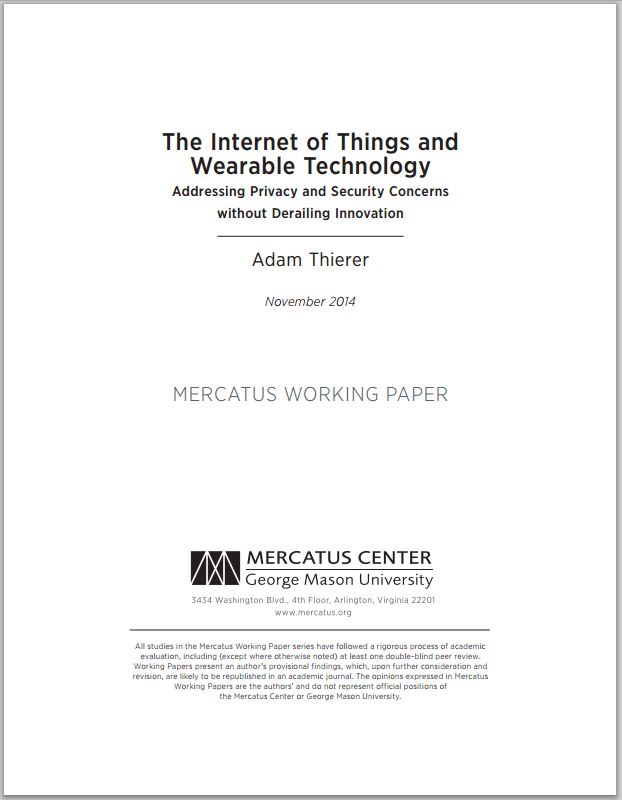 The Mercatus Center at George Mason University has just released my latest working paper, “The Internet of Things and Wearable Technology: Addressing Privacy and Security Concerns without Derailing Innovation.” The “Internet of Things” (IoT) generally refers to “smart” devices that are connected to both the Internet and other devices. Wearable technologies are IoT devices that are worn somewhere on the body and which gather data about us for various purposes. These technologies promise to usher in the next wave of Internet-enabled services and data-driven innovation. Basically, the Internet will be “baked in” to almost everything that consumers own and come into contact with.
Some critics are worried about the privacy and security implications of the Internet of Things and wearable technology, however, and are proposing regulation to address these concerns. In my new 93-page article, I explain why preemptive, top-down regulation would derail the many life-enriching innovations that could come from these new IoT technologies. Building on a recent book of mine, I argue that “permissionless innovation,” which allows new technology to flourish and develop in a relatively unabated fashion, is the superior approach to the Internet of Things.
As I note in the paper and my earlier book, if we spend all our time living in fear of the worst-case scenarios — and basing public policies on them — then best-case scenarios can never come about. As the old saying goes: nothing ventured, nothing gained. Precautionary principle-based regulation paralyzes progress and must be avoided. We instead need to find constructive, “bottom-up” solutions to the privacy and security risks accompanying these new IoT technologies instead of top-down controls that would limit the development of life-enriching IoT innovations. Continue reading →
In my previous essay, I discussed a new white paper by my colleague Robert Graboyes, Fortress and Frontier in American Health Care, which examines the future of medical innovation. Graboyes uses the “fortress vs frontier” dichotomy to help explain different “visions” about how public policies debates about technological innovation in the health care arena often play out. It’s a terrific study that I highly recommend for all the reasons I stated in my previous post.
As I was reading Bob’s new report, I realized that his approach shared much in common with a couple of other recent innovation policy paradigms I have discussed here before from Virginia Postrel (“Stasis” vs. “Dynamism”), Robert D. Atkinson (“Preservationists” vs. “Modernizers”), and myself (“Precautionary Principle” vs. “Permissionless Innovation”). In this essay, I will briefly relate Bob’s’ approach to those other three innovation policy paradigms and then note a deficiency with our common approaches. I’ll conclude by briefly discussing another interesting framework from science writer Joel Garreau. Continue reading →
 I want to bring to everyone’s attention an important new white paper by Dr. Robert Graboyes, a colleague of mine at the Mercatus Center at George Mason University who specializes in the economics of health care. His new 67-page study, Fortress and Frontier in American Health Care, seeks to move away from the tired old dichotomies that drive health care policy discussions: Left versus Right, Democrat versus Republican, federal versus state, and public versus private, and so on. Instead, Graboyes seeks to reframe the debate over the future of health care innovation in terms of “Fortress versus Frontier” and to highlight what lessons we can learn from the Internet and the Information Revolution when considering health care policy.
What does Graboyes mean by “Fortress and Frontier”? Here’s how he explains this conflict of visions:
The Fortress is an institutional environment that aims to obviate risk and protect established producers (insiders) against competition from newcomers (outsiders). The Frontier, in contrast, tolerates risk and allows outsiders to compete against established insiders. . . . The Fortress-Frontier divide does not correspond neatly with the more familiar partisan or ideological divides. Framing health care policy issues in this way opens the door for a more productive national health care discussion and for unconventional policy alliances. (p. 4)
He elaborates in more detail later in the paper: Continue reading →
 Last Wednesday, it was my great pleasure to testify at a Senate Commerce Committee hearing entitled, “The Connected World: Examining the Internet of Things.” The hearing focused “on how devices… will be made smarter and more dynamic through Internet technologies. Government agencies like the Federal Trade Commission, however, are already considering possible changes to the law that could have the unintended consequence of slowing innovation.”
 The Technology Liberation Front is the tech policy blog dedicated to keeping politicians' hands off the 'net and everything else related to technology.