Make sure to watch this terrific little MR University video featuring my Mercatus Center colleague Don Boudreaux discussing what fueled the “Orgy of Innovation” we have witnessed over the past century. Don brings in one our our mutual heroes, the economic historian Deirdre McCloskey, who has coined the term “innovationism” to describe the phenomenal rise in innovation over the past couple hundred years. As I have noted in my essay on “Embracing a Culture of Permissionless Innovation,” McCloskey’s work highlights the essential that role that values—cultural attitudes, social norms, and political pronouncements—have played in influencing opportunities for entrepreneurialism, innovation, and long-term growth. Watch Don’s video for more details:
Last week while I was visiting the Silicon Valley area, it was my pleasure to visit the venture capital firm of Andreessen Horowitz. While I was there, Sonal Chokshi was kind enough to invite me on the a16z podcast, which was focused on “Making the Case for Permissionless Innovation.” We had a great discussion on a wide range of disruptive technology policy issues (robotics, drones, driverless cars, medical technology, Internet of Things, crypto, etc.) and also talked about how innovators should approach Washington and public policymakers more generally. Our 23-minute conversation follows:
And for more reading on permissionless innovation more generally, see my book page.
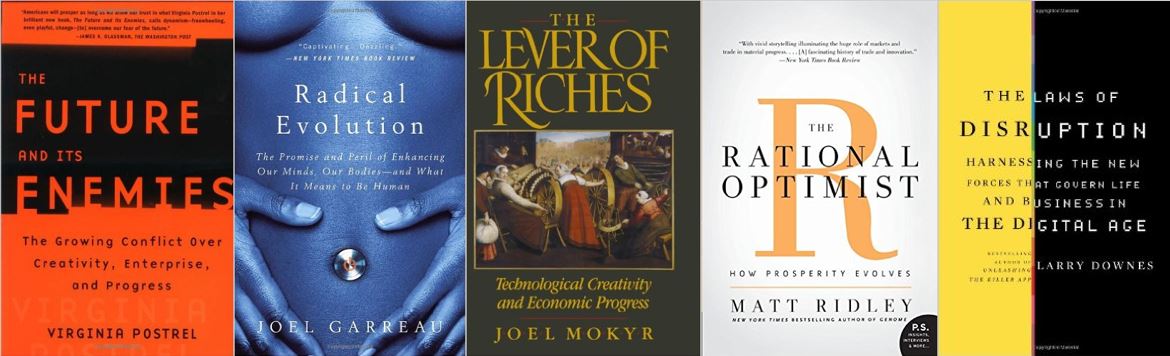
I was delivering a lecture to a group of academics and students out in San Jose recently [see the slideshow here] and someone in the crowd asked me to send them a list of some of the many books I had mentioned during my talk, which was about future policy clashes over various emerging technologies. I cut the list down to the five books that I believe best frame the nature of debates over innovation and technology policy. They are:
Virginia Postrel, The Future and Its Enemies (1998): Contrasts the conflicting worldviews of “dynamism” and “stasis” and shows how the tensions between these two visions influences debates over technological progress. No book has had a greater influence on my own thinking about debates over innovation and progress.
Joel Mokyr, Lever of Riches: Technological Creativity and Economic Progress (1990): One of the finest histories of technological innovation ever penned. It’s certainly my favorite. It explores how earlier technologies evolved and created social and economic tensions.
Matt Ridley, The Rational Optimist: How Prosperity Evolves (2010): Makes the case for “rational optimism” in debates about technology and innovation and takes on pessimistic critics of technological change.
Larry Downes, The Laws of Disruption: Harnessing the New Forces That Govern Life and Business in the Digital Age (2009): Explains how lawmaking in the information age is inexorably governed by the “law of disruption” or the fact that “technology changes exponentially, but social, economic, and legal systems change incrementally.” That fact, he explains, has profound ramifications for all technology policy debates going forward.
If you haven’t read these amazing books yet, add them to your collection
right now! They are worth reading again and again. They will forever change the way you think about debates over technology and innovation.
I’ve been thinking about the “right to try” movement a lot lately. It refers to the growing movement (especially at the state level here in the U.S.) to allow individuals to experiment with alternative medical treatments, therapies, and devices that are restricted or prohibited in some fashion (typically by the Food and Drug Administration). I think there are compelling ethical reasons for allowing citizens to determine their own course of treatment in terms of what they ingest into their bodies or what medical devices they use, especially when they are facing the possibility of death and have exhausted all other options.
But I also favor a more general “right to try” that allows citizens to make their own health decisions in other circumstances. Such a general freedom entails some risks, of course, but the better way to deal with those potential downsides is to educate citizens about the trade-offs associated with various treatments and devices, not to forbid them from seeking them out at all.
The Costs of Control
But this debate isn’t just about ethics. There’s also the question of the costs associated with regulatory control. Practically speaking, with each passing day it becomes harder and harder for governments to control unapproved medical devices, drugs, therapies, etc. Correspondingly, that significantly raises the costs of enforcement and makes one wonder exactly how far the FDA or other regulators will go to stop or slow the advent of new technologies.
I have written about this “cost of control” problem in various law review articles as well as my little Permissionless Innovation book and pointed out that, when enforcement challenges and costs reach a certain threshold, the case for preemptive control grows far weaker simply because of (1) the massive resources that regulators would have to pour into the task on crafting a workable enforcement regime; and/or (2) the massive loss of liberty it would entail for society more generally to devise such solutions. With the rise of the Internet of Things, wearable devices, mobile medical apps, and other networked health and fitness technologies, these issues are going to become increasingly ripe for academic and policy consideration. Continue reading →
“Why hasn’t Europe fostered the kind of innovation that has spawned hugely successful technology companies?” asks James B. Stewart in an important new column for the New York Times (“A Fearless Culture Fuels U.S. Tech Giants“).
That’s a great question, and one that I have tried to answer in a series of recent essays. (See, for example, “Europe’s Choice on Innovation” and “Embracing a Culture of Permissionless Innovation.”) What I have suggested in those essays is that the starkly different outcomes on either side of the Atlantic in terms of recent economic growth and innovation can primarily be explained by cultural attitudes toward risk-taking and failure. “For innovation and growth to blossom, entrepreneurs need a clear green light from policymakers that signals a general acceptance of risk-taking—especially risk-taking that challenges existing business models and traditional ways of doing things,” I have argued. And the most powerful proof of this is to examine the amazing natural experiment that has played out on either side of the Atlantic over the past two decades with the Internet and the digital economy.
For example, an annual Booz & Company report on the world’s most innovative companies revealed that 9 of the top 10 most innovative companies are based in the U.S. and that most of them are involved in computing and digital technology. None of them are based in Europe, however. Another recent survey revealed that the world’s 15 most valuable Internet companies (based on market capitalizations) have a combined market value of nearly $2.5 trillion, but none of them are European while 11 of them are U.S. firms. Again, it is America’s tech innovators that dominate that list.
Many European officials and business leaders are waking up to this grim reality and are wondering how to reverse this situation. In his
Times essay, Stewart quotes Danish economist Jacob Kirkegaard of the Peterson Institute for International Economics, who notes that Europeans “all want a Silicon Valley. . . . But none of them can match the scale and focus on the new and truly innovative technologies you have in the United States. Europe and the rest of the world are playing catch-up, to the great frustration of policy makers there.”
Today, Eli Dourado, Ryan Hagemann and I filed comments with the Federal Aviation Administration (FAA) in its proceeding on the “Operation and Certification of Small Unmanned Aircraft Systems” (i.e. small private drones). In this filing, we begin by arguing that just as “permissionless innovation” has been the primary driver of entrepreneurialism and economic growth in many sectors of the economy over the past decade, that same model can and should guide policy decisions in other sectors, including the nation’s airspace. “While safety-related considerations can merit some precautionary policies,” we argue, “it is important that those regulations leave ample space for unpredictable innovation opportunities.”
We continue on in our filing to note that “while the FAA’s NPRM is accompanied by a regulatory evaluation that includes benefit-cost analysis, the analysis does not meet the standard required by Executive Order 12866. In particular, it fails to consider all costs and benefits of available regulatory alternatives.” After that, we itemize the good and the bad of the FAA propose with an eye toward how the agency can maximize innovation opportunities. We conclude by noting:
The FAA must carefully consider the potential effect of UASs on the US economy. If it does not, innovation and technological advancement in the commercial UAS space will find a home elsewhere in the world. Many of the most innovative UAS advances are already happening abroad, not in the United States. If the United States is to be a leader in the development of UAS technologies, the FAA must open the American skies to innovation.
In a recent Senate Commerce Committee hearing on the Internet of Things, Senators Ed Markey (D-Mass.) and Richard Blumenthal (D-Conn.) “announced legislation that would direct the National highway Traffic Safety Administration (NHTSA) and the Federal Trade Commission (FTC) to establish federal standards to secure our cars and protect drivers’ privacy.” Spurred by a recent report from his office (Tracking and Hacking: Security and Privacy Gaps Put American Drivers at Risk) Markey argued that Americans “need the equivalent of seat belts and airbags to keep drivers and their information safe in the 21st century.”
Among the many conclusions reached in the report, it says, “nearly 100% of cars on the market include wireless technologies that could pose vulnerabilities to hacking or privacy intrusions.” This comes across as a tad tautological given that everything from smartphones and computers to large-scale power grids are prone to being hacked, yet the Markey-Blumenthal proposal would enforce a separate set of government-approved, and regulated, standards for privacy and security, displayed on every vehicle in the form of a “Cyber Dashboard” decal.
Leaving aside the irony of legislators attempting to dictate privacy standards, especially in the post-Snowden world, it would behoove legislators like Markey and Blumenthal to take a closer look at just what it is they are proposing and ask whether such a law is indeed necessary to protect consumers. Continue reading →
A new bipartisan “sense of the Senate” resolution was introduced today calling for “a national strategy for the Internet of Things to promote economic growth and consumer empowerment.” [PDF is here.] The resolution was cosponsored by U.S. Senators Deb Fischer (R-Neb.), Cory A. Booker (D-N.J.), Kelly Ayotte (R-N.H.), and Brian Schatz (D-Hawaii), who are all members of the Senate Commerce Committee, which oversees these issues. Just last month, on February 11th, the full Commerce Committee held a hearing titled “The Connected World: Examining the Internet of Things,” which examined the policy issues surrounding this exciting new space.
[
Update: The U.S. Senate unanimously approved the resolution on the evening of March 24th, 2015.]
The new Senate resolution begins by stressing the many current or potential benefits associate with the Internet of Things (IoT), which, it notes, “currently connects tens of billions of devices worldwide and has the potential to generate trillions of dollars in economic opportunity.” It continues on to note how average consumers will benefit because “increased connectivity can empower consumers in nearly every aspect of [our] daily lives, including in the fields of agriculture, education, energy, healthcare, public safety, security, and transportation, to name just a few.” And then the resolution also discussed the commercial benefits, noting, “businesses across our economy can simplify logistics, cut costs in supply chains, and pass savings on to consumers because of the Internet of Things and innovations derived from it.” More generally, the Senators argue “the United States should strive to be a world leader in smart cities and smart infrastructure to ensure its citizens and businesses, in both rural and urban parts of the country, have access to the safest and most resilient communities in the world.”
In light of those amazing potential benefits, the resolution continues on to argue that while “the United States is the world leader in developing the Internet of Things technology,” an even more focused and dedicated policy vision is needed to promote continued success. “[W]ith a national strategy guiding both public and private entities,” it argues, “the United States will continue to produce breakthrough technologies and lead the world in innovation.” Continue reading →
Yesterday afternoon, the Federal Aviation Administration (FAA) finally released its much-delayed rules for private drone operations. As The Wall Street Journal points out, the rules “are about four years behind schedule,” but now the agency is asking for expedited public comments over the next 60 days on the whopping 200-page order. (You have to love the irony in that!) I’m still going through all the details in the FAA’s new order — and here’s a summary of what the major provisions — but here are some high-level thoughts about what the agency has proposed.
Opening the Skies…
The good news is that, after a long delay, the FAA is finally taking some baby steps toward freeing up the market for private drone operations.
Innovators will no longer have to operate entirely outside the law in a sort of drone black market. There’s now a path to legal operation. Specifically, small unmanned aircraft systems (UAS) operators (for drones under 55 lbs.) will be able to go through a formal certification process and, after passing a test, get to operate their systems.
The Technology Liberation Front is the tech policy blog dedicated to keeping politicians' hands off the 'net and everything else related to technology. Learn more about TLF →

 The Technology Liberation Front is the tech policy blog dedicated to keeping politicians' hands off the 'net and everything else related to technology.