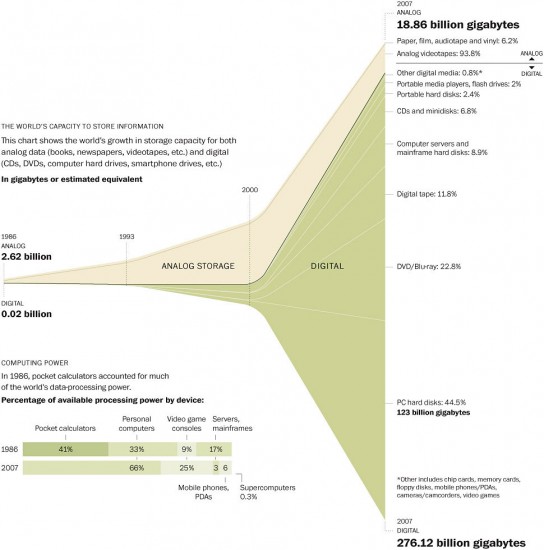
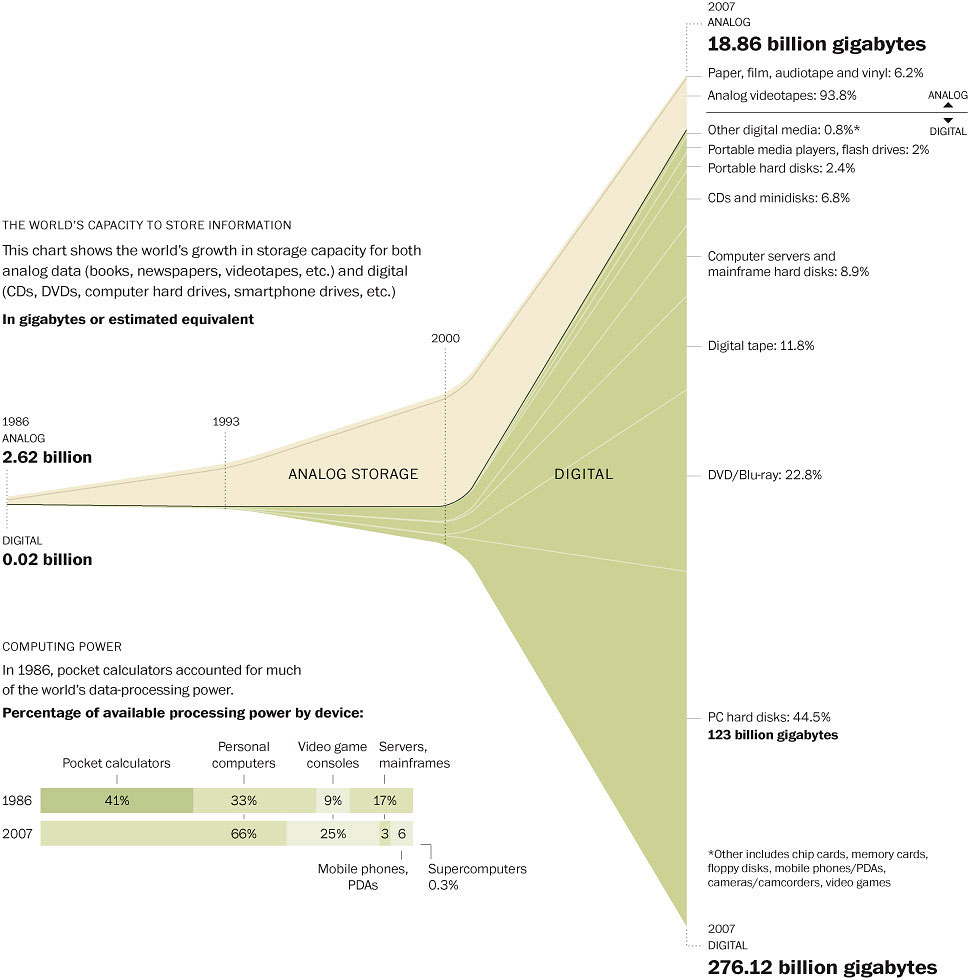
Here’s an amazing graphic that appeared in today’s Washington Post depicting how digital information has grown exploded over the past two decades. It’s better viewed on a large monitor from this link on the Post website. And here’s the accompanying Post article. The underlying data come from a new study by Martin Hilbert and Priscila Lopez of the University of Southern California, which is entitled, “The World’s Technological Capacity to Store, Communicate, and Compute Information.” It appears in the latest issue of Science but is not available without a subscription.
Today the Mercatus Center has released a short new paper I have authored on “Unappreciated Benefits of Advertising and Commercial Speech.” I begin the piece by noting that:
Federal policy makers, state legislators, and state attorneys general have recently shown interest in regulating commercial advertising and marketing. Several new regulatory initiatives are being proposed, or are already underway, that could severely curtail or restrict advertising or marketing on a variety of platforms. The consequences of these stepped-up regulatory efforts will be profound and will hurt consumer welfare both directly and indirectly.
I go on to note that “advertising can be an easy target for politicians or regulatory activist groups who make a variety of (typically unsubstantiated) claims about its negative impact on society,” but then continue on to explain how “the role of commercial speech in a free-market economy is often misunderstood or taken for granted.” I outline how, despite regulators’ concerns, consumers actually derive three important types of benefits from advertising and marketing: (1) Informational / Educational Benefits; (2) Market Choice / Pro-Competitive Benefits; and (3) Media Promotion / Cross-Subsidization. After discussing each benefit, I conclude that:
For these reasons, a stepped-up regulatory crusade against advertising and marketing will hurt consumer welfare since it will raise prices, restrict choice, and diminish marketplace competition and innovation—both in ad-supported content and service markets, and throughout the economy at large. Simply stated, there is no free lunch.
Read the entire 1,800-word essay here. I have also embedded the document down below in a Scribd reader.
Continue reading →
Wow, what a year for cyberlaw and information technology policy books! Both in terms of number of titles and the gravity of the books released, 2010 was one of the biggest years of the past decade (perhaps matched only by 2006 or 2008 in terms of significance). So, here’s my annual list of the Most Important Info-Tech Policy Books of 2010.
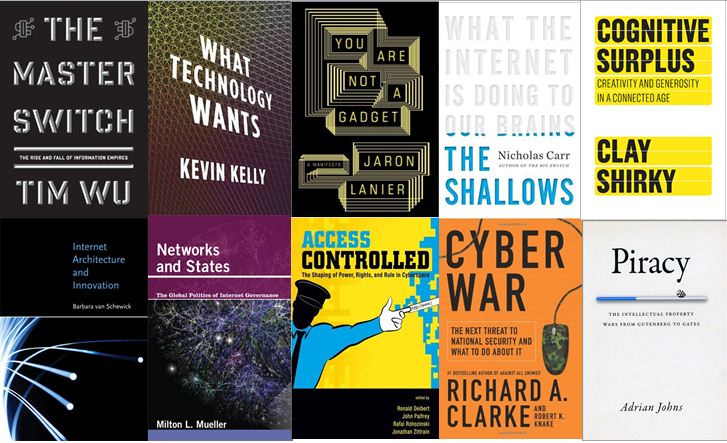 First, however, as is the case each year [see my 2008 & 2009 lists], I need to repeat a few disclaimers. First, what qualifies as an “important” info-tech policy book is highly subjective, but I would define it as a title that many people — especially scholars in the field — are currently discussing and that we will likely be referencing for many years to come. But I “weight” books in the sense that narrowly-focused titles lose a few points. For example, books that deal mostly with privacy issues, copyright law, or antitrust policy do not exactly qualify as the same sort of “info-tech policy book” as other titles that offer a broader exploration of policy issues / concerns. For that reason, “big picture” info-tech policy books tend to rank higher on my lists.
The second caveat: Merely because a book appears on my list
it does not necessarily mean I agree with everything in it. In fact, as was the case in previous years, I found much with which to disagree in my picks for the most important books of 2010 and I find that the cyber-libertarianism I subscribe to has very few fans out there.
With those caveats in mind, here are my choices for the Most Important Info-Tech Policy Books of 2010. Continue reading →
 This morning at the Newseum in Washington, DC, U.S. Secretary of State Hillary Rodham Clinton delivered remarks on Internet freedom and the future of global free speech and expression. [Transcript is here + video.] It will go down as a historic speech in the field of Internet policy since she drew a bold line in the cyber-sand regarding exactly where the United States stands on global online freedom. Clinton’s answer was unequivocal: “Both the American people and nations that censor the Internet should understand that our government is committed to helping promote Internet freedom.” “The Internet can serve as a great equalizer,” she argued. “By providing people with access to knowledge and potential markets, networks can create opportunities where none exist.”
Unfortunately, however, “the same networks that help organize movements for freedom… can also be hijacked by governments to crush dissent and deny human rights.” Echoing Winston Churchill’s famous “iron curtain” speech, Sec. Clinton argued that “With the spread of these restrictive practices, a new information curtain is descending across much of the world.” She noted that virtual walls are replacing traditional walls in many nations as repressive regimes seek to squash the liberties of their citizenry. That’s why the Administration’s bold stand in favor of online freedom is so essential.
Importantly, Sec. Clinton made it clear that the Obama Administration is ready to commit significant resources to this effort. She said that, over the next year, the State Department plans to work with others to establish a standing effort to promote technology and will invite technologists to help advance the cause through a new “innovation competition” that will promote circumvention technologies and other technologies of freedom. Sec. Clinton also challenged private companies to stand up to censorship globally and challenge foreign governments when they demand controls on the free flow of information or digital technology.
That is particularly important because Secretary Clinton’s speech comes on the heels of the recent news that Google and at least 30 other Internet companies were the victims of cyberattacks in China, which raises profound questions about the future of online freedom and cybersecurity. Sec. Clinton’s remarks will make it clear to online operators that the U.S. government stands prepared to back them up when they challenge the censorial policies of repressive foreign regimes.
Continue reading →
As I pointed out here before (see, “And so the Comcast-NBC Merger Hysteria Begins: Help Me Document It!“), every time a media merger is proposed we hear all sorts of silly Chicken Little predictions of impending doom as well as preposterous conspiracy theories about supposed nefarious schemes to take over the media universe and control our minds. For good measure, there’s also plenty of talk of “the death of deliberative democracy,” or efforts to weed out one sort of perspective or another.
As history has shown, it’s all complete bunk. But that doesn’t stop critics from concocting asinine theories about media providers seeking to “silence critics.” Here’s two bits of Chicken Little-ism that I missed in my previous essay documenting this silliness. First, over at Huffington Post, Marvin Ammori tells us that America is about to become Italy or Argentina because of the deal:
Putting so much power in the hands of one company–and, specifically, its executives–is dangerous for a democracy. There is a reason why autocratic regimes control the media–media shape public opinion and define what is “possible” in politics. We have seen the problem of private media consolidation in many countries. In Italy, Silvio Berlusconi used his massive media empire to win elections and is now Prime Minister (Italy’s longest serving ever). In Argentina, the government had to pass a media consolidation law because of the power of one media company that happens to be far smaller than a combined Comcast-NBCU.
And then we have Wade Norris writing about the deal over at the Daily Kos, saying: “If you don’t want to see the progressive voices on MSNBC silenced, then join the ‘no merger’ petition.” Ah yes, another automated “stuff-the-online-complaint-ballot-box” petition. I love those gimmicks. But ignore fake complaints for a moment and focus on the accusations at hand here. The Ammori-Norris theory is: If Comcast and NBCU are allowed to marry (a) progressive voices will be driven off their platforms and (b) Silvio Berlusconi will take over America democracy will somehow suffer. Is there really any truth to this? Continue reading →
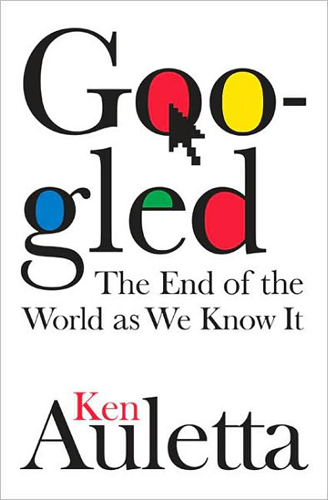 I just finished Ken Auletta’s latest book,
Googled: The End of the World As We Know It, and I highly recommend it. Auletta is an amazingly gifted journalist and knows how put together a hell of good story. It helps in this case that he was granted unprecedented access to the Google team and their day-to-day workings at the Googleplex. I’m really shocked by the level of access he was granted to important meetings and officials–over 150 interviews with Googlers, including 11 with CEO Eric Schmidt and several with founders Sergey Brin and Larry Page. That’s impressive.
I just finished Ken Auletta’s latest book,
Googled: The End of the World As We Know It, and I highly recommend it. Auletta is an amazingly gifted journalist and knows how put together a hell of good story. It helps in this case that he was granted unprecedented access to the Google team and their day-to-day workings at the Googleplex. I’m really shocked by the level of access he was granted to important meetings and officials–over 150 interviews with Googlers, including 11 with CEO Eric Schmidt and several with founders Sergey Brin and Larry Page. That’s impressive.
The book shares much in common with Randall Stross’s excellent Planet Google: One Company’s Audacious Plan to Organize Everything We Know, which I reviewed here earlier this year. Both books recount the history of Google from its early origins to present. And both survey a great deal of ground in terms of the challenges that Google faces as it matures and the policy issues that are relevant to the company (privacy, free speech, copyright law, etc).
What makes Auletta’s book unique is the way we taps his extensive “old media” world contacts and integrates such a diverse cast of characters into the narrative — Mel Karmazin (former Viacom, now Sirius XM), Bob Iger (Disney), Howard Stringer (Sony), Martin Sorrrell (WPP), Irwin Gotlieb (Group M), and even the Internet’s “inventor”–Al Gore! Auletta interviews them or recounts stories about their interactions with Google to show the growing tensions being created by this disruptive company and its highly disruptive technologies. There are some terrifically entertaining anecdotes in the book, but the bottom line is clear: Google has made a lot of enemies in a very short time.
Indeed, the book is as much about the decline of old media as it is about Google’s ascendancy. What Auletta has done so brilliantly here is to tell their stories together and ask how much old media’s recent woes can be blamed on Google and digital disintermediation in general. “If Google is destroying or weakening old business models,” Auletta argues, “it is because the Internet inevitably destroys old ways of doing things, spurs ‘creative destruction.’ This does not mean that Google is not ambitious to grow, and will not grow at the expense of others. But the rewards, and the pain, are unavoidable,” he concludes. Continue reading →
I cannot in strong enough terms recommend that everyone read Gordon Crovitz’s latest Wall Street Journal column, “Free Speech, Now that Speech is Free.” It perfectly encapsulates everything we stand for here and makes the case that I have made again and again: Speech regulation — of all flavors — makes less and less sense in a world of information abundance and user empowerment, and it is a complete affront to our First Amendment rights. As Crovitz argues:
The Constitution was drafted at a time when there were few media outlets, and few people could be heard. Since then, technology has made it possible for everyone to express their views. The cost of expressing opinions continues to fall. Now that speech is no longer expensive, it’s time to return to the Founders’ intention that speech be free and that Congress not abridge anyone’s right to speak.
Amen brother! In his essay today, Crovitz specifically takes on America’s increasingly insane campaign finance laws, which make a mockery of the First Amendment. In the wake of last week’s Supreme Court arguments in the Citizens United case, Crovitz points out the insulting stupidity and sheer futility of these analog era, scarcity-oriented laws:
Continue reading →
 I recently finished Tyler Cowen’s latest book, Create Your Own Economy: The Path to Prosperity in a Disordered World. Like everything he writes, this book is worth reading and it will be of interest to those who follow technology policy debates since Cowen makes a passionate case for “Internet optimism” in the face of recent criticisms of the Internet and the Information Age in general.
Cowen is a Professor of Economics at George Mason University and the co-author, along with Alex Tabarrok, of the wonderful MarginalRevolution.com blog. And if you haven’t read Cowen’s
In Praise of Commercial Culture, stop what you’re doing and go get yourself a copy right now. Brilliant book. Compared to that book, Create Your Own Economy is a difficult book to summarize. Seriously, this book is all over the place… but in a good way. Even though it sometimes feels like “Tyler’s Miscellaneous Ramblings,” those ramblings will keep you engaged and entertained. Cord Blomquist did a pretty good job of summarizing the general themes of the book in this post two months ago when he noted that, “despite cultural reflexes that would have us do otherwise, we should embrace… new technologies as means to be more selective about what information we absorb and therefore welcome the increased volume of bytes into our lives. In his new book, [Cowen] explores technology as a vehicle to help you determine what you really value, not a series of a email-powered torture devices.” That’s a pretty good summation, but the book is about much more than that.
Instead of a full-blown review, I want to focus on some of passages from Cowen’s book about coping with information overload, which I think readers here might find of interest. In doing so, I will contrast Cowen’s views with those of John Freeman, who just penned “A Manifesto for Slow Communication” in The Wall Street Journal. As we will see, Cowen and Freeman’s differences exemplify the heated ongoing debate taking place among “Internet optimists & pessimists,” which I have discussed here many times before. Continue reading →
What Unites Advocates of Speech Controls & Privacy Regulation? [pdf]
by Adam Thierer & Berin Szoka
The Progress & Freedom Foundation,
Progress on Point No. 16.19
Anyone who has spent time following debates about speech and privacy regulation comes to recognize the striking parallels between these two policy arenas. In this paper we will highlight the common rhetoric, proposals, and tactics that unite these regulatory movements. Moreover, we will argue that, at root, what often animates calls for regulation of both speech and privacy are two remarkably elitist beliefs:
- People are too ignorant (or simply too busy) to be trusted to make wise decisions for themselves (or their children); and/or,
- All or most people share essentially the same values or concerns and, therefore, “community standards” should trump household (or individual) standards.
While our use of the term “elitism” may unduly offend some understandably sensitive to populist demagoguery, our aim here is not to launch a broadside against elitism as
Time magazine culture critic William H. Henry once defined it: “The willingness to assert unyieldingly that one idea, contribution or attainment is better than another.”[1] Rather, our aim here is to critique that elitism which rises to the level of political condescension and legal sanction. We attack not so much the beliefs of some leaders, activists, or intellectuals that they have a better idea of what it in the public’s best interest than the public itself does, but rather the imposition of those beliefs through coercive, top-down mandates.
That sort of elitism—elitism enforced by law—is often the objective of speech and privacy regulatory advocates. Our goal is to identify the common themes that unite these regulatory movements, explain why such political elitism is unwarranted, and make it clear how it threatens individual liberty as well as the future of free and open Internet. As an alternative to this elitist vision, we advocate an empowerment agenda: fostering an environment in which users have the tools and information they need to make decisions for themselves and their families. Continue reading →
Interesting article here (“Not All Information Wants to Be Free“) by Jack Shafer of Slate. He notes that many people focus on why “pay wall” business models don’t work online, but few people discuss those models that do (i.e., the ones that successfully get customers to pay for access to content behind the wall). Shafer walks through some of the ones that have worked and concludes:
Not all successful paid sites are alike, but they all share at least one of these attributes:
1) They are so amazing as to be irreplaceable.
2) They are beautifully designed and executed and extremely easy to use.
3) They are stupendously authoritative.
Succinctly stated, the pay-per-view sites are damn unique, offering content or a service that consumers are unlikely to find elsewhere. Of course, that’s a pretty small universe of sites, and unless you content is extraordinarily unique and time-sensitive, I have a hard time believing that a pay wall model will work for most sites.
Continue reading →

 The Technology Liberation Front is the tech policy blog dedicated to keeping politicians' hands off the 'net and everything else related to technology.