Harvard’s Jonathan Zittrain has launched an interesting new project called “HerdictWeb,” which “seeks to gain insight into what users around the world are experiencing in terms of web accessibility; or in other words, determine the herdict.” It’s a useful tool for determining whether governments are blocking certain websites for whatever reason. Here’s Zittrain’s sock puppet video with all the details!
http://www.youtube.com/v/NggzBHSXdCo&hl=en&fs=1
The website is quite slick and very user-friendly, and they’ve even created a downloadable Firefox button that will automatically check site accessibility while you’re surfing the Net.
The information gathered from this effort will be useful for the OpenNet Initiative that Zittrain and John Palfrey co-created (with others from Univ. of Toronto, Oxford Univ., and Univ. of Cambridge) and wrote about in their excellent book, Access Denied: The Practice and Policy of Global Internet Filtering, which was one of my favorite technology policy books of the past year. The data collected will give them, and us, a fuller picture of just how widespread global filtering and censorship efforts really are. I encourage you to take a look and spread the word, especially to those in foreign countries who could probably use it more than us. (Of course, their governments will likely block Herdict once the word gets around!)
 On this episode of “Tech Policy Weekly,” we’re launching a new format called “Tech Book Corner” that will feature occasional conversations with the authors of important new books about technology policy and the other issues that we debate frequently at the Tech Liberation Front blog.
On this debut episode of Book Corner, we are joined by John Palfrey, a professor of law at Harvard University and the co-director of the Berkman Center for Internet & Society at Harvard. Along with his Berkman Center colleague Urs Gasser, Prof. Palfrey has recently co-authored Born Digital: Understanding the First Generation of Digital Natives, which was published last summer by Basic Books and which you can find out more information about at www.borndigitalbook.com. [Incidentally, I reviewed Born Digital here last October and I also named it one of the most important technology policy books of 2008.]
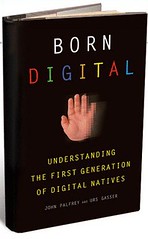
In our discussion, Prof. Palfrey explains who exactly counts as a “digital native” and tells us why he decided to write a book about them. He discusses why he believes that there has been some overreaction by older generations to fears about this Digital Generation and he argues that we need “to separate what we need to worry about from what’s not so scary” and “what we ought to resist from what we ought to embrace.” He then outlines how we should think about these issues and concerns going forward, and he stresses the importance of “balancing caution with encouragement” as we do so. Finally, he then applies that framework to three specific issues: privacy, child safety, and copyright.
It’s an interesting conversation and you can begin listening to it immediately by downloading the MP3 file here or by just clicking the play button below!
[display_podcast]
Online child safety — especially the fear of predators lurking on social networking sites (SNS) — continues to spur calls by state and federal lawmakers for regulation. At first, some federal lawmakers advocated outright bans on SNS in schools and libraries via the Deleting Online Predators Act (DOPA). Meanwhile, state and local lawmakers — specifically state Attorneys General (AGs) — have been even more vociferous in their calls for regulation in the form of mandatory age verification for social networking sites, which would cover a broad swath of online sites and activities according to their definitions of SNS. But the question that ultimately gets lost in this debate is: Just how much risk do social networking sites really pose for teens? Which risks are real and which are overblown? And what’s the best way to deal with the risks that we find to be legitimate?
 Nancy Willard devotes her life to answering those questions. Willard is one of America’s leading experts on online safety and risk prevention. She runs the Center for Safe and Responsible Internet Use and she is the author of two outstanding books, Cyberbullying and Cyberthreats and Cyber-Safe Kids, Cyber-Savvy Teens. In my opinion, Willard’s general approach to online child safety is the most enlightened, level-headed, and likely to be effective. That’s because Willard focuses on putting fears in perspective, identifying the actual risks that kids face online, and devising sensible strategies to deal with risks and problems as they are discovered. Her approach is holistic and built upon sound data, targeted risk-identification strategies, and time-tested education and mentoring methods. For my money, it’s the most sensible approach to online safety issues. In fact, when other parents ask me for “just one thing” to read on the topic, I usually recommend Willard’s work — especially her amazing book Cyber-Safe Kids, Cyber-Savvy Teens. And her background in early childhood education, special education for “at risk” children with emotional and behavior difficulties, as well as experience in computer law, means she is uniquely suited to be analyzing these issues. In sum, this is woman we should all be closely listening to on these issues.
Recently, Willard has been responding to criticisms that state AGs have leveled against the Internet Safety Technical Task Force (ISTTF) and its final report. [Disclaimer: I was a member of the ISTTF.] I’ve already outlined the ISTTF’s work at length here, but the three key takeaways from the report were that:
- the risk of predation on social network sites has been over-stated; the data suggest that cyber-bullying is the bigger problem on SNS;
- there is no silver-bullet technical solution to online child safety concerns, and mandatory age verification, in particular, would not make kids safer online but could even create bigger problems in the long-run;
- education and empowerment are the real keys to keeping kids safer online.
Continue reading →
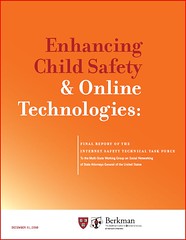 The Internet Safety Technical Task Force (ISTTF), which was formed a year ago to study online safety concerns and technologies, today issued its final report to the U.S. Attorneys General who authorized its creation. It was a great honor for me to serve as a member of the ISTTF and I believe this Task Force and its report represent a major step forward in the discussion about online child safety in this country.
The ISTTF was very ably chaired by John Palfrey, co-director of Harvard University’s Berkman Center for Internet & Society, and I just want to express my profound thanks here to John and his team at Harvard for doing a great job herding cats and overseeing a very challenging process. I encourage everyone to examine the full ISTTF report and all the submissions, presentations, and academic literature that we collected. [It’s all here.] It was a comprehensive undertaking that left no stone unturned.
Importantly, the ISTTF convened (1) a Research Advisory Board (RAB),which brought together some of the best and brightest academic researchers in the field of child safety and child development and (2) a Technical Advisory Board (TAB), which included some of America’s leading technologists, who reviewed child safety technologies submitted to the ISTTF. I strongly recommend you closely examine the RAB literature review and TAB assessment of technologies because those reports provide very detailed assessments of the issues. They both represent amazing achievements in their respective arenas.
There are a couple of key takeaways from the ISTTF’s research and final 278-page report that I want to highlight here. Most importantly, like past blue-ribbon commissions that have studied this issue, the ISTTF has generally concluded
there is no silver-bullet technical solution to online child safety concerns. The better way forward is a “layered approach” to online child protection. Here’s how we put it on page 6 of the final report:
The Task Force remains optimistic about the development of technologies to enhance protections for minors online and to support institutions and individuals involved in protecting minors, but cautions against overreliance on technology in isolation or on a single technological approach. Technology can play a helpful role, but there is no one technological solution or specific combination of technological solutions to the problem of online safety for minors. Instead, a combination of technologies, in concert with parental oversight, education, social services, law enforcement, and sound policies by social network sites and service providers may assist in addressing specific problems that minors face online. All stakeholders must continue to work in a cooperative and collaborative manner, sharing information and ideas to achieve the common goal of making the Internet as safe as possible for minors.
Continue reading →
I’ve spent a lot of time in recent years trying to debunk various myths about online child safety or at least put those risks into perspective. Too often, press reports and public policy initiatives are being driven by myths, irrational fears, or unjustified “moral panics.” Luckily, the New York Times reports that there’s another study out this week that helps us see things in a more level-headed light. This new MacArthur Foundation report is entitled Living and Learning with New Media: Summary of Findings from the Digital Youth Project. This white paper is a summary of three years of research on kids’ informal learning with digital media. The survey incorporates the insights from 800 youth and young adults and over 5000 hours of online observations. The information will eventually be contained in a book from MIT Press (“Hanging Out, Messing Around, Geeking Out: Living and Learning with New Media.”)
From the summary of the study on the MacArthur website:
“It might surprise parents to learn that it is not a waste of time for their teens to hang out online,” said Mizuko Ito, University of California, Irvine researcher and the report’s lead author. “There are myths about kids spending time online – that it is dangerous or making them lazy. But we found that spending time online is essential for young people to pick up the social and technical skills they need to be competent citizens in the digital age.”
Importantly, regarding the concerns many parents and policymakers have about online predation, Ms. Ito told the
New York Times that, “Those concerns about predators and stranger danger have been overblown.” “There’s been some confusion about what kids are actually doing online. Mostly, they’re socializing with their friends, people they’ve met at school or camp or sports.”
In the report, according to the summary, the researchers “identified two distinctive categories of teen engagement with digital media: friendship-driven and interest-driven. While friendship-driven participation centered on “hanging out” with existing friends, interest-driven participation involved accessing online information and communities that may not be present in the local peer group.” The specific findings of the study are as follows:
Continue reading →
Earlier this year, I mentioned an outstanding book that John Palfrey of the Berkman Center for Internet & Society at Harvard Law School co-edited entitled Access Denied: The Practice and Policy of Global Internet Filtering. It’s an excellent resource for anyone studying the methods governments are (unfortunately) using to stifle online expression across the globe. It’s one of the most important technology policy books of the year.
Well, it looks like John Palfrey will have a second title on this year’s “Best Tech Books” list. I’ve just finished his new book with his Berkman Center colleague Urs Gasser, Born Digital: Understanding the First Generation of Digital Natives, and it is definitely worthy of your attention. In my book review posted today on the City Journal’s website, I argue that “Palfrey and Gasser’s fine early history of this generation serves as a starting point for any conversation about how to mentor the children of the Web.” It’s a comprehensive and very even-handed discussion about a variety of concerns or Internet pathologies, including: online safety, personal privacy, copyright piracy, offensive content, classroom learning, and much more.
My
City Journal review is down below, but in coming weeks I will be posting some additional thoughts about some specific things in the book worthy of more attention (including a few things I disagreed with). Overall, I’d say Born Digital is a close runner-up in the race for “Tech Book of the Year,” closely trailing Jonathan Zittrain’s Future of the Internet and How to Stop It (which I have reviewed multiple times) and Nick Carr’s The Big Switch. But I found far more to agree with in Born Digital than I did in those two books. Highly recommended.
Continue reading →
A few days ago I posted an open letter to New York Gov. David Patterson about a measure that recently passed through the New York legislature and was awaiting his signature. The bill proposes a new regulatory regime for video games that would include greater state-based oversight of video game labels and console controls as well as an advisory board to monitor the industry. Unfortunately—but quite unsurprisingly—Gov. Patterson signed the bill last night. And so I am certain that another legal battle will ensue regarding the constitutionality of the measure, and it will likely be struck down like every other measure on this front because it violates the First Amendment. Regardless, let’s talk a little more about what animates this specific legislative effort, because I think it is very important and foreshadows the heated debate to come over video games and all media in coming years.
The New York measure is notable in that, unlike most of the other state or local measures that had been stuck down in recent years that proposed penalties for the sale of games to youngsters which were labeled by the ESRB to be intended for an older audience, it simply proposed more “oversight” of the ratings process and parental control technologies by the state. Specifically, it mandated that all games be rated and that all consoles contain screening controls. The response to that proposal has generally been: “So what?” After all, all video games are rated already and all game consoles contain parental controls. The measure also mandated a 16-member oversight board to monitor the industry and this process. Again, that proposal was not regarded by many as a serious threat to the video games or free speech.
But I fear that many are missing the big picture here. The New York bill is actually far more important that many people suspect because of what it foreshadows: A day when politicians will claim that we can make rating systems more “scientific” by putting public health bureaucrats or university social scientists in charge of them. Indeed, last night on Bloomberg TV, this became the focus of a debate between me and Dr. Michael Rich, Director of the Center for Media and Child Health at the Harvard Medical School. After you watch the clip, I’ll have much more to say about this issue down below the fold.
http://eplayer.clipsyndicate.com/cs_api/get_swf/2/&csEnv=p&wpid=0&va_id=649150
Continue reading →

Well, I actually didn’t exactly get a chance to say quite enough for this to qualify as much of a “debate,” but I was brought in roughly a half hour into this WBUR (Boston NPR affiliate) radio show featuring Jonathan Zittrain, author of the recently released: The Future of the Internet–And How to Stop It. Jonathan was kind enough to suggest to the producers that I might make a good respondent to push back a bit in opposition to the thesis set forth in his new book.
Jonathan starts about 6 minutes into the show and they bring me in around 29 minutes in. Although I only got about 10 minutes to push back, I thought the show’s host Tom Ashbrook did an excellent job raising many of the same questions I do in my 3-part review (Part 1, 2, 3) of Jonathan’s provocative book.
In the show, I stress the same basic points I made in those reviews: (1) he seems to be over-stating things quite a bit in saying that the old “generative” Internet is “dying”; and in doing so, (2) he creates a false choice of possible futures from which we must choose. What I mean by false choice is that Jonathan doesn’t seem to believe a hybrid future is possible or desirable. I see no reason why we can’t have the best of both worlds–-a world full of plenty of tethered appliances, but also plenty of generativity and openness.
If you’re interested, listen in.
 Don’t judge a book by its cover (or its title, for that matter). I’m usually faithful to that maxim, but I must admit that when I first saw the title and cover of “<a href="http://www.amazon.com/Grand-Theft-Childhood-Surprising-Violent/dp/0743299515/ref=pd_bbs_sr_1?ie=UTF8&s=books&qid=1208179493&sr=8-1″>Grand Theft Childhood: The Surprising Truth About Violent Video Games and What Parents Can Do,” I rolled my eyes and thought to myself, “here we go again.” I figured that I was in for another tedious anti-gaming screed full of myths and hysteria about games and gamers. Boy, was I wrong. Massively wrong.
Lawrence Kutner, PhD, and Cheryl K. Olson, ScD, cofounders and directors of the Harvard Medical School Center for Mental Health and Media, have written the most thoroughly balanced and refreshingly open-minded book about video games ever penned. They cut through the stereotypes and fear-mongering that have thus far pervaded the debate over the impact of video games and offer parents and policymakers common-sense advice about how to approach these issues in a more level-headed fashion. They argue that:
Today, an amalgam of politicians, health professionals, religious leaders and children’s advocates are voicing concerns about video games that are identical to the concerns raised one, two and three generations ago with the introduction of other new media. Most of these people have the best of intentions. They really want to protect children from evil influences. As in the past, a few have different agendas and are using the issue manipulatively. Unfortunately, many of their claims are based on scanty evidence, inaccurate assumptions, and pseudoscience. Much of the current research on violent video games is both simplistic and agenda driven. (p. 55)
They note that these groups, “probably worry too much about the wrong things and too little about more subtle issues and complex effects that are much more likely to affect our children.” They continue:
Continue reading →
I swear I’m not trying to pick on Jonathan Zittrain, but I continue to find examples that create problems for his thesis from The Future of the Internet–And How to Stop It that the whole world is going to hell because of the rise of what he contemptuously calls “sterile, tethered devices.” Again, in his provocative book, Zittrain argues that, for a variety of reasons, the glorious days of the generative, open Internet and general-purpose PCs are supposedly giving way to closed networks and closed devices. In my lengthy review of his book, I argued that Zittrain was over-stating things and creating a false choice of possible futures from which we must choose. I see no reason why we can’t have the best of both worlds–a world full of plenty of tethered appliances, but also plenty of generativity and openness. In a follow-up essay, I pointed out how Apple’s products create a particular problem for Zittrain’s thesis because even though they are “sterile and tethered,” there is no doubt that the company’s approach has produced some wonderful results. As I said..
Personally… I prefer all those “general purpose” devices that Zittrain lionizes. But, again, we can have both. Let Steve Jobs be a control freak and keep those walls around Apple’s digital garden high and tight if he wants. There are plenty of other wide open gardens for the rest of us to play in.
In my original review, I briefly mentioned another problem for the Zittrain thesis: old people! I was reminded about this when I was reading this
New York Times article today entitled, “At a Certain Age, Simplicity Sells in High-Tech Gadgets,” by Alina Tugend. Tugend argues:
Continue reading →

 The Technology Liberation Front is the tech policy blog dedicated to keeping politicians' hands off the 'net and everything else related to technology.