 Despite my frequent disagreements with his policy conclusions, Farhad Manjooo of Slate is one of the most gifted tech policy pundits around today and everything he writes is worth reading (and I whole-heartedly agreed with his recent article on the high-tech and antitrust). Alas, I find myself again disagreeing with him again today.
In his latest column, “The Great iPhone Lockdown: Should the FCC force Apple to sell Google’s apps?” Manjoo responds to a recent essay by TLF contributor Ryan Radia (“Newsflash to FCC: The iPhone is a Closed Platform, and Consumers Love It“). In that essay, Ryan generally argued that: (a) a lot of people own and love the iPhone despite some silly restrictions on certain apps; and (b) if they don’t like that, there are plenty of other options from which they can choose. Consequently, regulation seems unwarranted and likely highly misguided in light of the potential unitended consequences in might yield. It’s an argument I very much agree with, of course. Anyway, Manjoo responds:
Radia’s argument isn’t crazy. Just the other day, I argued that the government shouldn’t go after Google for antitrust violations because the tech industry is fluid; companies that are on top today can fall tomorrow. So what if Apple rejects apps capriciously? If its actions are so terrible, consumers will eventually abandon it.
But then Manjoo counters that argument and goes completely off-the-rails with several assertions that I find quite perplexing: Continue reading →
Well, here we go again. Harvard’s Jonathan Zittrain has penned another gloomy essay about how “freedom is at risk in the cloud” and the future of the Internet is in peril because nefarious digital schemers like Apple, Facebook, and Google are supposedly out to lock you into their services and take away your digital rights. And so, as I have done here many times before (see 1, 2, 3, 4, 5 + video!), I will offer a response arguing that Jonathan’s cyber-Chicken Little-ism is largely unwarranted.
Zittrain’s latest piece is entitled “Lost in the Cloud” and it appears in today’s New York Times. It closely tracks the arguments he has set forth in his book The Future of the Internet–And How to Stop It, which I named the most important technology policy book of 2008, but not because I agreed with its central thesis. Zittrain’s book and his new NYT essay are the ultimate exposition of Lessigite technological pessimism. I don’t know what they put in the water up at the Berkman Center to make these guys so remarkably cranky and despondent about the future of of the Internet, but starting with Lawrence Lessig’s Code in 1999 and running through to Zittrain’s Future of the Internet we have been forced to endure endless Tales of the Coming Techno-Apocalypse from these guys. Back in the late 90s, Prof. Lessig warned us that AOL and some other companies would soon take over the new digital frontier since “Left to itself, cyberspace will become a perfect tool of control.” Ah yes, how was it that we threw off the chains of our techno-oppressors and freed ourselves from that wicked walled garden hell? Oh yeah, we clicked our mouses and left! And that was pretty much the end of AOL’s “perfect control” fantasies. [See my recent debate with Prof. Lessig over at Cato Unbound for more about this “illusion of perfect control,” as I have labeled it.]
But Zittrain is the equivalent of the St. Peter upon which the Church of Lessigism has been built and, like any good disciple, he’s still vociferously preaching to the unconverted and using fire and brimstone sermons to warn of our impending digital damnation. In fact, he’s taken it to all new extremes. In
Future of the Internet, Jonathan argues that we run the risk of seeing the glorious days of the generative, open Net and digital devices give way to more “sterile, tethered devices” and closed networks. The future that he hopes to “stop” is one in which Apple, TiVo, Facebook, and Google — the central villains in his drama — are supposedly ceded too much authority over our daily lives because of a combination of (a) their wicked ways and (b) our ignorant ones.
Continue reading →
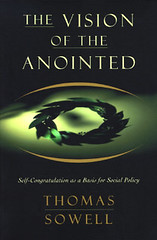 Berin recently encouraged me to re-read Thomas Sowell’s The Vision of the Anointed: Self-Congratulation as a Basis for Social Policy, which I hadn’t looked at since I first read it back in 1995 or 96. I’m glad I did since Sowell’s work has always been profoundly influential on my thinking (especially his masterpiece, A Conflict of Visions) and I had forgotten how useful The Vision of the Anointed was in helping me understand the reoccurring model that drives ideological crusades to expand government power over our lives and economy.
“The great ideological crusades of the twentieth-century intellectuals have ranged across the most disparate fields,” Sowell noted in the book. But what they all had in common, he argued, was “their moral exaltation of the anointed above others, who are to have their different views nullified and superseded by the views of the anointed, imposed via the power of government.” (p. 5) These elitist, government-expanding crusades shared several key elements, which Sowell identified as follows:
- Assertion of a great danger to the whole society, a danger to which the masses of people are oblivious.
- An urgent need for government action to avert impending catastrophe.
- A need for government to drastically curtail the dangerous behavior of the many, in response to the prescient conclusions of the few.
- A disdainful dismissal of arguments to the contrary as either uninformed, irresponsible, or motivated by unworthy purposes.
You can see this model at work on a daily basis today with our government’s various efforts to reshape our economy, but I think this model is equally applicable to debates over social policy and speech control. In particular, the various “technopanics” I have been writing about recently fit this model. (See 1, 2, 3, 4, 5). For example, consider how this plays out in the debate over online social networking:
Continue reading →
As anyone who has spent time searching for comments on the FCC’s website can tell you, the agency doesn’t exactly have the most user-friendly website. In the interest of making it easier for others to read the comments that came in last week in the agency’s “Child Safe Viewing Act” Notice of Inquiry, I have compiled all the major comments (those over 3 or 4 pages) and provided links to them below the fold.
Again, this proceeding was required under the “Child Safe Viewing Act of 2007,” which Congress passed last year and President Bush signed last December. The goal of the bill and the FCC’s proceeding (MB 09-26) is to study “advanced blocking technologies” that “may be appropriate across a wide variety of distribution platforms, including wired, wireless, and Internet platforms.” I filed 150+ pages worth of comments in this matter last week, and here’s my analysis of why this bill and the FCC’s proceeding are worth monitoring closely.
Continue reading →
Today I filed comments with the Federal Communications Commission (FCC) in its proceeding examining the marketplace for “advanced blocking technologies.” This proceeding was required under the “Child Safe Viewing Act of 2007,” which Congress passed last year and President Bush signed last December. The goal of the bill and the FCC’s proceeding (MB 09-26) is to study “advanced blocking technologies” that “may be appropriate across a wide variety of distribution platforms, including wired, wireless, and Internet platforms.” My colleagues will no doubt laugh about the fact that I have dropped an absurd 150 pages worth of comments on the FCC in this matter, but I had a lot to say on this topic! Parental controls, child safety, and free speech issues have been the focus of much of my research agenda over the past 10 years.
In my filing, I argue that the FCC should tread carefully in this matter since the agency has no authority over most of the media platforms and technologies described in the Commission’s recent Notice of Inquiry. Moreover, any related mandates or regulatory actions in in this area could diminish future innovation in this field and would violate the First Amendment rights of media creators and consumers alike. The other major conclusions of my filing are as follows:
- There exists an unprecedented abundance of parental control tools to help parents decide what constitutes acceptable media content in their homes and in the lives of their children.
- There is a trade-off between complexity and convenience for both tools and ratings, and no parental control tool is completely foolproof.
- Most homes have no need for parental control technologies because parents rely on other methods or there are no children in the home.
- The role of household media rules and methods is underappreciated and those rules have an important bearing on this debate.
- Parental control technologies work best in combination with educational efforts and parental involvement.
- The search for technological silver-bullets and “universal” solutions represent a quixotic, Holy Grail-like quest and it will destroy innovation in this marketplace.
- Enforcement of “household standards” made possible through use of parental controls and other methods negates the need for “community standards”-based content regulation.
My entire filing can be found here and down below in a Scribd reader. All comments in the matter are due tomorrow and then reply comments are due on May 18th.
Continue reading →
I’ve got a new essay up over at the
City Journal about John Nichols and Robert McChesney’s proposal to have the government heavily subsidize failing media enterprises to “save journalism.” It follows below:
“Socializing Media in Order to Save It“
by Adam D. Thierer
City Journal March 27, 2009
With proposals to nationalize or heavily subsidize various segments of our economy more in vogue than ever, it was probably only a matter of time before someone suggested that America’s media marketplace should be brought into the government fold. John Nichols of The Nation and the prolific neo-Marxist media theorist Robert W. McChesney have now provided the road map for media’s march to serfdom. The cost to the American taxpayer would be at least $60 billion, but the cost for the First Amendment and our democracy would be incalculable.
Nichols and McChesney have coauthored several books and essays about media policy that view the world through the prism of class struggle, “manufactured consent” (á la Noam Chomsky), and the rest of the typical Marxoid tripe about history and economics. In their view, private, for-profit media cannot be trusted. As they stated in their 2003 call to arms,
Our Media, Not Theirs: The Democratic Struggle Against Corporate Media, media-reform efforts must begin with “the need to promote an understanding of the urgency to assert public control over the media.” “Our claim,” they continue, “is simply that the media system produces vastly less of quality than it would if corporate and commercial pressures were lessened.”
In a new
Nation essay, “The Death and Life of Great American Newspapers,” the authors bring their earlier work to its logical conclusion. Saving journalism, they argue, essentially requires that media become an appendage of the state. Journalism, they claim, is a “public good,” which—like education and defense—requires constant government oversight and support: “A moment has arrived at which we must recognize the need to invest tax dollars to create and maintain news gathering, reporting and writing with the purpose of informing all our citizens.” They propose that government devote $60 billion to “subscription subsidies, postal reforms, youth media and investment in public broadcasting.” Think of it as a “free press ‘infrastructure project,’” they say. “It would keep the press system alive. And it has the added benefit of providing an economic stimulus.” (Isn’t it amazing how everything stimulates the economy these days?)
Continue reading →
Today, it was my great privilege to guest lecture at Princeton University’s Center for Information Technology Policy. Under the leadership of Ed Felten, who also runs the excellent “Freedom to Tinker” blog, the CITP has quickly become one of America’s premier institutions in the field of IT policy matters. David Robinson, who some of you will remember from his days as an editor at The American, serves as associate director of the CITP program and was kind enough to invite me to speak. And our own Tim Lee is currently studying there as well. I wish I was smart enough to get into that program!
The topic of my talk was “The Future of the First Amendment in an Age of Technological Convergence” and I used the opportunity to create a narrated video of this presentation, which I have made to several other groups through the years. In this presentation, I talk about “America’s First Amendment Twilight Zone,” which refers to the fact that identical words and images are being regulated in completely different ways today depending on the mode of transmission. This illogical and unfair situation could eventually threaten the Internet, video games, and all new media with many of the misguided regulations that have long been imposed on broadcast television and radio operators. In my presentation, which you can watch below, I make the case for changing our First Amendment regime to ensure “bit equality”; all speech and media platforms should be accorded the gold standard of First Amendment protection.
http://www.youtube.com/v/xJo3tVMScyI&hl=en&fs=1
Continue reading →
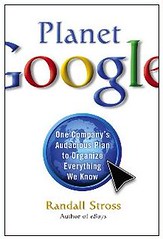 I finally got around to reading Planet Google: One Company’s Audacious Plan to Organize Everything We Know, by Randall Stross. It’s very well done. Stross is a frequently contributor to the New York Times and the author of several other interesting books on the technology industry. He knows how to weave a story together, and it helps that Google’s story is a pretty amazing one.
Each chapter discusses a different part of Google’s growing family of services — GMail, Google Maps, Google Earth, Book Search, and YouTube. Of course, it all started with search and Stross does a good job explaining how the ingenious Google search algorithm has grown from dorm room project to the greatest aggregator of human knowledge that the world has ever known. This, in turn, has powered Google’s hugely successful online advertising system. The real secret of their success with online advertising, Stross argues, is that “Google’s impersonal, mathematical approach search also provides you with the ability to serve advertisements that are tailored to a search, rather than to the person submitting the search request, whose identity would have to be known.”
Despite the benefits of such generally anonymous searching, as Google has grown and added new services and capabilities, concerns about the sheer volume of data that the company collects have led to heightened privacy concerns. Indeed, privacy is a core theme that Stross uses in the book to tie many of the chapters and issues together. Google is constantly struggling to strike the right balance between providing more access to the world’s information while also being careful not to raise privacy concerns. But it’s unclear exactly how much more information collection that users (or public officials) will tolerate before advocating stricter limits on Google’s reach. As Stross points out:
Guided by its founding mission, to organize all the world’s information, Google has created storage capacity that allows it to gain control of what its users are you doing in a comprehensive way that no other company has done, and to preserve those records indefinitely, without the need to clear out old records to make way for new ones. Moreover, Google differentiates its service by refining its own proprietary software formula to mine and massage the data, technology that it zealously protects from the sight of rivals. This sets up a conflict between Google’s wish to operate a “black box” (completely opaque to the outside) and its users’ wish for transparency.
Continue reading →
Before commenting on Lawrence Lessig’s latest call to abolish the Federal Communications Commission (he issued a similar call for the FCC’s abolition earlier this year, which I commented on here), let’s recall what Tim Lee posted yesterday about “Real Regulators“:
Too many advocates of regulation seem to have never considered the possibility that the FCC bureaucrats in charge of making these decisions at any point in time might be lazy, incompetent, technically confused, or biased in favor of industry incumbents. That’s often what “real regulators” are like, and it’s important that when policy makers are crafting regulatory scheme, they assume that some of the people administering the law will have these kinds of flaws, rather than imagining that the rules they write will be applied by infallible philosopher-kings.
Ironically, Prof. Lessig — who typically defends many forms of high-tech regulation like Net neutrality and online content labeling — is essentially agreeing with Tim’s critique of bureaucracy. But Lessig seems to ignore the underlying logic of Tim’s critique and instead imagines that we need only reinvent bureaucracy in order to save it. But I’m getting ahead of myself. First, let’s hear what Lessig proposes.
In a
Newsweek column this week entitled “Reboot the FCC,” Lessig argues that the FCC is beyond saving because, instead of protecting innovation, the agency has succumb to an “almost irresistible urge to protect the most powerful instead.” Consequently, he continues:
The solution here is not tinkering. You can’t fix DNA. You have to bury it. President Obama should get Congress to shut down the FCC and similar vestigial regulators, which put stability and special interests above the public good. In their place, Congress should create something we could call the Innovation Environment Protection Agency (iEPA), charged with a simple founding mission: “minimal intervention to maximize innovation.” The iEPA’s core purpose would be to protect innovation from its two historical enemies–excessive government favors, and excessive private monopoly power.
As was the case with his earlier call to “blow up the FCC,” I am tickled to hear Lessig call for shutting down an agency that many of us have been fighting against for the last few decades. (Here’s a 1995 blueprint for abolishing the FCC that I contributed to, and here’s PFF’s recent “DACA” project to comprehensively reform and downsize the agency.)
But is Lessig really calling for the same sort of sweeping regulatory reform and downsizing that others have been calling for? And has he identified the real source of the problem that he hopes to correct? I don’t think so. There are 3 basic problems with the argument Lessig is putting forward in his essay. I will address each in turn.
Continue reading →

 The Technology Liberation Front is the tech policy blog dedicated to keeping politicians' hands off the 'net and everything else related to technology.