Adam Thierer, Senior Research Fellow at the Mercatus Center discusses his recent working paper with coauthor Brent Skorup, A History of Cronyism and Capture in the Information Technology Sector. Thierer takes a look at how cronyism has manifested itself in technology and media markets — whether it be in the form of regulatory favoritism or tax privileges. Which tech companies are the worst offenders? What are the consequences for consumers? And, how does cronyism affect entrepreneurship over the long term?
Download
Related Links
As I noted in an addendum to my previous post, less than an hour after I posted an essay about how the District of Columbia’s subsidy deal with LivingSocial was potentially set to unravel, I received a call from two representatives of the D.C. Mayor’s office asking me to clarify a few aspects of the deal. The tone and substance of the call was courteous and profession from the start and I told them I would be happy to post a quick update to my essay letting readers know of the points that they wanted stressed.
After I did so, however, I kept thinking how strange it was that I received such a quick response from the Mayor’s office about my little post. After all, I can’t imagine that the
Technology Liberation Front is on the top of their morning reading list! I just figured that someone in the Mayor’s office probably had a Google Alert set up that caught it. But then, as luck would have it, I was reading through the Wall Street Journal at lunch and came across a story entitled, “In D.C., Social-Media Surveillance Pays Off” by Sarah Portlock. She reports that:
The local government in the nation’s capital is paying hundreds of thousands of dollars to a startup to gather comments on Twitter, Facebook and other online message boards as well as the government’s own website. The data help form a letter grade for the bureaucracies that handle drivers licenses, building permits and the like. These social-media analytics services are already common for businesses such as restaurants and hotel chains that want to go beyond the comment cards most customers ignore. The D.C. experiment suggests governments are beginning to mirror the private sector in seeking real-time unvarnished feedback.
The D.C. government apparently has a 2-year $670,000 contract with newBrandAnalytics, Inc. to gather social media feedback and insights about the District. So, I figure that’s how the folks in the D.C. Mayor’s office stumbled upon my little rant. I had posted a link to my essay on both Twitter and Google+ and they probably got an immediate report back about it.
In any event, that got me wondering about how people are going to respond to this sort of “surveillance” of social media sites and activities by governments. Continue reading →
Here’s a presentation I’ve been using lately for various audiences about “Cronyism: History, Costs, Case Studies and Solutions.” In the talk, I offer a definition of cronyism, explain its origins, discuss how various academics have traditionally thought about it, outline a variety of case studies, and then propose a range of solutions. Readers of this blog might be interested because I briefly mention the rise of cronyism in the high-tech sector. Brent Skorup and I have a huge paper in the works on that topic, which should be out early next year.
Andrew Orlowski of The Register (U.K.) recently posted a very interesting essay making the case for treating online copyright and privacy as essentially the same problem in need of the same solution: increased property rights. In his essay (“‘Don’t break the internet’: How an idiot’s slogan stole your privacy“), he argues that, “The absence of permissions on our personal data and the absence of permissions on digital copyright objects are two sides of the same coin. Economically and legally they’re an absence of property rights – and an insistence on preserving the internet as a childlike, utopian world, where nobody owns anything, or ever turns a request down. But as we’ve seen, you can build things like libraries with permissions too – and create new markets.” He argues that “no matter what law you pass, it won’t work unless there’s ownership attached to data, and you, as the individual, are the ultimate owner. From the basis of ownership, we can then agree what kind of rights are associated with the data – eg, the right to exclude people from it, the right to sell it or exchange it – and then build a permission-based world on top of that.”
And so, he concludes, we should set aside concerns about Internet regulation and information control and get down to the business of engineering solutions that would help us property-tize both intangible creations and intangible facts about ourselves to better shield our intellectual creations and our privacy in the information age. He builds on the thoughts of Mark Bide, a tech consultant:
For Bide, privacy and content markets are just a technical challenges that need to be addressed intelligently.”You can take two views,” he told me. “One is that every piece of information flowing around a network is a good thing, and we should know everything about everybody, and have no constraints on access to it all.” People who believe this, he added, tend to be inflexible – there is no half-way house. “The alternative view is that we can take the technology to make privacy and intellectual property work on the network. The function of copyright is to allow creators and people who invest in creation to define how it can be used. That’s the purpose of it. “So which way do we want to do it?” he asks. “Do we want to throw up our hands and do nothing? The workings of a civilised society need both privacy and creator’s rights.” But this a new way of thinking about things: it will be met with cognitive dissonance. Copyright activists who fight property rights on the internet and have never seen a copyright law they like, generally do like their privacy. They want to preserve it, and will support laws that do. But to succeed, they’ll need to argue for stronger property rights. They have yet to realise that their opponents in the copyright wars have been arguing for those too, for years. Both sides of the copyright “fight” actually need the same thing. This is odd, I said to Bide. How can he account for this irony? “Ah,” says Bide. “Privacy and copyright are two things nobody cares about unless it’s their own privacy, and their own copyright.”
These are important insights that get at a fundamental truth that all too many people ignore today: At root,
most information control efforts are related and solutions for one problem can often be used to address others. But there’s another insight that Orlowski ignores: Whether we are discussing copyright, privacy, online speech and child safety, or cybersecurity, all these efforts to control the free flow of digitized bits over decentralized global networks will be increasingly complex, costly, and riddled with myriad unintended consequences. Importantly, that is true whether you seek to control information flows through top-down administrative regulation or by assigning and enforcing property rights in intellectual creations or private information.
Let me elaborate a bit (and I apologize for the rambling mess of rant that follows).
I was just reading this interesting Broadcasting & Cable interview with Steven Waldman, senior advisor to FCC Chairman Julius Genachowski, who is heading up the FCC’s new effort on “The Future of Media and the Information Needs of Communities in a Digital Age.” The FCC’s Future of Media website says that “The goal of this project: to help ensure that all Americans have access to vibrant, diverse sources of news and information that will enable them to enrich their families, communities and democracy.” In the interview with B&C, Waldman promises that “we are not in the business of providing bailouts or encouraging bailouts to particular companies or industries,”and that “we can absolutely, definitively say that we have no plans to take over the media, and we have no plans to reinstitute the fairness doctrine while I am at it.” I’m certainly glad to hear that. As I’ve pointed out here many times before (1, 2, 3, 4), the prospect of greater government involvement in the news business raises profoundly troubling implications for an independent press and the First Amendment.
Anyway, I’ll be debating these issues with Mr. Waldman and others next week at this Georgetown Center for Business and Public Policy event on, “The Crisis in Journalism: What Should the Government Do?” It will be held on Wednesday, February 17, 2010 at 9:30am at the Newseum (Knight Conference Center) located at 555 Pennsylvania Ave here in Washington, DC. Breakfast will be served. (You can RSVP please by emailing: cbpp@msb.edustrong>cbpp@msb.edu</strong) Here’s the event description:
Continue reading →
As we’ve noted here before in our ongoing series on “Problems in Public Utility Paradise,” municipal wi-fi experiments and local government fiber investments don’t have a very impressive track record. The Philadelphia experiment, which I have discussed here before many times, has been particularly instructive. As Dan P. Lee documented in this spectacular Philadelphia magazine article last year, the city’s subsidized wi-fi system, Wireless Philadelphia, was a political and technical fiasco of the highest order right from the start. It unraveled fairly quickly after its 2005 launch and now, according to The Philadelphia Business Journal:
The city of Philadelphia said Wednesday it intends to purchase, for $2 million, the wireless network constructed by EarthLink Inc. to turn the entire city into a Wifi hotspot. The city said it intends to exercise an option in an agreement signed in August to buy the network from Network Acquisition Co. LLC, which took the network over from Atlanta-based EarthLink in June 2008. The city said the purchase will be the first in a series of steps to create a wireless network it will use to enhance public safety, improve government efficiency and provide Internet access in targeted public places. The city said creating that network will require it to spend nearly $17 million over its 2011 through 2015 fiscal years. The money would go to building out both the core fiber network it already owns and the wireless mesh network it intends to purchase from Network Acquisition Co…
In other words, taxpayers are stuck picking up the tab for this failed experiment and now have to hope that the city can somehow manage it into profitability. Well, good luck with that. Even Karl Bode of Broadband Reports, someone who usually has nothing but nice things to say about Big Government high-tech projects and regulation, is forced to admit that the script for muni wi-fi paradise didn’t quite play out as expected:
Network Acquisition Corporation purchased the network from Earthlink back in 2008, when Earthlink bailed (and we really mean bailed) on their muni-fi ambitions. The buyers briefly tinkered with free access and claimed they’d expand the network, but ultimately wound up being only a stepping stone between Earthlink and Philadelphia control. Philadelphia’s use of Wi-Fi as a municipal efficiency and communications tool is a growing trend among cities, many of which found that broad, free Wi-Fi for all simply wasn’t sustainable.
Do you mean to say that there is no such thing as a free lunch? I am shocked, shocked! Well, actually, I’m not. Continue reading →
by Berin Szoka & Adam Thierer, Progress Snapshot 5.11 (PDF)
Ten years ago, Nobel Prize-winning economist Milton Friedman lamented the “Business Community’s Suicidal Impulse:” the persistent propensity to persecute one’s competitors through regulation or the threat thereof. Friedman asked: “Is it really in the self-interest of Silicon Valley to set the government on Microsoft?” After yesterday’s FCC vote’s to open a formal “Net Neutrality” rule-making, we must ask whether the high-tech industry—or consumers—will benefit from inviting government regulation of the Internet under the mantra of “neutrality.”
The hatred directed at Microsoft in the 1990s has more recently been focused on the industry that has brought broadband to Americans’ homes (Internet Service Providers) and the company that has done more than any other to make the web useful (Google). Both have been attacked for exercising supposed “gatekeeper” control over the Internet in one fashion or another. They are now turning their guns on each other—the first strikes in what threatens to become an all-out, thermonuclear war in the tech industry over increasingly broad neutrality mandates. Unless we find a way to achieve “Digital Détente,” the consequences of this increasing regulatory brinkmanship will be “mutually assured destruction” (MAD) for industry and consumers.
New Fronts in the Neutrality Wars
The FCC’s proposed rules would apply to all broadband providers, including wireless, but not to Google or many other players operating in other layers of the Net who favor such broadband-specific rules. With this rulemaking looming, AT&T came after Google with letters to the FCC in late September and then another last week accusing the company of violating neutrality principles in their business practices and arguing that any neutrality rules that apply to ISPs should apply equally to Google’s panoply of popular services. In particular, AT&T accused Google of “search engine bias,” suggesting that only government-enforced neutrality mandates could protect consumers from Google’s supposed “monopolist” control.
The promise made yesterday by the FCC—to only apply neutrality principles to the infrastructure layer of the Net—is hollow and will ultimately prove unenforceable. Continue reading →
In a week in which neutrality regulation is making a lot of news, I hope that Robert Hahn and Hal Singer’s terrific new study, “Why the iPhone Won’t Last Forever and What the Government Should Do to Promote its Successor” gets some attention. It provides a wonderful overview of how dynamically competitive the mobile marketplace has been over the past two decades and why critics are wrong to get worked up about the short-term “dominance” of Apple’s iPhone. Here’s the abstract of their paper:
Because of the overwhelming, positive response to the iPhone as compared to other smart phones, exclusive agreements between handset makers and wireless carriers have come under increasing scrutiny by regulators and lawmakers. In this paper, we document the myriad revolutions that have occurred in the mobile handset market over the past twenty years. Although casual observers have often claimed that a particular innovation was here to stay, they commonly are proven wrong by unforeseen developments in this fast-changing marketplace. We argue that exclusive agreements can play an important role in helping to ensure that another must-have device will soon come along that will supplant the iPhone, and generate large benefits for consumers. These agreements, which encourage risk taking, increase choice, and frequently lower prices, should be applauded by the government. In contrast, government regulation that would require forced sharing of a successful break-through technology is likely to stifle innovation and hurt consumer welfare.
“New technologies often seemingly emerge from nowhere, but also frequently lose their luster quickly,” Hahn and Singer go on to argue. As evidence they cite the recent examples of Second Life and MySpace, which were hyped as potentially become dominant providers in their respective areas just a few years ago, but now are subjected to intense competition. “[T]he the mobile handset market is subject to these same disruptive forces,” they argue: Continue reading →
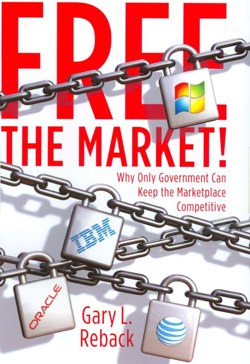 I recently finished reading Free the Market: Why Only Government Can Keep the Marketplace Competitive, a new book by noted antitrust agitator Gary L. Reback. Unsurprisingly, Reback, who led the antitrust jihad against Microsoft during the 1990s, has written a book that reads like an extended love letter to antitrust law. This man loves antitrust the way teenage girls love the Jonas Brothers — gushing, teary-eyed, ‘I-would-just-die-for-you’ sort of love. In Reback’s world, antitrust seemingly has no costs, no downsides, no trade-offs. It is our salvation and he serves as its high prophet. Everything good that happened in the world of high-tech over the past few decades? Oh, you can thank Almighty Antitrust for that. Anything bad that happened? Well, then, clearly there just wasn’t enough antitrust enforcement! That’s this book in a nutshell.
Think I’m kidding? How about this gem of quote from pg. 247: “Antitrust enforcement spawned Silicon Valley’s software industry as well.” Wow, who knew! Of course, that’s utter poppycock and should be somewhat insulting to the many entrepreneurial men and women in the high-tech world who risked everything in an attempt to build a better mousetrap. In Reback’s view of things, however, none of those mousetraps would have ever gotten built without antitrust there to supposedly shelter them from wicked “monopolists” (read: any large company) already operating in the marketplace. I’m sure many in Silicon Valley will also be surprised to hear Reback’s assertion that, “On closer examination, the Valley looks like one big public welfare project.” (p. 54) Ah yes, the old myth that government gave us the Net we know and love today. Please. Like many others, Reback spins a revisionist history of how early ARPANET involvement and seed money somehow made the Internet great when, in reality, the Net was stuck in the digital dark ages until it was finally allowed to be commercialized in 1992.
What irks me most about this book, however, is Reback’s perpetuation of the myth that antitrust is somehow not a form of economic regulation. I hear this tired old argument trotted out time and time again, even by many conservatives. Reback says, for example, that “Antitrust sets the rules of the road, so to speak, but doesn’t tell people where to drive.” By contrast, he argues, “Advocates of regulation want[] continuing government oversight and rule making to produce what would be the beneficial results of a free market… Neither approach works all the time, and decided between them remains difficult.” (p. 19) Again, this “choice” is largely a fiction since, for many industries, we end up getting both! Continue reading →

 The Technology Liberation Front is the tech policy blog dedicated to keeping politicians' hands off the 'net and everything else related to technology.