[originally published on Plaintext on June 21, 2017.]
This summer, we celebrate the 20th anniversary of two developments that gave us the modern Internet as we know it. One was a court case that guaranteed online speech would flow freely, without government prior restraints or censorship threats. The other was an official White House framework for digital markets that ensured the free movement of goods and services online.
The result of these two vital policy decisions was an unprecedented explosion of speech freedoms and commercial opportunities that we continue to enjoy the benefits of twenty years later.
While it is easy to take all this for granted today, it is worth remembering that, in the long arc of human history, no technology or medium has more rapidly expanded the range of human liberties — both speech and commercial liberties — than the Internet and digital technologies. But things could have turned out much differently if not for the crucially important policy choices the United States made for the Internet two decades ago. Continue reading →
Over the course of the year, I collect some of my favorite (and least favorite) tech policy essays and put them together in an end-of-year blog post so I will remember notable essays in the future. (Here’s my list from 2013.) Here are some of the best tech policy essays I read in 2014 (in chronological order).
- Joel Mokyr – “The Next Age of Invention,” City Journal, Winter 2014. (An absolutely beautiful refutation of the technological pessimism that haunts our age. Mokry concludes by noting that, “technology will continue to develop and change human life and society at a rate that may well dwarf even the dazzling developments of the twentieth century. Not everyone will like the disruptions that this progress will bring. The concern that what we gain as consumers, viewers, patients, and citizens, we may lose as workers is fair. The fear that this progress will create problems that no one can envisage is equally realistic. Yet technological progress still beats the alternatives; we cannot do without it.” Mokyr followed it up with a terrific August 8 Wall Street Journal oped, “What Today’s Economic Gloomsayers Are Missing.“)
- Michael Moynihan – “
Can a Tweet Put You in Prison? It Certainly Will in the UK
,”
The Daily Beast
, January 23, 2014. (Great essay on the right and wrong way to fight online hate. Here’s the kicker: “There is a presumption that ugly ideas are contagious and if the already overburdened police force could only disinfect the Internet, racism would dissipate. This is arrant nonsense.”)
- Hanni Fakhoury –
“
The U.S. Crackdown on Hackers Is Our New War on Drugs,”
Wired
, January 23, 2014.
(“We shouldn’t let the government’s fear of computers justify disproportionate punishment. . . . It’s time for the government to learn from its failed 20th century experiment over-punishing drugs and start making sensible decisions about high-tech punishment in the 21st century.”)
- Carole Cadwalladr – “Meet Cody Wilson, Creator of the 3D-gun, Anarchist, Libertarian,” Guardian/Observer, February 8, 2014. (Entertaining profile of one of the modern digital age’s most fascinating characters. “There are enough headlines out there which ask: Is Cody Wilson a terrorist? Though my favourite is the one that asks: ‘Cody Wilson: troll, genius, patriot, provocateur, anarchist, attention whore, gun nut or Second Amendment champion.’ Though it could have added, ‘Or b) all of the above?'”)
Continue reading →
The sharing economy is growing faster than ever and becoming a hot policy topic these days. I’ve been fielding a lot of media calls lately about the nature of the sharing economy and how it should be regulated. (See latest clip below from the Stossel show on Fox Business Network.) Thus, I sketched out some general thoughts about the issue and thought I would share them here, along with some helpful additional reading I have come across while researching the issue. I’d welcome comments on this outline as well as suggestions for additional reading. (Note: I’ve also embedded some useful images from Jeremiah Owyang of Crowd Companies.)
1)
Just because policymakers claim that regulation is meant to protect consumers does not mean it actually does so.
- Cronyism/ Rent-seeking: Regulation is often “captured” by powerful and politically well-connected incumbents and used to their own benefit. (+ Lobbying activity creates deadweight losses for society.)
- Innovation-killing: Regulations become a formidable barrier to new innovation, entry, and entrepreneurism.
- Unintended consequences: Instead of resulting in lower prices & better service, the opposite often happens: Higher prices & lower quality service. (Example: Painting all cabs same color destroying branding & ability to differentiate).
Continue reading →
Patrick Byrne, CEO of Overstock.com, discusses how Overstock.com became one of the first online retail stores to accept Bitcoin. Byrne provides insight into how Bitcoin lowers transaction costs, making it beneficial to both retailers and consumers, and how governments are attempting to limit access to Bitcoin. Byrne also discusses his project DeepCapture.com, which raises awareness for market manipulation and naked short selling, as well as his philanthropic work and support for education reform.
Download
Related Links
Ladar Levison, founder of encrypted email service Lavabit, discusses recent government action that led him to shut down his firm. When it was suspected that NSA whistleblower Edward Snowden used Lavabit’s email service, the FBI issued a National Security Letter ordering Levison to hand over SSL keys, jeopardizing the privacy of Lavabit’s 410,000 users. Levison discusses his inspiration for founding Lavabit and why he chose to suspend the service; how Lavabit was different from email services like Gmail; developments in his case and how the Fourth Amendment has come into play; and his involvement with the recently-formed Dark Mail Technical Alliance.
Download
Related Links
Anupam Chander, Director of the California International Law Center and Martin Luther King, Jr. Hall Research Scholar at the UC Davis School of Law, discusses his recent paper with co-author Uyen P. Lee titled The Free Speech Foundations of Cyberlaw. Chander addresses how the first amendment promotes innovation on the Internet; how limitations to free speech vary between the US and Europe; the role of online intermediaries in promoting and protecting the first amendment; the Communications Decency Act; technology, piracy, and copyright protection; and the tension between privacy and free speech.
Download
Related Links
Thomas Rid, author of the new book Cyber War Will Not Take Place discusses whether so-called “cyber war” is a legitimate threat or not. Since the early 1990s, talk of cyber war has caused undue panic and worry and, despite major differences, the military treats the protection of cyberspace much in the same way as protection of land or sea. Rid also covers whether a cyber attack should be considered an act of war; whether it’s correct to classify a cyber attack as “war” considering no violence takes place; how sabotage, espionage and subversion come into play; and offers a positive way to view cyber attacks — have such attacks actually saved millions of lives?
Download
Related Links
Jerry Ellig, senior research fellow at the Mercatus Center at George Mason University, discusses the the FCC’s lifeline assistance benefit funded through the Universal Service Fund (USF). The program, created in 1997, subsidizes phone services for low-income households. The USF is not funded through the federal budget, rather via a fee from monthly phone bills — reaching an all-time high of 17% of telecomm companies’ revenues last year. Ellig discusses the similarities between the USF fee and a tax, how the fee fluctuates, how subsidies to the telecomm industry have boomed in recent years, and how to curb the waste, fraud and abuse that comes as a result of the lifeline assistance benefit.
Download
Related Links
It was my pleasure last night to take part in an hour-long conversation on “Privacy, Security, and the Digital Age,” which was co-sponsored by Mediaite and the Koch Institute. The discussion focused on a wide range of issues related to government surveillance powers, Big Data, and the future of privacy. It opened with dueling remarks from former U.S. Ambassador to the U.N. John Bolton and Ben Wizner of the ACLU. You can view their respective remarks here.
I then sat on a panel that included Atlantic Media CTO Tom Cochrane and Michael R. Nelson, who is affiliated with with Bloomberg Government and Georgetown University. The entire session was expertly moderated by Andrew Kirell of Mediaite. He did an amazing job facilitating the discussion. Anyway, the videos for my panel are below, split into two parts. My comments focused heavily on the importance of separating the government uses of data from private sector uses and explaining the need to create a high and tight firewall between State and Industry when it comes to information sharing. I also argued that we will never get a handle on government-related privacy concerns until we get control of the scope of government power. I used the example of the drug war and our government’s constantly-expanding militaristic activities both abroad and here at home. So long as government is expanding without any rational, constitutional constraint, we are going to have serious surveillance and privacy problems. (See this essay, “It’s About Power, not Privacy,” by my colleague Eli Dourado for more on that theme.)
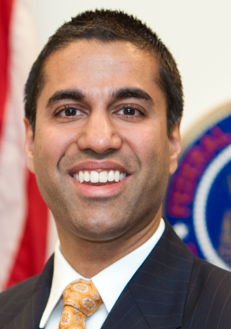 Ajit Pai, a Republican commissioner at the Federal Communications Commission (FCC), had an outstanding op-ed in the L.A. Times yesterday about state and local efforts to regulate private taxi or ride-sharing services such as Uber, Lyft, and Sidecar. “Ever since Uber came to California,” Pai notes, “regulators have seemed determined to send Uber and companies like it on a one-way ride out of the Golden State.” Regulators have thrown numerous impediments in their way in California as well as in other states and localities (including here in Washington, D.C.). Pai continues on to discuss how, sadly, “tech start-ups in other industries face similar burdens”:
For example, Square has created a credit card reader for mobile devices. Small businesses love Square because it reduces costs and is convenient for customers. But some states want a piece of the action. Illinois, for example, has ordered Square to stop doing business in the Land of Lincoln until it gets a money transmitter license, even though the money flows through existing payment networks when Square processes credit cards. If Square had to get licenses in the 47 states with such laws, it could cost nearly half a million dollars, an extraordinary expense for a fledgling company.
He also notes that “Obstacles to entrepreneurship aren’t limited to the tech world”:
Across the country, restaurant associations have tried to kick food trucks off the streets. Auto dealers have used franchise laws to prevent car company Tesla from cutting out the middleman and selling directly to customers. Professional boards, too, often fiercely defend the status quo, impeding telemedicine by requiring state-by-state licensing or in-person consultations and even restricting who can sell tooth-whitening services.
What’s going on here? It’s an old and lamentable tale of incumbent protectionism and outright cronyism, Pai notes: Continue reading →

 The Technology Liberation Front is the tech policy blog dedicated to keeping politicians' hands off the 'net and everything else related to technology.