Posts tagged as:

As Henry Blodget explained in his excellent Business Insider column yesterday, “Goldman Sachs Clients Can Invest In Facebook’s IPO — But You Can’t,” America’s increasingly counter-productive accounting, disclosure, and governance regulations are increasingly thwarting the ability of average Americans to invest in the leading capitalist companies of the Digital Age:

in an effort to protect investors from fraud (which is actually not the reason most IPOs fail), the government erected huge new barriers to going public, making it prohibitively expensive for most small companies to IPO.  So now small, speculative companies generally don’t IPO.  Instead, they stay private. And/or they do what Facebook just did, which was do a “private IPO” with Goldman Sachs. What’s a private IPO?  It’s a mechanism in which Goldman’s rich clients can invest in Facebook. But you can’t.  Seriously!

And that’s why Facebook, among others, don’t want to go public. Over at the Truth on the Market Blog, Larry Ribstein elaborates on the insanity of this: Continue reading →

TLF readers are undoubtedly familiar with the concept of regulatory capture. It’s a form of government failure, when a regulatory agency becomes overly influenced by the special interests of those (often large companies) it oversees.  Over at the NetChoice blog, my colleague Steve DelBianco talks about a different form of capture that’s equally bad–government capture of private sector management of the Internet’s addressing system. He asserts:

Before the US Government abdicates its oversight of the Internet Corporation for Assigned Names and Numbers (ICANN) it should take a long, hard look at the mounting efforts by world governments to assume greater power over the Internet’s addressing system. If those efforts meet no further resistance, the once-theoretical threat of “capture” could become a reality.

So what? In place of U.S. oversight, there are those that wish to create an international government bureaucracy to run ICANN:

In place of U.S. Government management, the [European] Commission recommends the creation of a multi-governmental tribunal with authority over ICANN. The European Commission posits that this new bureaucratic structure would not involve itself in “day-to-day” activities, but the distinction between “day-to-day” and other activities is utterly meaningless from a policy standpoint. Also, given the activism of the countries involved in such an effort, it would be ludicrous to expect such an entity to use its newfound power sparingly.

Steve’s post has a lot of background and explains things in detail, but I’ll share his ultimate conclusion:  our Commerce Dept. should be working with ICANN to retain the protective aspects of the JPA while ICANN develops permanent mechanisms to prevent external capture. It better hurry…it has only until the end of September to do something!

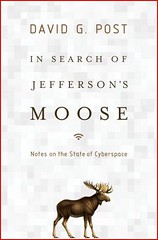
Post Jeffersons MooseI used to have a (semi-crazy) uncle who typically began conversations with lame jokes or bad riddles. This sounds like one he might have used had he lived long enough: What do Thomas Jefferson, a moose, and cyberspace have in common?

The answer to that question can be found in a new book, In Search of Jefferson’s Moose: Notes on the State of Cyberspace, by David G. Post, a Professor of Law at Temple University. Post, who teaches IP and cyberspace law at Temple, is widely regarded as one of the intellectual fathers of the “Internet exceptionalist” school of thinking about cyberlaw.  Basically, Post sees this place we call “cyberspace” as something truly new, unique, and potentially worthy of some special consideration, or even somewhat different ground rules than we apply in meatspace. More on that in a bit.

[ Full disclosure: Post’s work was quite influential on my own thinking during the late 1990s, so much so that when I joined the Cato Institute in 2000, one of the first things I did was invite David to become an adjunct scholar with Cato. He graciously accepted and remains a Cato adjunct scholar today. Incidentally, Cato is hosting a book forum for him on February 4th that I encourage you to attend or watch online. Anyway, it’s always difficult to be perfectly objective when you know and admire someone, but I will try to do so here.]

Post’s book is essentially an extended love letter — to both cyberspace and Jefferson. Problem is, as Post even admits at the end, it’s tough to know which subject this book is suppose to teach us more about. The book loses focus at times — especially in the first 100 pages — as Post meanders between historical tidbits of Jefferson’s life and thinking and what it all means for cyberspace. But the early focus is on TJ.  Thus, those who pick up the book expecting to be immediately immersed in cyber-policy discussions may be a bit disappointed at first.  As a fellow Jefferson fanatic, however, I found all this history terrifically entertaining, whether it was the story of Jefferson’s Plow and his other agricultural inventions and insights, TJ’s unique interest in science (including cryptography), or that big moose of his.

OK, so what’s the deal with the moose? When TJ was serving as a minister to France in in the late 1780s, at considerable expense to himself, he had the complete skeleton, skin and horns of a massive American moose shipped to the lobby of his Paris hotel. Basically, Jefferson wanted to make a bold statement to his French hosts about this New World he came from and wake them up to the fact that some very exciting things were happening over there that they should be paying attention to. That’s one hell of way to make a statement!

Continue reading →

The intrepid Chris Soghoian has turned up an important wrinkle in Google’s services. Google pulled his AdWords ad pointing out AT&T’s campaign contributions to an Indiana politician after AT&T lodged a trademark complaint about it.

Trademark law is for preventing confusion about the source of goods and services. There is no possibility that Chris’ ad would confuse consumers in this way. He’s not providing telecommunications services, and his ad didn’t suggest it. Chris’ use of “AT&T” did not violate AT&T’s trademarks.

The subject matter of Chris’ ad is an important part of our national discourse, and something people should be able to run ads about on a platform like Google. It would be, well, evil, to kick small public policy advocates to the curb in favor of big corporations.

A company like Google is in a tough spot, of course, trying to adjudicate trademark claims at scale. But it is not acceptable to treat trademark complaints as proven just for having been submitted.

Google should take some steps to make its process more fair, such as by allowing advertisers to respond to a trademark complaint before Google acts on it. Much of the process could be automated, and it could explain to both sides what trademark rights include – and what they don’t. If after a few automated steps, the two remained at loggerheads, Google employees could take a look to see whether the claim or the response were meritorious. (A trained monkey could have determined that Chris’ ad is not a trademark violation.)

In close cases, Google should leave it to the parties to resolve, while it works in the courts to generate a substantive body of law that service providers in the position of Google are not properly liable for the trademark infringements of users. (My brief pitch for common law findings of “no liability” in such situations – as opposed to statutory protections like CDA section 230 – starts at minute 22 of this video.)

Would these ideas increase Google’s cost and potential liability? Yes, some. But Google should embrace those costs as it educates its users, employees, courts, and – most important – trademark holders about what trademark does and does not do.

Kudos to Chris for his tenacity. Google, fix this.