Today, the U.S. Department of Transportation released its eagerly-awaited “Federal Automated Vehicles Policy.” There’s a lot to like about the guidance document, beginning with the agency’s genuine embrace of the potential for highly automated vehicles (HAVs) to revolutionize this sector and save thousands of lives annually in the process.
It is important we get HAV policy right, the DOT notes, because, “35,092 people died on U.S. roadways in 2015 alone” and “94 percent of crashes can be tied to a human choice or error.” (p. 5) HAVs could help us reverse that trend and save thousands of lives and billions in economic costs annually. The agency also documents many other benefits associated with HAVs, such as increasing personal mobility, reducing traffic and pollution, and cutting infrastructure costs.
I will not attempt here to comment on every specific recommendation or guideline suggested in the new DOT guidance document. I could nit-pick about some of the specific recommended guidelines, but I think many of the guidelines are quite reasonable, whether they are related to safety, security, privacy, or state regulatory issues. Other issues need to be addressed and CEI’s Marc Scribner does a nice job documenting some of them is his response to the new guidelines.
Instead of discussing those specific issues today, I want to ask a more fundamental and far-reaching question which I have been writing about in recent papers and essays:
Is this guidance or regulation? And what does the use of informal guidance mechanisms like these signal for the future of technological governance more generally? Continue reading →
On Tuesday, UN Secretary-General Ban Ki-Moon delivered an address to the UN Security Council “on the Non-Proliferation of Weapons of Mass Destruction.” He made many of the same arguments he and his predecessors have articulated before regarding the need for the Security Council “to develop further initiatives to bring about a world free of weapons of mass destruction.” In particular, he was focused on the great harm that could come about from the use of chemical, biological and nuclear weapons. “Vicious non-state actors that target civilians for carnage are actively seeking chemical, biological and nuclear weapons,” the Secretary-General noted. A stepped-up disarmament agenda is needed, he argued, “to prevent the human, environmental and existential destruction these weapons can cause . . . by eradicating them once and for all.”
The UN has created several multilateral mechanisms to pursue those objectives, including the Nuclear Non-Proliferation Treaty, the Chemical Weapons Convention, and the Biological Weapons Convention. Progress on these fronts has always been slow and limited, however. The Secretary-General observed that nuclear non-proliferation efforts have recently “descended into fractious deadlock,” but the effectiveness of those and similar UN-led efforts have long been challenged by the dual realities of (1) rapid ongoing technological change that has made WMDs more ubiquitous than ever, plus (2) a general lack of teeth in UN treaties and accords to do much to slow those advances, especially among non-signatories.
Despite those challenges, the Secretary-General is right to remain vigilant about the horrors of chemical, biological and nuclear attacks. But what was interesting about this address is that the Secretary-General continued on to discuss his concerns about a rising class of emerging technologies, which we usually don’t hear mentioned in the same breath as those traditional “weapons of mass destruction”: Continue reading →
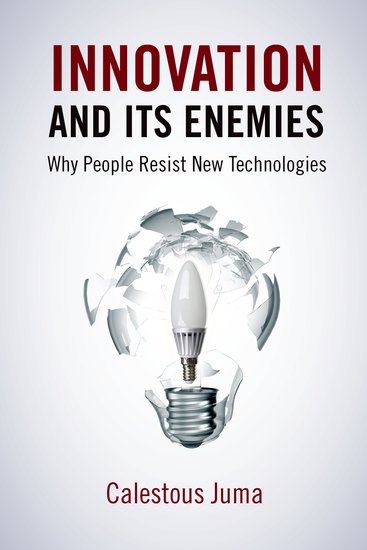
“The quickest way to find out who your enemies are is to try doing something new.” Thus begins Innovation and Its Enemies, an ambitious new book by Calestous Juma that will go down as one of the decade’s most important works on innovation policy.
Juma, who is affiliated with the Harvard Kennedy School’s Belfer Center for Science and International Affairs, has written a book that is rich in history and insights about the social and economic forces and factors that have, again and again, lead various groups and individuals to oppose technological change. Juma’s extensive research documents how “technological controversies often arise from tensions between the need to innovate and the pressure to maintain continuity, social order, and stability” (p. 5) and how this tension is “one of today’s biggest policy challenges.” (p. 8)
What Juma does better than any other technology policy scholar to date is that he identifies how these tensions develop out of deep-seated psychological biases that eventually come to affect attitudes about innovations among individuals, groups, corporations, and governments. “Public perceptions about the benefits and risks of new technologies cannot be fully understood without paying attention to intuitive aspects of human psychology,” he correctly observes. (p. 24) Continue reading →
On May 3rd, I’m excited to be participating in a discussion with Yale University bioethicist Wendell Wallach at the Microsoft Innovation & Policy Center in Washington, DC. (RSVP here.) Wallach and I will be discussing issues we write about in our new books, both of which focus on possible governance models for emerging technologies and the question of how much preemptive control society should exercise over new innovations.
Of all the books of technological criticism or skepticism that I’ve read in recent years—and I have read stacks of them!—
A Dangerous Master is by far the most thoughtful and interesting. I have grown accustomed to major works of technological criticism being caustic, angry affairs. Most of them are just dripping with dystopian dread and a sense of utter exasperation and outright disgust at the pace of modern technological change.
Although he is certainly concerned about a wide variety of modern technologies—drones, robotics, nanotech, and more—Wallach isn’t a purveyor of the politics of panic. There are some moments in the book when he resorts to some hyperbolic rhetoric, such as when he frets about an impending “techstorm” and the potential, as the book’s title suggests, for technology to become a “dangerous master” of humanity. For the most part, however, his approach is deeper and more dispassionate than what is found in the leading tracts of other modern techno-critics.
Earlier today on Twitter, I listed what I thought were the Top 5 “Biggest Internet Policy Issues of 2012.” In case you don’t follow me on Twitter — and shame on you if you don’t! — here were my choices:
Copyright wars reinvigorated post-SOPA; tide starting to turn in favor of copyright reform. [TLF posts on copyright.]
Privacy still red-hot w ECPA reform, online advertising regs & kids’ privacy issues all pending. [TLF posts on privacy.]
WCIT makes Internet governance / NetFreedom a major issue worldwide. [TLF posts on Net governance.]
Antitrust threat looms larger w pending Google case + Apple books investigation. [TLF posts on antitrust.]
Cybersecurity regulatory push continues in both legislative (CISPA) & executive branch. [TLF posts on cybersecurity.]
Lists like these are entirely subjective, of course, but I am basing my list on the general amount of chatter I tended to see and hear about each topic over the course of the year.
What do you think the top tech policy issues of the year were?
Perry Keller, Senior Lecturer at the Dickson Poon School of Law at King’s College London, and author of the recently released paper “Sovereignty and Liberty in the Internet Era,” discusses how the internet affects the relationship between the state and the media. According to Keller, media has played a formative role in the development of the modern state and, as it evolves, the way in which the state governs must change as well. However, that does not mean that there is a one-size-fits-all solution. In fact, as Keller demonstrates using real-world examples in the U.S., U.K., E.U., and China, the ways in which new media is governed can differ radically based upon the local legal and cultural environment.
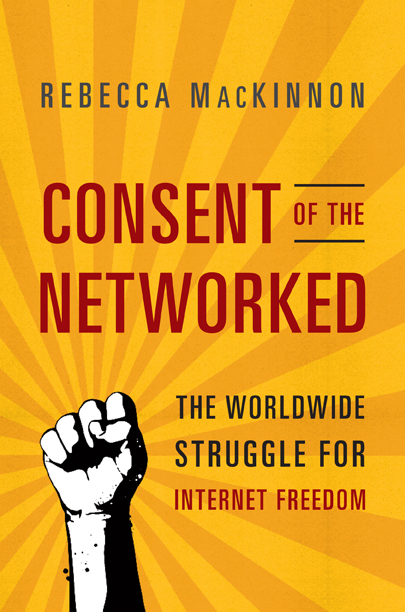
Rebecca MacKinnon’s new book, Consent of the Networked: The Worldwide Struggle for Internet Freedom, is well-researched exploration of the forces driving Internet developments and policy across the globe today. She serves up an outstanding history of recent global protest movements and social revolutions and explores the role that Internet technologies and digital networks played in those efforts. She also surveys some of the recent policy fights here and abroad over issues such as online privacy, Net neutrality regulation, free speech matters, and the copyright wars. The Consent of the Networked is certainly worth reading and will go down as one of the most important Internet policy books of 2012.
A Call to Action
Of course, it’s not just a history lesson. MacKinnon has also issued a call-to-arms here. As a well-known web activist, MacKinnon has emerged as a leading force in the broad-based, if loosely-defined, “Net freedom” movement. The term “Net freedom,” she notes, means very different things to different people. It’s “like a Rorschach inkblot test: different people look at the same ink splotch and see very different things.” (p. 188) Nonetheless, on the global stage, the Internet freedom movement is fundamentally tied up with efforts to hold both governments and corporate actors more accountable for their actions toward the Netizens, digital networks, and online speech and expression. Continue reading →
On Friday, both Josh Wright and I spoke on a panel at the Michigan State University’s conference on “Governance of Social Media.” Our particular panel focused on emerging competition policy issues affecting social media and social networking sites. Also joining us on the panel were Nicolas Economides of NYU and Michael Altschul of the CTIA. The video of the panel can be found here and I have also embedded it down below. [My remarks begin around the 23-min mark of the video.]
At the event, I presented my forthcoming paper on “The Perils of Classifying Social Media Platforms as Public Utilities,” which is currently out for peer review. I outlined the rising calls for treating social media or social networking sites as public utilities, essential facilities, or natural monopolies. Next, I briefly discussed some basic law and economics of public utility / essential facilities regulation. Third, I detailed six specific problems with efforts to classify these services as such. Finally, I briefly discussed regulatory proposals set forth by Professors Jonathan Zittrain and Tim Wu to apply traditional antitrust or public utility remedies to social media or information platforms. Specifically, I address Zittrain’s call for “API neutrality” (which would apply net neutrality-like principles at the applications and device layer) and Wu’s call for a “Separations Principle” (which would forcibly segregate information providers into three buckets: creators, distributors, and hardware makers). Watch the video for more details and see this for more critiques of the Zittrain and Wu proposals.
Here’s a sharp editorial from The Economist about Internet governance entitled, “In Praise of Chaos: Governments’ Attempts to Control the Internet Should be Resisted.” In the wake of the recent Internet Governance Forum meeting, many folks are once again debating the question of who rules the Net? Along with Wayne Crews, I edited a huge collection of essays on that topic back in 2003 and it’s a subject that continues to interest me greatly. As I noted here last week, many of those who desire greater centralization of control over Net governance decisions are using the fear that “fragmentation” will occur without some sort of greater plan for the Net’s future. I believe these fears are greatly overstated and are being used to justify expanded government meddling with online culture and economics.
The new
Economist piece nicely brings into focus the key question about who or what we should trust to guide the future of the Internet. It rightly notes that the current state of Net governance is, well, messy. But that’s not such a bad thing when compared to the alternative: Continue reading →
In a speech today before the Internet Governance Forum entitled “Taking Care of the Internet,” Neelie Kroes, Vice President of the European Commission, responsible for the Digital Agenda for Europe, argued for “a globally coherent approach” to preserve “the global character of the Internet, and keep it from fragmenting.” That sounds good in theory but, as always, the devil is in the details. No one wants to see a highly balkanized Internet with each country and continent becoming a digital island cut off from the rest of Internet. On the other hand, if “a globally coherent approach” means layers of international red tape and bureaucracy, then fragmentation doesn’t sound so bad by comparison. That’s particularly true for those of us who live in countries to cherish principles of freedom of speech and free enterprise, as we do in the United States.
For example, to most of the rest of the planet, America’s First Amendment is viewed as a pesky local ordinance that simply interferes with the ability of government to establish rules for acceptable speech and expression throughout society. What, then, does “a globally coherent approach” to Internet governance mean when America’s values conflict with other countries and continents? Does it mean that the U.S. should conform to a global norm as established by a “consensus body”? Who would that be? The OECD? The United Nations? The International Telecommunications Union? If so, it is clear that protections for freedom of speech and expression would be sacrificed on the altar of “consensus” or a “coherent global approach” to Net governance. Continue reading →
The Technology Liberation Front is the tech policy blog dedicated to keeping politicians' hands off the 'net and everything else related to technology. Learn more about TLF →




 The Technology Liberation Front is the tech policy blog dedicated to keeping politicians' hands off the 'net and everything else related to technology.