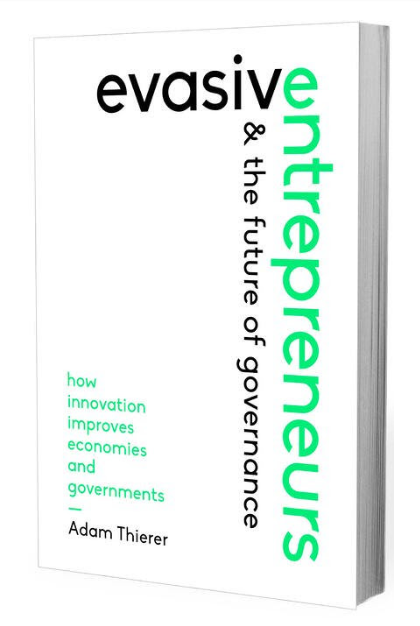
In coming days and weeks I will be occasionally blogging about different arguments made in the 368-page book, but here’s a quick summary of some of the key points I make in the book. These ten passages are pulled directly from the text:
“the freedom to innovate is essential to human betterment for each of us individually and for civilization as a whole. That freedom deserves to be taken more seriously today.”
“Entrepreneurialism and technological innovation are the fundamental drivers of economic growth and of the incredible advances in the everyday quality of life we have enjoyed over time. They are the key to expanding economic opportunities, choice, and mobility.”
“Unfortunately, many barriers exist to expanding innovation opportunities and our entrepreneurial efforts to help ourselves, our loved ones, and others. Those barriers include occupational licensing rules, cronyism-based industrial protectionist schemes, inefficient tax schemes, and many other layers of regulatory red tape at the federal, state, and local levels. We should not be surprised, therefore, when citizens take advantage of new technological capabilities to evade some of those barriers in pursuit of their right to earn a living, to tinker with or try doing new things, or just to learn about the world and serve it better.”
“Evasive entrepreneurs rely on a strategy of permissionless innovation in both the business world and the political arena. They push back against ‘the Permission Society,’ or the convoluted labyrinth of permits and red tape that often encumber entrepreneurial activities.”
“We should be willing to tolerate a certain amount of such outside-the-box thinking because entrepreneurialism expands opportunities for human betterment by constantly replenishing the well of important, life-enhancing ideas and applications.”
“we should better appreciate how creative acts and the innovations they give rise to can help us improve government by keeping public policies fresh, sensible, and in line with common sense and the consent of the governed.”
“Evasive entrepreneurialism is not so much about evading law altogether as it is about trying to get interesting things done, demonstrating a social or an economic need for new innovations in the process, and then creating positive leverage for better results when politics inevitably becomes part of the story. By acting as entrepreneurs in the political arena, innovators expand opportunities for themselves and for the public more generally, which would not have been likely if they had done things by the book.”
“Dissenting through innovation can help make public officials more responsive to the people by reining in the excesses of the administrative state, making government more transparent and accountable, and ensuring that our civil rights and economic liberties are respected.”
“In an age when many of the constitutional limitations on government power are being ignored or unenforced, innovation itself can act as a powerful check on the power of the state and can help serve as a protector of important human liberties.”
“Lawmakers and regulators need to consider a balanced response to evasive entrepreneurialism that is rooted in the realization that technology creators and users are less likely to seek to evade laws and regulations when public policies are more in line with common sense.”
The race for artificial intelligence (AI) supremacy is on with governments across the globe looking to take the lead in the next great technological revolution. As they did before during the internet era, the US and Europe are once again squaring off with competing policy frameworks.
It seems the EU basically wants to have its cake and eat it too by marrying up an ambitious industrial policy with a precautionary regulatory regime. We’ve seen this show before. Europe is doubling down on the same policy regime it used for the internet and digital commerce. It did not work out well for the continent then, and there are reasons to think it will backfire on them again for AI technologies. Continue reading →
Congress has become a less important player in the field of technology policy. Why did that happen, and what are the ramifications for technological governance efforts going forward?
I’ve spent almost 30 years covering technology policy. There was a time in my life when I spent almost all my time as a policy analyst preoccupied with developments in the federal legislative arena. I lived in the trenches of Capitol Hill and interacted with lawmakers and their staff morning, noon, and night.
In recent years, however, I have spent very little time focused on the Legislative Branch because it has effectively become a non-actor on technology policy. It is not that congressional lawmakers stopped caring about tech policy. Interest actually remains quite high—perhaps higher than ever before. Congress also continues to introduce lots of bills, host plenty of hearings, and issue mountains of press releases related to tech policy issues.
Nonetheless, all that interest and activity has not really translated into much important legislation. Continue reading →
This week, the Trump Administration proposed a new policy framework for artificial intelligence (AI) technologies that attempts to balance the need for continued innovation with a set of principles to address concerns about new AI services and applications. This represents an important moment in the history of emerging technology governance as it creates a policy vision for AI that is generally consistent with earlier innovation governance frameworks established by previous administrations.
Generally speaking, the Trump governance vision for AI encourages regulatory humility and patience in the face of an uncertain technological future. However, the framework also endorses a combination of “hard” and “soft” law mechanisms to address policy concerns that have already been raised about developing or predicted AI innovations.
AI promises to revolutionize almost every sector of the economy and can potentially benefit our lives in numerous ways. But AI applications also raise a number of policy concerns, specifically regarding safety or fairness. On the safety front, for example, some are concerned about the AI systems that control drones, driverless cars, robots, and other autonomous systems. When it comes to fairness considerations, critics worry about “bias” in algorithmic systems that could deny people jobs, loans, or health care, among other things.
These concerns deserve serious consideration and some level of policy guidance or else the public may never come to trust AI systems, especially if the worst of those fears materialize as AI technologies spread. But
how policy is formulated and imposed matters profoundly. A heavy-handed, top-down regulatory regime could undermine AI’s potential to improve lives and strengthen the economy. Accordingly, a flexible governance framework is needed and the administration’s new guidelines for AI regulation do a reasonably good job striking that balance. Continue reading →
What happens when technological innovation outpaces the ability of laws and regulations to keep up?
This phenomenon is known as “the pacing problem,” and it has profound ramifications for the governance of emerging technologies. Indeed, the pacing problem is becoming the great equalizer in debates over technological governance because it forces governments to rethink their approach to the regulation of many sectors and technologies.
The Innovation Cornucopia
Had Rip Van Winkle woken up his famous nap today, he’d be shocked by all the changes around him. At-home genetics tests, personal drones, driverless cars, lab-grown meats, and 3D-printed prosthetic limbs are just some of the amazing innovations that would boggle his mind. New devices and services are flying at us so rapidly that we sometimes forget that most did not even exist a short time ago. Continue reading →
“You don’t gank the noobs” my friend’s brother explained to me, growing angrier as he watched a high-level player repeatedly stalk and then cut down my feeble, low-level night elf cleric in the massively multiplayer online roleplaying game World of Warcraft. He logged on to the server to his “main,” a high-level gnome mage and went in search of my killer, carrying out two-dimensional justice. What he meant by his exclamation was that players have developed a social norm banning the “ganking” or killing of low-level “noobs” just starting out in the game. He reinforced that norm by punishing the overzealous player with premature annihilation.
Ganking noobs is an example of undesirable social behavior in a virtual space on par with cutting people off in traffic or budging people in line. Punishments for these behaviors take a variety of forms, from honking, to verbal confrontation, to virtual manslaughter. Virtual reality social spaces, defined as fully artificial digital environments, are the newest medium for social interaction. Increased agency and a sense of physical presence within a VR social world like VRChat allows users to more intensely experience both positive and negative situations, thus reopening the discussion for how best to govern these spaces.
“Responsible research and innovation,” or “RRI,” has become a major theme in academic writing and conferences about the governance of emerging technologies. RRI might be considered just another variant of corporate social responsibility (CSR), and it indeed borrows from that heritage. What makes RRI unique, however, is that it is more squarely focused on mitigating the potential risks that could be associated with various technologies or technological processes. RRI is particularly concerned with “baking-in” certain values and design choices into the product lifecycle before new technologies are released into the wild.
In this essay, I want to consider how RRI lines up with the opposing technological governance regimes of “permissionless innovation” and the “precautionary principle.” More specifically, I want to address the question of whether “permissionless innovation” and “responsible innovation” are even compatible. While participating in recent university seminars and other tech policy events, I have encountered a certain degree of skepticism—and sometimes outright hostility—after suggesting that, properly understood, “permissionless innovation” and “responsible innovation” are not warring concepts and that RRI can co-exist peacefully with a legal regime that adopts permissionless innovation as its general tech policy default. Indeed, the application of RRI lessons and recommendations can strengthen the case for adopting a more “permissionless” approach to innovation policy in the United States and elsewhere. Continue reading →
What are we to make of this peculiar new term “permissionless innovation,” which has gained increasing currency in modern technology policy discussions? And how much relevance has this notion had—or
should it have—on those conversations about the governance of emerging technologies? That’s what I’d like to discuss here today.
Uncertain Origins, Unclear Definitions
I should begin by noting that while I have written a book with the term in the title, I take no credit for coining the phrase “permissionless innovation,” nor have I been able to determine who the first person was to use the term. The phrase is sometimes attributed to Grace M. Hopper, a computer scientist who was a rear admiral in the United States Navy. She once famously noted that, “It’s easier to ask forgiveness than it is to get permission.”
“Hopper’s Law,” as it has come to be known in engineering circles, is probably the most concise articulation of the general notion of “permissionless innovation” that I’ve ever heard, but Hopper does not appear to have ever used the actual phrase anywhere. Moreover, Hopper was not
necessarily applying this notion to the realm of technological governance, but was seemingly speaking more generically about the benefit of trying new things without asking for the blessing of any number of unnamed authorities or overseers—which could include businesses, bosses, teachers, or perhaps even government officials. Continue reading →
The future of emerging technology policy will be influenced increasingly by the interplay of three interrelated trends: “innovation arbitrage,” “technological civil disobedience,” and “spontaneous private deregulation.” Those terms can be briefly defined as follows:
“Innovation arbitrage” refers to the idea that innovators can, and will with increasingly regularity, move to those jurisdictions that provide a legal and regulatory environment more hospitable to entrepreneurial activity. Just as capital now fluidly moves around the globe seeking out more friendly regulatory treatment, the same is increasingly true for innovations. And this will also play out domestically as innovators seek to play state and local governments off each other in search of some sort of competitive advantage.
“Technological civil disobedience” represents the refusal of innovators (individuals, groups, or even corporations) or consumers to obey technology-specific laws or regulations because they find them offensive, confusing, time-consuming, expensive, or perhaps just annoying and irrelevant. New technological devices and platforms are making it easier than ever for the public to openly defy (or perhaps just ignore) rules that limit their freedom to create or use modern technologies.
“Spontaneous private deregulation” can be thought of as de facto rather than the de jure elimination of traditional laws and regulations owing to a combination of rapid technological change as well the potential threat of innovation arbitrage and technological civil disobedience. In other words, many laws and regulations aren’t being formally removed from the books, but they are being made largely irrelevant by some combination of those factors. “Benign or otherwise, spontaneous deregulation is happening increasingly rapidly and in ever more industries,” noted Benjamin Edelman and Damien Geradin in a Harvard Business Reviewarticle on the phenomenon.[1]
In this essay, I want to briefly highlight how, over the course of just the past month, a single company has offered us a powerful example of how both global innovation arbitrage and technological civil disobedience—
or at least the threat thereof—might become a more prevalent feature of discussions about the governance of emerging technologies. And, in the process, that could lead to at least the partial spontaneous deregulation of certain sectors or technologies. Finally, I will discuss how this might affect technological governance more generally and accelerate the movement toward so-called “soft law” governance mechanisms as an alternative to traditional regulatory approaches. Continue reading →
The Technology Liberation Front is the tech policy blog dedicated to keeping politicians' hands off the 'net and everything else related to technology. Learn more about TLF →


 Congress has become a less important player in the field of technology policy. Why did that happen, and what are the ramifications for technological governance efforts going forward?
 The Technology Liberation Front is the tech policy blog dedicated to keeping politicians' hands off the 'net and everything else related to technology.