For my latest regular column in The Hill, I took a look at the trade-offs associated with the EU’s AI Act. This is derived from a much longer chapter on European AI policy that is in my forthcoming book, and I also plan on turning it into a free-standing paper at some point soon. My oped begins as follows:
In the intensifying race for global competitiveness in artificial intelligence (AI), the United States, China and the European Union are vying to be the home of what could be the most important technological revolution of our lifetimes. AI governance proposals are also developing rapidly, with the EU proposing an aggressive regulatory approach to add to its already-onerous regulatory regime.
It would be imprudent for the U.S. to adopt Europe’s more top-down regulatory model, however, which already decimated digital technology innovation in the past and now will do the same for AI. The key to competitive advantage in AI will be openness to entrepreneurialism, investment and talent, plus a flexible governance framework to address risks.
Jump over to The Hill to read the entire thing. And down below you will find all my recent writing on AI and robotics. This will be my primary research focus in coming years.
On July 12, I participated in a Bipartisan Policy Center event on “Civil Society Perspectives on Artificial Intelligence Impact Assessments.” It was an hour-long discussion moderated by Michele Nellenbach, Vice President of Strategic Initiatives at the Bipartisan Policy Center, and which also featured Miriam Vogel, President and CEO of EqualAI. We discussed the ins and outs of algorithmic auditing and impact assessments for artificial intelligence. This is one of the hottest topics in the field of AI governance today, with proposals multiplying rapidly in academic and public policy circles. Several governments are already considering mandating AI auditing and impact assessments.
You can watch the entire discussion here, and down below I have included some of my key talking points from the session. I am currently finishing up my next book, which is on how to craft a flexible governance framework for AI and algorithmic technologies. It includes a lengthy chapter on this issue and I also plan on eventually publishing a stand-alone study on this topic.
[This is a draft of a section of a forthcoming study on “A Flexible Governance Framework for Artificial Intelligence,” which I hope to complete shortly. I welcome feedback. I have also cross-posted this essay at Medium.]
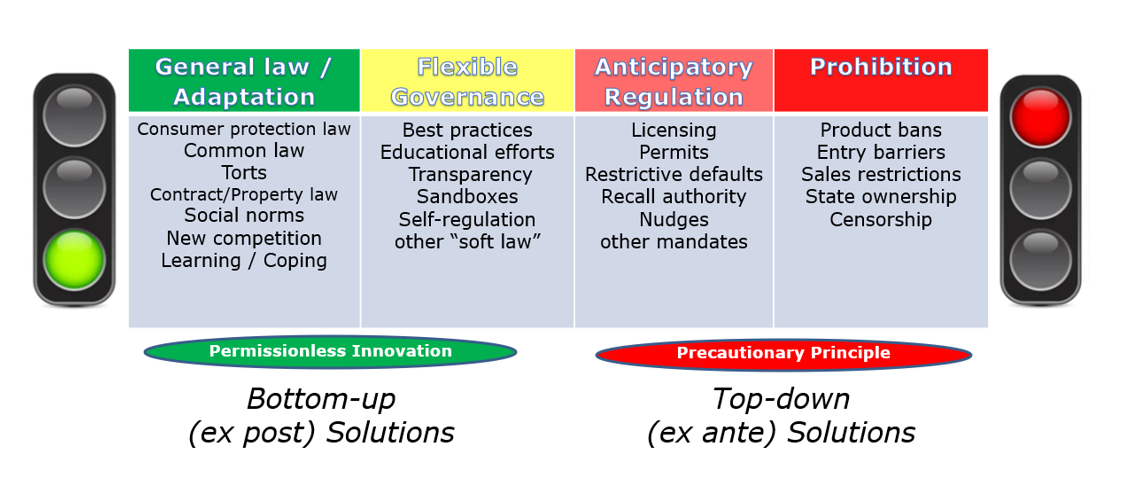
Debates about how to embed ethics and best practices into AI product design is where the question of public policy defaults becomes important. To the extent AI design becomes the subject of legal or regulatory decision-making, a choice must be made between two general approaches: the precautionary principle or the proactionary principle.[1] While there are many hybrid governance approaches in between these two poles, the crucial issue is whether the initial legal default for AI technologies will be set closer to the red light of the precautionary principle (i.e., permissioned innovation) or to the green light of the proactionary principle (i.e., (permissionless innovation). Each governance default will be discussed.
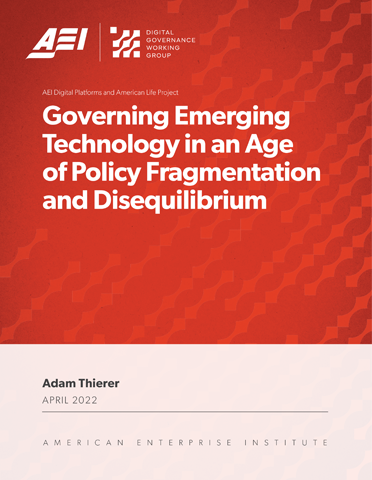
The American Enterprise Institute (AEI) has kicked off a new project called “Digital Platforms and American Life,” which will bring together a variety of scholars to answer the question: How should policymakers think about the digital platforms that have become embedded in our social and civic life? The series, which is being edited by AEI Senior Fellow Adam J. White, highlights how the democratization of knowledge and influence in the Internet age comes with incredible opportunities but also immense challenges. The contributors to this series will approach these issues from various perspectives and also address different aspects of policy as it pertains to the future of technological governance.
It is my honor to have the lead paper in this new series. My 19-page essay is entitled, Governing Emerging Technology in an Age of Policy Fragmentation and Disequilibrium, and it represents my effort to concisely tie together all my writing over the past 30 years on governance trends for the Internet and related technologies. The key takeaways from my essay are:
Traditional governance mechanisms are being strained by modern technological and political realities. Newer technologies, especially digital ones, are developing at an ever-faster rate and building on top of each other, blurring lines between sectors.
Congress has failed to keep up with the quickening pace of technological change. It also continues to delegate most of its constitutional authority to agencies to deal with most policy concerns. But agencies are overwhelmed too. This situation is unlikely to change, creating a governance gap.
Decentralized governance techniques are filling the gap. Soft law—informal, iterative, experimental, and collaborative solutions—represents the new normal for technological governance. This is particularly true for information sectors, including social media platforms, for which the First Amendment acts as a major constraint on formal regulation anyway.
No one-size-fits-all tool can address the many governance issues related to fast-paced science and technology developments; therefore, decentralized governance mechanisms may be better suited to address newer policy concerns.
My arguments will frustrate many people of varying political dispositions because I adopt a highly pragmatic approach to technological governance. Continue reading →
This report was a major undertaking that involved dozens of interviews, extensive historic research, several events and presentations, and then numerous revisions before the final product was released. The final PDF version of the journal article is attached.
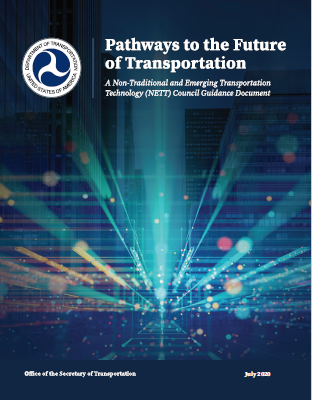
On July 23rd, the U.S. Department of Transportation (DoT) released Pathways to the Future of Transportation, which was billed as “a policy document that is intended to serve as a roadmap for innovators of new cross modal technologies to engage with the Department.” This guidance document was created by a new body called the Non-Traditional and Emerging Transportation Technology (NETT) Council, which was formed by U.S. Transportation Secretary Elaine L. Chao last year. The NETT Council is described as “an internal deliberative body to identify and resolve jurisdictional and regulatory gaps that may impede the deployment of new technologies.”
The creation of NETT Council and the issuance of its first major report highlight the continued growth of “soft law” as a major governance trend for emerging technology in the US. Soft law refers to informal, collaborative, and constantly evolving governance mechanisms that differ from hard law in that they lack the same degree of enforceability. A partial inventory of soft law methods includes: multistakeholder processes, industry best practices or codes of conduct, technical standards, private certifications, agency workshops and guidance documents, informal negotiations, and education and awareness efforts. But this list of soft law mechanisms is amorphous and ever-changing.
Soft law systems and processes are multiplying at every level of government today: federal, state, local, and even globally. Such mechanisms are being tapped by government bodies today to deal with fast-moving technologies that are evolving faster than the law’s ability to keep up.
The US Department of Transportation has become a leading candidate for Soft Law Central at the federal level. The agency has been tapping a variety of soft law mechanisms and approaches to deal with driverless cars and drone policy issues in particular. (See the essays listed down below for more details).
The NETT Council represents the next wave of this governance trend. We might consider it an effort to bring a greater degree of formality and coordination to the agency’s soft law efforts. Continue reading →
In an amazing new MIT Technology Review piece, Antonio Regalado discusses how, “Some scientists are taking a DIY coronavirus vaccine, and nobody knows if it’s legal or if it works.” It is another powerful example of how “citizen-science” and medical self-experimentation (or “biohacking”) is increasingly being used to improve health outcomes, enhance human capabilities, or fight against deadly diseases like COVID. Regalado reports that:
Nearly 200 covid-19 vaccines are in development and some three dozen are at various stages of human testing. But in what appears to be the first “citizen science” vaccine initiative, Estep and at least 20 other researchers, technologists, or science enthusiasts, many connected to Harvard University and MIT, have volunteered as lab rats for a do-it-yourself inoculation against the coronavirus. They say it’s their only chance to become immune without waiting a year or more for a vaccine to be formally approved.
Among those who’ve taken the DIY vaccine is George Church, the celebrity geneticist at Harvard University, who took two doses a week apart earlier this month. The doses were dropped in his mailbox and he mixed the ingredients himself.
Regalado notes that this is all happening despite legal and ethical questions:
By distributing directions and even supplies for a vaccine, though, the Radvac group is operating in a legal gray area. The US Food and Drug Administration (FDA) requires authorization to test novel drugs in the form of an investigational new drug approval. But the Radvac group did not ask the agency’s permission, nor did it get any ethics board to sign off on the plan.
A pandemic is no time for bad governance. As the COVID-19 crisis intensified, bureaucrats and elected officials slumbered. Government regulations prevented many in the private sector from helping with response efforts. The result was a sudden surge of evasive entrepreneurialism and technological civil disobedience. With institutions and policies collapsing around them, many people took advantage of cutting‐edge technological capabilities to evade public policies that were preventing practical solutions from emerging.
Examples were everywhere. Distilleries started producing hand sanitizers to address shortages while average folks began sharing do‐it‐yourself sanitizer recipes online. The Food and Drug Administration (FDA) looked to modify hand sanitizer guidelines quickly to allow for it, but few really cared because those rules weren’t going to stop them. Gray markets in face masks, medical face shields, and respirators developed. Some people and organizations worked together to make medical devices using off‐the‐shelf hardware and open source software. More simply, others just fired up sewing machines to make masks—and then, faced with an emerging public health consensus, the guidance from the federal government shifted dramatically: where formerly ordinary people were instructed not to buy or use masks, within a matter of days, the policy reversed, and all were encouraged to make and use cloth protective masks. Continue reading →
Compliance paradox: The situation in which heightened legal or regulatory efforts fail to reverse unwanted behavior and instead lead to increased legal evasion and additional enforcement problems.
Demosclerosis: Growing government dysfunction brought on by the inability of public institutions to adapt to change, especially technological change.
Evasive entrepreneurs: Innovators who do not always conform to social or legal norms.
Free innovation: Bottom-up, noncommercial forms of innovation that often take on an evasive character. Free innovation is sometimes called “grassroots” or “household” innovation or “social entrepreneurialism.” Even though it is typically noncommercial in character, free innovation often involves regulatory entrepreneurialism and technological civil disobedience.
Innovation arbitrage: The movement of ideas, innovations, or operations to jurisdictions that provide legal and regulatory environments most hospitable to entrepreneurial activity. It can also be thought of as a form of jurisdictional shopping and can be facilitated by competitive federalism.
Innovation culture: The various social and political attitudes and pronouncements toward innovation, technology, and entrepreneurial activities that, taken together, influence the innovative capacity of a culture or nation.
Pacing problem: A term that generally refers to the inability of legal or regulatory regimes to keep up with the intensifying pace of technological change.
Permissionless innovation: The general notion that “it’s easier to ask forgiveness than it is to get permission.” As a policy vision, it refers to the idea that experimentation with new technologies and innovations should generally be permitted by default.
Precautionary principle: The practice of crafting public policies to control or limit innovations until their creators can prove that they will not cause any harm or disruptions.
Regulatory entrepreneurs: Evasive entrepreneurs who set out to intentionally challenge and change the law through their innovative activities. In essence, policy change is part of their business model.
Soft law: Informal, collaborative, and constantly evolving governance mechanisms that differ from hard law in that they lack the same degree of enforceability.
Technological civil disobedience: The technologically enabled refusal of individuals, groups, or businesses to obey certain laws or regulations because they find them offensive, confusing, time-consuming, expensive, or perhaps just annoying and irrelevant.
Technologies of freedom: Devices and platforms that let citizens openly defy (or perhaps just ignore) public policies that limit their liberty or freedom to innovate. Another term with the same meaning is “technologies of resistance.”
The Technology Liberation Front is the tech policy blog dedicated to keeping politicians' hands off the 'net and everything else related to technology. Learn more about TLF →

 On July 23rd, the U.S. Department of Transportation (DoT) released

 The Technology Liberation Front is the tech policy blog dedicated to keeping politicians' hands off the 'net and everything else related to technology.