On Forbes yesterday, I posted a detailed analysis of the successful (so far) fight to block quick passage of the Protect-IP Act (PIPA) and the Stop Online Piracy Act (SOPA). (See “Who Really Stopped SOPA, and Why?“) I’m delighted that the article, despite its length, has gotten such positive response.
As regular readers know, I’ve been following these bills closely from the beginning, and made several trips to Capitol Hill to urge lawmakers to think more carefully about some of the more half-baked provisions.
But beyond traditional advocacy–of which there was a great deal–something remarkable happened in the last several months. A new, self-organizing protest movement emerged on the Internet, using social news and social networking tools including Reddit, Tumblr, Facebook and Twitter to stage virtual teach-ins, sit-ins, boycotts, and other protests. Continue reading →
 After three years of politicking, it now looks like Congress may actually give the FCC authority to conduct incentive auctions for mobile spectrum, and soon. That, at least, is what the FCC seems to think.
At CES last week, FCC Chairman Julius Genachowski largely repeated the speech he has now given three years in a row. But there was a subtle twist this time, one echoed by comments from Wireless Bureau Chief Rick Kaplan at a separate panel.
Instead of simply warning of a spectrum crunch and touting the benefits of the incentive auction idea, the Chairman took aim at a House Republican bill that would authorize the auctions but limit the agency’s “flexibility” in designing and conducting them. “My message on incentive auctions today is simple,” he said, “we need to get it done now, and we need to get it done right.” Continue reading →
Here’s the notice I’ve been getting the last few days when, logged into Facebook from a computer, I try to post a comment or update my status.
Clever observers will note that the recommendation to log in from a computer is misplaced, as I get it when I’m logged in from a computer. Facebook gives me no instructions when I log in (or when I log out and log in again), though it did once ask me to change my password, which I did.
Most likely, Facebook’s algorithms believe I’ve violated some part of the Terms of Service, such as by repetitive posting or other spammy behavior. My exclusion from the site began contemporaneous with my attempt to post a single comment that failed for reasons I couldn’t discern in several tries.
Undoubtedly, my friends at Facebook will leap to my aid and clear this up for me in short order, feeling slightly stung that I “went public” with the problem rather than going to them. But I wanted to experience this as an ordinary consumer, not as a member of the digerati with insider access to people at important companies. In the past, I’ve used insider access with services like PayPal and (the now defunct) Bitcoin7 to get help that an ordinary user couldn’t have gotten. Bully for me that I can do that, but my experience is atypical and no basis for observing how the world works.
Some observations: Continue reading →
By Geoffrey Manne and Berin Szoka
Back in September, the Senate Judiciary Committee’s Antitrust Subcommittee held a hearing on “The Power of Google: Serving Consumers or Threatening Competition?” Given the harsh questioning from the Subcommittee’s Chairman Herb Kohl (D-WI) and Ranking Member Mike Lee (R-UT), no one should have been surprised by the letter they sent yesterday to the Federal Trade Commission asking for a “thorough investigation” of the company. At least this time the danger is somewhat limited: by calling for the FTC to investigate Google, the senators are thus urging the agency to do . . . exactly what it’s already doing.
So one must wonder about the real aim of the letter. Unfortunately, the goal does not appear to be to offer an objective appraisal of the complex issues intended to be addressed at the hearing. That’s disappointing (though hardly surprising) and underscores what we noted at the time of the hearing: There’s something backward about seeing a company hauled before a hostile congressional panel and asked to defend itself, rather than its self-appointed prosecutors being asked to defend their case.
Senators Kohl and Lee insist that they take no position on the legality of Google’s actions, but their lopsided characterization of the issues in the letter—and the fact that the FTC is already doing what they purport to desire as the sole outcome of the letter!—leaves little room for doubt about their aim: to put political pressure on the FTC not merely to investigate, but to reach a particular conclusion and bring a case in court (or simply to ratchet up public pressure from its bully pulpit). Continue reading →
It’s time again to look back at the major cyberlaw and information tech policy books of the year. I’ve decided to drop the top 10 list approach I’ve used in past years (see 2008, 2009, 2010) and just use a more thematic listing of major titles released in 2011. This thematic approach gets me out of hot water since I have found that people take numeric lists very seriously, especially when they are the author of one of the books and their title isn’t #1 on the list! Nonetheless, at the end, I will name what I regard as the most important Net policy book of the year.
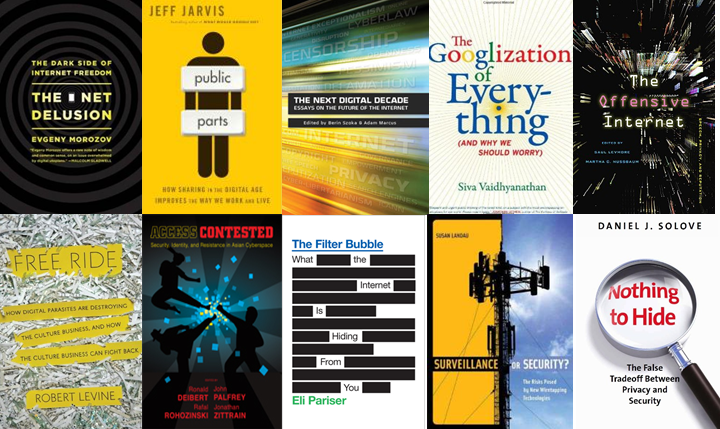
I hope I’ve included all the major titles released during the year, but I ask readers to please let me know what I have missed that belongs on this list. I want this to be a useful resource to future scholars and students in the field. [Reminder: Here’s my compilation of major Internet policy books from the past decade.] Where relevant, I’ve added links to my reviews as well as discussions with the authors that Jerry Brito conducted as part of his “Surprisingly Free” podcast series. Finally, as always, I apologize to international readers for the somewhat U.S.-centric focus of this list.
Continue reading →
 Earlier this year I read Scott Cleland’s new book, Search & Destroy: Why You Can’t Trust Google, Inc., after he was kind enough to send me an advance copy. I didn’t have time to review it at the time and just jotted down a few notes for use later. Because the year is winding down, I figured I should get my thoughts on it out now before I publish my end of year compendium of important tech policy books.
Cleland is President of Precursor LLC and a noted Beltway commentator on information policy issues, especially Net neutrality regulation, which he has vociferously railed against for many years. On a personal note, I’ve known Scott for many years and always enjoyed his analysis and wit, even when I disagree with the thrust of some of it.
And I’m sad to report that I disagree with most of it in
Search & Destroy, a book that is nominally about Google but which is really a profoundly skeptical look at the modern information economy as we know it. Indeed, Cleland’s book might have been more appropriately titled, “Second Thoughts about Cyberspace.” In a sense, it represents an outline for an emerging “cyber-conservative” vision that aims to counter both “cyber-progressive” and “cyber-libertarian” schools of thinking.
After years of having Scott’s patented bullet-point mini-manifestos land in my mailbox, I think it’s only appropriate I write this review in the form of a bulleted list! So, here it goes.. Continue reading →
 On NPR’s Marketplace this morning, I talk about net neutrality litigation with host John Moe.
Nearly a year after the FCC passed controversial new “Open Internet” rules by a 3-2 vote, the White House finally gave approval for the rules to be published last week, unleashing lawsuits from both supporters and detractors.
The supporters don’t have any hope or expectation of getting a court to make the rules more comprehensive. So why sue? When lawsuits challenging federal regulations are filed in multiple appellate courts, a lottery determines which court hears a consolidated appeal.
So lawsuits by net neutrality supporters are a procedural gimmick, an effort to take cases challenging the FCC’s authority out of the D.C. Circuit Court of Appeals, which has already made clear the FCC has no legal basis here.
Continue reading →
 For Forbes this morning, I reflect on the publication late last week of the FCC’s “Open Internet” or net neutrality rules and their impact on spectrum auctions past and future. Hint: not good.
An important study last year by Prof. Faulhaber and Prof. Farber, former chief economist and chief technologist, respectively, for the FCC, found that the last-minute imposition of net neutrality limits on the 700 MHz “C” block in the FCC’s 2008 auction reduced the winning bid by 60%–a few billion dollars for the Treasury.
Yet the FCC maintained in the December Report and Order approving similar rules for all broadband providers that the cost impact of these “prophylactic” rules would be minimal, because, after all, they simply endorse practices most providers already follow. (And the need for the new rules, then, came from where?)
Continue reading →
I started to see hints of it last week, but I now believe Google+ is in full stumble-mode over user identity and naming. It looks as though they’ve taken common sense—everyone has one name—and woven it into their terms of service. You can’t use a non-traditional name on Google+. But naming and identity are more complex than that.
In my book, Identity Crisis, I wrote that an identity is a collection of information other people and institutions have about a person. Others use identity information they have to distinguish you from other people (or to group you) in their minds or records. This makes identity a gating mechanism: you can allow people into a part of your life by making them privy to the relevant set of identifiers, or keep them out by denying them that information.
Commonly, people use varied identities to exclude others, for social or professional reasons, such as when they open a social network account in a false name to keep their parents or their students from accessing parts of social life that are not meant for them to see. Sometimes identity is varied for political reasons, such as when an account opens in a pseudonym for the purpose of avoiding reprisal. This is an area where Facebook’s “real names” policy has stepped in it. The further one lives from conventional life in a given society, or the more contrarily to power, the more important it is to control identity.
Identity Woman—who tells her story at the first link above—uses her non-traditional identity in a non-traditional, but completely reasonable, way. It’s just the name that identifies her better to the community she plans to reach on Google+. But Google+ thinks that the name she is supposed to use is the same one her parents gave her, is the same one on her tax return, is the same one on her college degree, is the same one on her driver’s license.
Google+ has smartly replicated the real-world concept of social circles in its “circles” function. But they haven’t replicated real-world practice in terms of naming and identity. Why? Among other reasons, because doing so would allow users to decide which “circle” Google itself is in. Google doesn’t want that. Like Facebook wants to be your super-friend, Google wants to be your super-circle.
Google+ is seeing like a state, vastly simplifying the use of identity on its platform to serve its purposes. That will be a continuing discomfort and an impediment to its fullest success. But the fullest success of social networking will probably not be on an owned platform anyway.
[By Geoffrey Manne and Joshua Wright. Cross-posted at TOTM]
Our search neutrality paper has received some recent attention. While the initial response from Gordon Crovitz in the Wall Street Journal was favorable, critics are now voicing their responses. Although we appreciate FairSearch’s attempt to engage with our paper’s central claims, its response is really little more than an extended non-sequitur and fails to contribute to the debate meaningfully.
Unfortunately, FairSearch grossly misstates our arguments and, in the process, basic principles of antitrust law and economics. Accordingly, we offer a brief reply to correct a few of the most critical flaws, point out several quotes in our paper that FairSearch must have overlooked when they were characterizing our argument, and set straight FairSearch’s various economic and legal misunderstandings.
We want to begin by restating the simple claims that our paper does—and does not—make.
Our fundamental argument is that claims that search discrimination is anticompetitive are properly treated skeptically because: (1) discrimination (that is, presenting or ranking a search engine’s own or affiliated content more prevalently than its rivals’ in response to search queries) arises from vertical integration in the search engine market (i.e., Google responds to a query by providing not only “10 blue links” but also perhaps a map or video created Google or previously organized on a Google-affiliated site (YouTube, e.g.)); (2) both economic theory and evidence demonstrate that such integration is
generally pro-competitive; and (3) in Google’s particular market, evidence of intense competition and constant innovation abounds, while evidence of harm to consumers is entirely absent. In other words, it is much more likely than not that search discrimination is pro-competitive rather than anticompetitive, and doctrinal error cost concerns accordingly counsel great hesitation in any antitrust intervention, administrative or judicial. As we will discuss, these are claims that FairSearch’s lawyers are quite familiar with.
FairSearch, however, grossly mischaracterizes these basic points, asserting instead that we claim
“that even if Google does [manipulate its search results], this should be immune from antitrust enforcement due to the difficulty of identifying ‘bias’ and the risks of regulating benign conduct.”
This statement is either intentionally deceptive or betrays a shocking misunderstanding of our central claim for at least two reasons: (1) we
never advocate for complete antitrust immunity, and (2) it trivializes the very real—and universally-accepted–difficulty of distinguishing between pro- and anticompetitive conduct.
Continue reading →


 The Technology Liberation Front is the tech policy blog dedicated to keeping politicians' hands off the 'net and everything else related to technology.