I caught this tidbit today in a Washington Post article about Julius Genachowski’s tenure as Federal Communications Commission chairman:
He wound up presiding over a crucial period in which the powerful companies of Silicon Valley turned into Washington power players. Lobbying the FCC has become a major economic franchise. Each day, hundreds of dark-suited lawyers crowd the antiseptic, midcentury-modern agency building.
Can anyone think this is a good thing? To be clear, I don’t think Genachowski is solely responsible for Silicon Valley innovators getting more aggressive in Washington or for tech lobbying becoming “a major economic franchise” at the FCC. There’s plenty of blame to go around in that regard. Regardless, every legislative and regulatory action that opens the door to greater regulation of the information economy also opens the door a bit wider to unproductive rent-seeking and cronyist activities. Moreover, every minute and every dollar spent focusing on making legislators and regulators happy is another minute and dollar that could have better been spent making consumers happy in the marketplace. It’s a pure deadweight loss to society.
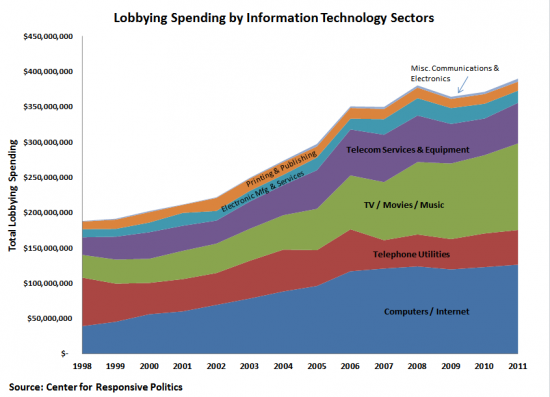
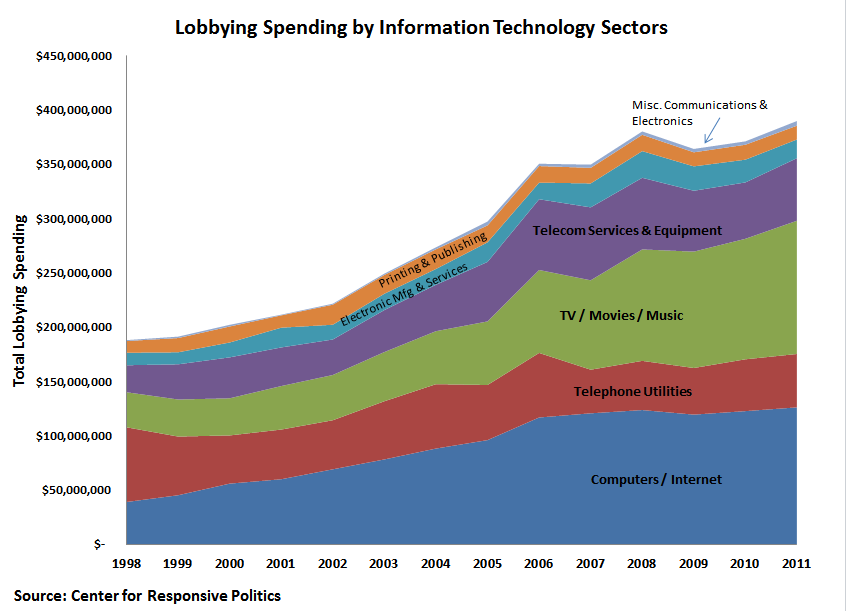
And there has been a remarkable expansion in such tech lobbying activity over the past decade, as the following charts illustrate. The first shows the dramatic growth of lobbying by computer and Internet companies relative to other sectors and the second shows lobbying spending by specific computer and Internet companies. [Click to enlarge.]
Continue reading →
In a New York Times op-ed this weekend entitled “You Can’t Say That on the Internet,” Evgeny Morozov, author of The Net Delusion, worries that Silicon Valley is imposing a “deeply conservative” “new prudishness” on modern society. The cause, he says, are “dour, one-dimensional algorithms, the mathematical constructs that automatically determine the limits of what is culturally acceptable.” He proposes that some form of external algorithmic auditing be undertaken to counter this supposed problem. Here’s how he puts it in the conclusion of his essay:
Quaint prudishness, excessive enforcement of copyright, unneeded damage to our reputations: algorithmic gatekeeping is exacting a high toll on our public life. Instead of treating algorithms as a natural, objective reflection of reality, we must take them apart and closely examine each line of code.
Can we do it without hurting Silicon Valley’s business model? The world of finance, facing a similar problem, offers a clue. After several disasters caused by algorithmic trading earlier this year, authorities in Hong Kong and Australia drafted proposals to establish regular independent audits of the design, development and modifications of computer systems used in such trades. Why couldn’t auditors do the same to Google?
Silicon Valley wouldn’t have to disclose its proprietary algorithms, only share them with the auditors. A drastic measure? Perhaps. But it’s one that is proportional to the growing clout technology companies have in reshaping not only our economy but also our culture.
It should be noted that in a Slate
essay this past January, Morozov had also proposed that steps be taken to root out lies, deceptions, and conspiracy theories on the Internet. Morozov was particularly worried about “denialists of global warming or benefits of vaccination,” but he also wondered how we might deal with 9/11 conspiracy theorists, the anti-Darwinian intelligent design movement, and those that refuse to accept the link between HIV and AIDS.
To deal with that supposed problem, he recommended that Google “come up with a database of disputed claims” or “exercise a heavier curatorial control in presenting search results,” to weed out such things. He suggested that the other option “is to nudge search engines to take more responsibility for their index and exercise a heavier curatorial control in presenting search results for issues” that someone (he never says who) determines to be conspiratorial or anti-scientific in nature.
Taken together, these essays can be viewed as a preliminary sketch of what could become a comprehensive information control apparatus instituted at the code layer of the Internet. Continue reading →
[UPDATE
4/30/13: This article was subsequently published in Volume 65, Issues 2 of the Federal Communications Law Journal in April 2013. The links below now point to the final FCLJ version.]
The Mercatus Center at George Mason University has just released a new paper by Brent Skorup and me entitled, “Uncreative Destruction: The War on Vertical Integration in the Information Economy.” Brent, who is the research director for the Information Economy Project at the George Mason University School of Law, and I have been working on this paper since the Spring and we are looking forward to getting it published in a law review shortly. The paper focuses on Tim Wu’s “separations principle” for the digital economy, something I’ve spent some time critiquing here in the past. Here’s the introduction from the 44-page paper that Brent and I just released:
Are information sectors sufficiently different from other sectors of the economy such that more stringent antitrust standards should be applied to them preemptively? Columbia Law School professor Tim Wu responds in the affirmative in his book The Master Switch: The Rise and Fall of Information Empires. Having successfully pushed net-neutrality regulation into the policy spotlight, Wu has turned his attention to what he regards as excessive market concentration and threats to free speech throughout the entire information economy.To support his call for increased antitrust intervention, Wu explains his view of competition in the information economy—a view that deviates substantially from current mainstream antitrust theory.
Continue reading →
 On Friday, California Governor Jerry Brown signed SB 1161, which prohibits the state’s Public Utilities Commission from any new regulation of Voice over Internet Protocol or other IP-based services without the legislature’s authorization.
California now joins over twenty states that have enacted similar legislation.
The bill, which is only a few pages long, was introduced by State Senator Alex Padilla (D) in February. It passed both houses of the California legislature with wide bi-partisan majorities.
California lawmakers and the governor are to be praised for quickly enacting this sensible piece of legislation.
Whatever the cost-benefit of continued state regulation of traditional utilities such as water, power, and landline telephone services, it’s clear that the toolkit of state and local PUCs is a terrible fit for Internet services such as Skype, Google Voice or Apple’s FaceTime. Continue reading →
That was the response of a friend currently in Rwanda who had issued a Facebook plea for someone to upload the weird “Innocence of Muslims” video to Dropbox.
“Oh, where is the stupid internet in Rwanda?????” she exclaimed.
In typical snark, I had asked, “What do you connect to Dropbox with? Tin-can on string?”
She actually has Internet access, but she finds YouTube so much less reliable than other platforms that she asks friends to upload YouTube videos elsewhere.
I anecdotally find YouTube videos to be clunky downloads compared to others. Quite naturally, I watch fewer videos on YouTube and more on other platforms. I don’t know, but guess, that Google has made some decision to economize on video downloads—a high percentage of people probably watch only the first third of any video, so why send them the whole thing right away?—and that its imperfect implementation has me watching the spinning “pause” wheel (or playing “snake”) routinely when I think a YouTube offering would be interesting.
Would the Google of five years have allowed that? It’s well known that Google recognizes speed as an important elements of quality service on the Internet.
And this is why antitrust action against Google is unwarranted. When companies get big, they lose their edge, as I’m guessing Google is losing its edge in video service. This opens the door to competitors as part of natural economic processes.
Just the other week, I signed up with Media.net and I’ll soon be running tests on whether it gets better results for me on WashingtonWatch.com than Google AdSense. So far so good. A human customer service representative navigated me through the (simple) process of opening an account and getting their ad code.
These are anecdotes suggesting Google’s competitive vulnerability. But you can get a more systematic airing of views at TechFreedom’s event September 28th: “Should the FTC Sue Google Over Search?“
In a recent post, Tim Lee does a good job of explaining why facilities-based competition in broadband is difficult. He writes,
As Verizon is discovering with its FiOS project, it’s much harder to turn a profit installing the second local loop; both because fewer than 50 percent of customers are likely to take the service, and because competition pushes down margins. And it’s almost impossible to turn a profit providing a third local loop, because fewer than a third of customers are likely to sign up, and even more competition means even thinner margins.
Tim thus concludes that
the kind of “facilities-based” competition we’re seeing in Kansas City, in which companies build redundant networks that will sit idle most of the time, is extremely wasteful. In a market where every household has n broadband options (each with its own fiber network), only 1/n local loops will be in use at any given time. The larger n is, the more resources are wasted on redundant infrastructure.
I don’t understand that conclusion. You would imagine that redundant infrastructure would be built only if it is profitable to its builder. Tim is right we probably should not expect more than a few competitors, but I don’t see how more than one pipe is necessarily wasteful. If laying down a second set of pipes is profitable, shouldn’t we welcome the competition? The question is whether that second pipe is profitable without government subsidy.
That brings me to a larger point: I think what Tim is missing is what makes Google Fiber so unique. Tim is assuming that all competitors in broadband will make their profits from the subscription fees they collect from subscribers. As we all know, that’s not how Google tends to operate. Google’s primary business model is advertising, and that’s likely from where they expect their return to come. One of Google Fiber’s price points is free, so we might expect greater adoption of the service. That’s disruptive innovation that could sustainably increase competition and bring down prices for consumers–without a government subsidy.
Kansas City sadly gave Google all sorts of subsidies, like free power and rackspace for its servers as Tim has pointed out, but it also cut serious red tape. For example, there is no build-out requirement for Google Fiber, a fact now bemoaned by digital divide activists. Such requirements, I would argue, are the true cause of the unused and wasteful overbuilding that Tim laments.
So what matters more? The in-kind subsidies or the freedom to build only where it’s profitable? I think that’s the empirical question we’re really arguing about. It’s not a forgone conclusion of broadband economics that there can be only one. And do we want to limit competition in part of a municipality in order to achieve equity for the whole? That’s another question over which “original recipe” and bleeding-heart libertarians may have a difference of opinion.
 Ronald Cass, Dean Emeritus of Boston University School of Law, has penned the best paper on antitrust regulation that you will read this year, especially if you’re interested in the relationship between antitrust and information technology sectors. His paper is entitled, “Antitrust for High-Tech and Low: Regulation, Innovation, and Risk,” and it makes two straightforward points:
- Antitrust enforcement has characteristics and risks similar to other forms of regulation.
- Antitrust authorities need to exercise special care in making enforcement decisions respecting conduct of individual dominant firms in high-technology industries.
Here are some highlights from the paper that build on those two points. Continue reading →
Google’s first lesson for building affordable, one Gbps fiber networks with private capital is crystal clear: If government wants private companies to build ultra high-speed networks, it should start by waiving regulations, fees, and bureaucracy.
Executive Summary
For three years now the Obama Administration and the Federal Communications Commission (FCC) have been pushing for national broadband connectivity as a way to strengthen our economy, spur innovation, and create new jobs across the country. They know that America requires more private investment to achieve their vision. But, despite their good intentions, their policies haven’t encouraged substantial private investment in communications infrastructure. That’s why the launch of Google Fiber is so critical to policymakers who are seeking to promote investment in next generation networks.
The Google Fiber deployment offers policymakers a rare opportunity to examine policies that successfully spurred new investment in America’s broadband infrastructure. Google’s intent was to “learn how to bring faster and better broadband access to more people.” Over the two years it planned, developed, and built its ultra high-speed fiber network, Google learned a number of valuable lessons for broadband deployment – lessons that policymakers can apply across America to meet our national broadband goals.
To my surprise, however, the policy response to the Google Fiber launch has been tepid. After reviewing Google’s deployment plans, I expected to hear the usual chorus of Rage Against the ISP from Public Knowledge, Free Press, and others from the left-of-center, so-called “public interest” community (PIC) who seek regulation of the Internet as a public utility. Instead, they responded to the launch with deafening silence.
Maybe they were stunned into silence. Google’s deployment is a
real-world rejection of the public interest community’s regulatory agenda more powerful than any hypothetical. Google is building fiber in Kansas City because its officials were willing to waive regulatory barriers to entry that have discouraged broadband deployments in other cities. Google’s first lesson for building affordable, one Gbps fiber networks with private capital is crystal clear: If government wants private companies to build ultra high-speed networks, it should start by waiving regulations, fees, and bureaucracy
. Continue reading →
 On Forbes today, I have a long article on the progress being made to build gigabit Internet testbeds in the U.S., particularly by Gig.U.
Gig.U is a consortium of research universities and their surrounding communities created a year ago by Blair Levin, an Aspen Institute Fellow and, recently, the principal architect of the FCC’s National Broadband Plan. Its goal is to work with private companies to build ultra high-speed broadband networks with sustainable business models .
Gig.U, along with Google Fiber’s Kansas City project and the White House’s recently-announced US Ignite project, spring from similar origins and have similar goals. Their general belief is that by building ultra high-speed broadband in selected communities, consumers, developers, network operators and investors will get a clear sense of the true value of Internet speeds that are 100 times as fast as those available today through high-speed cable-based networks. And then go build a lot more of them.
Google Fiber, for example, announced last week that it would be offering fully-symmetrical 1 Gbps connections in Kansas City, perhaps as soon as next year. (By comparison, my home broadband service from Xfinity is 10 Mbps download and considerably slower going up.)
US Ignite is encouraging public-private partnerships to build demonstration applications that could take advantage of next generation networks and near-universal adoption. It is also looking at the most obvious regulatory impediments at the federal level that make fiber deployments unnecessarily complicated, painfully slow, and unduly expensive.
I think these projects are encouraging signs of native entrepreneurship focused on solving a worrisome problem: the U.S. is nearing a dangerous stalemate in its communications infrastructure. We have the technology and scale necessary to replace much of our legacy wireline phone networks with native IP broadband. Right now, ultra high-speed broadband is technically possible by running fiber to the home. Indeed, Verizon’s FiOS network currently delivers 300 Mbps broadband and is available to some 15 million homes.
Continue reading →

 The Technology Liberation Front is the tech policy blog dedicated to keeping politicians' hands off the 'net and everything else related to technology.