Posts tagged as:

Viral Hate coverThe Internet’s greatest blessing — its general openness to all speech and speakers — is also sometimes its biggest curse. That is, you cannot expect to have the most widely accessible, unrestricted communications platform the world has ever known and not also have some imbeciles who use it to spew insulting, vile, and hateful comments.

It is important to put things in perspective, however. Hate speech is not the norm online. The louts who spew hatred represent a small minority of all online speakers. The vast majority of online speech is of a socially acceptable — even beneficial — nature.

Still, the problem of hate speech remains very real and a diverse array of strategies are needed to deal with it. The sensible path forward in this regard is charted by Abraham H. Foxman and Christopher Wolf in their new book, Viral Hate: Containing Its Spread on the Internet. Their book explains why the best approach to online hate is a combination of education, digital literacy, user empowerment, industry best practices and self-regulation, increased watchdog / press oversight, social pressure and, most importantly, counter-speech. Foxman and Wolf also explain why — no matter how well-intentioned — legal solutions aimed at eradicating online hate will not work and would raise serious unintended consequences if imposed.

In striking this sensible balance, Foxman and Wolf have penned the definitive book on how to constructively combat viral hate in an age of ubiquitous information flows. Continue reading →

Declan McCullagh, chief political correspondent for CNET and former Washington bureau chief for Wired News, discusses recent leaks of NSA surveillance programs. What do we know so far, and what more might be unveiled in the coming weeks? McCullagh covers legal challenges to the programs, the Patriot Act, the fourth amendment, email encryption, the media and public response, and broader implications for privacy and reform.

Download

Related Links


Are we as globalized and interconnected as we think we are? Ethan Zuckerman, director of the MIT Center for Civic Media and author of the new book, Rewire: Digital Cosmopolitans in the Age of Connection, argues that America was likely more globalized before World War I than it is today. Zuckerman discusses how we’re more focused on what’s going on in our own backyards; how this affects creativity; the role the Internet plays in making us less connected with the rest of the world; and, how we can broaden our information universe to consume a more healthy “media diet.”

Download

Related Links


David Garcia, post doctoral researcher at the Swiss Federal Institute of Technology and co-author of Social Resilience in Online Communities: The Autopsy of Friendster, discusses the concept of social resilience and how online communities, like Facebook and Friendster, withstand changes in their environment.

Garcia’s paper examines one of the first online social networking sites, Friendster, and analyzes its post-mortem data to learn why users abandoned it.

Garcia goes on to explain how opportunity cost and cost benefit analysis can affect a user’s decision whether or not to remain in an online community.

Download

Related Links


The US Patent and Trademark office is starting to recognize that it has a software patent problem and is soliciting suggestions for how to improve software patent quality. A number of parties such as Google and EFF have filed comments.

I am on record against the idea patenting software at all. I think it is too difficult for programmers, as they are writing code, to constantly check to see if they are violating existing software patents, which are not, after all, easy to identify. Furthermore, any complex piece of software is likely to violate hundreds of patents owned by competitors, which makes license negotiation costly and not straightforward.

However, given that the abolition of software patents seems unlikely in the medium term, there are some good suggestions in the Google and EFF briefs. They both note that the software patents granted to date have been overbroad, equivalent to patenting headache medicine in general rather than patenting a particular molecule for use as a headache drug.

This argument highlights one significant problem with patent systems generally, that they depend on extremely high-quality review of patent applications to function effectively. If we’re going to have patents for software, or anything else, we need to take the review process seriously. Consequently, I would favor whatever increase in patent application fees is necessary to ensure that the quality of review is rock solid. Give USPTO the resources it needs to comply with existing patent law, which seems to preclude such overbroad patents. Simply applying patent law consistently would reduce some of the problems with software patents.

Higher fees would also function as a Pigovian tax on patenting, disincentivizing patent protection for minor innovations. This is desirable because the licensing cost of these minor innovations is likely to exceed the social benefits the patents generate, if any.

While it remains preferable to undertake major patent reform, many of the steps proposed by Google and EFF are good marginal policy improvements. I hope the USPTO considers these proposals carefully.

Last week on his personal blog, Peter Fleischer, Global Privacy Counsel for Google, posted an interesting essay entitled “We Need a Better, Simpler Narrative of US Privacy Laws.” Fleischer says that Europe has done a better job marketing its privacy regime to the world than the United States and argues that “The US has to figure out how to explain its privacy laws on the global stage” since “Europe is convincing many countries around the world to implement privacy laws that follow the European model.” He notes that “in the last year alone, a dozen countries in Latin America and Asia have adopted euro-style privacy laws [while] not a single country, anywhere, has followed the US model.” Fleischer argues that this has ramifications for long-term trade policy and global Internet regulation more generally.

I found this essay very interesting because I deal with some of these issues in my latest law review article, “The Pursuit of Privacy in a World Where Information Control is Failing” (Harvard Journal of Law & Public Policy, vol. 36, no. 2, Spring 2013). In the article, I suggest that the U.S. does have a unique privacy regime and it is one that is very similar in character to the regime that governs online child safety issues. Whether we are talking about online safety or digital privacy, the defining characteristics of the U.S. regime are that it is bottom-up, evolutionary, education-based, empowerment-focused, and resiliency-centered. It focuses on responding to safety and privacy harms after exhausting other alternatives, including market responses and the evolution of societal norms.

The EU regime, by contrast, is more top-down in character and takes a more static, inflexible view of privacy rights. It tries to impose a one-size-fits-all model on a diverse citizenry and it attempts to do so through heavy-handed data directives and ongoing “agency threats.” It is a regime that makes more sweeping pronouncements about rights and harms and generally recommends a “precautionary principle” approach to technological change in which digital innovation is more “permissioned.”

Put simply, the U.S. regime is reactive in character while the E.U. regime is more preemptive.  The U.S. system focuses on responding to safety and privacy problems using a more diverse toolbox of solutions, some of which are governmental in character while others are based on evolving social and market norms and responses. To be clear, law does enter the picture here in the U.S., but it does so in a very different way than it does in the E.U.   Continue reading →

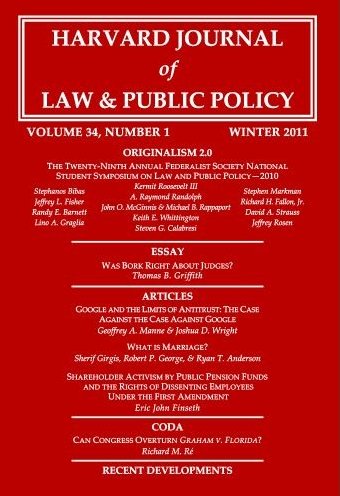
HJLPP coverI’m excited to announce the release of my latest law review article, “The Pursuit of Privacy in a World Where Information Control is Failing,” which appears in the next edition (vol. 36) of the Harvard Journal of Law & Public Policy. This is the first of two complimentary law review articles that I will be releasing this year dealing with privacy policy. The second, which will be published later this summer by the George Mason University Law Review, is entitled, “A Framework for Benefit-Cost Analysis in Digital Privacy Debates.” (FYI: Both articles focus on privacy claims made against private actors — namely, efforts to limit private data collection — and not on privacy rights against governments.)

The new Harvard Journal article is divided into three major sections. Part I focuses on some of normative challenges we face when discussing privacy and argues that there may never be a widely accepted, coherent legal standard for privacy rights or harms here in the United States. It also explores the tensions between expanded privacy regulation and online free speech. Part II turns to the many enforcement challenges that are often ignored when privacy policies are being proposed or formulated and argues that legislative and regulatory efforts aimed at protecting privacy must now be seen as an increasingly intractable information control problem. Most of the problems policymakers and average individuals face when it comes to controlling the flow of private information online are similar to the challenges they face when trying to control the free flow of digitalized bits in other information policy contexts, such as online safety, cybersecurity, and digital copyright.

If the effectiveness of law and regulation is limited by the normative considerations discussed in Part I and the practical enforcement complications discussed in Part II, what alternatives remain to assist privacy-sensitive individuals? I address that question in Part III of the paper and argue that the approach America has adopted to deal with concerns about objectionable online speech and child safety offers a path forward on the privacy front as well. Continue reading →

While there is evidence that patents encourage investment in industries like pharmaceuticals and materials science, their effect on many other industries is markedly negative. In the computing, software, and Internet space, patents represent a serious barrier to innovation, as companies who need to assemble a huge number of licenses are subject to the holdout problem, and as incumbent or has-been firms use patents as weapons against more innovative upstarts. In some cases, these firms deliberately transfer patents to entities known as “trolls,” who exist solely for the purpose of suing the competition.

In theory, it is possible for firms to contract around these problems on a bilateral basis—as a basic reading of Coase suggests, because patents are inefficient in the tech industry, there exists in principle a bargain in which any two firms could agree to ignore patent law. The problem, of course, is the transaction costs. Transaction costs don’t merely add up in the tech industry; they multiply, because of holdout considerations and all the strategic maneuvering associated with firms competing on multiple margins.

I was thrilled, therefore, to see that Google is taking steps to solve this problem. They are proposing to set up a pool which would cross-license their patents to any other firms willing to reciprocate. All members of the pool would receive licenses to all of the patents in the pool. Unlike other existing patent pools, they seem to be interested in achieving the broadest possible participation, and it is being created purely for defensive purposes, not to receive a competitive advantage over firms excluded from the pool.

The proposal is still in a relatively early stage—they are still seeking feedback about which of four licenses the pool should use, which have different features such as permanence of licenses (“sticky” vs. “non-sticky”) and whether firms would be required to license their entire portfolio. For what it’s worth, I hope they choose the Sticky DPL, which seems like the most aggressive of the licenses in terms of taking weapons off the table.

An excellent feature of the pool, particularly if the participants decide to go with the Sticky DPL, is that it would feature very strong network effects. If several firms license their entire patent portfolios to the pool, then that strongly increases the incentive of other firms to join the pool. There is an intriguing tension here between the stated aim of the pool and the incentives pool members have to force other firms to join—by suing non-pool members who infringe on the pool’s patents, they can increase the membership of the pool. I do not strongly oppose this, but I imagine that there will be some philosophical discussion about whether such actions would be right.

Another wrinkle is that firms might transfer several crucial patents to trolls right before they join the pool (keeping a license for themselves, of course). More generally, they may look for legal ways to reap the benefits of the pool while continuing to use trolls to skirmish with their competitors.

But nevertheless, this is an encouraging development that I hope succeeds. If, as I strongly suspect, we are on the wrong side of the Tabarrok curve, the creation of a large cross-licensing pool could increase further the dynamism of our most dynamic industry.

In the upcoming issue of Harvard Business Review, my colleague Paul Nunes at Accenture’s Institute for High Performance and I are publishing the first of many articles from an on-going research project on what we are calling “Big Bang Disruption.”

The project is looking at the emerging ecosystem for innovation based on disruptive technologies.  It expands on work we have done separately and now together over the last fifteen years.

Our chief finding is that the nature of innovation has changed dramatically, calling into question much of the conventional wisdom on business strategy and competition, especially in information-intensive industries–which is to say, these days, every industry.

The drivers of this new ecosystem are ever-cheaper, faster, and smaller computing devices, cloud-based virtualization, crowdsourced financing, collaborative development and marketing, and the proliferation of mobile everything.  There will soon be more smartphones sold than there are people in the world.  And before long, each of over one trillion items in commerce will be added to the network.

The result is that new innovations now enter the market cheaper, better, and more customizable than products and services they challenge.  (For example, smartphone-based navigation apps versus standalone GPS devices.)  In the strategy literature, such innovation would be characterized as thoroughly “undiscplined.”  It shouldn’t succeed.  But it does. Continue reading →

Earlier today on Twitter, I listed what I thought were the Top 5 “Biggest Internet Policy Issues of 2012.” In case you don’t follow me on Twitter — and shame on you if you don’t! — here were my choices:

  1. Copyright wars reinvigorated post-SOPA; tide starting to turn in favor of copyright reform. [TLF posts on copyright.]
  2. Privacy still red-hot w ECPA reform, online advertising regs & kids’ privacy issues all pending. [TLF posts on privacy.]
  3. WCIT makes Internet governance / NetFreedom a major issue worldwide. [TLF posts on Net governance.]
  4. Antitrust threat looms larger w pending Google case + Apple books investigation. [TLF posts on antitrust.]
  5. Cybersecurity regulatory push continues in both legislative (CISPA) & executive branch. [TLF posts on cybersecurity.]

Lists like these are entirely subjective, of course, but I am basing my list on the general amount of chatter I tended to see and hear about each topic over the course of the year.

What do you think the top tech policy issues of the year were?