Jack Schinasi discusses his recent working paper, Practicing Privacy Online: Examining Data Protection Regulations Through Google’s Global Expansion published in the Columbia Journal of Transnational Law. Schinasi takes an in-depth look at how online privacy laws differ across the world’s biggest Internet markets — specifically the United States, the European Union and China. Schinasi discusses how we exchange data for services and whether users are aware they’re making this exchange. And, if not, should intermediaries like Google be mandated to make its data tracking more apparent? Or should we better educate Internet users about data sharing and privacy? Schinasi also covers whether privacy laws currently in place in the US and EU are effective, what types of privacy concerns necessitate regulation in these markets, and whether we’ll see China take online privacy more seriously in the future.
Download
Related Links
Robert Scoble, Startup Liaison Officer at Rackspace discusses his recent book, Age of Context: Mobile, Sensors, Data and the Future of Privacy, co-authored by Shel Israel. Scoble believes that over the next five years we’ll see a tremendous rise in wearable computers, building on interest we’ve already seen in devices like Google Glass. Much like the desktop, laptop, and smartphone before it, Scoble predicts wearable computers represent the next wave in groundbreaking innovation. Scoble answers questions such as: How will wearable computers help us live our lives? Will they become as common as the cellphone is today? Will we have to sacrifice privacy for these devices to better understand our preferences? How will sensors in everyday products help companies improve the customer experience?
Download
Related Links
Alice Marwick, assistant professor of communication and media studies at Fordham University, discusses her newly-released book, Status Update: Celebrity, Publicity, and Branding in the Social Media Age. Marwick reflects on her interviews with Silicon Valley entrepreneurs, technology journalists, and venture capitalists to show how social media affects social dynamics and digital culture. Marwick answers questions such as: Does “status conscious” take on a new meaning in the age of social media? Is the public using social media the way the platforms’ creators intended? How do you quantify the value of online social interactions? Are social media users becoming more self-censoring or more transparent about what they share? What’s the difference between self-branding and becoming a micro-celebrity? She also shares her advice for how to make Twitter, Tumblr, Instagram and other platforms more beneficial for you.
Download
Related Links
Christopher Wolf, director of the law firm Hogan Lovells’ Privacy and Information Management group, addresses his new book with co-author Abraham Foxman, Viral Hate: Containing Its Spread on the Internet. To what extent do hateful or mean-spirited Internet users hide behind anonymity? How do we balance the protection of the First Amendment online while addressing the spread of hate speech? Wolf discusses how to define hate speech on the Internet; whether online hate speech leads to real-world violence; how news sites like the Huffington Post and New York Times have dealt with anonymity; lessons we should impart on the next generation of Internet users to discourage hate speech; and cases where anonymity has proved particularly beneficial or valuable.
Download
Related Links
 I’m pleased to announce the release of my latest law review article, “A Framework for Benefit-Cost Analysis in Digital Privacy Debates.” It appears in the new edition of the George Mason University Law Review. (Vol. 20, No. 4, Summer 2013)
This is the second of two complimentary law review articles I am releasing this year dealing with privacy policy. The first, “The Pursuit of Privacy in a World Where Information Control is Failing,” was published in Vol. 36 of the Harvard Journal of Law & Public Policy
this Spring. (FYI: Both articles focus on privacy claims made against private actors — namely, efforts to limit private data collection — and not on privacy rights against governments.)
My new article on benefit-cost analysis in privacy debates makes a seemingly contradictory argument: benefit-cost analysis (“BCA”) is extremely challenging in online child safety and digital privacy debates, yet it remains essential that analysts and policymakers attempt to conduct such reviews. While we will never be able to perfectly determine either the benefits or costs of online safety or privacy controls, the very act of conducting a regulatory impact analysis (“RIA”) will help us to better understand the trade-offs associated with various regulatory proposals. Continue reading →
 CBS and Time Warner Cable have been embroiled in a heated contractual battle over the past week that has resulted in viewers in some major markets losing access to CBS programming. When disputes like these go nuclear and signal blackouts occur, it is inevitable that some folks will call for policy interventions since nobody likes it when the content they love goes dark.
While some policy responses are warranted in this matter, policymakers should proceed with caution. Heated contractual negotiations are a normal part of any capitalist marketplace. We shouldn’t expect lawmakers to intervene to speed up negotiations or set content prices because that would disrupt the normal allocation of programming by placing a regulatory thumb too heavily on one side of the scale. This is why I am somewhat sympathetic to CBS in this fight. In an age when content creators struggle to protect their copyrighted content and get compensation for it, the last thing we need is government intervention that undermines the few distribution schemes that actually work well.
On the other hand, Time Warner Cable deserves sympathy here, too, since CBS currently enjoys some preexisting regulatory benefits. As I noted in this 2012
Forbes oped, “Toward a True Free Market in Television Programming,” many layers of red tape still encumber America’s video marketplace and prevent a truly free market in video programming from developing. The battle here revolves around the “retransmission consent” rules that were put in place as part of the Cable Act of 1992 and govern how video distributors carry signals from TV broadcasters, which includes CBS.
But those “retrans” rules are not the only part of the regulatory mess here. Continue reading →
Adam Thierer, Senior Research Fellow at the Mercatus Center discusses his recent working paper with coauthor Brent Skorup, A History of Cronyism and Capture in the Information Technology Sector. Thierer takes a look at how cronyism has manifested itself in technology and media markets — whether it be in the form of regulatory favoritism or tax privileges. Which tech companies are the worst offenders? What are the consequences for consumers? And, how does cronyism affect entrepreneurship over the long term?
Download
Related Links
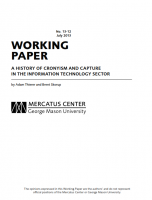 The Mercatus Center at George Mason University has just released a new paper by Brent Skorup and me entitled, “A History of Cronyism and Capture in the Information Technology Sector.” In this 73-page working paper, which we hope to place in a law review or political science journal shortly, we document the evolution of government-granted privileges, or “cronyism,” in the information and communications technology marketplace and in the media-producing sectors. Specifically, we offer detailed histories of rent-seeking and regulatory capture in: the early history of the telephony and spectrum licensing in the United States; local cable TV franchising; the universal service system; the digital TV transition in the 1990s; and modern video marketplace regulation (i.e., must-carry and retransmission consent rules, among others.
Our paper also shows how cronyism is slowly creeping into new high-technology sectors.We document how Internet companies and other high-tech giants are among the fastest-growing lobbying shops in Washington these days. According to the Center for Responsive Politics, lobbying spending by information technology sectors has almost doubled since the turn of the century, from roughly $200 million in 2000 to $390 million in 2012. The computing and Internet sector has been responsible for most of that growth in recent years. Worse yet, we document how many of these high-tech firms are increasingly seeking and receiving government favors, mostly in the form of targeted tax breaks or incentives. Continue reading →
Patrick Ruffini, political strategist, author, and President of Engage, a digital agency in Washington, DC, discusses his latest book with coauthors David Segal and David Moon: Hacking Politics: How Geeks, Progressives, the Tea Party, Gamers, Anarchists, and Suits Teamed Up to Defeat SOPA and Save the Internet. Ruffini covers the history behind SOPA, its implications for Internet freedom, the “Internet blackout” in January of 2012, and how the threat of SOPA united activists, technology companies, and the broader Internet community.
Download
Related Links
Richard Brandt, technology journalist and author, discusses his new book, One Click: Jeff Bezos and the Rise of Amazon.Com. Brandt discusses Bezos’ entrepreneurial drive, his business philosophy, and how he’s grown Amazon to become the biggest retailer in the world. This episode also covers the biggest mistake Bezos ever made, how Amazon uses patent laws to its advantage, whether Amazon will soon become a publishing house, Bezos’ idea for privately-funded space exploration and his plan to revolutionize technology with quantum computing.
Download
Related Links


 The Technology Liberation Front is the tech policy blog dedicated to keeping politicians' hands off the 'net and everything else related to technology.