Posts tagged as:

The future of emerging technology policy will be influenced increasingly by the interplay of three interrelated trends: “innovation arbitrage,” “technological civil disobedience,” and “spontaneous private deregulation.” Those terms can be briefly defined as follows:

  • Innovation arbitrage” refers to the idea that innovators can, and will with increasingly regularity, move to those jurisdictions that provide a legal and regulatory environment more hospitable to entrepreneurial activity. Just as capital now fluidly moves around the globe seeking out more friendly regulatory treatment, the same is increasingly true for innovations. And this will also play out domestically as innovators seek to play state and local governments off each other in search of some sort of competitive advantage.
  • Technological civil disobedience” represents the refusal of innovators (individuals, groups, or even corporations) or consumers to obey technology-specific laws or regulations because they find them offensive, confusing, time-consuming, expensive, or perhaps just annoying and irrelevant. New technological devices and platforms are making it easier than ever for the public to openly defy (or perhaps just ignore) rules that limit their freedom to create or use modern technologies.
  • Spontaneous private deregulation” can be thought of as de facto rather than the de jure elimination of traditional laws and regulations owing to a combination of rapid technological change as well the potential threat of innovation arbitrage and technological civil disobedience. In other words, many laws and regulations aren’t being formally removed from the books, but they are being made largely irrelevant by some combination of those factors. “Benign or otherwise, spontaneous deregulation is happening increasingly rapidly and in ever more industries,” noted Benjamin Edelman and Damien Geradin in a Harvard Business Review article on the phenomenon.[1]

I have previously documented examples of these trends in action for technology sectors as varied as drones, driverless cars, genetic testing, Bitcoin, and the sharing economy. (For example, on the theme of global innovation arbitrage, see all these various essays. And on the growth of technological civil disobedience, see, “DOT’s Driverless Cars Guidance: Will ‘Agency Threats’ Rule the Future?” and “Quick Thoughts on FAA’s Proposed Drone Registration System.” I also discuss some of these issues in the second edition of my Permissionless Innovation book.)

In this essay, I want to briefly highlight how, over the course of just the past month, a single company has offered us a powerful example of how both global innovation arbitrage and technological civil disobedience— or at least the threat thereof—might become a more prevalent feature of discussions about the governance of emerging technologies. And, in the process, that could lead to at least the partial spontaneous deregulation of certain sectors or technologies. Finally, I will discuss how this might affect technological governance more generally and accelerate the movement toward so-called “soft law” governance mechanisms as an alternative to traditional regulatory approaches. Continue reading →

The big news out of Europe today is that the European Court of Justice (ECJ) has invalidated the 15-year old EU-US safe harbor agreement, which facilitated data transfers between the EU and US. American tech companies have relied on the safe harbor to do business in the European Union, which has more onerous data handling regulations than the US. [PDF summary of decision here.] Below I offer some quick thoughts about the decision and some of its potential unintended consequences.

#1) Another blow to new entry / competition in the EU: While some pundits are claiming this is a huge blow to big US tech firms, in reality, the irony of the ruling is that it will bolster the market power of the biggest US tech firms, because they are the only ones that will be able to afford the formidable compliance costs associated with the resulting regulatory regime. In fact, with each EU privacy decision, Google, Facebook, and other big US tech firms just get more dominant. Small firms just can’t comply with the EU’s expanding regulatory thicket. “It will involve lots of contracts between lots of parties and it’s going to be a bit of a nightmare administratively,” said Nicola Fulford, head of data protection at the UK law firm Kemp Little when commenting on the ruling to the BBC. “It’s not that we’re going to be negotiating them individually, as the legal terms are mostly fixed, but it does mean a lot more paperwork and they have legal implications.” And by driving up regulatory compliance costs and causing constant delays in how online business is conducted, the ruling will (again, on top of all the others) greatly limits entry and innovation by new, smaller players in the digital world. In essence, EU data regulations have already wiped out much of the digital competition in Europe and now this ruling finishes off any global new entrants who might have hoped of breaking in and offering competitive alternatives. These are the sorts of stories never told in antitrust circles: costly government rulings often solidify and extend the market dominance of existing companies. Dynamic effects matter. That is certainly going to be the case here. Continue reading →

Tech Policy Threat Matrix

by on September 24, 2015 · 2 comments

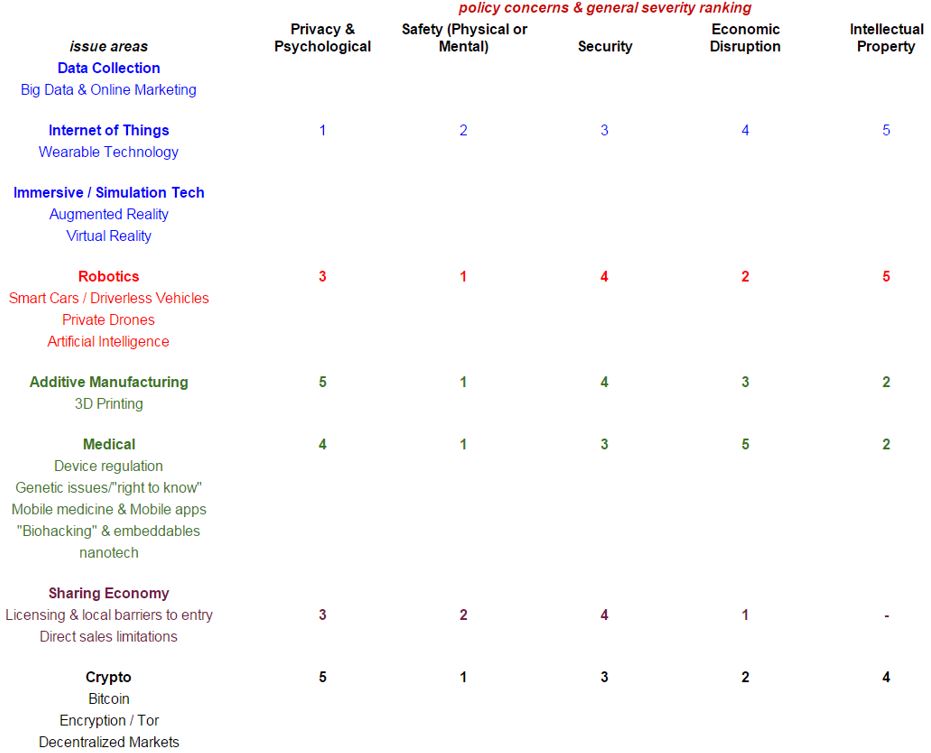
On the whiteboard that hangs in my office, I have a giant matrix of technology policy issues and the various policy “threat vectors” that might end up driving regulation of particular technologies or sectors. Along with my colleagues at the Mercatus Center’s Technology Policy Program, we constantly revise this list of policy priorities and simultaneously make an (obviously quite subjective) attempt to put some weights on the potential policy severity associated with each threat of intervention. The matrix looks like this: [Sorry about the small fonts. You can click on the image to make it easier to see.]


Tech Policy Issue Matrix 2015

I use 5 general policy concerns when considering the likelihood of regulatory intervention in any given area. Those policy concerns are:

  1. privacy (reputation issues, fear of “profiling” & “discrimination,” amorphous psychological / cognitive harms);
  2. safety (health & physical safety or, alternatively, child safety and speech / cultural concerns);
  3. security (hacking, cybersecurity, law enforcement issues);
  4. economic disruption (automation, job dislocation, sectoral disruptions); and,
  5. intellectual property (copyright and patent issues).

Continue reading →

Over the course of the year, I collect some of my favorite (and least favorite) tech policy essays and put them together in an end-of-year blog post so I will remember notable essays in the future. (Here’s my list from 2013.) Here are some of the best tech policy essays I read in 2014 (in chronological order).

  • Joel Mokyr – “The Next Age of Invention,” City Journal, Winter 2014. (An absolutely beautiful refutation of the technological pessimism that haunts our age. Mokry concludes by noting that, “technology will continue to develop and change human life and society at a rate that may well dwarf even the dazzling developments of the twentieth century. Not everyone will like the disruptions that this progress will bring. The concern that what we gain as consumers, viewers, patients, and citizens, we may lose as workers is fair. The fear that this progress will create problems that no one can envisage is equally realistic. Yet technological progress still beats the alternatives; we cannot do without it.” Mokyr followed it up with a terrific August 8 Wall Street Journal oped, “What Today’s Economic Gloomsayers Are Missing.“)
  • Michael Moynihan – “ Can a Tweet Put You in Prison? It Certainly Will in the UK ,”  The Daily Beast , January 23, 2014. (Great essay on the right and wrong way to fight online hate. Here’s the kicker: “There is a presumption that ugly ideas are contagious and if the already overburdened police force could only disinfect the Internet, racism would dissipate. This is arrant nonsense.”)
  • Hanni Fakhoury –  The U.S. Crackdown on Hackers Is Our New War on Drugs,” Wired , January 23, 2014. (“We shouldn’t let the government’s fear of computers justify disproportionate punishment. . . . It’s time for the government to learn from its failed 20th century experiment over-punishing drugs and start making sensible decisions about high-tech punishment in the 21st century.”)
  • Carole Cadwalladr – “Meet Cody Wilson, Creator of the 3D-gun, Anarchist, Libertarian,” Guardian/Observer, February 8, 2014. (Entertaining profile of one of the modern digital age’s most fascinating characters. “There are enough headlines out there which ask: Is Cody Wilson a terrorist? Though my favourite is the one that asks: ‘Cody Wilson: troll, genius, patriot, provocateur, anarchist, attention whore, gun nut or Second Amendment champion.’ Though it could have added, ‘Or b) all of the above?'”)

Continue reading →

Earlier this week I posted an essay entitled, “Global Innovation Arbitrage: Commercial Drones & Sharing Economy Edition,” in which I noted how:

Capital moves like quicksilver around the globe today as investors and entrepreneurs look for more hospitable tax and regulatory environments. The same is increasingly true for innovation. Innovators can, and increasingly will, move to those countries and continents that provide a legal and regulatory environment more hospitable to entrepreneurial activity.

That essay focused on how actions by U.S. policymakers and regulatory agencies threatened to disincentivize homegrown innovation in the commercial drone and sharing economy sectors. But there are many other troubling examples of how America risks losing its competitive advantage in sectors where we should be global leaders as innovators looks offshore. We can think of this as “global innovation arbitrage,” as venture capitalist Marc Andreessen has aptly explained:

Think of it as a sort of “global arbitrage” around permissionless innovation — the freedom to create new technologies without having to ask the powers that be for their blessing. Entrepreneurs can take advantage of the difference between opportunities in different regions, where innovation in a particular domain of interest may be restricted in one region, allowed and encouraged in another, or completely legal in still another.

One of the more vivid recent examples of global innovation arbitrage involves the well-known example of 23andMe, which sells mail-order DNA-testing kits to allow people to learn more about their genetic history and predisposition to various diseases. Continue reading →

Yesterday, the Article 29 Data Protection Working Party issued a press release providing more detailed guidance on how it would like to see Europe’s so-called “right to be forgotten” implemented and extended. The most important takeaway from the document was that, as Reuters reported, “European privacy regulators want Internet search engines such as Google and Microsoft’s Bing to scrub results globally.” Moreover, as The Register reported, the press release made it clear that “Europe’s data protection watchdogs say there’s no need for Google to notify webmasters when it de-lists a page under the so-called “right to be forgotten” ruling.” (Here’s excellent additional coverage from Bloomberg: Google.com Said to Face EU Right-to-Be-Forgotten Rules“). These actions make it clear that European privacy regulators hope to expand the horizons of the right to be forgotten in a very significant way.

The folks over at Marketplace radio asked me to spend a few minutes with them today discussing the downsides of this proposal. Here’s the quick summary of what I told them: Continue reading →

If there is one thing I have learned in almost 23 years of covering communications and media regulation it is this: No matter how well-intentioned, regulation often has unintended consequences that hurt the very consumers the rules are meant to protect. Case in point: “universal service” mandates that require a company to serve an entire area as a condition of offering service at all. The intention is noble: Get service out to everyone in the community, preferably at a very cheap rate. Alas, the result of mandating that result is clear: You get less competition, less investment, less innovation, and less consumer choice. And often you don’t even get everyone served.

Consider this Wall Street Journal article today, “Google Fiber Is Fast, but Is It Fair? The Company Provides Neighborhoods With Faster and Cheaper Service, but Are Some Being Left Behind?” In the story, Alistair Barr notes that:

U.S. policy long favored extending service to all. AT&T touted its “universal service” in advertisements more than a century ago. The concept was codified in a 1934 law requiring nationwide “wire and radio services” to reach everyone at “reasonable charges.” In exchange for wiring a community, telecommunications providers often gained a monopoly. Cities made similar deals with cable-TV providers beginning in the 1960s.

The problem, of course, is that while this model allowed for the slow spread of service to most communities, it came at a very steep cost: Monopoly and plain vanilla service. I documented this in a 1994 essay entitled, “Unnatural Monopoly: Critical Moments in the Development of the Bell System Monopoly.” As well-intentioned regulatory mandates started piling up, competition slowly disappeared. And a devil’s deal was eventually cut between regulators and AT&T to adopt the company’s advertising motto — “One Policy, One System, Universal Service” — as the de facto law of the land. Continue reading →

How is it that we humans have again and again figured out how to assimilate new technologies into our lives despite how much those technologies “unsettled” so many well-established personal, social, cultural, and legal norms?

In recent years, I’ve spent a fair amount of time thinking through that question in a variety of blog posts (“Are You An Internet Optimist or Pessimist? The Great Debate over Technology’s Impact on Society”), law review articles (“Technopanics, Threat Inflation, and the Danger of an Information Technology Precautionary Principle”), opeds (“Why Do We Always Sell the Next Generation Short?”), and books (See chapter 4 of my new book, “Permissionless Innovation: The Continuing Case for Comprehensive Technological Freedom”).

It’s fair to say that this issue — how individuals, institutions, and cultures adjust to technological change — has become a personal obsession of mine and it is increasingly the unifying theme of much of my ongoing research agenda. The economic ramifications of technological change are part of this inquiry, of course, but those economic concerns have already been the subject of countless books and essays both today and throughout history. I find that the social issues associated with technological change — including safety, security, and privacy considerations — typically get somewhat less attention, but are equally interesting. That’s why my recent work and my new book narrow the focus to those issues. Continue reading →

book cover (small)I am pleased to announce the release of my latest book, “Permissionless Innovation: The Continuing Case for Comprehensive Technological Freedom.” It’s a short manifesto (just under 100 pages) that condenses — and attempts to make more accessible — arguments that I have developed in various law review articles, working papers, and blog posts over the past few years. I have two goals with this book.

First, I attempt to show how the central fault line in almost all modern technology policy debates revolves around “the permission question,” which asks: Must the creators of new technologies seek the blessing of public officials before they develop and deploy their innovations? How that question is answered depends on the disposition one adopts toward new inventions. Two conflicting attitudes are evident.

One disposition is known as the “precautionary principle.” Generally speaking, it refers to the belief that new innovations should be curtailed or disallowed until their developers can prove that they will not cause any harms to individuals, groups, specific entities, cultural norms, or various existing laws, norms, or traditions.

The other vision can be labeled “permissionless innovation.” It refers to the notion that experimentation with new technologies and business models should generally be permitted by default. Unless a compelling case can be made that a new invention will bring serious harm to society, innovation should be allowed to continue unabated and problems, if they develop at all, can be addressed later.

I argue that we are witnessing a grand clash of visions between these two mindsets today in almost all major technology policy discussions today. Continue reading →

Google’s announcement this week of plans to expand to dozens of more cities got me thinking about the broadband market and some parallels to transportation markets. Taxi cab and broadband companies are seeing business plans undermined with the emergence of nimble Silicon Valley firms–Uber and Google Fiber, respectively.

The incumbent operators in both cases were subject to costly regulatory obligations in the past but in return they were given some protection from competitors. The taxi medallion system and local cable franchise requirements made new entry difficult. Uber and Google have managed to break into the market through popular innovations, the persistence to work with local regulators, and motivated supporters. Now, in both industries, localities are considering forbearing from regulations and welcoming a competitor that poses an economic threat to the existing operators.

Notably, Google Fiber will not be subject to the extensive build-out requirements imposed on cable companies who typically built their networks according to local franchise agreements in the 1970s and 1980s. Google, in contrast, generally does substantial market research to see if there is an adequate uptake rate among households in particular areas. Neighborhoods that have sufficient interest in Google Fiber become Fiberhoods.

Similarly, companies like Uber and Lyft are exempted from many of the regulations governing taxis. Taxi rates are regulated and drivers have little discretion in deciding who to transport, for instance. Uber and Lyft drivers, in contrast, are not price-regulated and can allow rates to rise and fall with demand. Further, Uber and Lyft have a two-way rating system: drivers rate passengers and passengers rate drivers via smartphone apps. This innovation lowers costs and improves safety: the rider who throws up in cars after bar-hopping, who verbally or physically abuses drivers (one Chicago cab driver told me he was held up at gunpoint several times per year), or who is constantly late will eventually have a hard time hailing an Uber or Lyft. The ratings system naturally forces out expensive riders (and ill-tempered drivers).

Interestingly, support and opposition for Uber and Google Fiber cuts across partisan lines (and across households–my wife, after hearing my argument, is not as sanguine about these upstarts). Because these companies upset long-held expectations, express or implied, strong opposition remains. Nevertheless, states and localities should welcome the rapid expansion of both Uber and Google Fiber.

The taxi registration systems and the cable franchise agreements were major regulatory mistakes. Local regulators should reduce regulations for all similarly-situated competitors and resist the temptation to remedy past errors with more distortions. Of course, there is a decades-long debate about when deregulation turns into subsidies, and this conversation applies to Uber and Google Fiber.

That debate is important, but regulators and policymakers should take every chance to roll back the rules of the past–not layer on more mandates in an ill-conceived attempt to “level the playing field.” Transportation and broadband markets are changing for the better with more competition and localities should generally stand aside.