At the “State of the Net” conference this morning, Alan Murray of The Wall Street Journal interviewed Brian Roberts, Chairman & CEO of Comcast. Here are some highlights. [You can follow all of my live Tweeting at: @AdamThierer]
- Stresses synergies from combination of Comcast cable channels & NBC broadcast properties (ex: Golf Channel & NBC Sports)
- Program access rules “should give fair amount of comfort” to critics who fear that content will be withheld
- “Businesses have to transform & reinvent themselves all the time” NBC part of that transformation for Comcast
- Internet is more friend than foe; broadband has transformed the business for the better
- Businesses grappling w/ ways to extend traditional services to consumers in new ways & still make $$$ (ex: TV Everywhere)

Worth It?
OK, time for a quick rant. What is all this confusion and consternation over early termination fees (ETFs) for high-end smartphones? I mean, seriously, how hard is this process to understand? The FCC has worked itself into a lather over this and is bombarding wireless operators and Google with hate mail letters of inquiry harassing asking them about their ETF policies. I just don’t get it. Let’s review some simple realities:
- Smartphones — especially high-end devices like the iPhone, the Droid, and the Nexus One — are basically mobile mini computers.
- Mini mobile computers do not grow on trees; someone has to make them and sell them at a profit or else no one would offer them to begin with.
- But the people who make and sell these devices (and wireless service for these devices) want to ensure rapid, widespread distribution to win over customers and recoup their costs.
- So, they offer a classic business inducement — an upfront subsidy for the product in exchange for monthly payments to amortize the upfront “loan” they have given the customer;
- AND THEN THEY FORM A CONTRACT WITH THE BUYER TO MAKE THE DEAL WORK. And that contract obligates both sides to live up to their end of the deal.
- Hey… did I mention they need to form a contract to make the deal worth it? OK, good, wanted to make sure I got that point across.
- Then they give you a nice shiny new mobile mini-computer that for some reason we Americans still insist on calling a cell phone.
- Then you start paying off the “loan” they’ve given you for that device over the span of the service contract. This is called “prorating.”
- But, if you default on that loan by breaking your contract, you’ll be hit with a penalty — an early termination fee — since it would leave the carrier without a way to recoup the cost of that shiny new mobile mini-computer that they handed you on the cheap when you just absolutely had to have the hot new toy in town.
Is this process really all that complicated? And why is it so controversial? It certainly shouldn’t be. Prorating happens every day in countless ways in a capitalist economy. And yet in the apparent techno-entitlement society we live in these days, some people seem to think there’s something scandalous about this process when it happens with our beloved mobile devices. In reality, the smartphone subsidy and prorated contract system is really one of the great pro-consumer accomplishments of our time. Continue reading →
There’s been a lot of hand-wringing lately about Google’s recent acquisitions of Teracent (ad-personalization) and AdMob (mobile ads), as well as Apple’s response, buying AdMob’s rival Quattro Wireless. Jeff Chester, true To form, quickly fired off an angry letter to FTC Chairman Jon Leibowitz, ranting about how the Google/AdMob deal would harm consumer privacy with the same vague fulminations as ever:
Google amasses a goldmine of data by tracking consumers’ behavior as they use its search engine and other online services. Combining this information with information collected by AdMob would give Google a massive amount of consumer data to exploit for its benefit.
Yup, that’s right, it’s all part of Google’s grand conspiracy to exploit (and eventually enslave) us all—and Apple is just a latecomer to this dastardly game. It’s not as if that data about users’ likely interests might, oh, I don’t know… actually help make advertising more relevant—and thus increase advertising revenues for the mobile applications/websites that depend on advertising revenues to make their business models work. No, of course not! Greedy capitalist scum like Google and Apple don’t care about anyone but themselves, and just want to extract every last drop of “surplus value” (as Marx taught us) from The Worker. (Never mind that in 4Q2009 Google generated $1.47 billion for website owners who use Google AdSense to sell ads on their sites—up 17% over 4Q2008—or that Apple has a strong incentive to maximize revenues for its iPhone app developers.) Internet users of the world, unite! You have nothing to lose but all those “free” content and services thrown at your feet! Continue reading →
 This morning at the Newseum in Washington, DC, U.S. Secretary of State Hillary Rodham Clinton delivered remarks on Internet freedom and the future of global free speech and expression. [Transcript is here + video.] It will go down as a historic speech in the field of Internet policy since she drew a bold line in the cyber-sand regarding exactly where the United States stands on global online freedom. Clinton’s answer was unequivocal: “Both the American people and nations that censor the Internet should understand that our government is committed to helping promote Internet freedom.” “The Internet can serve as a great equalizer,” she argued. “By providing people with access to knowledge and potential markets, networks can create opportunities where none exist.”
Unfortunately, however, “the same networks that help organize movements for freedom… can also be hijacked by governments to crush dissent and deny human rights.” Echoing Winston Churchill’s famous “iron curtain” speech, Sec. Clinton argued that “With the spread of these restrictive practices, a new information curtain is descending across much of the world.” She noted that virtual walls are replacing traditional walls in many nations as repressive regimes seek to squash the liberties of their citizenry. That’s why the Administration’s bold stand in favor of online freedom is so essential.
Importantly, Sec. Clinton made it clear that the Obama Administration is ready to commit significant resources to this effort. She said that, over the next year, the State Department plans to work with others to establish a standing effort to promote technology and will invite technologists to help advance the cause through a new “innovation competition” that will promote circumvention technologies and other technologies of freedom. Sec. Clinton also challenged private companies to stand up to censorship globally and challenge foreign governments when they demand controls on the free flow of information or digital technology.
That is particularly important because Secretary Clinton’s speech comes on the heels of the recent news that Google and at least 30 other Internet companies were the victims of cyberattacks in China, which raises profound questions about the future of online freedom and cybersecurity. Sec. Clinton’s remarks will make it clear to online operators that the U.S. government stands prepared to back them up when they challenge the censorial policies of repressive foreign regimes.
Continue reading →
In a letter to the editor of the Washington Post last week, former FTC Commissioner Thomas Leary responded to a Post article describing the FTC’s suit against Intel as a “major step for President Obama,” consistent with his campaign promise to “reinvigorate antitrust enforcement.” Leary responded indignantly to this characterization by declaring:
People seem to forget that the FTC is a bipartisan independent agency.
As a Republican FTC commissioner appointed by a Democratic president, I can vouch for the agency’s independence. During my service from 1999 to 2005 in the administrations of presidents Bill Clinton and George Bush, I never received a direct or indirect policy recommendation on a pending matter from anyone in the White House or from any of the people in Congress who had actively supported me.
Leary’s leeriness about political encroachment on the FTC illustrates the depth of abiding faith in independent regulatory agencies as standing truly apart from the day-to-day politics of Washington—especially when the might of the regulatory state is being wielded against a particular company in quasi-judicial prosecutions, such as antitrust enforcement actions. But if the independence of the FTC is this important, what about the independence of the Federal Communications Commission, with its broad jurisdiction over the media and tools of free speech?
Leary would probably be appalled at the politicization of the FCC in recent years. Bush’s second FCC chairman, Kevin Martin, was infamous for his political Machiavellianism and widely despised by the communications law bar. By contrast, when it became clear that Obama’s high-tech advisor Julius Genachowski would succeed Martin as FCC Chairman shortly before Obama’s inauguration, he received a chorus of applause from a wide range of philosophical perspectives, including from our former president at PFF, Ken Ferree:
Julius Genachowski is an outstanding choice to chair the Commission. He is knowledgeable, experienced, and presumably will have the ear of the most influential people within the Administration.
While no one would compare the eminently likable Genachowski to Martin, his relationship to the Obama administration appears unprecedented in its closeness, and one must ask whether that’s a good thing for the head of a supposedly “independent” regulatory agency or integrity of that agency’s decision-making. Continue reading →
It may be possible to wring consistency from the “open” manifesto Google SVP of Product Management Jonathan Rosenberg published earlier this week, but I can’t.
He correctly extols the virtues of openness in technology and data for its pro-competitive effects. Closed systems may be profitable in the short run, but they are weak innovation engines:
[A] well-managed closed system can deliver plenty of profits. They can also deliver well-designed products in the short run — the iPod and iPhone being the obvious examples — but eventually innovation in a closed system tends towards being incremental at best (is a four blade razor really that much better than a three blade one?) because the whole point is to preserve the status quo. Complacency is the hallmark of any closed system. If you don’t have to work that hard to keep your customers, you won’t.
But his paean to openness draws a tight line around Google’s profitable products: Continue reading →
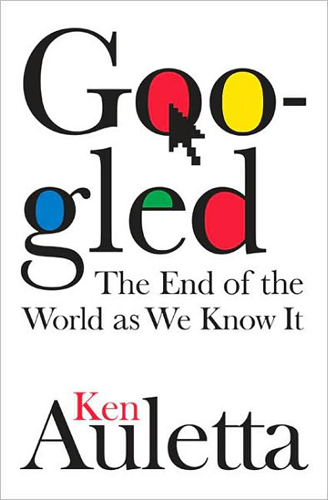 I just finished Ken Auletta’s latest book,
Googled: The End of the World As We Know It, and I highly recommend it. Auletta is an amazingly gifted journalist and knows how put together a hell of good story. It helps in this case that he was granted unprecedented access to the Google team and their day-to-day workings at the Googleplex. I’m really shocked by the level of access he was granted to important meetings and officials–over 150 interviews with Googlers, including 11 with CEO Eric Schmidt and several with founders Sergey Brin and Larry Page. That’s impressive.
I just finished Ken Auletta’s latest book,
Googled: The End of the World As We Know It, and I highly recommend it. Auletta is an amazingly gifted journalist and knows how put together a hell of good story. It helps in this case that he was granted unprecedented access to the Google team and their day-to-day workings at the Googleplex. I’m really shocked by the level of access he was granted to important meetings and officials–over 150 interviews with Googlers, including 11 with CEO Eric Schmidt and several with founders Sergey Brin and Larry Page. That’s impressive.
The book shares much in common with Randall Stross’s excellent Planet Google: One Company’s Audacious Plan to Organize Everything We Know, which I reviewed here earlier this year. Both books recount the history of Google from its early origins to present. And both survey a great deal of ground in terms of the challenges that Google faces as it matures and the policy issues that are relevant to the company (privacy, free speech, copyright law, etc).
What makes Auletta’s book unique is the way we taps his extensive “old media” world contacts and integrates such a diverse cast of characters into the narrative — Mel Karmazin (former Viacom, now Sirius XM), Bob Iger (Disney), Howard Stringer (Sony), Martin Sorrrell (WPP), Irwin Gotlieb (Group M), and even the Internet’s “inventor”–Al Gore! Auletta interviews them or recounts stories about their interactions with Google to show the growing tensions being created by this disruptive company and its highly disruptive technologies. There are some terrifically entertaining anecdotes in the book, but the bottom line is clear: Google has made a lot of enemies in a very short time.
Indeed, the book is as much about the decline of old media as it is about Google’s ascendancy. What Auletta has done so brilliantly here is to tell their stories together and ask how much old media’s recent woes can be blamed on Google and digital disintermediation in general. “If Google is destroying or weakening old business models,” Auletta argues, “it is because the Internet inevitably destroys old ways of doing things, spurs ‘creative destruction.’ This does not mean that Google is not ambitious to grow, and will not grow at the expense of others. But the rewards, and the pain, are unavoidable,” he concludes. Continue reading →
The disabled have much to give thanks for this year—but contrary to common assumptions, it’s not for paternalistic government accessibility mandates, regulations or subsidies (see, for example, the FCC’s November 6 Broadband Accessibility workshop), but for the good ol’ fashioned private sector ingenuity that has made America great. Five broad categories of examples suggest how constantly-improving computing power and innovation can make life easier for many, if not all, disabled users—and how market forces empower the disabled along with everyone else.
Video transcription. Last week, Google announced “the preliminary roll-out of automatic captioning in YouTube, an innovation that takes advantage of our speech recognition technology to turn the spoken word into text captions.” Google uses the same speech recognition technology it refined with its free Goog-411 and Google Voice services to automatically transcribe video dialog (which can also be automatically translated using Google’s translation engine). Why? Not because of any government mandate, but because of some combination of three factors: (i) it’s an easy way for Google to invest in its “reputational capital,” (ii) the underlying technologies of transcribing videos make videos easier to use for all users, not just the hearing-impaired, and (iii) those technologies also make it possible to contextually target advertising to the verbal content of videos.
http://www.youtube.com/v/kTvHIDKLFqc&hl=en_US&fs=1&
It’s worth noting that Hulu currently offers closed captioning for some of its television programming but notes that “closed-captioning data that’s used for broadcast TV isn’t easily translated for online use.” The online television clearinghouse promises to offer more closed-captioning soon. Perhaps they ought to license Google’s algorithmic transcription?
Voice recognition for direct consumer use—most notably, Dragon NaturallySpeaking 10, the latest version of the leading voice recognition software, which was released in summer 2008 but only recently seems to have really hit critical mass. Continue reading →
I was just digging through some old files and came across a quote that I found entertaining. Back in 2003, when he was still president and chief operating officer of Viacom, Mel Karmazin said with reference to Microsoft, AOL-Time Warner, and Comcast: “I can’t imagine being a competitor with any of these guys.” At the time, some media worrywarts made great hay of Mel’s quip and claimed, as Gene Kimmelman of Consumers Union argued at the time, that it proved how “Media moguls themselves admit their desire to avoid real competition within their industry.”
Utter rubbish. In fact, just six years after Karmazin spoke those words, Microsoft finds itself in a heated war with Google on all fronts, AOL-Time Warner has crumbled (even Time Warner Cable and Time Warner Entertainment got divorced!), and Comcast is now squaring off against telco and online video competitors that were unfathomable at the time (not to mention traditional satellite TV competitors.) In the meanwhile, Karmazin abandoned Viacom and today, as CEO of Sirius XM, is struggling to find a way to make the satellite radio universe survive the ongoing digital music bloodbath thanks to unforeseen competition from online music services and a little thing called the iPod!
It’s proof positive that media markets and digital technologies
always evolve faster than most people — even smart industry titans like Karmazin — anticipate.
Google has just announced its 2010 Fellowships, open to students 18+ (as of January 1st, 2010) eligible to work U.S. Among the participating organizations are three think tanks home to TLFers: The Progress & Freedom Foundation (Adam & I), the Competitive Enterprise Institute (Ryan Radia) and Cato (Jim Harper). Applications are due December 28th, 2009, so apply today to help us in the fight for real Internet freedom!

 The Technology Liberation Front is the tech policy blog dedicated to keeping politicians' hands off the 'net and everything else related to technology.