Posts tagged as:

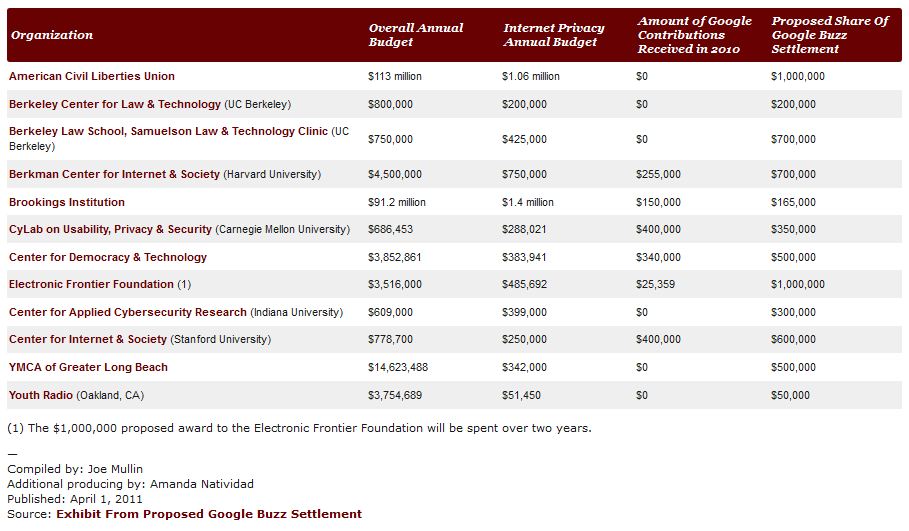
PaidContent.org has posted a chart showing “Who’s Getting Buzz Settlement Money.” This refers to the $9.5 million payout following the Federal Trade Commission settlement with Google a class action suit over its “Buzz” social networking service. Last week, the Federal Trade Commission entered into a consent decree with Google over its botched rollout of Buzz saying the search giant violated its own privacy policy. Google will also pay out to various advocacy groups according to the distribution seen in the chart as part of a separate class action. Payouts to advocates like this are not uncommon, although they are more often the result of a class action settlement than a regulatory agency consent decree. [Update/Correction 5:13 pm: I should have made it clear that this payout was the result of a class action lawsuit against Google and not the direct result of the FTC settlement. Apologies for that mistake, but still interested in the questions raised below.]

But that got me wondering whether this might make for good fodder for a case study by a public choice economist or political scientist. There are some really interesting questions raised by settlements like this that would be worth studying.

Continue reading →

I’ve posted a long article on Forbes.com this morning on the Global Network Initiative. A non-profit group aimed at improving human rights though the agency of information technology companies, GNI has never really gotten off the ground.

Since its formal launch in 2008, following two years of negotiations among tech companies, human rights groups and academics, not a single company has agreed to join beyond the original members–Google, Yahoo and Microsoft.

This despite considerable pressure from supporters of GNI, including Senator Richard Durbin (D-IL), Chair of the Senate Judiciary’s Subcommittee on Human Rights.  Indeed, in the wake of uprisings in Tunisia, Egypt, Libya and elsewhere and the seminal role played by social media and other IT, a full-court press has been launched against Facebook and Twitter in particular for failing to sign up. Continue reading →

The New York Times reports that, “Facebook is hoping to do something better and faster than any other technology start-up-turned-Internet superpower. Befriend Washington. Facebook has layered its executive, legal, policy and communications ranks with high-powered politicos from both parties, beefing up its firepower for future battles in Washington and beyond.”  The article goes on to cite a variety of recent hires by Facebook, its new DC office, and its increased political giving.

This isn’t at all surprising and, in one sense, it’s almost impossible to argue with the logic of Facebook deciding to beef up its lobbying presence inside the Beltway. In fact, later in the Times story we hear the same two traditional arguments trotted out for why Facebook must do so: (1) Because everyone’s doing it! and (2) You don’t want be Microsoft, do you?   But I’m not so sure whether “normalizing relations” with Washington is such a good idea for Facebook or other major tech companies, and I’m certainly not persuaded by the logic of those two common refrains regarding why every tech company must rush to Washington.

Continue reading →

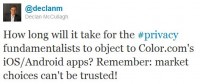
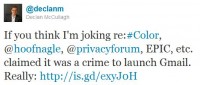
Last night, Declan McCullagh of CNet posted two tweets related to the concerns already percolating in the privacy community about a new Apple and Android app called “Color,” which allows those who use it to take photos and videos and instantaneously share them with other people within a 150-ft radius to create group photo/video albums. In other words, this new app marries photography, social networking, and geo-location. And because the app’s default setting is to share every photo and video you snap openly with the world, Declan wonders “How long will it take for the #privacy fundamentalists to object to Color.com’s iOS/Android apps?” After all, he says facetiously, “Remember: market choices can’t be trusted!”  He then reminds us that there’s really nothing new under the privacy policy sun and that we’ve seen this debate unfold before, such as when Google released its GMail service to the world back in 2004.

Indeed, for me, this debate has a “Groundhog Day” sort of feel to it.  I feel like I’ve been fighting the same fight with many privacy fundamentalists for the past decade. The cycle goes something like this: Continue reading →

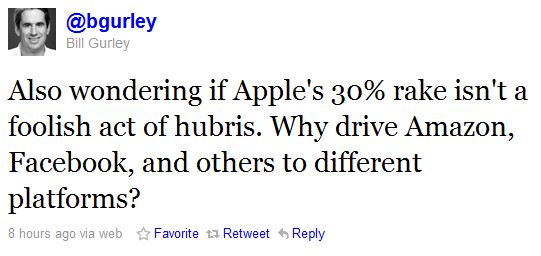
Venture capitalist Bill Gurley asked a good question in a Tweet late last night when he was “wondering if Apple’s 30% rake isn’t a foolish act of hubris. Why drive Amazon, Facebook, and others to different platforms?” As most of you know, Gurley is referring to Apple’s announcement in February that it would require a 30% cut of app developers’ revenues if they wanted a place in the Apple App Store.

Indeed, why would Apple be so foolish? Of course, some critics will cry “monopoly!” and claim that Apple’s “act of hubris” was simply a logical move by a platform monopolist to exploit its supposedly dominant position in the mobile OS / app store marketplace.  But what then are we to make of Amazon’s big announcement yesterday that it was jumping in the ring with its new app store for Android? And what are we to make of the fact that Google immediately responded to Apple’s 30% announcement by offering publishers a more reasonable 10%-of-the-cut deal?  And, as Gurley notes, you can’t forget about Facebook. Who knows what they have up their sleeve next.  They’ve denied any interest in marketing their own phone and, at least so far, have not announced any intention to offer a competing app store, but why would they need to? Their platform can integrate apps directly into it!  Oh, and don’t forget that there’s a little company called Microsoft out there still trying to stake its claim to a patch of land in the mobile OS landscape. Oh, and have you visited the HP-Palm development center lately?  Some very interesting things going on there that we shouldn’t ignore.

What these developments illustrate is a point that I have constantly reiterated here: Continue reading →

Here are some quick thoughts on the proposed AT&T – T-Mobile merger, mostly borrowed from my previous writing on the wireless marketplace. First, however, I highly recommend this excellent analysis of the issue by Larry Downes, which cuts through the hysteria we’re already hearing and offers a sober look at the issues at stake here.  Anyway, here are a few of my random thoughts on the deal:

  • The deal will likely be approved: First, to cut to the chase.. After much wrangling, the deal will probably be approved primarily because of two factors, both of which help political officials as much as AT&T: (1) The deal delivers upon the National Broadband Plan promise of getting the country blanketed with wireless broadband; and (2) it “brings home” T-Mobile by giving an American company control of a German-held interest. As Larry Dignan of ZNet says, it is tantamount to “playing the patriotism card.”

  • One reason it might not be approved: Some Administration critics, especially from the more liberal part of the Democratic base, could make this a litmus test for Obama administration’s antitrust enforcement efforts. In the wake of the Comcast merger approval — albeit after several pounds of flesh were handed over “voluntarily” to get the deal approved — some of the Administration’s base will be looking for blood. I remember how the Powell FCC was under real heat to “get tough” on mergers back in 2001-02 and during that time blocked the proposed DirecTV-EchoStar deal, possibly as a result of the pressure. The same thing could happen to AT&T – T-Mobile here.

  • It’s all about spectrum: From AT&T’s perspective, this deal is all about getting more high-quality spectrum, which is in increasingly short supply. Indeed, as Jerry Brito noted earlier, this merger should serve as another wake-up call regarding the need to get spectrum reform going again to ensure that existing players can reallocate their spectrum to those who demand it most. (Hint: Incentivize the TV broadcasters to sell... NOW!) But, in the short-term, this deal helps AT&T built out a more robust nationwide wireless network. Over the long-haul, that should help T-Mobile deliver better service to its customers. Continue reading →

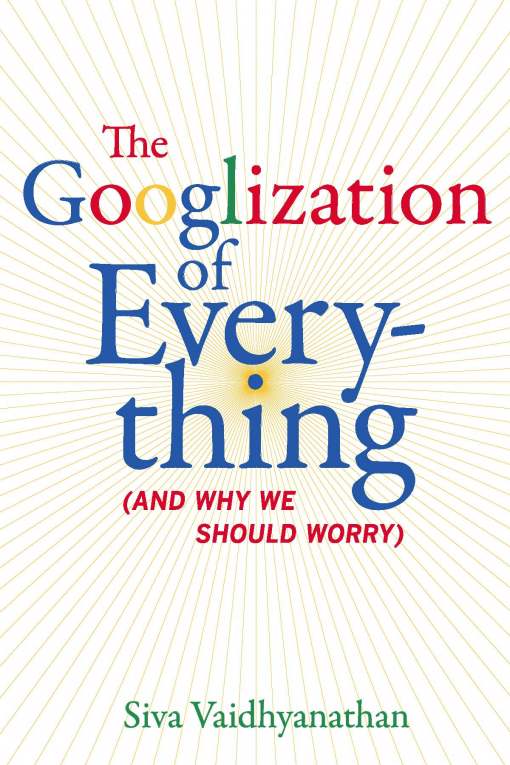
In one sense, Siva Vaidhyanathan’s new book, The Googlization of Everything (And Why Should Worry), is exactly what you would expect: an anti-Google screed that predicts a veritable techno-apocalypse will befall us unless we do something to deal with this company that supposedly “rules like Caesar.” (p. xi)  Employing the requisite amount of panic-inducing Chicken Little rhetoric apparently required to sell books these days, Vaidhyanathan tells us that “the stakes could not be higher,” (p. 7) because the “corporate lockdown of culture and technology” (p. xii) is imminent.

After lambasting the company in a breathless fury over the opening 15 pages of the book, Vaidhyanathan assures us that “nothing about this means that Google’s rule is as brutal and dictatorial as Caesar’s. Nor does it mean that we should plot an assassination,” he says. Well, that’s a relief!  Yet, he continues on to argue that Google is sufficiently dangerous that “we should influence—even regulate—search systems actively and intentionally, and thus take responsibility for how the Web delivers knowledge.” (p. xii)  Why should we do that? Basically, Google is just too damn good at what it does. The company has the audacity to give consumers exactly what they want! “Faith in Google is dangerous because it increases our appetite for goods, services, information, amusement, distraction, and efficiency.” (p. 55) That is problematic, Vaidhyanathan says, because “providing immediate gratification draped in a cloak of corporate benevolence is bad faith.” (p. 55) But this begs the question:  What limiting principle should be put in place to curb our appetites, and who or what should enforce it? Continue reading →

Today I filed roughly 30 pages worth of comments with the Federal Trade Commission (FTC) in its proceeding on “Protecting Consumer Privacy in an Era of Rapid Change: a Proposed Framework for Businesses and Policy Makers.” [Other comments filed in the proceeding can be found here.] Down below, I’ve attached the Table of Contents from my filing so you can see the major themes I’ve addressed, and I’ve also attached the entire document in a Scribd reader. In coming days and weeks, I’ll be expanding upon some of these themes in follow-up essays.

In my filing, I argue that while it remains impossible to predict with precision the impact a new privacy regulatory regime will have the Internet economy and digital consumers, regulation will have consequences; of that much we can be certain.  As the FTC  and other policy makers move forward with proposals to expand regulation in this regard, it is vital that the surreal “something-for-nothing” quality of current privacy debate cease. Those who criticize data collection or online advertising and call for expanded regulation should be required to provide a strict cost-benefit analysis of the restrictions they would impose upon America’s vibrant digital marketplace.

In particular, it should be clear that the debate over Do Not Track and online advertising regulation is fundamentally tied up with the future of online content, culture, and services. Thus, regulatory advocates must explain how the content and services supported currently by advertising and marketing will be sustained if current online data collection and ad targeting techniques are restricted. Continue reading →

As Adam notes, Columbia lawprof and holder of the dubious distinction of having originated the term and concept of Net Neutrality, Tim Wu, is headed to the FTC as a senior advisor.

Curiously, his guest stint runs for only about four and a half months.  As the WSJ reports:

Mr. Wu, 38, will start his new position on Feb. 14 in the FTC’s Office of Policy Planning, and will help the agency to develop policies that affect the Internet and the market for mobile communications and services. The FTC said Mr. Wu will work in the unit until July 31. Mr. Wu, who is taking a leave from Columbia, said that to work after that date he would have to request a further leave from the university.

Mr. Wu’s claim that the source of the date constraint is Columbia doesn’t pass the smell test.  Now, it is possible that what he says is  literally true–and therefore intentionally misleading.  Perhaps he asked only for leave through the end of July and would indeed have to request further leave if he wanted it.  But the implication that Columbia would have trouble granting further leave–especially during the summer!–and thus the short tenure seems very fishy to me.

So what else could be going on, while we’re reading inscrutable tea leaves?  Well, for one thing, it could be that Wu has already signed on for some not-yet-public role at Columbia that he prefers not to imperil.  Maybe associate dean or something like that.

But I have another, completely unsupported speculation.  I think the author of The Master Switch (commented on by Josh and me here) and one of the most capable (as far as that goes) proponents of Internet regulation in the land is being brought in to the FTC to help the agency gin up a case against Google.

I think with Google-ITA seemingly approaching its denouement, the FTC knows or believes that Google is either planning to abandon the merger or else enter into an (insufficiently-restrictive for the FTC) settlement with the DOJ.  In either case, not a full-blown investigation and intervention into Google’s business.  So the FTC is preparing its own Section 5 (and Section 2, but who needs that piker when you have the real deal in Section 5?) (for previous TOTM takes on Section 5, see, e.g., here and here) case and has brought in Wu to help.  Given the switching back and forth between the DOJ and FTC in reviewing Google mergers, it could very well be (I haven’t kept close tabs on Google’s proposed acquisitions) that there’s even already another merger review in waiting at the FTC on which the agency is planning to build its case.

But the phase of the case requiring Wu’s full attention–the conceptual early phase–should be completed by the end of July, so no need to detain him further.

More concretely, I would point out that it says a lot about the agency’s mindset that it is bringing in the likes of Wu to help it with its ongoing forays into the regulation of Internet businesses.  By comparison, I would just point out that Chairman Majoras’ FTC brought in our own Josh Wright as the agency’s first Scholar in Residence.  Sends a very different signal, don’t you think?
For my contribution to Berin Szoka and Adam Marcus’ (of TechFreedom fame) awesome Next Digital Decade book, I wrote about search engine “neutrality” and the implicit and explicit claims that search engines are “essential facilities.” (Check out the other essays on this topic by Frank Pasquale, Eric Goldman and James Grimmelmann, linked to here, under Chapter 7).

The scare quotes around neutrality are there because the term is at best a misnomer as applied to search engines and at worst a baseless excuse for more regulation of the Internet.  (The quotes around essential facilities are there because it is a term of art, but it is also scary).  The essay is an effort to inject some basic economic and legal reasoning into the overly-emotionalized (is that a word?) issue.

So, what is wrong with calls for search neutrality, especially those rooted in the notion of Internet search (or, more accurately, Google, the policy scolds’ bête noir of the day) as an “essential facility,” and necessitating government-mandated access? As others have noted, the basic concept of neutrality in search is, at root, farcical. The idea that a search engine, which offers its users edited access to the most relevant websites based on the search engine’s assessment of the user’s intent, should do so “neutrally” implies that the search engine’s efforts to ensure relevance should be cabined by an almost-limitless range of ancillary concerns. Nevertheless, proponents of this view have begun to adduce increasingly detail-laden and complex arguments in favor of their positions, and the European Commission has even opened a formal investigation into Google’s practices, based largely on various claims that it has systematically denied access to its top search results (in some cases paid results, in others organic results) by competing services, especially vertical search engines. To my knowledge, no one has yet claimed that Google should offer up links to competing general search engines as a remedy for its perceived market foreclosure, but Microsoft’s experience with the “Browser Choice Screen” it has now agreed to offer as a consequence of the European Commission’s successful competition case against the company is not encouraging. These more superficially sophisticated claims are rooted in the notion of Internet search as an “essential facility” – a bottleneck limiting effective competition. These claims, as well as the more fundamental harm-to-competitor claims, are difficult to sustain on any economically-reasonable grounds. To understand this requires some basic understanding of the economics of essential facilities, of Internet search, and of the relevant product markets in which Internet search operates.

The essay goes into much more detail, of course, but the basic point is that Google’s search engine is not, in fact, “essential” in the economically-relevant sense.  Rather, Google’s competitors and other detractors have basically built precisely the most problematic sort of antitrust case, where success itself is penalized (in this case, Google is so good at what it does it just isn’t fair to keep it all to itself!). Continue reading →