[UPDATE
4/30/13: This article was subsequently published in Volume 65, Issues 2 of the Federal Communications Law Journal in April 2013. The links below now point to the final FCLJ version.]
The Mercatus Center at George Mason University has just released a new paper by Brent Skorup and me entitled, “Uncreative Destruction: The War on Vertical Integration in the Information Economy.” Brent, who is the research director for the Information Economy Project at the George Mason University School of Law, and I have been working on this paper since the Spring and we are looking forward to getting it published in a law review shortly. The paper focuses on Tim Wu’s “separations principle” for the digital economy, something I’ve spent some time critiquing here in the past. Here’s the introduction from the 44-page paper that Brent and I just released:
Are information sectors sufficiently different from other sectors of the economy such that more stringent antitrust standards should be applied to them preemptively? Columbia Law School professor Tim Wu responds in the affirmative in his book The Master Switch: The Rise and Fall of Information Empires. Having successfully pushed net-neutrality regulation into the policy spotlight, Wu has turned his attention to what he regards as excessive market concentration and threats to free speech throughout the entire information economy.To support his call for increased antitrust intervention, Wu explains his view of competition in the information economy—a view that deviates substantially from current mainstream antitrust theory.
Continue reading →
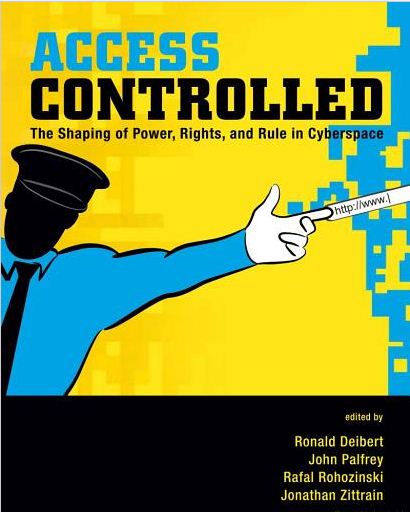
 Faithful readers know of my geeky love for tech policy books. I read lots of ’em. There’s a steady stream of Amazon.com boxes that piles up on my doorstop some days because my mailman can’t fit them all in my mailbox. But I go pretty hard on all the books I review. It’s rare for me pen a glowing review. Occasionally, however, a book will come along that I think is both worthy of your time and which demands a place on your bookshelf because it is such an indispensable resource. Access Controlled: The Shaping of Power, Rights, and Rule in Cyberspace is one of those books.
Smartly organized and edited by Ronald J. Deibert, John G. Palfrey, Rafal Rohozinski, and Jonathan Zittrain, Access Controlled is essential reading for anyone studying the methods governments are using globally to stifle online expression and dissent. As I noted of their previous edition, Access Denied: The Practice and Policy of Global Internet Filtering, there is simply no other resource out there like this; it should be required reading in every cyberlaw or information policy program.
The book, which is a project of the OpenNet Initiative (ONI), is divided into two parts. Part 1 of the book includes six chapters on “Theory and Analysis.” They are terrifically informative essays, and the editors have made them all available online here (I’ve listed them down below with links embedded). The beefy second part of the book provides a whopping 480 pages(!) of detailed regional and country-by-country overviews of the global state of online speech controls and discuss the long-term ramifications of increasing government meddling with online networks.
In their interesting chapter on “Control and Subversion in Russian Cyberspace,” Deibert and Rohozinski create a useful taxonomy to illustrate the three general types of speech and information controls that states are deploying today. What I find most interesting is how, throughout the book, various authors document the increasing movement away from “first generation controls,” which are epitomized by “Great Firewall of China”-like filtering methods, and toward second- and third-generation controls, which are more refined and difficult to monitor. Here’s how Deibert and Rohozinski define those three classes (or “generations”) of controls: Continue reading →
 This morning at the Newseum in Washington, DC, U.S. Secretary of State Hillary Rodham Clinton delivered remarks on Internet freedom and the future of global free speech and expression. [Transcript is here + video.] It will go down as a historic speech in the field of Internet policy since she drew a bold line in the cyber-sand regarding exactly where the United States stands on global online freedom. Clinton’s answer was unequivocal: “Both the American people and nations that censor the Internet should understand that our government is committed to helping promote Internet freedom.” “The Internet can serve as a great equalizer,” she argued. “By providing people with access to knowledge and potential markets, networks can create opportunities where none exist.”
Unfortunately, however, “the same networks that help organize movements for freedom… can also be hijacked by governments to crush dissent and deny human rights.” Echoing Winston Churchill’s famous “iron curtain” speech, Sec. Clinton argued that “With the spread of these restrictive practices, a new information curtain is descending across much of the world.” She noted that virtual walls are replacing traditional walls in many nations as repressive regimes seek to squash the liberties of their citizenry. That’s why the Administration’s bold stand in favor of online freedom is so essential.
Importantly, Sec. Clinton made it clear that the Obama Administration is ready to commit significant resources to this effort. She said that, over the next year, the State Department plans to work with others to establish a standing effort to promote technology and will invite technologists to help advance the cause through a new “innovation competition” that will promote circumvention technologies and other technologies of freedom. Sec. Clinton also challenged private companies to stand up to censorship globally and challenge foreign governments when they demand controls on the free flow of information or digital technology.
That is particularly important because Secretary Clinton’s speech comes on the heels of the recent news that Google and at least 30 other Internet companies were the victims of cyberattacks in China, which raises profound questions about the future of online freedom and cybersecurity. Sec. Clinton’s remarks will make it clear to online operators that the U.S. government stands prepared to back them up when they challenge the censorial policies of repressive foreign regimes.
Continue reading →
The smell of high-tech regulation is increasingly in the air these days and many lawmakers and some activist groups now have the mobile marketplace in their regulatory cross-hairs. Critics make a variety of claims about the wireless market supposedly lacking competition, choice, innovation, or reasonable pricing. Consequently, they want to wrap America’s wireless sector in a sea of red tape. Two important new studies thoroughly debunk these assertions and set the record straight regarding the state of wireless competition and innovation in the U.S. today. These reports are must-reading for Washington policymakers and FCC officials who are currently contemplating regulatory action.
First, Gerald Faulhaber and Dave Farber have a new report out entitled “Innovation in the Wireless Ecosystem: A Customer-Centric Framework.” Here’s what Faulhaber and Farber find:
the three segments of the wireless marketplace (applications, devices, and core network) have exhibited very substantial innovation and investment since its inception. Perhaps more interesting, innovation in each segment is highly dependent upon innovation in the other segments. For example, new applications depend upon both advances in device hardware capabilities and advances in spectral efficiency of the core network to provide the network capacity to serve those applications. Further, we find that the three segments of the industry are also highly competitive. There are many players in each segment, each of which aggressively seeks out customers through new technology and new business methods. The results of this competition are manifest: (i) firms are driven to innovate and invest in order to win in the competitive marketplace; (ii) new business models have emerged that give customers more choice; and (iii) firms have opened new areas such as wireless broadband and laptop wireless in order to expand their strategic options.
They continue on to address the policy issues in play here and discuss the “consumer-centric” approach they recommend that the FCC adopt: Continue reading →
Harvard’s Jonathan Zittrain has launched an interesting new project called “HerdictWeb,” which “seeks to gain insight into what users around the world are experiencing in terms of web accessibility; or in other words, determine the herdict.” It’s a useful tool for determining whether governments are blocking certain websites for whatever reason. Here’s Zittrain’s sock puppet video with all the details!
http://www.youtube.com/v/NggzBHSXdCo&hl=en&fs=1
The website is quite slick and very user-friendly, and they’ve even created a downloadable Firefox button that will automatically check site accessibility while you’re surfing the Net.
The information gathered from this effort will be useful for the OpenNet Initiative that Zittrain and John Palfrey co-created (with others from Univ. of Toronto, Oxford Univ., and Univ. of Cambridge) and wrote about in their excellent book, Access Denied: The Practice and Policy of Global Internet Filtering, which was one of my favorite technology policy books of the past year. The data collected will give them, and us, a fuller picture of just how widespread global filtering and censorship efforts really are. I encourage you to take a look and spread the word, especially to those in foreign countries who could probably use it more than us. (Of course, their governments will likely block Herdict once the word gets around!)
ICANN has just released a second draft of its Applicant Guidebook, which would guide the creation of new generic topmore generic top-level domains (gTLDs) such as .BLOG, .NYC or .BMW. As ICANN itself declared (PDF), “New gTLDs will bring about the biggest change in the Internet since its inception nearly 40 years ago.” PFF Adjunct Fellow Michael Palage and former ICANN Board member addressed the key problems with ICANN’s original proposal in his paper ICANN’s “Go/ No-Go” Decision Concerning New gTLDs (PDF & embedded below), released earlier this week.
ICANN deserves credit for its detailed analysis of the many comments on the original draft which Mike summarized back in December. ICANN also deserved credit for addressing two strong concerns of the global Internet community in response to the first draft:
- ICANN has removed its proposed 5% global domain name tax on all registry services, something Mike explains in greater detail in his “Go/No-Go” paper.
- ICANN has commissioned a badly-needed economic study on the dynamics of the domain name system “in broad.” But such a study must address how the fees ICANN collects from specific user communities relate to the actual costs of the services ICANN provides. The study should also consider why gTLDs should continue to provide such a disproportionate percentage of ICANN’s funding—currently 90%—given increasing competition between gTLDs and ccTLDs (e.g., the increasing use of .CN in China instead of .COM).
These concerns are part of a broader debate: Will ICANN abide by its mandate to justify its fees based on recovering the costs of services associated with those fees, or will ICANN be free to continue “leveraging its monopoly over an essential facility of the Internet (
i.e., recommending additions to the Internet’s Root A Server) to charge whatever fees it wants?” If, as Mike has discussed, ICANN walks away from its existing contractual relationship with the Department of Commerce and claims “fee simple absolute” ownership of the domain name system, who will enforce such a cost-recovery mandate?
But ICANN simply “kicked the can down the road on the biggest concern”: how to minimize abusive domain name registrations (
e.g., cybersquatting, typosquatting, phishing, etc.) and reduce their impact on consumers. Continue reading →

 The Technology Liberation Front is the tech policy blog dedicated to keeping politicians' hands off the 'net and everything else related to technology.