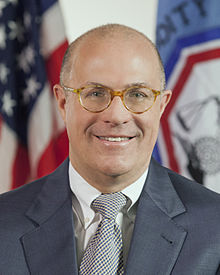
U.S. Commodity Futures Trading Commission (CFTC) Commissioner J. Christopher Giancarlo delivered an amazing address this week before the Depository Trust & Clearing Corporation 2016 Blockchain Symposium. The title of his speech was “Regulators and the Blockchain: First, Do No Harm,” and it will go down as the definitive early statement about how policymakers can apply a principled, innovation-enhancing policy paradigm to distributed ledger technology (DLT) or “blockchain” applications.
“The potential applications of this technology are being widely imagined and explored in ways that will benefit market participants, consumers and governments alike,” Giancarlo noted in his address. But in order for that to happen, he said, we have to get policy right. “It is time again to remind regulators to ‘do no harm,'” he argued, and he continued on to note that
The United States’ global leadership in technological innovation of the Internet was built hand-in-hand with its enlightened “do no harm” regulatory framework. Yet, when the Internet developed in the mid-1990s, none of us could have imagined its capabilities that we take for granted today. Fortunately, policymakers had the foresight to create a regulatory environment that served as a catalyst rather than a choke point for innovation. Thanks to their forethought and restraint, Internet-based applications have revolutionized nearly every aspect of human life, created millions of jobs and increased productivity and consumer choice. Regulators must show that same forethought and restraint now [for the blockchain].
What Giancarlo is referring to is the approach that the U.S. government adopted toward the Internet and digital networks in the mid-1990s. You can think of this vision as “permissionless innovation.” As I explain in my recent book of the same title, permissionless innovation refers to the notion that we should generally be free to experiment and learn new and better ways of doing things through ongoing trial-and-error. Continue reading →
Last week while I was visiting the Silicon Valley area, it was my pleasure to visit the venture capital firm of Andreessen Horowitz. While I was there, Sonal Chokshi was kind enough to invite me on the a16z podcast, which was focused on “Making the Case for Permissionless Innovation.” We had a great discussion on a wide range of disruptive technology policy issues (robotics, drones, driverless cars, medical technology, Internet of Things, crypto, etc.) and also talked about how innovators should approach Washington and public policymakers more generally. Our 23-minute conversation follows:
And for more reading on permissionless innovation more generally, see my book page.
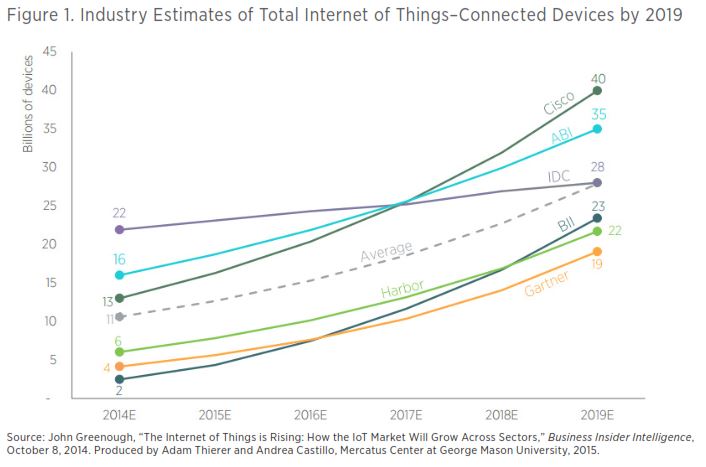
The “Internet of Things” (IoT) is already growing at a breakneck pace and is expected to continue to accelerate rapidly. In a short new paper (“Projecting the Growth and Economic Impact of the Internet of Things“) that I’ve just released with my Mercatus Center colleague Andrea Castillo, we provide a brief explanation of IoT technologies before describing the current projections of the economic and technological impacts that IoT could have on society. In addition to creating massive gains for consumers, IoT is projected to provide dramatic improvements in manufacturing, health care, energy, transportation, retail services, government, and general economic growth. Take a look at our paper if you’re interested, and you might also want to check out my 118-page law review article, “The Internet of Things and Wearable Technology: Addressing Privacy and Security Concerns without Derailing Innovation” as well as my recent congressional testimony on the policy issues surrounding the IoT.)
Today, Eli Dourado, Ryan Hagemann and I filed comments with the Federal Aviation Administration (FAA) in its proceeding on the “Operation and Certification of Small Unmanned Aircraft Systems” (i.e. small private drones). In this filing, we begin by arguing that just as “permissionless innovation” has been the primary driver of entrepreneurialism and economic growth in many sectors of the economy over the past decade, that same model can and should guide policy decisions in other sectors, including the nation’s airspace. “While safety-related considerations can merit some precautionary policies,” we argue, “it is important that those regulations leave ample space for unpredictable innovation opportunities.”
We continue on in our filing to note that “while the FAA’s NPRM is accompanied by a regulatory evaluation that includes benefit-cost analysis, the analysis does not meet the standard required by Executive Order 12866. In particular, it fails to consider all costs and benefits of available regulatory alternatives.” After that, we itemize the good and the bad of the FAA propose with an eye toward how the agency can maximize innovation opportunities. We conclude by noting:
The FAA must carefully consider the potential effect of UASs on the US economy. If it does not, innovation and technological advancement in the commercial UAS space will find a home elsewhere in the world. Many of the most innovative UAS advances are already happening abroad, not in the United States. If the United States is to be a leader in the development of UAS technologies, the FAA must open the American skies to innovation.
Last Wednesday, it was my great pleasure to testify at a Senate Commerce Committee hearing entitled, “The Connected World: Examining the Internet of Things.” The hearing focused “on how devices… will be made smarter and more dynamic through Internet technologies. Government agencies like the Federal Trade Commission, however, are already considering possible changes to the law that could have the unintended consequence of slowing innovation.”
But the session went well beyond the Internet of Things and became a much more wide-ranging discussion about how America can maintain its global leadership for the next-generation of Internet-enabled, data-driven innovation. On both sides of the aisle at last week’s hearing, one Senator after another made impassioned remarks about the enormous innovation opportunities that were out there. While doing so, they highlighted not just the opportunities emanating out of the IoT and wearable device space, but also many other areas, such as connected cars, commercial drones, and next-generation spectrum.
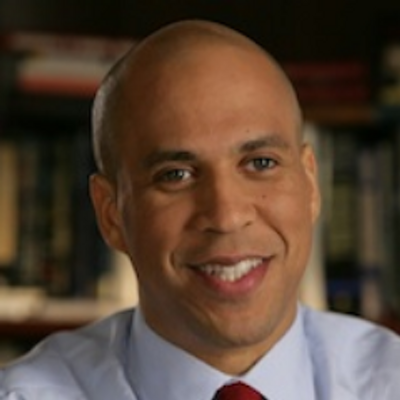
I was impressed by the energy and nonpartisan vision that the Senators brought to these issues, but I wanted to single out the passionate statement that Sen. Cory Booker (D-NJ) delivered when it came his turn to speak because he very eloquently articulated what’s at stake in the battle for global innovation supremacy in the modern economy. (Sen. Booker’s remarks were not published, but you can watch them starting at the 1:34:00 mark of the hearing video.) Continue reading →
Farhad Manjoo’s latest New York Times column, “Giving the Drone Industry the Leeway to Innovate,” discusses how the Federal Aviation Administration’s (FAA) current regulatory morass continues to thwart many potentially beneficial drone innovations. I particularly appreciated this point:
But perhaps the most interesting applications for drones are the ones we can’t predict. Imposing broad limitations on drone use now would be squashing a promising new area of innovation just as it’s getting started, and before we’ve seen many of the potential uses. “In the 1980s, the Internet was good for some specific military applications, but some of the most important things haven’t really come about until the last decade,” said Michael Perry, a spokesman for DJI [maker of Phantom drones]. . . . He added, “Opening the technology to more people allows for the kind of innovation that nobody can predict.”
That is exactly right and it reflects the general notion of “permissionless innovation” that I have written about extensively here in recent years. As I summarized in a recent essay: “Permissionless innovation refers to the notion that experimentation with new technologies and business models should generally be permitted by default. Unless a compelling case can be made that a new invention or business model will bring serious harm to individuals, innovation should be allowed to continue unabated and problems, if they develop at all, can be addressed later.” Continue reading →
But I recently heard three policymakers articulate their recommended vision for the Internet of Things (IoT) and I found their approach so inspiring that I wanted to discuss it here in the hopes that it will become the foundation for future policy in this arena.
Last Thursday, it was my pleasure to attend a Center for Data Innovation (CDI) event on “How Can Policymakers Help Build the Internet of Things?” As the title implied, the goal of the event was to discuss how to achieve the vision of a more fully-connected world and, more specifically, how public policymakers can help facilitate that objective. It was a terrific event with many excellent panel discussions and keynote addresses.
Two of those keynotes were delivered by Senators Deb Fischer (R-Neb.) and Kelly Ayotte (R-N.H.). Below I will offer some highlights from their remarks and then relate them to the vision set forth by Federal Trade Commission (FTC) Commissioner Maureen K. Ohlhausen in some of her recent speeches. I will conclude by discussing how the Ayotte-Fischer-Ohlhausen vision can be seen as the logical extension of the Clinton Administration’s excellent 1997
Framework for Global Electronic Commerce, which proposed a similar policy paradigm for the Internet more generally. This shows how crafting policy for the IoT can and should be a nonpartisan affair. Continue reading →
Capital moves like quicksilver around the globe today as investors and entrepreneurs look for more hospitable tax and regulatory environments. The same is increasingly true for innovation. Innovators can, and increasingly will, move to those countries and continents that provide a legal and regulatory environment more hospitable to entrepreneurial activity. I was reminded of that fact today while reading two different reports about commercial drones and the sharing economy and the global competition to attract investment on both fronts. First, on commercial drone policy, a new Wall Street Journal article notes that:
Amazon.com Inc., which recently began testing delivery drones in the U.K., is warning American officials it plans to move even more of its drone research abroad if it doesn’t get permission to test-fly in the U.S. soon. The statement is the latest sign that the burgeoning drone industry is shifting overseas in response to the Federal Aviation Administration’s cautious approach to regulating unmanned aircraft.
According to the
Journal reporters, Amazon has sent a letter to the FAA warning that, “Without the ability to test outdoors in the United States soon, we will have no choice but to divert even more of our [drone] research and development resources abroad.” And another report in the U.K. Telegraph notes that other countries are ready and willing to open their skies to the same innovation that the FAA is thwarting in America. Both the UK and Australia have been more welcoming to drone innovators recently. Here’s a report from an Australian newspaper about Google drone services testing there. (For more details, see this excellent piece by Alan McQuinn, a research assistant with the Information Technology and Innovation Foundation: “Commercial Drone Companies Fly Away from FAA Regulations, Go Abroad.”) None of this should be a surprise, as I’ve noted in recent essays and filings. With the FAA adopting such a highly precautionary regulatory approach, innovation has been actively disincentivized. America runs the risk of driving still more private drone innovation offshore in coming months since all signs are that the FAA intends to drag its feet on this front as long as it can, even though Congress has told to agency to take steps to integrate these technologies into national airspace. Continue reading →
If there are two general principles that unify my recent work on technology policy and innovation issues, they would be as follows. To the maximum extent possible:
We should avoid preemptive and precautionary-based regulatory regimes for new innovation. Instead, our policy default should be innovation allowed (or “permissionless innovation”) and innovators should be considered “innocent until proven guilty” (unless, that is, a thorough benefit-cost analysis has been conducted that documents the clear need for immediate preemptive restraints).
We should avoid rigid, “top-down” technology-specific or sector-specific regulatory regimes and/or regulatory agencies and instead opt for a broader array of more flexible, “bottom-up” solutions (education, empowerment, social norms, self-regulation, public pressure, etc.) as well as reliance on existing legal systems and standards (torts, product liability, contracts, property rights, etc.).
Weaver argues that new robot technology “is going to develop fast, almost certainly faster than we can legislate it. That’s why we need to get ahead of it now.” In order to preemptively address concerns about new technologies such as driverless cars or commercial drones, “we need to legislate early and often,” Weaver says. Stated differently, Weaver is proposing “precautionary principle”-based regulation of these technologies. The precautionary principle generally refers to the belief that new innovations should be curtailed or disallowed until their developers can prove that they will not cause any harms to individuals, groups, specific entities, cultural norms, or various existing laws, norms, or traditions.
Calo argues that we need “the establishment of a new federal agency to deal with the novel experiences and harms robotics enables” since there exists “distinct but related challenges that would benefit from being examined and treated together.” These issues, he says, “require special expertise to understand and may require investment and coordination to thrive.
I’ll address both Weaver and Calo’s proposals in turn. Continue reading →
Jack Schinasi discusses his recent working paper, Practicing Privacy Online: Examining Data Protection Regulations Through Google’s Global Expansion published in the Columbia Journal of Transnational Law. Schinasi takes an in-depth look at how online privacy laws differ across the world’s biggest Internet markets — specifically the United States, the European Union and China. Schinasi discusses how we exchange data for services and whether users are aware they’re making this exchange. And, if not, should intermediaries like Google be mandated to make its data tracking more apparent? Or should we better educate Internet users about data sharing and privacy? Schinasi also covers whether privacy laws currently in place in the US and EU are effective, what types of privacy concerns necessitate regulation in these markets, and whether we’ll see China take online privacy more seriously in the future.
The Technology Liberation Front is the tech policy blog dedicated to keeping politicians' hands off the 'net and everything else related to technology. Learn more about TLF →

 The Technology Liberation Front is the tech policy blog dedicated to keeping politicians' hands off the 'net and everything else related to technology.