On Tuesday, UN Secretary-General Ban Ki-Moon delivered an address to the UN Security Council “on the Non-Proliferation of Weapons of Mass Destruction.” He made many of the same arguments he and his predecessors have articulated before regarding the need for the Security Council “to develop further initiatives to bring about a world free of weapons of mass destruction.” In particular, he was focused on the great harm that could come about from the use of chemical, biological and nuclear weapons. “Vicious non-state actors that target civilians for carnage are actively seeking chemical, biological and nuclear weapons,” the Secretary-General noted. A stepped-up disarmament agenda is needed, he argued, “to prevent the human, environmental and existential destruction these weapons can cause . . . by eradicating them once and for all.”
The UN has created several multilateral mechanisms to pursue those objectives, including the Nuclear Non-Proliferation Treaty, the Chemical Weapons Convention, and the Biological Weapons Convention. Progress on these fronts has always been slow and limited, however. The Secretary-General observed that nuclear non-proliferation efforts have recently “descended into fractious deadlock,” but the effectiveness of those and similar UN-led efforts have long been challenged by the dual realities of (1) rapid ongoing technological change that has made WMDs more ubiquitous than ever, plus (2) a general lack of teeth in UN treaties and accords to do much to slow those advances, especially among non-signatories.
Despite those challenges, the Secretary-General is right to remain vigilant about the horrors of chemical, biological and nuclear attacks. But what was interesting about this address is that the Secretary-General continued on to discuss his concerns about a rising class of emerging technologies, which we usually don’t hear mentioned in the same breath as those traditional “weapons of mass destruction”: Continue reading →
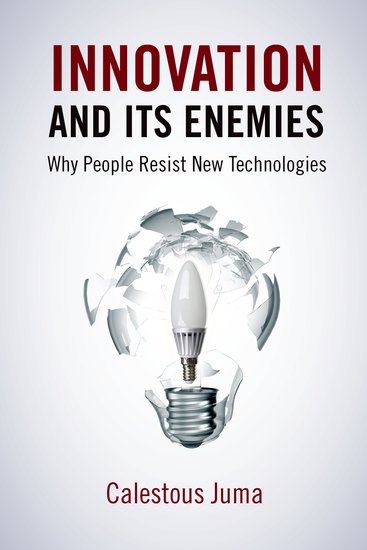
“The quickest way to find out who your enemies are is to try doing something new.” Thus begins Innovation and Its Enemies, an ambitious new book by Calestous Juma that will go down as one of the decade’s most important works on innovation policy.
Juma, who is affiliated with the Harvard Kennedy School’s Belfer Center for Science and International Affairs, has written a book that is rich in history and insights about the social and economic forces and factors that have, again and again, lead various groups and individuals to oppose technological change. Juma’s extensive research documents how “technological controversies often arise from tensions between the need to innovate and the pressure to maintain continuity, social order, and stability” (p. 5) and how this tension is “one of today’s biggest policy challenges.” (p. 8)
What Juma does better than any other technology policy scholar to date is that he identifies how these tensions develop out of deep-seated psychological biases that eventually come to affect attitudes about innovations among individuals, groups, corporations, and governments. “Public perceptions about the benefits and risks of new technologies cannot be fully understood without paying attention to intuitive aspects of human psychology,” he correctly observes. (p. 24) Continue reading →
In a terrific little essay on “Local Economic Revival and The Unpredictability of Technological Innovation,” Michael Mandel, the chief economic strategist at the Progressive Policy Institute, makes several important points regarding the fundamental folly for future forecasting efforts as it pertains to new innovations. He notes, for example:
There are plenty of candidates for the “next big thing,” ranging from the Internet of Things to additive manufacturing to artificial organ factories to autonomous cars to space commerce to Elon Musk’s hyperloop. Each of these has the potential to revolutionize an industry, and to create many thousands or even millions of jobs in the process–not just for the highly-educated, but a whole range of workers.
Yet the problem–and the beauty–is that technological innovation is fundamentally unpredictable, even at close range. Consider this: The two most important innovations of the past decade, economically, have been the smartphone and fracking. The smartphone transformed the way that we communicate and hydraulic fracturing has driven down the price of energy, not to mention shifting the geopolitical balance of power.
But few saw the smartphone and fracking revolutions coming, he notes. The pundits and the press were too focused on technologies of the past. Continue reading →
How is it that we humans have again and again figured out how to assimilate new technologies into our lives despite how much those technologies “unsettled” so many well-established personal, social, cultural, and legal norms?
It’s fair to say that this issue — how individuals, institutions, and cultures adjust to technological change — has become a personal obsession of mine and it is increasingly the unifying theme of much of my ongoing research agenda. The
economic ramifications of technological change are part of this inquiry, of course, but those economic concerns have already been the subject of countless books and essays both today and throughout history. I find that the social issues associated with technological change — including safety, security, and privacy considerations — typically get somewhat less attention, but are equally interesting. That’s why my recent work and my new book narrow the focus to those issues. Continue reading →
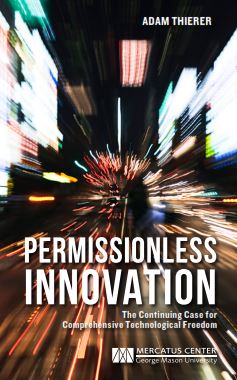
I am pleased to announce the release of my latest book, “Permissionless Innovation: The Continuing Case for Comprehensive Technological Freedom.” It’s a short manifesto (just under 100 pages) that condenses — and attempts to make more accessible — arguments that I have developed in various law review articles, working papers, and blog posts over the past few years. I have two goals with this book.
First, I attempt to show how the central fault line in almost all modern technology policy debates revolves around “the permission question,” which asks:
Must the creators of new technologies seek the blessing of public officials before they develop and deploy their innovations? How that question is answered depends on the disposition one adopts toward new inventions. Two conflicting attitudes are evident.
One disposition is known as the “precautionary principle.” Generally speaking, it refers to the belief that new innovations should be curtailed or disallowed until their developers can prove that they will not cause any harms to individuals, groups, specific entities, cultural norms, or various existing laws, norms, or traditions.
The other vision can be labeled “permissionless innovation.” It refers to the notion that experimentation with new technologies and business models should generally be permitted by default. Unless a compelling case can be made that a new invention will bring serious harm to society, innovation should be allowed to continue unabated and problems, if they develop at all, can be addressed later.
I argue that we are witnessing a grand clash of visions between these two mindsets today in almost all major technology policy discussions today. Continue reading →
James Barrat, author of Our Final Invention: Artificial Intelligence and the End of the Human Era, discusses the future of Artificial Intelligence (AI). Barrat takes a look at how to create friendly AI with human characteristics, which other countries are developing AI, and what we could expect with the arrival of the Singularity. He also touches on the evolution of AI and how companies like Google and IBM and government entities like DARPA and the NSA are developing artificial general intelligence devices right now.
Timothy B. Lee, founder of The Washington Post’s blog The Switch discusses his approach to reporting at the intersection of technology and policy. He covers how to make tech concepts more accessible; the difference between blogs and the news; the importance of investigative journalism in the tech space; whether paywalls are here to stay; Jeff Bezos’ recent purchase of The Washington Post; and the future of print news.
Few modern intellectuals gave more serious thought to forecasting the future than Herman Kahn. He wrote several books and essays imagining what the future might look like. But he was also a profoundly humble man who understood the limits of forecasting the future. On that point, I am reminded of my favorite Herman Kahn quote:
History is likely to write scenarios that most observers would find implausible not only prospectively but sometimes, even in retrospect. Many sequences of events seem plausible now only because they have actually occurred; a man who knew no history might not believe any. Future events may not be drawn from the restricted list of those we have learned are possible; we should expect to go on being surprised.[1]
I have always loved that phrase, “a man who knew no history might not believe any.” Indeed, sometimes the truth (how history actually unfolds) really is stranger than fiction (or the hypothetical forecasts that came before it.)
This insight has profound ramifications for public policy and efforts to “plan progress,” something that typically ends badly. Continue reading →
I was honored to be asked by the editors at Reason magazine to be a part of their “Revolutionary Reading” roundup of “The 9 Most Transformative Books of the Last 45 Years.” Reason is celebrating its 45th anniversary and running a wide variety of essays looking back at how liberty has fared over the past half-century. The magazine notes that “Statism has hardly gone away, but the movement to roll it back is stronger than ever.” For this particular feature, Reason’s editors “asked seven libertarians to recommend some of the books in different fields that made [the anti-statist] cultural and intellectual revolution possible.”
When Jesse Walker of
Reason first contacted me about contributing my thoughts about which technology policy books made the biggest difference, I told him I knew exactly what my choices would be: Ithiel de Sola Pool’s Technologies of Freedom (1983) and Virginia Postrel’s The Future and Its Enemies (1998). Faithful readers of this blog know all too well how much I love these two books and how I am constantly reminding people of their intellectual importance all these years later. (See, for example, this and this.) All my thinking and writing about tech policy over the past two decades has been shaped by the bold vision and recommendations set forth by Pool and Postrel in these beautiful books.
So, I’m sitting here at today’s Federal Trade Commission (FTC) workshop, “Will Journalism Survive the Internet Age?” and several panelists have argued that private “professional” media is toast, not just because of the rise of the Net and digital media, but also because the inherent cross-subsidy that advertising has traditionally provided is drying up. It very well could be the case that both statements are true and that private media operators are in some trouble because of it. But what nobody seems to be acknowledging is that our government is currently on the regulatory warpath against advertising and that this could have profound impact on the outcome of this debate.
The advertising industry is heading for a “tsunami” of regulation and is at a “tipping point” of greatly increased scrutiny, warned a panel on social media and privacy at the American Advertising Federation conference here [in Orlando].
The reason this is so important for the ongoing debate about the future of media and journalism is because, as Berin and I argued in our paper: Continue reading →
The Technology Liberation Front is the tech policy blog dedicated to keeping politicians' hands off the 'net and everything else related to technology. Learn more about TLF →




 The Technology Liberation Front is the tech policy blog dedicated to keeping politicians' hands off the 'net and everything else related to technology.