Posts tagged as:

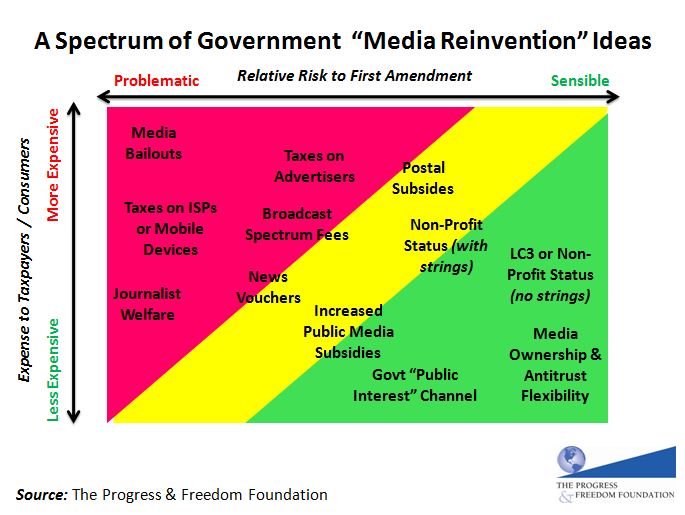
As I’ve noted here before, the Federal Trade Commission (FTC) has an ongoing proceeding asking “How Will Journalism Survive the Internet Age?” The agency has hosted two workshops on the issue and a third is scheduled for June 15th at the National Press Club. Recently, the FTC released a 47-page staff discussion draft entitled “Potential Policy Recommendations to Support the Reinvention of Journalism,” which outlines dozens of proposals that have been set forth in recent years to “save journalism,” “reinvent media,” or support various forms of so-called “public interest programming.”  [I’ve embedded the document down below.] Although the FTC makes it very clear on the first page of the discussion draft that it “does not represent final conclusions or recommendations by the Commission or FTC staff [and] it is solely for purposes of discussion,” the document is drawing scrutiny and raising concern since it might foreshadow where the FTC (and Obama Administration) could be heading on this front.

Some of those raising a stink about the FTC draft include: Jeff Jarvis (“FTC Protects Journalism’s Past“); Rob Port (“Federal Government Considering “iPad Tax” To Subsidize Journalism“); Mark Tapscott: “(Will Journalists Wake up in Time to Save Journalism from Obama’s FTC?”); and Andrew Malcolm of the Los Angeles Times (“Obama’s FTC Plan to Reinvent America’s News Media“), who says, “this FTC study is rated R for anyone who thinks the federal government, the object of copious news coverage itself, has no business deciding which sectors of the private media business survive and thrive through its support, subsidies and encouragement with things like tax incentives. Yet that’s what this Obama administration paper is suggesting as another of the ex-community organizer’s galactic reform plans.”   Ouch!
Continue reading →

Yesterday, the Federal Trade Commission (FTC) hosted an all-day workshop on “Protecting Kids’ Privacy Online,” which looked into the Children’s Online Privacy Protection Act of 1998 (COPPA) and challenges posed to its enforcement by new technological developments. The FTC staff did a nice job bringing together and moderating 5 panels worth of participants, all of whom had plenty of interesting things to say about the future of COPPA.  But I was more struck by what was not said yesterday. Namely, there was:

  • ZERO explanation of the supposed harms of advertising, marketing, and data collection. Advertising-bashing is an old sport here in Washington, so I guess I should not have been surprised to hear several panelists yesterday engaging in teeth-gnashing and hand-wringing about advertising, marketing, and the data collection methods that make it possible. But this grousing just went on and on without any explanation by the critics of the supposed harms that would result from it.
  • ZERO appreciation of the benefits of advertising, marketing, and data collection. Not once yesterday — NOT ONCE — did anyone pause to ask what it is that makes all these wonderful online sites, services and content free (or dirt cheap) to consumers.  Everyone at this show was guilty of the “manna fallacy” (that all this stuff just falls magically to Earth from the Net Gods above). Well, back here in the real world, something has to pay for all those goodies, and that something is advertising and marketing, which are facilitated by data collection! Or would you like to pay $19.95 a month for each of those currently free sites and services? Yeah, I didn’t think so.

Continue reading →

Facebook has had a tough month. The site’s latest round of privacy changes, implemented last month, spurred stiff backlash — not just from so-called privacy advocates, but also from several U.S. Senators. Facebook CEO Mark Zuckerberg shot back with an op-ed in The Washington Post, as Braden discussed here yesterday.

I’ve had much to say about Facebook’s past privacy controversies (1, 2, 3, 4, 5), but what really sticks out about the latest anti-Facebook backlash is who’s leading the charge: U.S. Senator Chuck Schumer.

Seriously, of all people, Chuck Schumer should be the last to criticize Facebook’s privacy practices. That’s because Schumer is leading the push in Congress to establish a biometric national identification regime. If Schumer had his way, all Americans, including U.S. citizens, wishing to legally work in this country would be required by law to obtain a national ID card! Compared to this highly invasive potential exercise of the state’s coercive power, concerns about Facebook’s privacy practices seem downright trivial.

Continue reading →

I’ve complained mightily (here and here) about the agonizing technological awfulness that was, at least until recently the website of the FCC (you know, one of the two federal agencies—besides the FTC—that thinks it has the expertise necessary to regulate the Internet). My point wasn’t just that the FCC’s website made it very difficult to find and access data, but that this was a serious problem for transparency in government. I have to give the agency credit for improving many aspects of its site, though much work still remains to be done.

But then there are all the other agencies of our sprawling regulatory Leviathan! And in particular, the Securities and Exchange Commission (SEC), which processes—crudely—huge amounts of financial data. A new report from House Oversight and Government Reform Committee Ranking Member Darrell Issa released today describes just how severe the SEC’s problems are:

The Commission’s securities disclosure processes are technologically backward.  It reviews corporate filings manually, using printouts, pencils, and calculators.  It has never developed the ability to perform large-scale quantitative analysis to find fraud.  Commission staff use Google Finance, Yahoo! Finance, and other commercially-available resources to analyze corporate filings.  If the Commission had a robust database of the financial information filed by its registrants, it could automatically prioritize the thousands of tips and complaints it receives.  But no such database has ever been constructed.

Hence the biting title of the report: The SEC: Designed for Failure. Ouch! It’s really amazing how, when regulators fail to protect consumers, the default response by most in Congress is to assume that only sweeping new powers will fix the problem (which is what “financial reform” legislation would do) instead of, say, bringing the agency into the 21st century.

Similarly, there’s a move afoot to give the FTC vast new powers across the board or to protect our privacy online (from evil companies that don’t respect the privacy promises they made to consumers) with little thought given to data-driven technological  through user empowerment. Continue reading →

I’m keeping tabs on who filed “major” comments (more than a 10-15 pages) in the Federal Communications Commission’s “Future of Media” proceeding (GN Docket No. 10-25).  As I noted last week, The Progress & Freedom Foundation submitted almost 80 pages of comments (single-spaced!) in the matter, so it’s something I care deeply about and will be tracking closely going forward.

Incidentally, the general consensus of those who filed (especially if you count “minor” comments) is fairly overwhelming: Bring on Big Government! Seriously, I only found a handful of comments that object strenuously to government meddling in media markets or that raised concerns about the potential for the State’s increasing involvement in the journalism profession. Even many of the affected industries appear to be suffering from a bit of Stockholm syndrome here.  Most of them just play up the good things they are doing but barely utter a peep about the dangers of federal encroachment into the affairs of the Press.

Anyway, for those of you who care to track the gradual federalization of media and journalism, I think what you see below is a fairly comprehensive listing of the major filings submitted thus far in the FCC’s “Future of Media” proceeding. I’ll try to add more as I find them. You might also want to track what was filed in the Federal Trade Commission’s workshops on “How Will Journalism Survive the Internet Age.”  Finally, if you care to learn more of this issue, I’m hosting an event on the morning of May 20th to discuss these issues in more detail.

Continue reading →

Thought you all might be interested in this upcoming PFF event on “Can Government Help Save the Press?” It will take place on Thursday, May 20, 2010 from 8:30 a.m. – 12:00 p.m. in the International Gateway Room, Mezzanine Level of the Ronald Reagan Building on 1300 Pennsylvania Ave, N.W. here in DC.   This event will consider the FCC’s “Future of Media” proceeding (comments are due this Friday) and debate what role the government should play (if any) in sustaining struggling media enterprises, “saving journalism,” or promoting more “public media” or “public interest” content. [You can find all our essays about this here.]

The event will feature a keynote address by Ellen P. Goodman of the FCC’s Future of Media team. Ellen is one of the sharpest minds in the media policy universe today, and a real asset to the FCC team. She is a Distinguished Visiting Scholar at the FCC, a Research Fellow at American University’s Center for Social Media, and a Visiting Scholar at the University of Pennsylvania’s Annenberg School of Communications.  She is also a Professor at Rutgers University School of Law at Camden, specializing in information law and policy. She has spoken before a wide range of audiences around the world on media policy issues, has consulted with the U.S. government on communications policy, and served as an advisor to President Obama’s presidential campaign and transition team.

After Ellen Goodman brings us up to speed with where the FCC’s Future of Media process stands, we’ll hear from a diverse panel of experts that I am still busy assembling. But so far it includes Charlie Firestone of the Aspen Institute, who will be on hand to discuss the work he’s been doing with the Knight Commission on this front.  I’ve also invited a rep from the Newspaper Association of America to come and talk about the diversity of new media monetization models that they have been aggregating.  (Check out the appendix of their outstanding FTC filing last Nov.) And Kurt Wimmer of Covington & Burling, who represents broadcasters among others, will talk about the need for regulatory flexibility / forbearance, especially on ownership issues.  Again, more panelists to come. But please sign up now!

No, I’m not here to tell you more about the “supersized” FTC. Berin has done yeoman’s work to highlight that issue, among other things with the PFF event you can review here. On TechDirt, Mike Masnick wrote this morning about how the feds are itching to regulate the Internet.

This is about the direct government invasions of privacy likely to occur if S. 3217 passes. On the Cato@Liberty blog I write about the detailed financial market research that new regulatory agencies would do—research aimed at you.

Example:

Section 1071(b) requires any deposit-taking financial institution to geo-code customer addresses and maintain records of deposits for at least three years. Think of the government having its own Google map of where you and your neighbors do your banking. The Bureau [of Consumer Financial Protection] may “use the data for any other purpose as permitted by law,” such as handing it off to other bureaus, like the Federal Bureau of Investigation.

“Washington, D.C. has determined that Washington, D.C. should manage the financial services industry. Your personal and private financial affairs will be managed there too.”

What would I say about my own writing but read the whole thing?

The Federal Trade Commission is reportedly on the verge of suing to block Google’s proposed acquisition of mobile advertising firm AdMob. The deal’s antitrust implications were discussed in a panel earlier this month on Capitol Hill featuring Berin Szoka. (For other interesting perspectives on the topic, see Geoff Manne and Tom Lenard).

In an opinion essay on Forbes.com this week, I argue that the FTC should approve Google’s acquisition of AdMob without conditions:

FTC Should Green-light Google AdMob Deal

by Ryan Radia

Google competes in many markets, but its most pressing threat comes not from a rival but from antitrust authorities. The Federal Trade Commission is reportedly on the verge of filing a lawsuit against Google to block its proposed $750 million acquisition of mobile advertising company AdMob. Yet antitrust fears about Google are misplaced. Government intervention would harm the very consumer interests the FTC is supposed to protect.

As the government prepares for a potential court battle against Google, the budding mobile advertising market is evolving before our very eyes. Just two weeks ago Apple launched iAd, a mobile advertising platform aimed at the world’s 50 million iPhone users. And Microsoft is in talks to acquire Millenial Media, another major player in mobile advertising, according to Business Insider.

Meanwhile, smart phone use is increasing rapidly–and opportunities for entry in the mobile advertising market are increasing with it. Can Google, armed with AdMob’s advertising platform, succeed in gaining the top spot in mobile advertising? Perhaps — but only if Google-AdMob manages to outcompete and out-innovate rivals that have deep pockets and brilliant engineers of their own.

What tomorrow’s mobile ad market will look like if Google and AdMob join forces is anybody’s guess. Trying to predict how a proposed merger or acquisition will impact consumers is difficult, if not impossible.

Continue reading →

The Washington Post carried an article earlier this week by Cecilia Kang that noted the Federal Trade Commission could gain enforcement power over online businesses as a result of the financial services legislation under discussion in Congress. Ms. Kang contrasted the possibility of an empowered FTC issuing fast-track regulations against the recent experience of the Federal Communications Commission, which has become bogged down in its search for legal authority to issue net neutrality regulations. 

The comparison is insightful, but not for the reasons you might expect. Part of the debate over the FTC revolves around language in the House financial services bill that would repeal the “Magnuson-Moss” provisions that govern FTC promulgation of consumer protection regulations. (The name comes from the fact that these restrictions on FTC rulemaking were included in the Magnuson-Moss Warranty Act, which got the FTC into the business of regulating car warranties.)

If the FTC wants to regulate some type of general business practice under the FTC Act, it has to establish a factual record substantiating that there is actually a systemic problem that regulation can solve, hold a public hearing, allow cross-examination on factual matters, and conduct an economic analysis of the regulation’s effects.  In short, the commission has to do the homework necessary to demonstrate that its proposed regulation will actually solve a widespread problem that actually exists.

When Tim Muris directed the FTC’s Bureau of Consumer Protection in the early 1980s, he authored an article in Regulation magazine pointing out that when the FTC does careful analysis before issuing a rule, the rule is more likely to benefit consumers, more likely to be upheld in court, and more likely to be issued expeditiously. He contrasted the evidence-based eyeglass rule, which took three years to issue, with the anecdote-based funeral rule, which took ten. Muris noted wryly, “Some critics of my position charge that it is revolutionary to ask a body of lawyers and economists not to impose its own view of proper regulation on the world without first systematically evaluating the problem.” Muris went on to serve as chairman of the FTC between 2001-04, and last month he defended the Magnuson-Moss restrictions in testimony before Congress.  

What does this have to do with the FCC?  The FCC lost its case against Comcast on appeal, precisely because the FCC tried to take shortcuts. The FCC tried to promote net neutrality by enforcing a set of “principles” that originated in a former chairman’s speech and were never promulgated in a notice-and-comment rulemaking. The FCC commissioners endorsed these principles without investigating whether there was a systemic problem (ie, more than a few anecdotes of misbehavior). Indeed, Chairman Martin’s Notice of Inquiry on “Broadband Industry Practices” that was launched around the same time the FCC took its enforcement action against Comcast turned up no evidence of a systemic problem. If the FCC now tries to impose net neutrality by reclassifying broadband as a “Title II” common carrier, it will have to do the difficult but necessary work of demonstrating, with real factual evidence, that broadband is more like a common carrier than like the lightly-regulated “information service” the commission previously decided it was.

We don’t need Congress to free the FTC from Magnuson-Moss. Instead, Congress should impose the same requirements on the FCC. Sometimes, taking the time to do your homework leads to better decisions, sooner.

Facebook is in the spotlight—unfairly.

Yesterday, four Democratic U.S. senators — Charles Schumer (D-N.Y.), Michael Bennet (D-Col.), Mark Begich (Alaska) and Al Franken (D-Minn.) — published a letter to Facebook expressing their concern over Facebook’s privacy policies.  They asked Facebook to “fix” its privacy policy?

Privacy is a complex and often personal concept – how do these four senators know it’s broken?

Well, the letter follows the announcement of Facebook’s new Open Graph API that could revolutionize social networking. As one commentator wrote on ReadWriteWeb, “the bits of this platform bring together the visions of a social, personalized and semantic Web that have been discussed since del.icio.us pioneered Web 2.0 back in 2004.” The future of the web is not just knowing whether a user is interacting with a webpage, but knowing whether users are liking a specific kind of thing (referred to as the semantic web).

This sounds like very interesting stuff (understatement intended). And here’s the thing that many people (including many members of Congress) forget:  Facebook is a new model of business that has shaken up the way we communicate. And it’s operating in uncharted territory, miles ahead of the Washington, D.C. crowd that would like to put their own stamp on the company. This is a company that is driving innovation, the last thing we need are politicians attempting to fine-tune the engine.

Which company is the next target of a letter? What’s the precedent being set by these demands for Facebook and other innovative web-based companies? I imagine there are a lot of concerned entrepreneurs across the country wondering if they’re next.