Posts tagged as:

It remains unclear how interested the Federal Trade Commission (FTC) is in bringing a formal antitrust action against Google, but we at least know that inquiries have been made. I suspect these inquires are far more serious than whatever the agency is fishing for with its new Twitter inquires. After all, as I note in my latest Forbes column, “Google isn’t even a teenager yet (having only been founded in September 1998), but the firm’s rise has been meteoric and it has made a long list of enemies in the process. Practically every major player in the Digital Economy… is gunning for Google these days, both in the commercial and political marketplace.” In this sense, it’s not surprising the FTC might take a keen interest in the company with so many competitors complaining.

Still, I just can’t find much merit in an antitrust case against Google since, as I noted in my column, “The firm’s success seems tied to high quality products that users prefer over rival services. Importantly, barriers to entry are low: there’s nothing stopping new entrants from innovating and offering competing online services to match Google.”

Regardless, instead of arguing about the merits of an antitrust action against Google, let’s consider the more interesting, and I think intractable, question of remedies. Here’s what I had to say about that in my Forbes essay: Continue reading →

According to a report today from SAI Business Insider, “The Federal Trade Commission is actively investigating Twitter and the way it deals with the companies building applications and services for its platform.”  Apparently the agency has reached out to some competing application / platform providers to ask questions about Twitter’s recent efforts to exert more control over the uses of its API by third parties. [The Wall Street Journal confirms the FTC’s interest in Twitter.]

It remains to be seen whether this leads to any serious regulatory action against Twitter by the FTC, but such a move wouldn’t necessarily be surprising considering the more activist tilt of the agency recently. It’s even less surprising considering that Columbia University law professor and prolific cyberlaw scholar Tim Wu was appointed as a senior advisor to the FTC earlier this year. When the announcement of Wu’s appointment was made, the Wall Street Journal kicked off an article with the warning, “Silicon Valley has a new fear factor.”  It seems the Journal may have been on to something!

It’s impossible to know how much of an influence Tim Wu is having on the agency, but as I have noted here before, Prof. Wu is man with a healthy appetite for regulatory activism. [See all my essays about Wu’s work here.] Moreover, he’s a man who has already determined that Twitter is a “monopolist” in his November 13, 2010 Wall Street Journal op-ed, “In the Grip of the New Monopolists.”

That essay prompted a fiery response from me [“Tim Wu Redefines Monopoly“] as well as a far more reasoned essay by antitrust gurus Geoff Manne and Josh Wright [“What’s An Internet Monopolist? A Reply to Professor Wu.”] Prof. Wu was kind enough to swing by the TLF and respond to my criticisms in an essay “On the Definition of Monopoly,” which he said served as a “corrective” to my earlier essay [even though I continue to believe that what I said fairly reflected the last four decades of economic wisdom on competition policy and that it is Wu who is well off the reservation with his expansionist views of antitrust enforcement].

Regardless of what one thinks about that exchange, if the FTC is moving forward with a case against Twitter, three practical questions need to be considered: (1) What’s the relevant market? (2) Where’s the harm? and (3) What’s the remedy?

I’ll briefly discuss each question below but should also mention that I already explored many of these issues in my essay,  “A Vision of (Regulatory) Things to Come for Twitter,” so I apologize in advance for the repetition.  I will then discuss all this in the context of Tim Wu’s latest law review article on “Agency Threats” and what he approvingly refers to as regulatory “threat regimes.” Continue reading →

This morning, the Federal Communications Commission (FCC) released its eagerly-awaited “Future of Media” report. The 475-page final report is entitled, “The Information Needs of Communities: The Changing Media Landscape in a Broadband Age.”  [Here’s a 2-page summary and the official press release.]  The report is a bit overdue; the effort was supposed to be wrapped up late last year. Comments in the proceeding were filed over a year ago. Here are some of the major ones. Also, here is the 80-page monster filing that I submitted with my former PFF colleagues Berin Szoka and Ken Ferree.

Quick refresher… Federal policymakers have been taking a greater interest in the health of media and journalism in recent years. In 2009, the Senate held hearings about “the future of journalism,” and Senator Benjamin L. Cardin (D-MD) introduced the “Newspaper Revitalization Act,” which would allow newspapers to become tax-exempt non-profits in an effort to help them stay afloat. In 2010, the Federal Trade Commission hosted two workshops asking “How Will Journalism Survive the Internet Age?” and also released a staff report on “Potential Policy Recommendations to Support the Reinvention of Journalism.” (As I noted here and here, the FTC was blasted for that report and quickly backed off the issue. The agency has since gone radio silent on the issue.) The FCC also launched its “Examination of the Future of Media and Information in a Digital Age” in 2010, and today’s report wraps up their work on this front.

My first reaction after scanning the FCC’s final report is one of relief. For those of us who care about the First Amendment, media freedom, and free-market experimentation with new media business models, it feels like we’ve dodged a major bullet. The report does not recommend sweeping regulatory actions that might have seen Washington inserting itself into the affairs of the press or bailing out dying business models.

Continue reading →

It might be tempting to laugh at France’s ban on words like “Facebook” and Twitter” in the media. France’s Conseil Supérieur de l’Audiovisuel recently ruled that specific references to these sites (in stories not about them) would violate a 1992 law banning “secret” advertising. The council was created in 1989 to ensure fairness in French audiovisual communications, such as in allocation of television time to political candidates, and to protect children from some types of programming.

Sure, laugh at the French. But not for too long. The United States has similarly busy-bodied regulators, who, for example, have primly regulated such advertising themselves. American regulators carefully oversee non-secret advertising, too. Our government nannies equal the French in usurping parents’ decisions about children’s access to media. And the Federal Communications Commission endlessly plays footsie with speech regulation.

In the United States, banning words seems too blatant an affront to our First Amendment, but the United States has a fairly lively “English only” movement. Somehow, regulating an entire communications protocol doesn’t have the same censorious stink.

So it is that our Federal Communications Commission asserts a right to regulate the delivery of Internet service. The protocols on which the Internet runs are communications protocols, remember. Withdraw private control of them and you’ve got a more thoroughgoing and insidious form of speech control: it may look like speech rights remain with the people, but government controls the medium over which the speech travels.

The government has sought to control protocols in the past and will continue to do so in the future. The “crypto wars,” in which government tried to control secure communications protocols, merely presage struggles of the future. Perhaps the next battle will be over BitCoin, an online currency that is resistant to surveillance and confiscation. In BitCoin, communications and value transfer are melded together. To protect us from the scourge of illegal drugs and the recently manufactured crime of “money laundering,” governments will almost certainly seek to bar us from trading with one another and transferring our wealth securely and privately.

So laugh at France. But don’t laugh too hard. Leave the smugness to them.

I’ve already Tweeted about it, but if you are following Internet privacy debates and have not yet had the chance to read Lauren Weinstein‘s new paper, “Do-Not-Track, Doctor Who, and a Constellation of Confusion,” it is definitely worth a look.  Weinstein, founder of the Privacy Forum, zeroes in on two related issue that I have made the focus of much of my work on this issue: (1) the fact that Do Not Track is seemingly viewed by some as a silver-bullet quick fix to online privacy concerns but will really be far more complicated in practice to enforce, and (2) that Do Not Track regulation will likely have many unintended consequences, most of which are going unexplored by proponents.

For example, Weinstein says:

Do-not-track in actuality encompasses an immensely heterogeneous mosaic of issues and considerations, not appropriately subject to simplistic approaches or “quick fix” solutions.   Approaching this area without a realistic appreciation of such facts is fraught with risks and the potential for major undesirable collateral damages to businesses, organizations, and individuals. Attempts to portray these controversies as “black or white” topics subject to rapid or in some cases even unilaterally imposed resolutions may be politically expedient, but are ultimately both childish and dangerous. […] Above all, we should endeavor to remember that tracking issues both on and off the Internet are in reality part of a complicated whole, a multifaceted  set of problems — and very importantly — potentials as well. The decisions that we make now regarding these issues will likely have far-ranging implications and effects on the Internet for many years to come, perhaps for decades.

Continue reading →

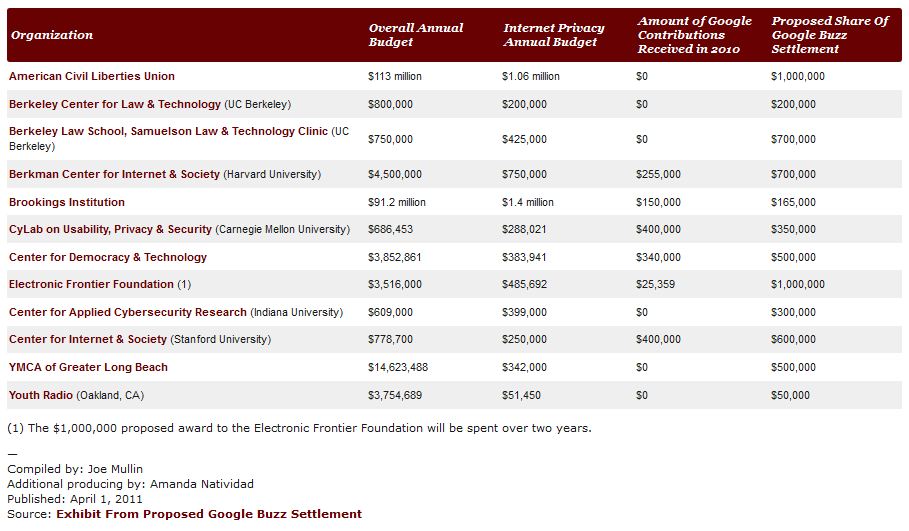
PaidContent.org has posted a chart showing “Who’s Getting Buzz Settlement Money.” This refers to the $9.5 million payout following the Federal Trade Commission settlement with Google a class action suit over its “Buzz” social networking service. Last week, the Federal Trade Commission entered into a consent decree with Google over its botched rollout of Buzz saying the search giant violated its own privacy policy. Google will also pay out to various advocacy groups according to the distribution seen in the chart as part of a separate class action. Payouts to advocates like this are not uncommon, although they are more often the result of a class action settlement than a regulatory agency consent decree. [Update/Correction 5:13 pm: I should have made it clear that this payout was the result of a class action lawsuit against Google and not the direct result of the FTC settlement. Apologies for that mistake, but still interested in the questions raised below.]

But that got me wondering whether this might make for good fodder for a case study by a public choice economist or political scientist. There are some really interesting questions raised by settlements like this that would be worth studying.

Continue reading →

Yet another hearing on privacy issues has been slated for this coming Wednesday, March 16th. This latest one is in the Senate Commerce Committee and it is entitled “The State of Online Consumer Privacy.” As I’m often asked by various House and Senate committee staffers to help think of good questions for witnesses, I’m listing a few here that I would love to hear answered by any Federal Trade Commission (FTC) or Dept. of Commerce (DoC) officials testifying. You will recall that both agencies released new privacy “frameworks” late last year and seem determined to move America toward a more “European-ized” conception of privacy regulation. [See our recent posts critiquing the reports here.] Here are a few questions that should be put to the FTC and DoC officials, or those who support the direction they are taking us. Please feel free to suggest others:

  • Before implying that we are experiencing market failure, why hasn’t either the FTC or DoC conducted a thorough review of online privacy policies to evaluate how well organizational actions match up with promises made in those policies?
  • To the extent any sort of internal cost-benefit analysis was done internally before the release of these reports, has an effort been made to quantify the potential size of the hidden “privacy tax” that new regulations like “Do Not Track” could impose on the market?
  • Has the impact of new regulations on small competitors or new entrants in the field been considered?  Has any attempt been made to quantify how much less entry / innovation would occur as a result of such regulation?
  • Were any economists from the FTC’s Economics Bureau consulted before the new framework was released? Did the DoC consult any economists?
  • Why do FTC and DoC officials believe that citing unscientific public opinions polls from regulatory advocacy organizations serves as a surrogate for serious cost-benefit analysis or an investigation into how well privacy policies actual work in the marketplace?
  • If they refuse to conduct more comprehensive internal research, have the agencies considered contracting with external economists to build a body of research looking into these issues (as the Federal Communications Commission did in a decade ago in its media ownership proceeding)?
  • Has either agency attempted to determine consumer’s “willingness to pay” for increased privacy regulation?
  • More generally, where is the “harm” and aren’t there plenty of voluntary privacy-enhancing tools out there that privacy-sensitive users can tap to shield their digital footsteps, if they feel so inclined?

It seems peculiar to me that some of the same individuals and groups who so vociferously opposed a “broadcast flag” technological mandate in past years are now in a mad rush to have federal policymakers mandate a “Do Not Track” regulatory regime for privacy purposes. The broadcast flag debate, you will recall, centered around the wisdom of mandating a technological fix to the copyright arms race before digitized high-definition broadcast signals were effectively “Napster-ized.” At least that was the fear six or seven years ago. TV broadcasters and some content companies wanted the Federal Communications Commission (FCC) to recognize and enforce a string of code that would have been embedded in digital broadcast program signals such that mass redistribution of video programming could have been prevented.

Flash forward to the present debate about mandating a “Do Not Track” scheme to help protect privacy online. As I noted in my filing last week to the Federal Trade Commission, at root, Do Not Track is just another “information control regime.” Much like the broadcast flag proposal, it’s an attempt to use a technological quick-fix to solve a complex problem. When it comes to such information control efforts, however, there aren’t many good examples of simple fixes or silver-bullet solutions that have worked, at least not for very long. The debates over Wikileaks, online porn, Internet hate speech, and Spam all demonstrate how challenging it can be to put information back into the bottle once it is released into the digital wild.

To be clear, I am not opposed to technological solutions like broadcast flag or Do Not Track, but I am opposed to forcing them upon the Internet and digital markets in a top-down, centrally-planned fashion. While I am skeptical that either scheme would work well in practice (whether voluntary or mandated), my concern in these debates is that forcing such solutions by law will have many unintended consequences, not the least of which will be the gradual growth of invasive cyberspace controls in these or other contexts. After all, if we can have “broadcast flags” and “Do Not Track” schemes, why not “flag” mandates for objectionable speech or “Do Not Porn” browser mandates? Continue reading →

Today I filed roughly 30 pages worth of comments with the Federal Trade Commission (FTC) in its proceeding on “Protecting Consumer Privacy in an Era of Rapid Change: a Proposed Framework for Businesses and Policy Makers.” [Other comments filed in the proceeding can be found here.] Down below, I’ve attached the Table of Contents from my filing so you can see the major themes I’ve addressed, and I’ve also attached the entire document in a Scribd reader. In coming days and weeks, I’ll be expanding upon some of these themes in follow-up essays.

In my filing, I argue that while it remains impossible to predict with precision the impact a new privacy regulatory regime will have the Internet economy and digital consumers, regulation will have consequences; of that much we can be certain.  As the FTC  and other policy makers move forward with proposals to expand regulation in this regard, it is vital that the surreal “something-for-nothing” quality of current privacy debate cease. Those who criticize data collection or online advertising and call for expanded regulation should be required to provide a strict cost-benefit analysis of the restrictions they would impose upon America’s vibrant digital marketplace.

In particular, it should be clear that the debate over Do Not Track and online advertising regulation is fundamentally tied up with the future of online content, culture, and services. Thus, regulatory advocates must explain how the content and services supported currently by advertising and marketing will be sustained if current online data collection and ad targeting techniques are restricted. Continue reading →

As Adam notes, Columbia lawprof and holder of the dubious distinction of having originated the term and concept of Net Neutrality, Tim Wu, is headed to the FTC as a senior advisor.

Curiously, his guest stint runs for only about four and a half months.  As the WSJ reports:

Mr. Wu, 38, will start his new position on Feb. 14 in the FTC’s Office of Policy Planning, and will help the agency to develop policies that affect the Internet and the market for mobile communications and services. The FTC said Mr. Wu will work in the unit until July 31. Mr. Wu, who is taking a leave from Columbia, said that to work after that date he would have to request a further leave from the university.

Mr. Wu’s claim that the source of the date constraint is Columbia doesn’t pass the smell test.  Now, it is possible that what he says is  literally true–and therefore intentionally misleading.  Perhaps he asked only for leave through the end of July and would indeed have to request further leave if he wanted it.  But the implication that Columbia would have trouble granting further leave–especially during the summer!–and thus the short tenure seems very fishy to me.

So what else could be going on, while we’re reading inscrutable tea leaves?  Well, for one thing, it could be that Wu has already signed on for some not-yet-public role at Columbia that he prefers not to imperil.  Maybe associate dean or something like that.

But I have another, completely unsupported speculation.  I think the author of The Master Switch (commented on by Josh and me here) and one of the most capable (as far as that goes) proponents of Internet regulation in the land is being brought in to the FTC to help the agency gin up a case against Google.

I think with Google-ITA seemingly approaching its denouement, the FTC knows or believes that Google is either planning to abandon the merger or else enter into an (insufficiently-restrictive for the FTC) settlement with the DOJ.  In either case, not a full-blown investigation and intervention into Google’s business.  So the FTC is preparing its own Section 5 (and Section 2, but who needs that piker when you have the real deal in Section 5?) (for previous TOTM takes on Section 5, see, e.g., here and here) case and has brought in Wu to help.  Given the switching back and forth between the DOJ and FTC in reviewing Google mergers, it could very well be (I haven’t kept close tabs on Google’s proposed acquisitions) that there’s even already another merger review in waiting at the FTC on which the agency is planning to build its case.

But the phase of the case requiring Wu’s full attention–the conceptual early phase–should be completed by the end of July, so no need to detain him further.

More concretely, I would point out that it says a lot about the agency’s mindset that it is bringing in the likes of Wu to help it with its ongoing forays into the regulation of Internet businesses.  By comparison, I would just point out that Chairman Majoras’ FTC brought in our own Josh Wright as the agency’s first Scholar in Residence.  Sends a very different signal, don’t you think?