My latest law review article is entitled, “Privacy Law’s Precautionary Principle Problem,” and it appears in Vol. 66, No. 2 of the Maine Law Review. You can download the article on my Mercatus Center page, on the Maine Law Review website, or via SSRN. Here’s the abstract for the article:
Privacy law today faces two interrelated problems. The first is an
information control problem. Like so many other fields of modern cyberlaw—intellectual property, online safety, cybersecurity, etc.—privacy law is being challenged by intractable Information Age realities. Specifically, it is easier than ever before for information to circulate freely and harder than ever to bottle it up once it is released.
This has not slowed efforts to fashion new rules aimed at bottling up those information flows. If anything, the pace of privacy-related regulatory proposals has been steadily increasing in recent years even as these information control challenges multiply.
This has led to privacy law’s second major problem:
the precautionary principle problem. The precautionary principle generally holds that new innovations should be curbed or even forbidden until they are proven safe. Fashioning privacy rules based on precautionary principle reasoning necessitates prophylactic regulation that makes new forms of digital innovation guilty until proven innocent.
This puts privacy law on a collision course with the general freedom to innovate that has thus far powered the Internet revolution, and privacy law threatens to limit innovations consumers have come to expect or even raise prices for services consumers currently receive free of charge. As a result, even if new regulations are pursued or imposed, there will likely be formidable push-back not just from affected industries but also from their consumers.
In light of both these information control and precautionary principle problems, new approaches to privacy protection are necessary. Continue reading →
 I am pleased to announce the release of my latest book, “Permissionless Innovation: The Continuing Case for Comprehensive Technological Freedom.” It’s a short manifesto (just under 100 pages) that condenses — and attempts to make more accessible — arguments that I have developed in various law review articles, working papers, and blog posts over the past few years. I have two goals with this book.
First, I attempt to show how the central fault line in almost all modern technology policy debates revolves around “the permission question,” which asks:
Must the creators of new technologies seek the blessing of public officials before they develop and deploy their innovations? How that question is answered depends on the disposition one adopts toward new inventions. Two conflicting attitudes are evident.
One disposition is known as the “precautionary principle.” Generally speaking, it refers to the belief that new innovations should be curtailed or disallowed until their developers can prove that they will not cause any harms to individuals, groups, specific entities, cultural norms, or various existing laws, norms, or traditions.
The other vision can be labeled “permissionless innovation.” It refers to the notion that experimentation with new technologies and business models should generally be permitted by default. Unless a compelling case can be made that a new invention will bring serious harm to society, innovation should be allowed to continue unabated and problems, if they develop at all, can be addressed later.
I argue that we are witnessing a grand clash of visions between these two mindsets today in almost all major technology policy discussions today. Continue reading →
With each booth I pass and presentation I listen to at the 2014 International Consumer Electronics Show (CES), it becomes increasingly evident that the “Internet of Things” era has arrived. In just a few short years, the Internet of Things (IoT) has gone from industry buzzword to marketplace reality. Countless new IoT devices are on display throughout the halls of the Las Vegas Convention Center this week, including various wearable technologies, smart appliances, remote monitoring services, autonomous vehicles, and much more.
This isn’t vaporware; these are devices or services that are already on the market or will launch shortly. Some will fail, of course, just as many other earlier technologies on display at past CES shows didn’t pan out. But many of these IoT technologies will succeed, driven by growing consumer demand for highly personalized, ubiquitous, and instantaneous services.
But will policymakers let the Internet of Things revolution continue or will they stop it dead in its tracks? Interestingly, not too many people out here in Vegas at the CES seem all that worried about the latter outcome. Indeed, what I find most striking about the conversation out here at CES this week versus the one about IoT that has been taking place in Washington over the past year is that there is a large and growing disconnect between consumers and policymakers about what the Internet of Things means for the future.
When every device has a sensor, a chip, and some sort of networking capability, amazing opportunities become available to consumers. And that’s what has them so excited and ready to embrace these new technologies. But those same capabilities are exactly what raise the blood pressure of many policymakers and policy activists who fear the safety, security, or privacy-related problems that might creep up in a world filled with such technologies.
But at least so far, most consumers don’t seem to share the same worries. Continue reading →
Tomorrow, the Federal Trade Commission (FTC) will host an all-day workshop entitled, “Internet of Things: Privacy and Security in a Connected World.” [Detailed agenda here.] According to the FTC: “The workshop will focus on privacy and security issues related to increased connectivity for consumers, both in the home (including home automation, smart home appliances and connected devices), and when consumers are on the move (including health and fitness devices, personal devices, and cars).”
Where is the FTC heading on this front? This Politico story by Erin Mershon from last week offers some possible ideas. Yet, it still remains unclear whether this is just another inquiry into an exciting set of new technologies or if it is, as I worried in my recent comments to the FTC on this matter, “the beginning of a regulatory regime for a new set of information technologies that are still in their infancy.”
First, for those not familiar with the “Internet of Things,” this short new report from Daniel Castro & Jordan Misra of the Center for Data Innovation offers a good definition:
The “Internet of Things” refers to the concept that the Internet is no longer just a global network for people to communicate with one another using computers, but it is also a platform or devices to communicate electronically with the world around them. The result is a world that is alive with information as data flows from one device to another and is shared and reused for a multitude of purposes. Harnessing the potential of all of this data for economic and social good will be one of the primary challenges and opportunities of the coming decades.
The report continues on to offer a wide range of examples of new products and services that could fulfill this promise.
What I find somewhat worrying about the FTC’s sudden interest in the Internet of Things is that it opens to the door for some regulatory-minded critics to encourage preemptive controls on this exciting new wave of digital age innovation, based almost entirely on hypothetical worst-case scenarios they have conjured up. Continue reading →
Last week, the FTC proposed to use its Section 6(b) power to investigate patent trolls. Its clear from the agency’s comment request that what they’re really interested in examining is the practice of patent privateering.
For
The Umlaut, I wrote an article explaining what patent privateering is and how it upsets the fragile state of affairs in the software industry.
Because patent trolls are non-practicing, they are not subject to threats of counter-suit and mutually assured destruction. Because they are not members of any SSOs, they do not have any obligation to license on a FRAND basis; standard-essential patents can be transferred to privateers and then asserted against all users of the standard. And because the transfer of patents to patent trolls is often done through various shell companies or other shadowy means, the defendant and the public often cannot know on which practicing software company’s behalf the privateer is working. This means the defendant cannot retaliate through countersuits or a public relations offensive.
I think that understanding how patent privateering actually works and how it disrupts companies’ attempts to innovate makes one much more sympathetic to simply abolishing software patents outright. Given that the practice is
not widely understood, the FTC could add value by simply disseminating information about it to a wider audience. I don’t think that the FTC has the authority to regulate patent enforcement, since patent rights are explicitly authorized by Congress, but they can and should send Congress the message that software patents are being used to stifle innovation, not promote it.
Much of my recent research and writing has been focused on the contrast between “permissionless innovation” (the notion that innovation should generally be allowed by default) versus its antithesis, the “precautionary principle” (the idea that new innovations should be discouraged or even disallowed until their developers can prove that they won’t cause any harms). I have discussed this dichotomy in three recent law review articles, a couple of major agency filings, and several blog posts. Those essays are listed at the end of this post.
In this essay, I want to discuss a recent speech by Federal Trade Commission (FTC) Chairwoman Edith Ramirez and show how precautionary principle thinking is increasingly creeping into modern information technology policy discussions, prompted by the various privacy concerns surrounding “big data” and the “Internet of Things” among other information innovations and digital developments.
First, let me recap the core argument I make in my recent articles and filings. It can be summarized as follows: Continue reading →
 I’m pleased to announce the release of my latest law review article, “A Framework for Benefit-Cost Analysis in Digital Privacy Debates.” It appears in the new edition of the George Mason University Law Review. (Vol. 20, No. 4, Summer 2013)
This is the second of two complimentary law review articles I am releasing this year dealing with privacy policy. The first, “The Pursuit of Privacy in a World Where Information Control is Failing,” was published in Vol. 36 of the Harvard Journal of Law & Public Policy
this Spring. (FYI: Both articles focus on privacy claims made against private actors — namely, efforts to limit private data collection — and not on privacy rights against governments.)
My new article on benefit-cost analysis in privacy debates makes a seemingly contradictory argument: benefit-cost analysis (“BCA”) is extremely challenging in online child safety and digital privacy debates, yet it remains essential that analysts and policymakers attempt to conduct such reviews. While we will never be able to perfectly determine either the benefits or costs of online safety or privacy controls, the very act of conducting a regulatory impact analysis (“RIA”) will help us to better understand the trade-offs associated with various regulatory proposals. Continue reading →
This afternoon, Berin Szoka asked me to participate in a TechFreedom conference on “COPPA: Past, Present & Future of Children’s Privacy & Media.” [CSPAN video is here.] It was a in-depth, 3-hour, 2-panel discussion of the Federal Trade Commission’s recent revisions to the rules issued under the 1998 Children’s Online Privacy Protection Act (COPPA).
While most of the other panelists were focused on the devilish details about how COPPA works in practice (or at least
should work in practice), I decided to ask a more provocative question to really shake up the discussion: What are we going to do when COPPA fails?
My notes for the event follow down below. I didn’t have time to put them into a smooth narrative, so please pardon the bullet points. Continue reading →
In mid-April, the Federal Trade Commission (FTC) requested comments regarding “the consumer privacy and security issues posed by the growing connectivity of consumer devices, such as cars, appliances, and medical devices” or the so-called “Internet of Things.” This is in anticipation of a November 21 public workshop that the FTC will be hosting on the same issue.
These issues are finally starting to catch the attention of the public and policymakers alike with the rise of wearable computing, remote home automation and monitoring technologies, smart grids, autonomous vehicles and intelligent traffic systems, and so on. The Internet of Things represents the next great wave of Internet innovation, but it also represents the next great battleground in the field of Internet policy.
I filed comments with the FTC today in this proceeding and made a few simple points about why they should proceed cautiously here. A summary of my filing follows. Continue reading →
My colleague Eli Dourado brought to my attention this XKCD comic and when tweeting it out yesterday he made the comment that “Half of tech policy is dealing with these people”:
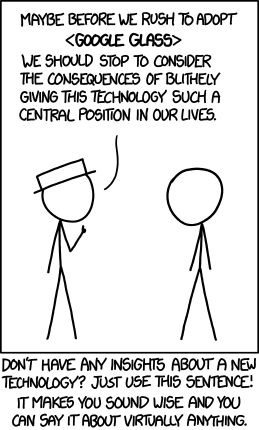
The comic and Eli’s comment may be a bit snarky, but something about it rang true to me because while conducting research on the impact of new information technologies on society I often come across books, columns, blog posts, editorials, and tweets that can basically be summed up with the line from that comic: “we should stop to consider the consequences of [this new technology] before we …” Or, equally common is the line: “we need to have a conversation about [this new technology] before we…”
But what does that really mean? Certainly “having a conversation” about the impact of a new technology on society is important. But what is the nature of that “conversation”? How is it conducted? How do we know when it is going on or when it is over? Continue reading →



 The Technology Liberation Front is the tech policy blog dedicated to keeping politicians' hands off the 'net and everything else related to technology.