“We’re from government and we’re here to help save journalism.”
 That seems to be the hot new meme in media policy circles these days. Last week, it was the Federal Communications Commission (FCC) kicking off their “Future of Media” effort with a workshop on “Serving the Public Interest in the Digital Era.” This week, it’s the Federal Trade Commission’s (FTC) turn as they host the second in their series of workshops on How Will Journalism Survive the Internet Age? Meanwhile, the Senate has already held hearings about “the future of journalism,” and Senator Benjamin L. Cardin (D-MD) recently introduced the “Newspaper Revitalization Act,” which would allow newspapers to become nonprofit organizations in an effort to help them stay afloat.
I have no doubt that many of the public policymakers behind these efforts have the best of intentions and really are concerned about what many believe to be a crisis in the field of journalism. But here are my three primary concerns with Washington’s sudden interest in “saving journalism”: Continue reading →
 Congress gets dinged a lot for slowing down innovation, but sometimes that is just what the doctor ordered. Thirty-five years ago, a Democratically controlled Congress passed the Magnuson-Moss Act in an attempt to check a hyperactive FTC.
Like a kid set loose in a candy store, the FTC at the time had gone on a binge of overreaching and harmful regulation. The core enabler of this action is the exceptionally broad mandate bestowed on the agency to regulate all “unfair” consumer activity. Unlike regulating the structural stability of bridges or safety in food, “fairness” is a subjective concept.
Congress’ prudent action to place special restrictions on FTC rulemaking [15 U.S.C. Sect. 57a(b)(2)(A)] was in direct response to the agency’s overreach and regulation of activities that would have included advertising children’s products – in essence, acting like a kid in a candy store. Magnuson-Moss was the equivalent of putting the candy behind the counter, providing Congress and courts control over how much candy was appropriate.
Now, 35 years later, the FTC has that ‘unfairness feeling’ again. In a NY Times interview last month, FTC Chairman Jon Leibowitz signaled his intent to change standard marketing tactics of disclosure and opt-out, by requiring users to opt-In for collection of information for targeting ads. They are concerned about what’s “fair” in advertising, but we know that low rates of opt-in will reduce ad revenue. If the change were put into effect, free online services might have to charge a “fare” to users.
At the same time, the FTC is seeking to shed what the Chair called “medieval restrictions” on its rulemaking powers. A change that would allow the FTC to move quickly to require opt-in. Taken together, these threats to online services and e-commerce are #1 on the NetChoice 2010 iAWFUL list. Continue reading →
By Adam Thierer & Berin Szoka
Progress & Freedom Foundation Progress Snapshot No. 6.5, Feb 2010 [.pdf]
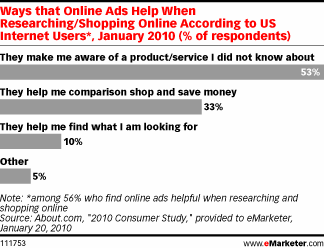 Advertising is increasingly under attack in Washington. In fact, we’re busy finishing up a paper with the working title: “The New Assault on Advertising: What it Means for the Future of Media & Culture.” Among other things, the paper inventories the many ways in which policymakers in Washington and elsewhere are stepping up regulation of commercial advertising and marketing efforts-and highlights the common themes that unite them. Unfortunately, the report is already over 50 pages long and we keep finding new threats to discuss!
This regulatory tsunami could not come at a worse time, of course, since an attack on advertising is tantamount to an attack on media itself, and media is at a critical point of technological change. As we have pointed out repeatedly, the vast majority of media and content in this country is supported by commercial advertising in one way or another-particularly in the era of “free” content and services.[1]
An Attack on Advertising Will Hurt Consumers
But there’s a more important reason to fear Washington’s new war on advertising:
It will hurt consumer welfare. That’s because advertising provides important information and signals to consumers about goods and services that are competing for their attention and business—and that scarcest of all things in the modern world, consumers’ attention. Continue reading →
Third on the headlines today on TechMeme (perhaps the leading tech news aggregator) is this headline: “An Apology To Our Readers,” a heart-felt piece from TechCrunch editor Michael Arrington disclosing that a TechCrunch intern had, on at least two occasions, demanded computers from start-ups as compensation for writing favorable blog posts about them on the highly influential site. The intern was immediately suspended and, when the allegation was confirmed, terminated. Arrington made no excuses for Daniel Brusilovsky on account of his age (he’s under 18). You can read Daniel’s response here.
If this incident demonstrates anything, it’s just how essential it is for a site like TechCrunch to, as Arrington promised his readers in closing, “maintain complete transparency with you on how we operate, even when it isn’t such an easy thing to do.” Arrington went so far as to have “deleted all content created by this person on our blogs”—indeed, “every word written by this person on the TechCrunch network,” which presumably includes comments.
One might take from this the lesson that the press, as it evolves from the newspaper model towards something blog-ier but still hard to pin down precisely, can police itself pretty darn well. Alas, the FTC has taken a much dimmer view of the ability of reputational incentives to discipline the influence that might be exerted by “blogola” payments (cash or in-kind) on editorial discretion and journalistic creation. Continue reading →
At today FTC’s “Exploring Privacy” roundtable event at Berkeley Law School, were heard a lunchtime address from Daniel J. Weitzner, Associate Administrator for Policy, National Telecommunications and Information Administration (NTIA) at the Department of Commerce. Down below is a brief summary of his remarks. (Berin Szoka and have been live-tweeting the event at @AdamThierer and @BerinSzoka). You can view all our tweets here.
- Obama Administration is looking at nexus between privacy & innovation
- Success of Internet has depended upon creative use of information
- Predictability and certainty is imp for both consumers and companies on this front
- Believes we CAN have both innovation and privacy protection; but there will be some tensions
- Challenge of the 3rd decade of Internet policymaking = to get together set of policies to bring security to Net while preserving freedom
- Does domestic & global patchwork of #privacy policies hurt or help innovation?
- Need to take a hard look at the traditional notice & choice framework
- Rules for COLLECTION or USE of data is key question
- Concepts of “accountability” … to what or whom?
- a Notice of Inquiry coming from NTIA about privacy to help shape privacy policy for Obama Admin
I’m attending the FTC’s 2nd “Exploring Privacy” roundtable event, which is taking place at the University of California-Berkeley School of Law. Here’s the agenda. (I’ll be live Tweeting @AdamThierer). FTC Commissioner Pamela Jones Harbour & FTC Bureau of Consumer Protection Director David Vladeck kicked things off. Here’s a quick summary of their remarks:
- Data collection has vast opportunities but drawbacks also
- “non-price dimensions” of privacy important
- Talking about recent Facebook privacy changes
- Privacy is not “over” as McNealy once said; recent public outcry about Facebook changes make that clear
- “delicate balance” between data collection and consumer control
- Concerned about privacy in the mobile environment
- “Apple could do more to require baseline level of privacy disclosures”; other could set such defaults too
- Similar fears about privacy in the cloud; difficult for consumers to define privacy expectation in the cloud; fear of lock-in concerns
- Wants more data portability
- Concerned that anonymization doesn’t work good enough; Perhaps our faith in current technologies is misplaced
- Must address the question of privacy by design sooner rather than later
Continue reading →
Berin Szoka and I will be in Berkeley, CA tomorrow attending the FTC’s 2nd “Exploring Privacy” roundtable event. The event will take place at the University of California-Berkeley School of Law. Here’s the agenda and speaker bios. The event will be webcast for those who cannot make it. But for those of you who going, make sure to come say hi to Berin and me. We were thinking about trying to get a group together afterward to grab a beer somewhere nearby.
Incidentally, Berin and I testified at the FTC’s first Exploring Privacy workshop, which took place on December 7th. You can find webcasts of the panels here, and here are Berin’s comments and my summary of what we had to say that day.
by Adam Thierer & Berin Szoka, Progress Snaphot 6.1
Stephanie Clifford of the
New York Times posted a very interesting article this week summarizing a recent “on-the-record chat” the Times staff had with Federal Trade Commission (FTC) chairman Jon Leibowitz and FTC Bureau of Consumer Protection chief David Vladeck. The interview [discussed by Braden here] is profoundly important in that it reveals an alarming disconnect regarding the relationship between “privacy” regulation and the future of media, which were the subjects of their discussion with Times staff. Namely, Leibowitz and Vladeck apparently fail to appreciate how the delicate balance between commercial advertising and journalism is at risk precisely because of the sort of regulations they apparently are ready to adopt. Because the value of online advertising depends on data about its effectiveness and consumers’ likely interests, and because advertising is indispensable to funding media, what’s ultimately at stake here is nothing short of the future of press freedom.
The “Day of Reckoning” Is Upon Us
Leibowitz and Vladeck spend the first half of
The Times interview wringing their hands about “privacy policies,” the declarations made by websites and advertising networks about their data collection and use practices (for which the FTC can and must hold them accountable). But the two feel that privacy policies don’t adequately inform consumers. Chairman Leibowitz claims that online companies “haven’t given consumers effective notice, so they can make effective choices.” And Mr. Vladeck states that advise-and-consent models “depended on the fiction that people were meaningfully giving consent.” But he and the FTC seem ready to abandon the notice and choice model because the “literature is clear” that few people read privacy policies, Vladeck told the Times. He and Leibowitz continue:
“Philosophically, we wonder if we’re moving to a post-disclosure era and what that would look like,” Mr. Vladeck said. “What’s the substitute for it?” He said the commission was still looking into the issue, but it hoped to have an answer by June or July, when it plans to publish a report on the subject. Mr. Leibowitz gave a hint as to what might be included: “I have a sense, and it’s still amorphous, that we might head toward opt-in,” Mr. Leibowitz said.
This clearly foreshadows the regulatory endgame we have long suspected was coming. When the FTC released its “Self-Regulatory Principles for Online Behavioral Advertising” eleven months ago, we asked: “What’s the Harm & Where Are We Heading?” Their answers to both questions have become clearer with each new calculated comment—all apparently intended to slowly “turn up the heat” on the advertising industry so that the proverbial frog will stay in the pot until the water finally boils. Leibowitz’s FTC has simply dodged the “harm” question with a four-part strategy: Continue reading →
Last year there was discussion of a possible return of the FCC’s “Fairness Doctrine” that used to apply to broadcasters. This year, we should all be aware of the FTC’s stepped-up rhetoric toward an “Unfairness Doctrine” for privacy–an increased effort toward enforcing the “unfair” part of Section 5 of the FTC Act, which prohibits unfair or deceptive practices.
Historically, the approach of the FTC toward privacy has been one of notice and consent and to hold companies to the word of their privacy policies — if companies say one thing and then do another, the FTC goes after them for being deceptive. This is the “deceptive” part of the FTC’s power to enforce the law against unfair or deceptive commercial practices.
For privacy, we really haven’t seen the “unfair” part being enforced. But if public comments from high-ranking officials is any indicator (and it is), that’s about to change.
A recent New York Times article summarizes its interview with FTC Chairman Jon Leibowitz and David Vladeck, chief of the FTC’s Bureau of Consumer Protection. It’s another insight into how aggressive the commission wants to be toward privacy.
Advise-and-consent “depended on the fiction that people were meaningfully giving consent,” Mr. Vladeck said. “The literature is clear” that few people read privacy policies, he said.
But even if people did read privacy policies, Vladeck still doesn’t think it is
fair that people give consent to data practices, often in exchange for free services: Continue reading →
 ACT represents the interests of software companies, but today we’ve released a new paper trumpeting the virtues of hardware.
We highlight how software developers and computer chip makers increasingly depend on one another for better products. This symbiotic hardware/software relationship is crucial for the sort of exponential innovation we’ve grown accustomed to in the IT industry. And it is something ACT recently highlighted in a letter to the FTC signed by 37 software developers.
The old days of understanding computer processors and its effect on software was easy. Chips increased in clock speed (first in MHz, then in GHz) and this made software run faster. This worked well for years, but then it became apparent that high clock speed processors often ran idle because other system components couldn’t keep up. These processors also ran very hot, consuming lots of power and creating heat problems.
Today’s chips take a different approach. Chips now have processors with multiple cores (or CPUs) to separately but simultaneously handle independent tasks. In a survey of ACT members that we conducted for the paper, 58% of the respondents identified multicore technology as the processor advancement that has most improved their software products. One member said “multicore makes programming harder, but when my apps leverage it, they can do more.”
But how do programmers know what to do so they can better leverage processor designs such as multicore? Every major chip manufacturer worth a grain of sand has established support programs and created tools for the developer community. Sun has its Sun Developer Network, Intel has a Software Partner Program (and just announced a new software development kit (SDK) for its mobile Atom processor), and AMD has the CodeAnalyst Performance Analyzer to analyze software performance and help developers optimize applications.
In some ways it seems like chip manufacturers are sucking up to software developers. Continue reading →

 The Technology Liberation Front is the tech policy blog dedicated to keeping politicians' hands off the 'net and everything else related to technology.