 I often ponder what the TLF is all about. Of course, our official mission is “keeping politicians’ hands off the ‘net and everything else related to technology.” You can read more on our “About Us” page. But this quote from Robert Heinlein‘s 1973 classic Time Enough for Love (among my top five favorite novels) really hits the nail on the head for me:
Throughout history, poverty is the normal condition of man. Advances which permit this norm to be exceeded — here and there, now and then — are the work of an extremely small minority, frequently despised, often condemned, and almost always opposed by all right-thinking people. Whenever this tiny minority is kept from creating, or (as sometimes happens) is driven out of a society, the people then slip back into abject poverty. This is known as “bad luck.”
“Man is the measure of all things,” said Protagoras of Abdera (c. 480-410 B.C.). So it is for me: technology is ultimately a means—indeed, the means—by which the condition of humanity is improved. By “liberating technology”—i.e., defending the freedom to innovate and to profit from bringing innovation to the marketplace—we’re all doing our small part to prevent “right-thinking people” from squelching the creative minority whose toils will sometday take the species to the stars.
I can’t wait to see what the coming decades will bring. In the words of the immortal 1970s rock band, Bachman-Turner Overdrive: You ain’t seen nothing yet!
http://www.youtube.com/v/lJmBPCYt5LY&hl=en&fs=1
(The full version of the video—not the embedded player—includes an ad to buy the song, a new YouTube feature. Heinlein would be proud.)
Tim Lee has been taking some heat here from Richard Bennett and Steve Schultze about various aspects of his new Net neutrality paper. I haven’t had much time this week to jump into these debates, but I did want to mention one important portion of Tim’s paper that is being overlooked. Specifically, I like the way Tim took head-on some of the silly free speech arguments being put forth as a rationale for net neutrality regulation. As Tim notes in the introduction of the paper:
Concerns that network owners will undermine free speech online are particularly misguided. Network owners have neither the technology nor the manpower to effectively filter online content based on the viewpoints being expressed, nor do profit-making businesses have any real incentive to do so. Should a network owner be foolish enough to attempt large-scale censorship of its customers, it would not only fail to suppress the disfavored speech, but the network would actually increase the visibility of the content as the effort at censorship attracted additional coverage of the material being censored.
I think that’s exactly right and, later in his paper (between pgs 22-3), Tim nicely elaborates about the “Herculean task” associated with any attempt by a broadband provider to “manipulate human communication.” Not only is it true, as Tim argues, that “no widescale manipulation would go unnoticed for very long,” but he is also correct in noting that the public and press backlash would be enormous.
Again, I agree wholeheartedly with all these sentiments, but I think Tim missed another important angle here when discussing the unfounded fears about corporate censorship and the misguided attempts to use free speech as a justification for imposing net neutrality regulations.
Continue reading →
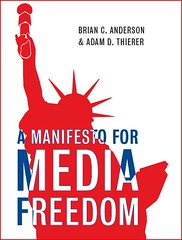 I’m pleased to announce the publication of A Manifesto for Media Freedom, which I co-authored with Brian C. Anderson of the Manhattan Institute. Brian serves as editor of Manhattan Institute’s excellent City Journal and he is the author of best-selling books like South Park Conservatives and Democratic Capitalism and Its Discontents.
In this little manifesto, we highlight one of the central ironies of the Information Age. Namely, that despite “the breathtaking abundance of new and old media outlets for obtaining news, information, and entertainment…”
many people hate this profusion, and never more than when it involves political speech. The current media market, they charge, doesn’t represent true diversity, or isn’t fair, or is subject to manipulation by a small and shrinking group of media barons. They want the government to regulate it into better shape, which just happens to be a shape that benefits them. Doing so… would be a disaster, a kind of soft or not-so-soft tyranny that would wipe out whole sectors of media, curtailing free speech and impoverishing our democracy.
In other words, instead of celebrating the unprecedented cornucopia of media choices at our collective disposal, many policymakers and media critics are calling for just as much media regulation as ever. We itemize these threats in our chapters and they include: efforts to revive the “Fairness Doctrine”, media ownership regulations, “localism” requirements, Net neutrality mandates, a la carte regulations, cable and satellite censorship, video game censorship, regulation of social networking sites, campaign finance-related speech restrictions, and so on.
In each case, we advance a pro-freedom paradigm to counter the advocates of media control. What do we mean by the “media freedom” that we advocate as the alternative to these new regulatory crusades? Here’s how we put it in the book:
Continue reading →
 In a new
PFF
essay, my colleague Barbara Esbin and I address a recent petition filed by the Rural Cellular Association (RCA) asking the FCC to prohibit exclusive arrangements between wireless handset producers and carriers. The RCA petition claims that large wireless companies have an unfair market advantage by giving their customers exclusive access to certain advanced smart phones, such as the Apple/AT&T iPhone—and that this anticompetitive practice is harmful to rural consumers served by RCA members.
In a new
PFF
essay, my colleague Barbara Esbin and I address a recent petition filed by the Rural Cellular Association (RCA) asking the FCC to prohibit exclusive arrangements between wireless handset producers and carriers. The RCA petition claims that large wireless companies have an unfair market advantage by giving their customers exclusive access to certain advanced smart phones, such as the Apple/AT&T iPhone—and that this anticompetitive practice is harmful to rural consumers served by RCA members.
In the piece, we debunk RCA’s arguments premised on a supposed lack of competition in wireless markets. RCA will likely now redouble these arguments by pointing to Verizon’s planned acquisition of Alltel (by far the smallest of the “Big 5” carriers), which was announced the day our piece was published. But even with four large carriers instead of five, the wireless market remains vibrantly competitive—especially as compared to 1992, when the FCC decided that even the two-carrier market was “extremely competitive,” and rejecting arguments that it ban exclusive handset arrangements. Continue reading →

 The Technology Liberation Front is the tech policy blog dedicated to keeping politicians' hands off the 'net and everything else related to technology.