What Unites Advocates of Speech Controls & Privacy Regulation? [pdf]
by Adam Thierer & Berin Szoka
The Progress & Freedom Foundation,
Progress on Point No. 16.19
Anyone who has spent time following debates about speech and privacy regulation comes to recognize the striking parallels between these two policy arenas. In this paper we will highlight the common rhetoric, proposals, and tactics that unite these regulatory movements. Moreover, we will argue that, at root, what often animates calls for regulation of both speech and privacy are two remarkably elitist beliefs:
- People are too ignorant (or simply too busy) to be trusted to make wise decisions for themselves (or their children); and/or,
- All or most people share essentially the same values or concerns and, therefore, “community standards” should trump household (or individual) standards.
While our use of the term “elitism” may unduly offend some understandably sensitive to populist demagoguery, our aim here is not to launch a broadside against elitism as
Time magazine culture critic William H. Henry once defined it: “The willingness to assert unyieldingly that one idea, contribution or attainment is better than another.”[1] Rather, our aim here is to critique that elitism which rises to the level of political condescension and legal sanction. We attack not so much the beliefs of some leaders, activists, or intellectuals that they have a better idea of what it in the public’s best interest than the public itself does, but rather the imposition of those beliefs through coercive, top-down mandates.
That sort of elitism—elitism enforced by law—is often the objective of speech and privacy regulatory advocates. Our goal is to identify the common themes that unite these regulatory movements, explain why such political elitism is unwarranted, and make it clear how it threatens individual liberty as well as the future of free and open Internet. As an alternative to this elitist vision, we advocate an empowerment agenda: fostering an environment in which users have the tools and information they need to make decisions for themselves and their families. Continue reading →
I’ve spent a lot of time here deconstructing and criticizing the proposals set forth by the Free Press, the radical media “reformista” group founded by the prolific Marxist media theorist Robert McChesney. I have been trying to shine more light on their proposals and activities because I believe they are antithetical to freedom of speech and a free society. That’s because, as media scholar Ben Compaine has noted, “What the hard core reformistas really want, it seems, is not diversity or an open debate but a media that promotes their own vision of society and the world.” That’s exactly right and, more specifically, as I argued in my 2005 Media Myths book, the media reformistas want to impose this control by taking the fantasy that “the public owns the [broadcast] airwaves” and extending it to ALL media platforms and outlets. In other words, McChesney and the Free Press want an UnFree Press. To cast things in neo-Marxist terms that they could appreciate, they want to take control of the information means of production. And it begins, McChesney argues, by all of us having to give up this “sort of religious attachment to the idea of a ‘free-press'” from which we all suffer.
Some people accuse me of “red-baiting” or “McCarthyite” tactics when I use the “M-word” (Marxism) or the “S-Word” (socialism) to describe McChesney, the Free Press, and the movement they have spawned. But these are labels with real meaning and ones that McChesney himself embraces in his work. In his 1999 book
Rich Media, Poor Media, he says that “Media reform cannot win without widespread support and such support needs to be organized as part of a broad anti-corporate, pro-democracy movement.” He casts everything in “social justice” terms and speaks of the need “to rip the veil off [corporate] power, and to work so that social decision making and power may be made as enlightened and as egalitarian as possible.” What exactly would all that mean in practice for media? In his 2002 book Our Media, Not Theirs: The Democratic Struggle against Corporate Media with John Nichols of The Nation, McChesney argues that media reform efforts must begin with “the need to promote an understanding of the urgency to assert public control over the media.” They go on to state that, “Our claim is simply that the media system produces vastly less of quality than it would if corporate and commercial pressures were lessened.”
If you want additional proof of his intentions, then I encourage you to read this lengthy interview with McChesney that appears in the new edition of The Bullet, an online newsletter produced by the Canada-based “Socialist Project.” (If you ask me, there’s something strangely appropriate about a socialist newsletter named “The Bullet” in light of the millions of people who died while living under socialist tyranny!) Anyway, let’s ignore that and focus on what neo-Marxist media reform entails according to McChesney. Because never before has he laid his cards on the table as clearly as he does in this interview. Continue reading →
Well, here we go again. Harvard’s Jonathan Zittrain has penned another gloomy essay about how “freedom is at risk in the cloud” and the future of the Internet is in peril because nefarious digital schemers like Apple, Facebook, and Google are supposedly out to lock you into their services and take away your digital rights. And so, as I have done here many times before (see 1, 2, 3, 4, 5 + video!), I will offer a response arguing that Jonathan’s cyber-Chicken Little-ism is largely unwarranted.
Zittrain’s latest piece is entitled “Lost in the Cloud” and it appears in today’s New York Times. It closely tracks the arguments he has set forth in his book The Future of the Internet–And How to Stop It, which I named the most important technology policy book of 2008, but not because I agreed with its central thesis. Zittrain’s book and his new NYT essay are the ultimate exposition of Lessigite technological pessimism. I don’t know what they put in the water up at the Berkman Center to make these guys so remarkably cranky and despondent about the future of of the Internet, but starting with Lawrence Lessig’s Code in 1999 and running through to Zittrain’s Future of the Internet we have been forced to endure endless Tales of the Coming Techno-Apocalypse from these guys. Back in the late 90s, Prof. Lessig warned us that AOL and some other companies would soon take over the new digital frontier since “Left to itself, cyberspace will become a perfect tool of control.” Ah yes, how was it that we threw off the chains of our techno-oppressors and freed ourselves from that wicked walled garden hell? Oh yeah, we clicked our mouses and left! And that was pretty much the end of AOL’s “perfect control” fantasies. [See my recent debate with Prof. Lessig over at Cato Unbound for more about this “illusion of perfect control,” as I have labeled it.]
But Zittrain is the equivalent of the St. Peter upon which the Church of Lessigism has been built and, like any good disciple, he’s still vociferously preaching to the unconverted and using fire and brimstone sermons to warn of our impending digital damnation. In fact, he’s taken it to all new extremes. In
Future of the Internet, Jonathan argues that we run the risk of seeing the glorious days of the generative, open Net and digital devices give way to more “sterile, tethered devices” and closed networks. The future that he hopes to “stop” is one in which Apple, TiVo, Facebook, and Google — the central villains in his drama — are supposedly ceded too much authority over our daily lives because of a combination of (a) their wicked ways and (b) our ignorant ones.
Continue reading →
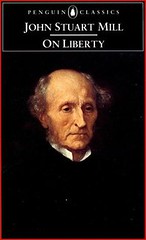 John Stuart Mill’s On Liberty turns 150 this year. Published in 1859, this slender manifesto for human liberty went on to become a classic of modern philosophy and political science. It remains a beautiful articulation of the core principles of human liberty and a just society.
Anyone familiar with the book recognizes the importance of the opening chapter and Mill’s “one very simple principle” for “the dealings of society with the individual in the way of compulsion and control, whether the means used be physical force in the form of legal penalties, or the moral coercion of public opinion”:
That principle is, that the sole end for which mankind are warranted, individually or collectively, in interfering with the liberty of action of any of their number, is self-protection. That the only purpose for which power can be rightfully exercised over any member of a civilized community, against his will, is to prevent harm to others. His own good, either physical or moral, is not a sufficient warrant. He cannot rightfully be compelled to do or forbear because it will be better for him to do so, because it will make him happier, because, in the opinions of others, to do so would be wise, or even right. These are good reasons for remonstrating with him, or reasoning with him, or persuading him, or entreating him, but not for compelling him, or visiting him with any evil in case he do otherwise. To justify that, the conduct from which it is desired to deter him, must be calculated to produce evil to some one else. The only part of the conduct of any one, for which he is amenable to society, is that which concerns others. In the part which merely concerns himself, his independence is, of right, absolute. Over himself, over his own body and mind, the individual is sovereign.
Mill went on to outline “the appropriate region of human liberty,” and divided it into:
- “liberty of conscience, in the most comprehensive sense; liberty of thought and feeling; absolute freedom of opinion and sentiment on all subjects, practical or speculative, scientific, moral, or theological. The liberty of expressing and publishing opinions may seem to fall under a different principle, since it belongs to that part of the conduct of an individual which concerns other people; but, being almost of as much importance as the liberty of thought itself, and resting in great part on the same reasons, is practically inseparable from it.”
- “liberty of tastes and pursuits; of framing the plan of our life to suit our own character; of doing as we like, subject to such consequences as may follow: without impediment from our fellow-creatures, so long as what we do does not harm them, even though they should think our conduct foolish, perverse, or wrong”
- “freedom to unite, for any purpose not involving harm to others”
Bringing it altogether, he argued:
The only freedom which deserves the name, is that of pursuing our own good in our own way, so long as we do not attempt to deprive others of theirs, or impede their efforts to obtain it. Each is the proper guardian of his own health, whether bodily, or mental and spiritual. Mankind are greater gainers by suffering each other to live as seems good to themselves, than by compelling each to live as seems good to the rest.
To this day, I do not believe there has been a more eloquent or concise summation of the central principles of libertarianism than those passages from Chapter 1 of the book.
But what many fail to remember or appreciate is the equally powerful second chapter of Mill’s treatise, “On the Liberty of Thought and Discussion.” It was a bold defense of freedom of speech and expression that was many decades ahead of its time. And it still has lessons and warnings worth heeding in our modern Information Age.
Continue reading →

He Wants to Terminate Your First Amendment Rights
Robert Corn-Revere, a partner with the law firm of Davis Wright Tremaine and one of America’s greatest living defenders of the First Amendment, has a new essay up on the Media Institute website entitled “The Terminator Cometh.” Corn-Revere takes on the former Terminator himself, California Gov. Arnold Schwarzenegger, who along with other Calif. lawmakers, has asked the Supreme Court to review a Ninth Circuit Court of Appeals decision holding that a California video game statute was unconstitutional. (More background in my previous post here). California’s decision to appeal the law up to the Supreme Court [petition is here] sets up a potential historic First Amendment decision (if they Court agrees to take the case, that is). Corn-Revere points out why this case is so important:
In seeking review, California is asking the Supreme Court to reverse 60 years of First Amendment jurisprudence and to hold that “excessively violent” material — whatever that may be –“deserves no constitutional protection.” It is also asking the Court to relieve government from actually having to demonstrate the purported harmfulness of speech it seeks to regulate, but instead to defer to “reasonable inferences” and “legislative judgments.”

The John Connor of Your First Amendment Freedoms
In other words, Corn-Revere notes, “the state is asking the Court simply to lower the bar so that protected speech may be regulated based on legislative whim.” He continues:
Thus, like the Terminator, no matter how many times you kill it, the government drive that motivates these laws keeps on going and going until it achieves its programmed goal. If California is successful, it will open the door to regulate not just video games, but a wide range of speech that is currently protected under the First Amendment.
Corn-Revere is right. The ramifications of this case could be profound. As I pointed out in my previous essay on this case:
Continue reading →
In response to my essay last night about this new Free Press campaign to layer price controls on the Internet by banning metered prices via Rep. Massa’s new bill (the “Broadband Internet Fairness Act“), George Ou and Richard Bennett reminded me of some of the contradictory statements that the (Un)Free Press crew have made on this issue. Indeed, if you look back at what Free Press and their chairman have said about the matter over just the past 18 months, they seem to be whistling two very different tunes.
For example, George Ou reminded me of what Free Press had to say in its November 2007 filing in the FCC’s Comcast-Bit Torrent proceeding:
“More importantly, if Comcast is concerned that the collective set of users running P2P applications are affecting quality of service for other users on a cable loop… they could also charge by usage.” (p. 29)
[…]
“Indeed, in many nations, network providers do meter, and bill their customers on the basis of amount used. So the transaction costs of doing so must not be prohibitively high. Indeed, a network provider can apparently meter cheaply because, in most networks, users’ traffic to and from the Internet passes through a single gateway, the network access server.” (p. 31)
And Richard Bennett reminded me of what Tim Wu, chairman of the Free Press, had to say about metering to the Washington Post just one year ago:
“I don’t quite see [metering] as an outrage, and in fact is probably the fairest system going — though of course the psychology of knowing that you’re paying for bandwidth may change behavior.”
So, what gives? Will the real Free Press please stand up? Does the Free Press believe in pricing freedom or price controls for the Internet?
As faithful readers no doubt know, I’m a big fan of Section 230 and believe it has been the foundation of a great many of the online freedoms we enjoy (dare I say, take for granted?) today. That’s why I’m increasingly concerned about some of the emerging thinking and case law I am seeing on this front, which takes a decidedly anti-230 tone.
Consider, for example, how some might weaken Sec. 230 in the name of “child safety.” You will recall the friendly debate about the future of Sec. 230 that I engaged in with Harvard’s John Palfrey. Prof. Palfrey has argued that: “The scope of the immunity the CDA provides for online service providers is too broad” and that the law “should not preclude parents from bringing a claim of negligence against [a social networking site] for failing to protect the safety of its users.” Similarly, Andrew LaVallee of The Wall Street Journal reported from a conference this week that Sec. 230 became everyone’s favorite whipping boy, with several participants suggesting that the law needs to be re-opened and altered to somehow solve online “cyber-bullying” problems.
Continue reading →
 When the history books are finally written documenting America’s failed experiment with broadcast industry content regulation, this past week may go down as a critical moment in the story. The obvious reason this week was so important was the Senate’s 87-11 vote on Thursday to prevent the Federal Communications Commission (FCC) from reinstating the Fairness Doctrine. But an equally important development this past week was the release of a new white paper by the radical Leftist activist group Free Press.
The Free Press, which was founded by the socialist media theorist Robert McChesney, doesn’t typically publish many things admitting to the failures of coercive government regulation. Nonetheless, in “The Fairness Doctrine Distraction,” a paper by Josh Silver and Marvin Ammori, the media reformistas at Free Press told their Big Government comrades in Congress and academia that it was finally OK to let go of at least this one old pet project of theirs. In their paper, Silver and Ammori note that, “The Fairness Doctrine put the federal government in the position of judging content and controlling speech” and “Reinstating the Doctrine will not result in greater viewpoint diversity in broadcasting.” They continue:
The Fairness Doctrine, while originally well-intentioned, is not wise public policy. [T]he Doctrine places the FCC in charge of determining what is fair in political speech — a difficult task in the best of circumstances. Placing the government in the role of monitoring and judging political speech will inevitably produce controversy that is impossible to resolve.
I applaud the Free Press for finally fessing up to the Fairness Doctrine’s many failings. This First Amendment-violating abomination should have never been allowed to be enforced by the FCC to begin with, but at least we can now all finally agree it should stay off the books for good.
Of course, the radicals at the (Un)Free Press weren’t about to let one of the Left’s old favorite regulations go so away without asking for something in return. One of the reasons that Silver and Ammori are suddenly willing to give their blessing to the Doctrine’s burial is because they want to get on with the more far-reaching agenda of micro-managing media markets using a variety of less visible regulations.
Continue reading →
Matt Lasar of Ars
tells us not to worry about the Fairness Doctrine being revived, only to go on and cite several lawmakers who have said they’d like to revive it. Meanwhile, over at the American Spectator, somebody called “The Prowler” seems to have all sorts of unnamed sources on the Hill telling him the Fairness Doctrine will be revived any day now.
Who knows what to believe. But let’s keep our eye on the real issue here. The danger is not that the Fairness Doctrine gets back on the books in the same form; it’s that versions of it sneak in through the back door via other regulatory initiatives. As Cord Blomquist pointed out here last April, “localism is the new Fairness Doctrine.” There are a lot of people are running around Washington today insisting that government must intervene in the marketplace to “save media localism” and “strengthen the public interest obligations” of local TV and radio broadcasters. There’s been an FCC proceeding open on this issue for some time, and everything about it reeks of the Fairness Doctrine in drag.
This effort is being spearheaded by the media reformistas whose short-term goal is to reinvigorate the amorphous “public interest standard” such that the FCC has open-ended powers to regulate everything under the sun going forward. That’s why a key part of the “localism” battle is their effort to breathe new life into “ascertainment rules,” which used to be more formal and required broadcasters to strictly report everything they aired and did in their communities. There’s lots of talk of ensuring more “accountability” from broadcasters regarding how they serve their local communities, and there’s even rumblings of “local community boards” who will sit as mini-free speech Star Chambers and pass judgment on whether local media outlets are doing their job. Again, it’s all just the Fairness Doctrine by another name. Continue reading →
David Margolick has penned a lengthy piece for Portfolio.com about the AutoAdmit case, which has important ramifications for the future of Section 230 and online speech in general. Very brief background: AutoAdmit is a discussion board for students looking to enter, or just discuss, law schools. Some threads on the site have included ugly — insanely ugly — insults about some women. A couple of those women sued to reveal the identities of their attackers and hold them liable for supposedly wronging them. The case has been slowly moving through the courts ever since. Again, read Margolick’s article for all the details. The important point here is that the women could not sue AutoAdmit directly for defamation or harassment because Section 230 of the Communications Decency Act of 1996 immunizes websites from liability for the actions of their users. Consequently, those looking to sue must go after the actual individuals behind the comments which (supposedly) caused the harm in question.
I am big defender of Section 230 and have argued that it has been the cornerstone of Internet freedom. Keeping online intermediaries free from burdensome policing requirements and liability threats has created the vibrant marketplace of expression and commerce that we enjoy today. If not for Sec. 230, we would likely live in a very different world today.
Sec. 230 has come under attack, however, from those who believe online intermediaries should “do more” to address various concerns, including cyber-bullying, defamation, or other problems. For those of us who believe passionately in the importance of Sec. 230, the better approach is to preserve immunity for intermediaries and instead encourage more
voluntary policing and self-regulation by intermediaries, increased public pressure on those sites that turn a blind eye to such behavior to encourage them to change their ways, more efforts to establish “community policing” by users such that they can report or counter abusive language, and so on.
Of course, those efforts will never be fool proof and a handful of bad apples will still be able to cause a lot of grief for some users on certain discussion boards, blogs, and so on. In those extreme cases where legal action is necessary, it would be optimal if every effort was exhausted to go after the actual end-user who is causing the problem before tossing Sec. 230 and current online immunity norms to the wind in an effort to force the intermediaries to police speech. After all, how do the intermediaries know what is defamatory? Why should they be forced to sit in judgment of such things? If, under threat of lawsuit, they are petitioned by countless users to remove content or comments that those individuals find objectionable, the result will be a massive chilling effect on online free speech since those intermediaries would likely play is safe most of the time and just take everything down. Continue reading →

 The Technology Liberation Front is the tech policy blog dedicated to keeping politicians' hands off the 'net and everything else related to technology.