Posts tagged as:

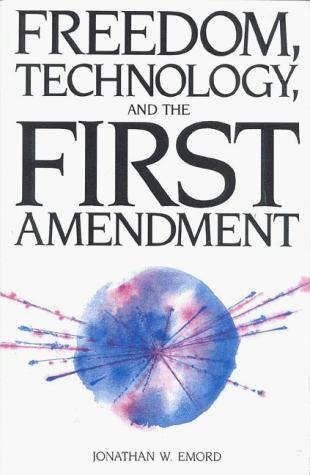
Twenty years ago, one of the best books ever penned about freedom of speech was released. Sadly, many people still haven’t heard of it. That book was Freedom, Technology and the First Amendment, by Jonathan Emord. With the exception of Ithiel de Sola Pool’s 1983 masterpiece Technologies of Freedom: On Free Speech in an Electronic Age, no book has a more profound impact on my thinking about free speech and technology policy than Emord’s 1991 classic. Emord’s book is, at once, a magisterial history and a polemical paean. This is no wishy-washy apologia for free speech, rather, it is a celebration of the amazing gift of freedom that the Founding Fathers gave us with the very first amendment to our constitution.

Unlike most people, Emord assumes nothing about the nature and purpose of the First Amendment; instead, he starts in pre-colonial times and explains how our rich heritage of freedom of speech and expression came about. Like Pool, Emord also makes the case for equality of all press providers and debunks the twisted logic behind much of this century’s corrupt jurisprudence governing speech transmitted via electronic media. Pool and Emord make it clear that if the First Amendment is retain its true meaning and purpose as a bulwark against government control of speech and expression, electronic media providers (TV, radio, cable, the Internet) must be accorded full First Amendment freedoms on par with traditional print media (newspapers, magazines, books and journals). Continue reading →

Over on his Google+ page, cyber-guru Andrew McLaughlin posted a bit of a rant about libertarians and Net neutrality arguing, among other things, that “the pro-freedom position is to enforce net neutrality.” Needless to say, I disagree and posted a long comment explaining why and trying to help him and others on the Left understand the way libertarians generally look at this issue. For what it’s worth, I thought I would just repost my response to him here:
________

Andrew… I’m happy, as always, to engage in friendly debate with you about this, although I suspect from the tone of some of the others here that nothing I will say will convince them that opposition to Net neutrality regulation can be based on anything other than pure corporate whoring!

I’m always mystified by the highly selective nature of this rhetorical device when employed by some on the Left against libertarians. After all, as Tim Lee already alluded to in his comments above, we never seem to hear our Lefty friends trot out those arguments when they agree with us. For example, Berin Szoka and I filed an amicus brief in the Supreme Court last year in the BROWN v. EMA video game case along with Lee Tien and Cindy Cohn of EFF. Why is it that I did not hear one peep from any Lefties about my obvious corporate whoring in that matter! I mean, clearly, there’s no possible way that a libertarian could support First Amendment rights. I must have just been in it for video game industry money, right?

OK, I’m being snarky here. And I know this is not your position because I’ve known you a long time and know that you do not adopt such tactics even when we do, on occasion, disagree heatedly over a major policy issue.  But, even if I am wasting my breath, let me just say this to others: We libertarians in the academic and think tank world aren’t exactly living “Lifestyles of the Rich and Famous.” If we all just in it for the money than I can tell you that we are doing a tremendously shitty job at it! (In fact, most libertarian think tanks or organizations only have something like 5 to 10% corporate funding. The organization I work for has even less.) Seriously folks, we libertarians believe in our ideas and fight for them with the same passion that you fight for yours because of a heart-felt belief in the inherent rightness of our core principles. Continue reading →

FCC Commissioner Robert M. McDowell delivered a terrific speech this week on “Technology and the Sovereignty of the Individual” at a broadband conference in Stockholm, Sweden.  The speech serves as another reminder that McDowell is one of those ultimate rare birds: a regulator who is a first-rate intellectual thinker and a great champion of individual liberty. It’s a beautiful statement in defense of real Internet freedom. I can’t recall ever seeing another federal official cite the great Bruno Leoni in a speech!

Here’s a sample of what Commissioner McDowell had to say:

To propel freedom’s momentum, policy makers should remember that, since their inception, the Internet and mobile connectivity have migrated further away from government control.  As the result of longstanding international consensus, the Internet itself has become the greatest deregulatory success story of all time.  To continue to promote freedom and prosperity, regulators should continue to rely on the “bottom up” nongovernmental Internet governance bodies that have a perfect record of keeping the ’Net working and open.  We must heed the advice of leaders like Neelie Kroes, who has consistently called on regulators to “avoid over-hasty regulatory intervention,” and steer clear of “unnecessary measures which may hinder new efficient business models from emerging.” I couldn’t agree more.  Changing course now could not only trigger an avalanche of international regulation, but it could halt the progress of freedom’s march as well.

Continue reading →

I’m very excited to announce that I now have a regular Forbes column that will fly under the banner, “Technologies of Freedom.” My first essay for them is already live and it addresses a topic I’ve dealt with here extensively through the years: Irrational fears about tech monopolies and “information empires.” Jump over to Forbes to read the whole thing.

Regular readers of this blog will understand why I chose “Technologies of Freedom” as the title for my column, but I thought it was worth reiterating. No book has had a more formative impact on my thinking about technology policy than Ithiel de Sola Pool’s 1983 masterpiece, Technologies of Freedom: On Free Speech in an Electronic Age.  As I noted in my short Amazon.com review, Pool’s technological tour de force is simply breathtaking in its polemical power and predictive capabilities. Reading this book almost three decades after it was published, one comes to believe that Pool must have possessed a crystal ball or had a Nostradamus-like ability to foresee the future.

For example, long before anyone else had envisioned what we now refer to as “cyberspace,” Pool was describing it in this book. “Networked computers will be the printing presses of the twenty-first century,” he argued in his remarkably prescient chapter on electronic publishing. “Soon most published information will disseminated electronically,” and “there will be networks on networks on networks,” he predicted. “A panoply of electronic devices puts at everyone’s hands capacities far beyond anything that the printing press could offer.” Few probably believed his prophecies in 1983, but no one doubts him now! Continue reading →

Nate Anderson of Ars Technica has posted an interview with Sen. Al Franken (D-MN) about Defining Internet “Freedom”. Neither Sen. Franken nor Mr. Anderson ever get around to defining that term in their exchange, but the clear implication from the piece is that “freedom” means freedom for the government to plan more and for policymakers to more closely monitor and control the Internet economy.  The clearest indication of this comes when Sen. Franken repeats the old saw that net neutrality regulation is “the First Amendment issue of our time.”

As a lover of liberty, I find this corruption of language and continued debasement of the term “freedom” to be extremely troubling. The thinking we see at work here reflects the ongoing effort by many cyber-progressives (or “cyber-collectivists,” as I prefer to call them) to redefine Internet freedom as liberation from the supposed tyranny of the marketplace and the corresponding empowerment of techno-cratic philosopher kings to guide us toward a more enlightened and noble state of affairs. We are asked to ignore our history lessons, which teach us that centralized planning and bureaucracy all too often lead to massively inefficient outcomes, myriad unforeseen unintended consequences, bureaucratic waste, and regulatory capture.  Instead, we are asked to believe that high-tech entrepreneurs are the true threat to human progress and liberty. They are cast as nefarious villains and their innovations, we are told, represent threats to our “freedom.” We even hear silly comparisons likening innovators like Apple to something out of George Orwell’s 1984.  Continue reading →

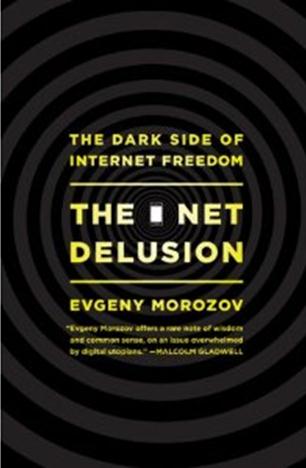
In his new book, The Net Delusion: The Dark Side of Internet Freedom, Evgeny Morozov aims to prick the bubble of hyper-optimism that surrounds debates about the Internet’s role in advancing human freedom or civic causes.  Morozov, a native of Belarus, is a tremendously gifted young cyber-policy scholar affiliated with Stanford University and the New America Foundation.  He’s an expert on the interaction of digital technology and democracy and writes frequently on that topic for a variety of respected media outlets.

In Net Delusion, as with many of his previous columns and essays, Morozov positions himself the ultimate Net “realist,” aiming to bring a dose of realpolitik to discussions about how much of a difference the Net and digital technologies make to advancing democracy and freedom.  His depressing answer: Not much.  Indeed, Morozov’s book is one big wet blanket on the theory that “technologies of freedom” can help liberate humanity from the yoke of repressive government.

Morozov clearly relishes his skunk at the garden party role, missing few opportunities to belittle those who subscribe to such theories.  If you’re one of those who tinted your Twitter avatar green as an expression of solidarity with Iranian “Green Movement” dissidents, Morozov’s view is that, at best, you’re wasting your time and, at worst, you’re aiding and abetting tyrants by engaging in a form of “slacktivism” that has little hope of advancing real regime change.  The portrait he paints of technology and democracy is a dismal one in which cyber-utopian ideals of information as liberator are not just rejected but inverted.  He regards such “cyber-utopian” dreams as counter-productive, even dangerous, to the advance of democracy and human freedom. Continue reading →

Today I appeared on CNBC’s “Power Lunch” to debate Net neutrality issues and the specific role of pricing in this debate. Specifically, the producers wanted to know whether websites should be allowed to pay a higher fee to allow consumers faster access to their sites or should it be equal for every website.  The show was partially a response to the rumors that the may be some sort of deal pending between Verizon and Google about prioritized services. On the program, I was up against Craig Aaron of Free Press.  During the discussion I made several points, many of which first appeared in my 2005 essay on “The Real Net Neutrality Debate: Pricing Flexibility Versus Pricing Regulation.” Here are the key points I tried to get across:

  • In a free-market economy, companies should be able to freely set prices for goods and services without fear of government price controls.
  • This isn’t about consumers paying more for basic Internet access or having their connections “slowed down”?  This is about whether the government will allow some broadband services to be differentiated or specialized for unique needs, such as online gaming, live event telecasts, secure telepresence conferences, telemedicine, etc.
  • Differentiated and prioritized services and pricing are part of almost every industrial sector in a capitalistic economy. (ex: airlines, package shipping, hotels, amusement parks, grades of gasoline, etc.)  Why should it be any different for broadband?
  • It’s always important to remember that there is no such thing as a free lunch. Something has to pay for Internet access. It doesn’t just fall like manna from heaven.  Differentiated services may help in this regard by allowing carriers to price more intensive or specialized users and uses to ensure that carriers don’t have to hit everyone – including average household users – with the same bill for service.  Why should the government make that illegal through Net neutrality regulation?
  • Heavy-handing tech mandates – especially Internet price controls – could have a profoundly deleterious impact on investment, innovation, and competition. After all, there can be no innovation or investment without a company first turning a profit.   We don’t want to return to the era of rotary-dial regulated monopoly, in which our choices were few and our services were standardized and rudimentary.  We should let our current experiment with facilities-based, head-to-head competition continue.

http://plus.cnbc.com/rssvideosearch/action/player/id/1559985749/code/cnbcplayershare

hugo-like-the-Free-Press-plan-300x211

[cross-posted from BigGovernment.com]

In the battle over media and communications freedom, no group poses a more serious threat to a free and independent press than the insultingly misnamed regulatory activist group Free Press. Along with their founders, the prolific neo-Marxist media theorist Robert W. McChesney and Nation correspondent John Nichols, Free Press has engaged in relentless agitation for a truly radical media and communications policy agenda, and their influence is now spreading throughout the Obama Administration.

The Free Press-McChesney blueprint for media “reform” reads more like a script for State servitude. On the regulatory side, they call for media ownership restrictions, “localism” mandates, “Net neutrality” regulations, price controls on broadband, advertising and copyright restrictions, and layers of additional regulatory edicts.  Once all that red tape smothers the life out the independent press and private communications providers, they plan to have the State step in become the primary benefactor of the Fourth Estate and high-tech infrastructure. For starters, McChesney and Nichols advocate a $35 billion annual “public works” program for the press modeled after the Works Progress Administration of the New Deal era. Their media WPA would include a “News AmeriCorps” for out-of-work journalists, a “Citizenship News Voucher” to funnel taxpayer support to struggling media entities, a significant expansion of postal subsidies, a massive new subsidy for journalism schools, corporate welfare for newspapers sufficient to pay 50 percent of the salaries of all “journalistic employees,” municipal government ownership of press and infrastructure, and many more bureaucratic programs. Continue reading →

Today, China renewed Google’s license to do business in the country, reports The Washington Post. The announcement means that Google will maintain its presence in the country for the foreseeable future. Google will likely meet criticism, but this is good news nonetheless for Chinese Internet users.

The rapidly unfolding Google-China saga has made headline after headline since January, when Google announced that it had suffered an intrusion originating in China. In March, after months of internal debate and heavy public criticism, Google shut down its China-based search engine Google.cn, redirecting all queries to its Hong Kong-based Google.com.hk site. Late last month, Google reactivated some of its China-based services and has continued to operate in China, albeit on a limited basis.

Operating in China has long been a headache for Google, due to the Chinese government’s notorious disregard for Internet freedom, embodied by its infamous “Great Firewall of China.” China surveils all Internet traffic that traverses its borders and attempts to block its citizens from accessing information sources which the government considers unfavorable. China also gleans data from its network to identify and retaliate against political dissidents.

Human rights advocates have long derided Google and other U.S. tech companies, such as Microsoft and Yahoo, for doing business in China. China requires all search engines operating in the country to censor a broad range of information, like photos of the 1989 Tiananmen Square massacre. Critics contend that complying with the Chinese government’s oppressive demands is unethical and that facilitating censorship and suppression is morally unacceptable on its face.

Such criticisms, however principled, miss the forest for the trees. If Google were to cease its Chinese operations entirely, the result would be one less U.S. Internet firm accessible to Chinese citizens. While Google is the worldwide search leader, in the Chinese search market Google lags behind Baidu, a search company based in China. Baidu’s market share increased after Google shut down its China-based search site. If Google were to pull out of China entirely, chances are Baidu would pick up many more users.

Continue reading →

Wine (and beer) lovers who want to order hard-to-get vintages online have benefited greatly from federal court decisions that say state alcohol laws cannot discriminate against out-of-state sellers. Federal legislation introduced last week could threaten electronic commerce as it further entrenches middlemen who normally profit from every bottle of alcohol that passes from producers to consumers.

To understand what’s going on, you have to know something about Commerce Clause litigation. I’m not a lawyer, though I once played the teetotaling William Jennings Bryan character in a high school production of Inherit the Wind.  This proves my motives are pure. And since a lot of lawyers practice economics without a license, I figure I’ll return the favor.

The Commerce Clause of the US Constitution says that Congress, not the states, can regulate interstate commerce. A longstanding judicial interpretation, the “dormant” Commerce Clause, holds that if Congress has not chosen to regulate some aspect of interstate commerce, that means Congress doesn’t want the states to regulate it either.  So, normally a state can regulate interstate commerce only if Congress has given explicit permission.

If state law discriminates against out-of-state sellers who compete with in-state sellers, the state is regulating interstate commerce.  A state is not allowed to do this unless it can prove the discrimination is necessary to accomplish some clear state purpose that cannot be accomplished in some other way. States have to present evidence that proves these points, not just make arguments. 

The 21st Amendment, which repealed Prohibition, gave states the right to regulate alcohol.  Recent court cases involving direct wine shipment clarified that when states regulate alcohol, they must still obey the Commerce Clause. This makes good sense. Imagine if the 21st Amendment freed states from the rest of the Constitution when they regulate alcohol. The police could break into your house without warning if they imagined you might give your 20-year-old a beer, but they’d still need a search warrant if they thought you were cooking meth. 

In Granholm v. Heald (2005), the Surpeme Court said that states could either allow in-state and out-of-state sellers to ship wine directly to consumers, or prohibit it for both, but states couldn’t ban direct shipment for out-of-state sellers and allow it for in-state sellers. In response, most states have liberalized their direct shipment laws rather than making them more restrictive. In Family Wine Makers of California v. Jenkins (2008), federal courts said that an ostensibly neutral law that had a discriminatory effect on out-of-state sellers was also unconstitutional. Massachusetts had enacted a law that allowed only wineries producing 30,000 gallons or less to ship directly to consumers; the production cap was large enough to allow all in-state wineries to direct ship but small enough to exclude 637 larger out-of-state wineries that produce 98 percent of all wine in the United States.  The judge’s opinion essentially said, “By their fruits you shall know them,” and it reserved special grapes of wrath for the blatantly protectionist motives voiced by advocates of the law. Massachusetts appealed this decision to the First Circuit Court of Appeals, lost, and on April 12 decided not to appeal to the Supreme Court.

On April 15, Massachusetts Rep. Bill Delahunt introduced federal legislation that would turn alcoholic Commerce Clause litigation sideways. The legislation makes four big changes in the rules of the game:

  1. It says that states may not “facially discriminate without justification.” This standard might reverse Granholm, because the state laws were clearly discriminatory but the states offered justifications. It would likely reverse Family Wine Makers, because the law was “facially” neutral but had discriminatory effects. (Of course, if this thing passes, I’d be delighted to see a consumer or winery plaintiff prove me wrong.)
  2. It repeals the “dormant” Commerce Clause for alcohol by stating that congressional silence on interstate commerce in alcohol should not be interpreted as a prohibition on state regulation of interstate commerce in alcohol.
  3. It shifts the burden of proof by requiring that anyone challenging a state alcohol law must prove “by clear and convincing evidence” that the law is invalid. Normally, states have the obligation to present evidence that a discriminatory law accomplishes a state purpose and is no more discriminatory than necessary.  
  4. Any state law that burdens interstate commerce or contradicts any other federal law (!) would be upheld unless the person challenging it proves that the state law has no effect on temperance, orderly markets, tax collection, the structure of the distribution system, or underage drinking.  Since there’s plenty of economic evidence that state alcohol laws increase prices, a state could argue its laws reduce consumption and promote temperance, and the law would be upheld.  In other words, any state alcohol law that harms consumers by increasing prices would automatically be OK, even if it blatantly conflicted with other federal laws (such as antitrust laws, which are intended to protect consumers from the high prices associated with monopoly) or the Commerce Clause.

Word on the street is that the biggest pushers of this legislation are the beer wholesalers. Since most of this litigation has involved wine, what’s going on here?

The real goal of this legislation is not harrassing wineries that want to ship a few bottles to out-of-state customers. The real goal is to preserve anti-competitive state laws that force brewers, wine makers, and distillers to market most of their product through beer, wine, and spirits wholesalers, instead of marketing directly to retailers and restaurants. The proposed legislation would effectively insulate these state laws from challenge under the Commerce Clause, federal antitrust laws, or any other federal laws that might give alcohol producers and consumers some leverage to break the wholesalers’ lock on the market.

Call it states’ rights kool-aid with a chaser of economic protectionism.  A strange brew indeed.