Patrick Byrne, CEO of Overstock.com, discusses how Overstock.com became one of the first online retail stores to accept Bitcoin. Byrne provides insight into how Bitcoin lowers transaction costs, making it beneficial to both retailers and consumers, and how governments are attempting to limit access to Bitcoin. Byrne also discusses his project DeepCapture.com, which raises awareness for market manipulation and naked short selling, as well as his philanthropic work and support for education reform.
Download
Related Links
 I am pleased to announce the release of my latest book, “Permissionless Innovation: The Continuing Case for Comprehensive Technological Freedom.” It’s a short manifesto (just under 100 pages) that condenses — and attempts to make more accessible — arguments that I have developed in various law review articles, working papers, and blog posts over the past few years. I have two goals with this book.
First, I attempt to show how the central fault line in almost all modern technology policy debates revolves around “the permission question,” which asks:
Must the creators of new technologies seek the blessing of public officials before they develop and deploy their innovations? How that question is answered depends on the disposition one adopts toward new inventions. Two conflicting attitudes are evident.
One disposition is known as the “precautionary principle.” Generally speaking, it refers to the belief that new innovations should be curtailed or disallowed until their developers can prove that they will not cause any harms to individuals, groups, specific entities, cultural norms, or various existing laws, norms, or traditions.
The other vision can be labeled “permissionless innovation.” It refers to the notion that experimentation with new technologies and business models should generally be permitted by default. Unless a compelling case can be made that a new invention will bring serious harm to society, innovation should be allowed to continue unabated and problems, if they develop at all, can be addressed later.
I argue that we are witnessing a grand clash of visions between these two mindsets today in almost all major technology policy discussions today. Continue reading →

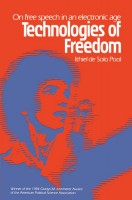 I was honored to be asked by the editors at Reason magazine to be a part of their “Revolutionary Reading” roundup of “The 9 Most Transformative Books of the Last 45 Years.” Reason is celebrating its 45th anniversary and running a wide variety of essays looking back at how liberty has fared over the past half-century. The magazine notes that “Statism has hardly gone away, but the movement to roll it back is stronger than ever.” For this particular feature, Reason’s editors “asked seven libertarians to recommend some of the books in different fields that made [the anti-statist] cultural and intellectual revolution possible.”
When Jesse Walker of
Reason first contacted me about contributing my thoughts about which technology policy books made the biggest difference, I told him I knew exactly what my choices would be: Ithiel de Sola Pool’s Technologies of Freedom (1983) and Virginia Postrel’s The Future and Its Enemies (1998). Faithful readers of this blog know all too well how much I love these two books and how I am constantly reminding people of their intellectual importance all these years later. (See, for example, this and this.) All my thinking and writing about tech policy over the past two decades has been shaped by the bold vision and recommendations set forth by Pool and Postrel in these beautiful books.
As I note in my
Reason write-up of the books: Continue reading →
 The Internet’s greatest blessing — its general openness to all speech and speakers — is also sometimes its biggest curse. That is, you cannot expect to have the most widely accessible, unrestricted communications platform the world has ever known and not also have some imbeciles who use it to spew insulting, vile, and hateful comments.
It is important to put things in perspective, however. Hate speech is not the norm online. The louts who spew hatred represent a small minority of all online speakers. The vast majority of online speech is of a socially acceptable — even beneficial — nature.
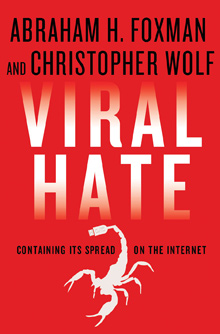
Still, the problem of hate speech remains very real and a diverse array of strategies are needed to deal with it. The sensible path forward in this regard is charted by Abraham H. Foxman and Christopher Wolf in their new book, Viral Hate: Containing Its Spread on the Internet. Their book explains why the best approach to online hate is a combination of education, digital literacy, user empowerment, industry best practices and self-regulation, increased watchdog / press oversight, social pressure and, most importantly, counter-speech. Foxman and Wolf also explain why — no matter how well-intentioned — legal solutions aimed at eradicating online hate will not work and would raise serious unintended consequences if imposed.
In striking this sensible balance, Foxman and Wolf have penned the definitive book on how to constructively combat viral hate in an age of ubiquitous information flows. Continue reading →
Following up on Eli’s earlier post (“Does CDT believe in Internet freedom?”), I thought I’d just point out that we’ve spent a great deal of time here through the years defending real Internet freedom, which is properly defined as “freedom from state action; not freedom for the State to reorder our affairs to supposedly make certain people or groups better off or to improve some amorphous ‘public interest.'” All too often these days, “Internet freedom,” like the term “freedom” more generally, is defined as a set of positive rights/entitlements complete with corresponding obligations on government to delivery the goods and tax/regulate comprehensively to accomplish it. Using “freedom” in that way represents a grotesque corruption of language and one that defenders of human liberty must resist with all our energy.
I’ll be writing more about this in upcoming columns, but here’s a short list of past posts on Internet freedom, properly defined:
- The Problem with the “Declaration of Internet Freedom” & the “Digital Bill of Rights” – by Adam Thierer (July 2, 2012)
- A Note to Congress: The United Nations Isn’t a Serious Threat to Internet Freedom—but You Are – by Jerry Brito & Adam Thierer (The Atlantic, June 19, 2012)
- Does the Internet Need a Global Regulator? – by Adam Thierer (Forbes, May 6, 2012)
- More Confusion about Internet “Freedom” – by Adam Thierer (Mar. 1, 2011)
- Internet Freedom–Real vs Imagined – by Adam Thierer (Dec. 12, 2007)
- A Response to Andrew McLaughlin on Net Neutrality & “Freedom” – by Adam Thierer (July 9, 2011)
- Web 2.0, Section 230, and Nozick’s “Utopia of Utopias” – by Adam Thierer (Jan. 13, 2009)
- Cyber-Libertarianism: The Case for Real Internet Freedom – by Adam Thierer & Berin Szoka (Aug. 12, 2009)
- Broadband as a Human Right (and a short list of other things I am entitled to on your dime) – by Adam Thierer (Oct. 14, 2009)
- “Internet Freedom”: How Statists Corrupt Our Language – by Berin Szoka (Oct. 27, 2009)
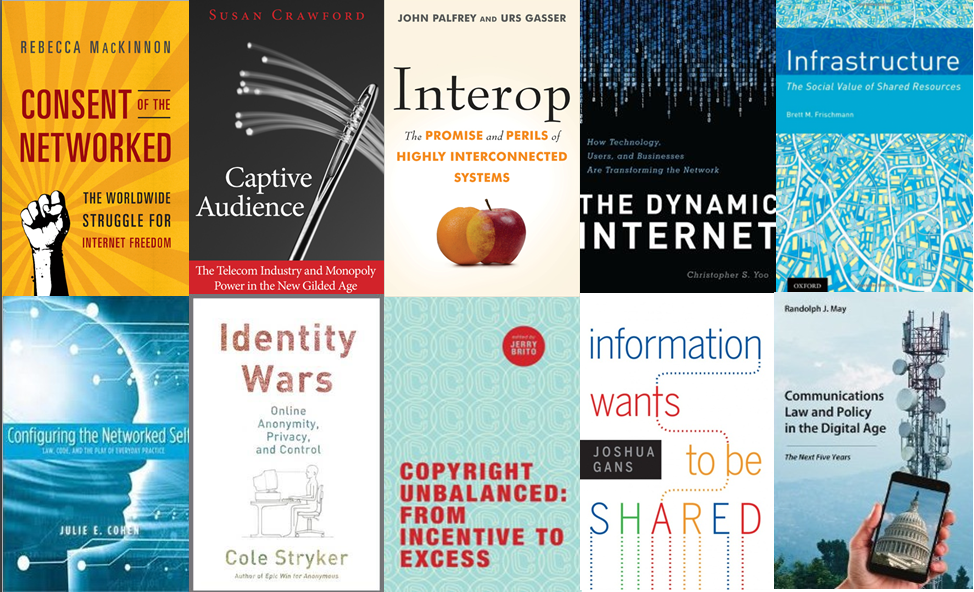
The number of major cyberlaw and information tech policy books being published annually continues to grow at an astonishing pace, so much so that I have lost the ability to read and review all of them. In past years, I put together end-of-year lists of important info-tech policy books (here are the lists for 2008, 2009, 2010, and 2011) and I was fairly confident I had read just about everything of importance that was out there (at least that was available in the U.S.). But last year that became a real struggle for me and this year it became an impossibility. A decade ago, there was merely a trickle of Internet policy books coming out each year. Then the trickle turned into a steady stream. Now it has turned into a flood. Thus, I’ve had to become far more selective about what is on my reading list. (This is also because the volume of journal articles about info-tech policy matters has increased exponentially at the same time.)
So, here’s what I’m going to do. I’m going to discuss what I regard to be the five most important titles of 2012, briefly summarize a half dozen others that I’ve read, and then I’m just going to list the rest of the books out there. I’ve read most of them but I have placed an asterisk next to the ones I haven’t. Please let me know what titles I have missed so that I can add them to the list. (Incidentally, here’s my compendium of all the major tech policy books from the 2000s and here’s the running list of all my book reviews.)
Continue reading →
Earlier today on Twitter, I listed what I thought were the Top 5 “Biggest Internet Policy Issues of 2012.” In case you don’t follow me on Twitter — and shame on you if you don’t! — here were my choices:
- Copyright wars reinvigorated post-SOPA; tide starting to turn in favor of copyright reform. [TLF posts on copyright.]
- Privacy still red-hot w ECPA reform, online advertising regs & kids’ privacy issues all pending. [TLF posts on privacy.]
- WCIT makes Internet governance / NetFreedom a major issue worldwide. [TLF posts on Net governance.]
- Antitrust threat looms larger w pending Google case + Apple books investigation. [TLF posts on antitrust.]
- Cybersecurity regulatory push continues in both legislative (CISPA) & executive branch. [TLF posts on cybersecurity.]
Lists like these are entirely subjective, of course, but I am basing my list on the general amount of chatter I tended to see and hear about each topic over the course of the year.
What do you think the top tech policy issues of the year were?
Yesterday it was my privilege to speak at a Free State Foundation (FSF) event on “Ideas for Communications Law and Policy Reform in 2013.” It was moderated by my friend and former colleague Randy May, who is president of FSF, and the event featured opening remarks from the always-excellent FCC Commissioner Robert McDowell.
During the panel discussing that followed, I offered my thoughts about the problem America continues to face in cleaning up communications and media law and proposed a few ideas to get reform done right once and for all. I don’t have time to formally write-up my remarks, but I thought I would just post the speech notes that I used yesterday and include links to the relevant supporting materials. (I’ve been using a canned version of this same speech at countless events over the past 15 years. Hopefully lawmakers will take up some of these reforms some time soon so I’m not using this same set of remarks in 2027!)
Continue reading →
We live in an entitlement era, when rights are seemingly invented out of whole-cloth. It should come as no surprise, therefore, that a bit of “rights inflation” is creeping into debates about Internet policy. Today, for example, a coalition of groups and individuals (many of which typically advocate greater government activism), have floated a “Declaration of Internet Freedom.” My concern with their brief manifesto is that is seems to based on a confused interpretation of the word “freedom,” which many of the groups behind the effort take to mean freedom for the government to reorder the affairs of cyberspace to achieve values they hold dear.
The manifesto begins with the assertion that “We stand for a free and open Internet,” and then says “We support transparent and participatory processes for making Internet policy and the establishment of five basic principles:”
- Expression: Don’t censor the Internet.
- Access: Promote universal access to fast and affordable networks.
- Openness: Keep the Internet an open network where everyone is free to connect, communicate, write, read, watch, speak, listen, learn, create and innovate.
- Innovation: Protect the freedom to innovate and create without permission. Don’t block new technologies, and don’t punish innovators for their users actions.
- Privacy: Protect privacy and defend everyone’s ability to control how their data and devices are used.
This effort follows close on the heels of a proposal from Rep. Darrell Issa (R-CA) and Sen. Ron Wyden (D-OR) to craft a “Digital Bill of Rights” that, not to be outdone, includes ten principles. They are: Continue reading →
In the wake of last week’s big SOPA showdown, a lot of people are talking about the expanded presence and power of the Internet, online operators, and digital Netizens in Washington policy debates. I certainly don’t mean to diminish the importance of this particular episode. It certainly is historic, regardless of how you feel about the specifics of SOPA. What does concern me, however, is the way this episode is prompting questions about how much more “engagement” Internet companies need to consider inside the Beltway. For example, today’s Wall Street Journal features an article on “The Web’s Growing Muscle” and notes:
The Internet industry has found a rare sweet spot in Washington. With Google in the lead, the companies have begun building a strong traditional lobbying force in Washington. And, to complement that inside game, websites’ millions of users have become a powerful outside weight on Congress. What’s more, in a rare Washington double play, the concerns of Internet companies have found a sympathetic ear both in the Democratic White House and among Republican presidential candidates who otherwise can’t agree with Barack Obama on anything.
The piece concludes with a quote from an anonymous media executive saying “People are looking at what Google spent on lobbying and wondering, ‘Can we match that?’ It has to be a big spend.”
I cannot possibly think of anything more demoralizing than that. Continue reading →



 The Technology Liberation Front is the tech policy blog dedicated to keeping politicians' hands off the 'net and everything else related to technology.