Today the Mercatus Center has released a short new paper I have authored on “Unappreciated Benefits of Advertising and Commercial Speech.” I begin the piece by noting that:
Federal policy makers, state legislators, and state attorneys general have recently shown interest in regulating commercial advertising and marketing. Several new regulatory initiatives are being proposed, or are already underway, that could severely curtail or restrict advertising or marketing on a variety of platforms. The consequences of these stepped-up regulatory efforts will be profound and will hurt consumer welfare both directly and indirectly.
I go on to note that “advertising can be an easy target for politicians or regulatory activist groups who make a variety of (typically unsubstantiated) claims about its negative impact on society,” but then continue on to explain how “the role of commercial speech in a free-market economy is often misunderstood or taken for granted.” I outline how, despite regulators’ concerns, consumers actually derive three important types of benefits from advertising and marketing: (1) Informational / Educational Benefits; (2) Market Choice / Pro-Competitive Benefits; and (3) Media Promotion / Cross-Subsidization. After discussing each benefit, I conclude that:
For these reasons, a stepped-up regulatory crusade against advertising and marketing will hurt consumer welfare since it will raise prices, restrict choice, and diminish marketplace competition and innovation—both in ad-supported content and service markets, and throughout the economy at large. Simply stated, there is no free lunch.
Read the entire 1,800-word essay here. I have also embedded the document down below in a Scribd reader.
Continue reading →
[Here’s an oped of mine that recently ran on Reuters. Readers will recognize many of these themes and arguments since I have developed them here on the TLF many times before.]
by Adam Thierer, Mercatus Center at George Mason University
Would you like to pay $20 a month for Facebook, or a dime every time you did a search on Google or Bing? That’s potentially what is at stake if the Obama administration and advocates of stepped-up regulation of online advertising get their way.
The Internet feels like the ultimate free lunch. Once we pay for basic access, a cornucopia of seemingly free services and content is at our fingertips. But those services don’t just fall to Earth like manna from heaven. What powers the “free” Internet are data collection and advertising. In essence, the relationship between consumers and online content and service providers isn’t governed by any formal contract, but rather by an unwritten
quid pro quo: tolerate some ads or we’ll be forced to charge you for service. Most consumers gladly take that deal—even if many of them gripe about annoying or intrusive ads, at times. Continue reading →
by Adam Thierer & Berin Szoka, Progress Snaphot 6.1
Stephanie Clifford of the
New York Times posted a very interesting article this week summarizing a recent “on-the-record chat” the Times staff had with Federal Trade Commission (FTC) chairman Jon Leibowitz and FTC Bureau of Consumer Protection chief David Vladeck. The interview [discussed by Braden here] is profoundly important in that it reveals an alarming disconnect regarding the relationship between “privacy” regulation and the future of media, which were the subjects of their discussion with Times staff. Namely, Leibowitz and Vladeck apparently fail to appreciate how the delicate balance between commercial advertising and journalism is at risk precisely because of the sort of regulations they apparently are ready to adopt. Because the value of online advertising depends on data about its effectiveness and consumers’ likely interests, and because advertising is indispensable to funding media, what’s ultimately at stake here is nothing short of the future of press freedom.
The “Day of Reckoning” Is Upon Us
Leibowitz and Vladeck spend the first half of
The Times interview wringing their hands about “privacy policies,” the declarations made by websites and advertising networks about their data collection and use practices (for which the FTC can and must hold them accountable). But the two feel that privacy policies don’t adequately inform consumers. Chairman Leibowitz claims that online companies “haven’t given consumers effective notice, so they can make effective choices.” And Mr. Vladeck states that advise-and-consent models “depended on the fiction that people were meaningfully giving consent.” But he and the FTC seem ready to abandon the notice and choice model because the “literature is clear” that few people read privacy policies, Vladeck told the Times. He and Leibowitz continue:
“Philosophically, we wonder if we’re moving to a post-disclosure era and what that would look like,” Mr. Vladeck said. “What’s the substitute for it?” He said the commission was still looking into the issue, but it hoped to have an answer by June or July, when it plans to publish a report on the subject. Mr. Leibowitz gave a hint as to what might be included: “I have a sense, and it’s still amorphous, that we might head toward opt-in,” Mr. Leibowitz said.
This clearly foreshadows the regulatory endgame we have long suspected was coming. When the FTC released its “Self-Regulatory Principles for Online Behavioral Advertising” eleven months ago, we asked: “What’s the Harm & Where Are We Heading?” Their answers to both questions have become clearer with each new calculated comment—all apparently intended to slowly “turn up the heat” on the advertising industry so that the proverbial frog will stay in the pot until the water finally boils. Leibowitz’s FTC has simply dodged the “harm” question with a four-part strategy: Continue reading →
2009 was not as big of a year for Internet and information technology (“info-tech”) policy books as 2008 was, but there were still some notable titles released that offered interesting perspectives about the future of the Net and the impact the Digital Revolution is having on our lives, culture, and economy. So, like last year, I figured I would throw together my list of the 10 most important info-tech policy books of the year.
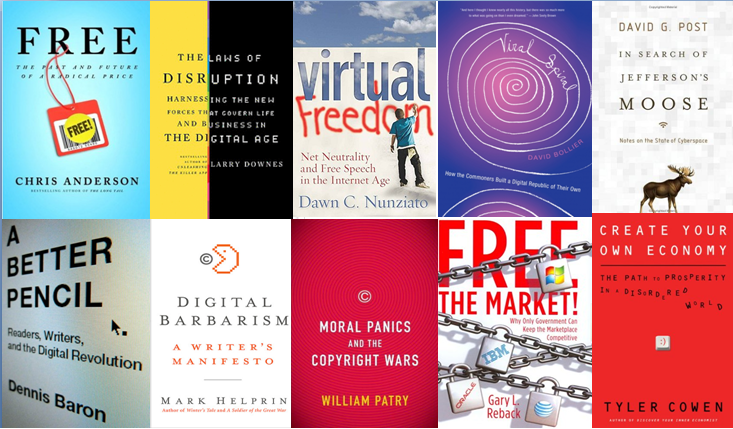 First, let me repeat a few of the same caveats and disclaimers that I set forth last year. What qualifies as an “important” info-tech policy book? Simply put, it’s a title that many people are currently discussing and that we will likely be referencing for many years to come. However, I want to be clear that merely because a book appears on my list it does not necessarily mean I agree with everything said in it. In fact, as was the case in previous years, I found much with which to disagree in my picks for the most important books of 2009 and I find that the cyber-libertarianism I subscribe to has very few fans out there.
Another caveat: Narrowly-focused titles lose a few points on my list. For example, if a book deals mostly with privacy issues, copyright law, or antitrust policy, it does not exactly qualify as the same sort of “tech policy book” as other titles found on this list since it is a narrow exploration of just one set of issues with a bearing on technology policy.
With those caveats in mind, here are my choices for the Most Important Info-Tech Policy Books of 2009. Continue reading →
I’ve always generally agreed with the conventional wisdom about micropayments as a method of funding online content or services: Namely, they won’t work. Clay Shirky, Tim Lee, and many others have made the case that micropayments face numerous obstacles to widespread adoption. The primary issue seems to be the “mental transaction cost” problem: People don’t want to be diverted–even for just a few seconds–from what they are doing to pay a fee, no matter how small. [That is why advertising continues to be the primary monetization engine of the Internet and digital services.]
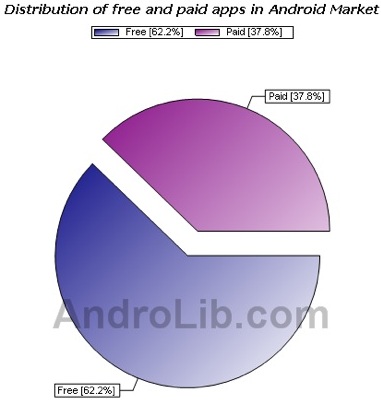 That being said, I keep finding examples of how micropayments do work in some contexts and it has kept me wondering if there’s still a chance for micropayments to work in other contexts (like funding media content). For example, I mentioned here before how shocked I was when I went back and looked at my eBay transactions for the past couple of years and realized how many “small-dollar” purchases I had made via PayPal (mostly dumb stickers and other little trinkets). And the micropayment model also seems to be doing reasonably well in the online music world. In January 2009, Apple reported that the iTunes Music Store had sold over 6 billion tracks.
And then there are mobile application stores. Just recently I picked up a Droid and I’ve been taking advantage of the rapidly growing Android marketplace, which recently hit the 20,000 apps mark. Like Apple’s 100,000-strong App Store, there’s a nice mix of paid and free apps, and even though I’m downloading mostly freebies, I’ve started buying more paid apps. Many of them are “upsells” from free apps I downloaded. In most cases, they are just 99 cents. A few examples of paid apps I’ve downloaded or considered buying: Stocks Pro, Mortgage Calc Pro, Currency Guide, Photo Vault, Weather Bug Elite, and Find My Phone. And there are all sorts of games, clocks, calendars, ringtones, heath apps, sports stuff, utilities, and more that are 99 cents or $1.99. Some are more expensive, of course.
Continue reading →
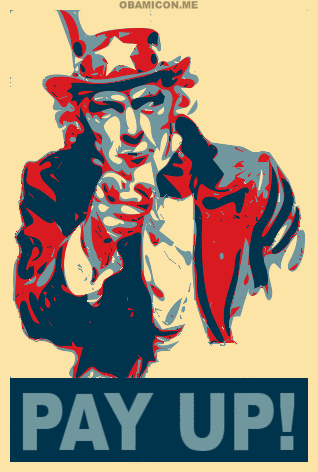 Hey people. You owe me. All of you. You owe me free broadband. I am entitled to it, after all. That seems to be where our current FCC is heading, anyway. And hey, Finland’s just done it, and the supposed Silicon Valley capitalists at TechCrunch are giddy with delight about it. We’re apparently all just Scandinavian socialists at heart now.
Thus, I too have decided to throw in the towel on the idea of everyone carrying their own weight and picking up their own tab. So, get your wallets open and ready for me because I have lots and lots of things that I believe I have an inalienable right to receive free of charge from the government (i.e, “the people”; i.e., “YOU”). Please let me know which of the things on my high-tech wish list that you’ll be purchasing for me and I’ll check you off my registry so I don’t have to send the cops to your house to collect:
- free broadband (fiber, Wi-Max, and whatever else is around the corner);
- a couple of free new computers (and a really fast ones, thank you very much);
- 3 new HDTVs for my home (including one of those sweet new DLP projectors that usually cost about $10,000 bucks. And I’ll need you to pay for someone to help me install it. Or could you just come over and do that for me perhaps?);
- 3 free new DVRs for each new TV set that you are buying me (and could I get a nice universal remote to control everything, please);
- a free subscription in my area to either DirecTV, Cox Cable, or Verizon FIOS TV (with all the premium channels and sports packages… and don’t forget the Playboy Channel!);
- a free lifetime subscription to Netflix (or I guess I would settle for a free Blu-Ray player and some free movies);
- free new wi-fi router and signal extenders for my home (N-standard please, none of that B or G garbage… too slow for me);
- free mobile phone service for life + an iPhone + unlimited downloads in their app store (oh, could you have that iPhone autographed by Steve Jobs if you get a chance?);
- free Playstation or XBox + lots of games (and if I could get one of those driving wheels to play my new Gran Turismo game that would be dandy); and finally,
- free lifetime tech support when all this crap breaks down.
In closing, I thank you for your generosity. I mean, look, I know I don’t actually deserve any of this stuff, and that there’s no good reason that you should have to pay for my free-riding ways, and there’s obviously nothing in our Constitution to support all this, but hey… screw all that! This is my God-given birthright. I am
entitled, baby! Now get busy thinking of how you are all going to start paying for me, you selfish bastards.
While I was away at Oxford University last week, a USA Today story ran entitled “Online Hate Speech: Difficult to Police… and Define.” The author, Theresa Howard, was kind enough to call me for comment on the issue before I left and I made two general points in response to her questions about how serious online hate speech was and how we should combat it:
(1)
“The Internet is a cultural bazaar. It’s the place to find the best and worst of all human elements on display.” What I meant by that, quite obviously, is that you can’t expect to have the most open, accessible communications platform the world has ever known and not also have a handful of knuckleheads who use it spew vile, hateful, ridiculous comments. But we need to put things in perspective: Those jerks represent only a very, very small minority of all online speech and speakers. Hate speech is not the norm online. The overwhelmingly majority of online speech is of a socially acceptable — even beneficial — nature.
(2)
“When advocacy groups work together and use the new technology at their disposal, they have a way of signaling out bad speech and bad ideas.” What I meant by that was that the best way to combat the handful of neanderthals out there that spew hateful garbage is to: (a) use positive speech to drown out hateful speech, and (b) encourage websites to self-police themselves or use community policing techniques to highlight hateful speech and encourage the community to fight back. Importantly, this process is reinforcing. When online communities “flag and tag” objectionable or hateful content, it is easier for better site policing to occur, for social norms to develop, and for better speech to be targeted at that bad speech. Moreover, these new tools and methods are helping groups like the Anti-Defamation League and the National Hispanic Media Coalition to better identify hate speech and then channel their collective energy and efforts to unite the rest of the online community against those hateful speakers and sites.
I think this approach makes more sense than calling in governments to police online hate speech through censorship efforts. This is especially the case because, at the margins, “hate speech” can often be tricky to define and, at least in the United States, regulatory efforts could conflict with legitimate free speech rights. Again, the best way to deal with and marginalize such knuckleheads is with more and better speech. Fight stupidity with sensibility, not censorship.
 I’ll be heading to Oxford University this week to participate in an Oxford Internet Institute (OII) forum on the subject of “Child Protection, Free Speech and the Internet: Mapping the Territory and Limitations of Common Ground.” It’s being led by several experts from the OII as well as my good friends John Morris and Leslie Harris of the Center for Democracy & Technology (CDT). The aims of this forum are:
- To facilitate a dialogue between NGOs campaigning to protect respectively, child protection and children’s rights online, and freedom of speech and other civil liberties online.
- To promote a better understanding of each others’ positions, to share perspectives and information with a view to identifying areas of common ground and areas of disagreement.
- To identify any shared policy goals, and possible tools to support the achievement of those goals.
- To publicize the findings of the forum in international policy debates about Internet governance and regulation.
Conference participants were asked to submit a 2-3 pg summary of their views on a couple of questions that will be discussed at this event. I have listed those questions, and my answers, down below the fold. It’s my best attempt to date to succinctly outline my views about how to balance content concerns and free speech issues going forward. Continue reading →
I really appreciate the venture capitalists (VCs) in Silicon Valley subsidizing my soapbox at Twitter. Seriously, it is an absolutely awesome platform for getting a message out to the masses. But at some point I worry that the gravy train will come to an end and that users will have to start picking up part of the tab. After all, will those VCs continue to subsidize Twitter if it never turns a profit? According to the Wikipedia entry about Twitter:
In total, Twitter has raised over US$57 million from venture capitalists. The exact amounts of funding have not been publicly released. Twitter’s first round of funding was for an undisclosed amount that is rumored to have been between $1 million and $5 million. Its B round of funding in 2008 was for $22 million and its C round of funding in 2009 was for $35 million from Institutional Venture Partners and Benchmark Capital along with an undisclosed amount from other investors including Union Square Ventures and Spark Capital. Twitter is backed by Union Square Ventures, Digital Garage, Spark Capital, and Bezos Expeditions.
Again, thank you VCs! But, like them, I do wonder when and how Twitter will bring in some cash. Is there a “freemium” model that could work? Perhaps. “Pro” or corporate accounts have been rumored to be in the works. Getting someone else to pick up the tab that way might bring in enough cash for Twitter to allow the free ride to continue for the rest of us. But what about advertising? It’s been the “mother’s milk” of most online media and platforms for some time now, and Twitter seems perfectly suited to insert a few banner ads or contextual ads here and there. It could be happening sooner than you think. Austin Modine of The Register notes in a new piece, “Twitter ‘Leaves Door Open’ for Targeted Ads,” that: Continue reading →
What Unites Advocates of Speech Controls & Privacy Regulation? [pdf]
by Adam Thierer & Berin Szoka
The Progress & Freedom Foundation,
Progress on Point No. 16.19
Anyone who has spent time following debates about speech and privacy regulation comes to recognize the striking parallels between these two policy arenas. In this paper we will highlight the common rhetoric, proposals, and tactics that unite these regulatory movements. Moreover, we will argue that, at root, what often animates calls for regulation of both speech and privacy are two remarkably elitist beliefs:
- People are too ignorant (or simply too busy) to be trusted to make wise decisions for themselves (or their children); and/or,
- All or most people share essentially the same values or concerns and, therefore, “community standards” should trump household (or individual) standards.
While our use of the term “elitism” may unduly offend some understandably sensitive to populist demagoguery, our aim here is not to launch a broadside against elitism as
Time magazine culture critic William H. Henry once defined it: “The willingness to assert unyieldingly that one idea, contribution or attainment is better than another.”[1] Rather, our aim here is to critique that elitism which rises to the level of political condescension and legal sanction. We attack not so much the beliefs of some leaders, activists, or intellectuals that they have a better idea of what it in the public’s best interest than the public itself does, but rather the imposition of those beliefs through coercive, top-down mandates.
That sort of elitism—elitism enforced by law—is often the objective of speech and privacy regulatory advocates. Our goal is to identify the common themes that unite these regulatory movements, explain why such political elitism is unwarranted, and make it clear how it threatens individual liberty as well as the future of free and open Internet. As an alternative to this elitist vision, we advocate an empowerment agenda: fostering an environment in which users have the tools and information they need to make decisions for themselves and their families. Continue reading →

 The Technology Liberation Front is the tech policy blog dedicated to keeping politicians' hands off the 'net and everything else related to technology.