[Note: This is the fourth in a series of essays about the legacy of the Supreme Court’s FCC v. Pacifica Foundation decision, which celebrates its 30th anniversary on July 3rd. Part 1, presented a general overview of the issue. Part 2 sketched a short history of FCC indecency regulation. Part 3 discussed the misguided logic of the Court’s reasoning in Pacifica as it stood in 1978. This installment will examine why that logic is even more misguided in light of modern developments.]
Whatever legitimacy
Pacifica’s “pervasiveness rationale” might have once had, it has been largely eroded by modern media developments.
First, the pervasiveness rationale for media regulation fails today because new content tailoring technologies make it easier than ever before for parents to manage media in their homes and in their lives of their children. It is impossible to consider video programming an “intruder” in the home when tools exist that can help parents almost perfectly tailor viewing experiences to individual household preferences.
When Justice Stevens argued in
Pacifica that broadcast signals represented an “intruder” in the home, he supported that claim by noting that: “Because the broadcast audience is constantly tuning in and out, prior warnings cannot completely protect the listener or viewer from unexpected program content.” While that may have reflected the state of technology and TV viewing at the time, it is completely at odds with modern realities. In 1978, the viewing experience was a more passive affair and consumers had very few ways to control that experience unless they turned off the television altogether. Today, by contrast, viewers (including parents) have the tools to “tune in and out” at will, and they have abundant “prior warnings” about program content thanks to the existence of ratings, program information, and electronic program guides. These tools help parents restrict or tailor the viewing experience in advance according to their values and preferences.
Continue reading →
[Note: This is the third in a series of essays about the legacy of the Supreme Court’s FCC v. Pacifica Foundation decision, which celebrates its 30th anniversary on July 3rd. Part 1, presented a general overview of the issue. Part 2 sketched a short history of FCC indecency regulation. This installment will examine the misguided logic of the Court’s reasoning in Pacifica as it stood in 1978. Part 4 will then examine why that logic is even more misguided in light of modern developments.]
For the past three decades, regulation of television programming has been premised on the “pervasiveness rationale” as articulated in the landmark Supreme Court case
FCC v. Pacifica Foundation. In Pacifica, in a 5-4 plurality decision, the Court held:
Of all forms of communication, broadcasting has the most limited First Amendment protection. Among the reasons for specially treating indecent broadcasting is the uniquely pervasive presence that medium of expression occupies in the lives of our people. Broadcasts extend into the privacy of the home and it is impossible completely to avoid those that are patently offensive. Broadcasting, moreover, is uniquely accessible to children.
In one portion of the decision, Justice John Paul Stevens, who authored the majority opinion, even referred to broadcast signals as an “intruder” into the home.
There were always serious problems with the “media-as-invader” logic of Pacifica.
Continue reading →
Next Thursday, July 3rd will mark the 30th anniversary of the Supreme Court’s landmark First Amendment decision, FCC v. Pacifica Foundation. Sadly, but somewhat ironically, the anniversary of this decision comes just a few days after we lost America’s greatest modern social satirist George Carlin, whose infamous “seven dirty words” monologue prompted the Supreme Court’s Pacifica decision. After a Pacifica Foundation radio station aired Carlin’s monologue and the FCC took action against that station, a court battle ensued regarding whether the agency had the authority to censor “indecent” content on broadcast radio and television stations.
Unfortunately, when the Supreme Court handed down its
Pacifica decision 30 years ago, the First Amendment lost. By a narrow 5-4 vote, the court held that the FCC could impose fines on broadcasters who aired indecent content during daytime and early evening hours. The Court used some rather tortured reasoning to defend the proposition that broadcast platforms deserved lesser First Amendment treatment than all other media platforms. The lynchpin of the decision was the so-called “pervasiveness theory,” which held that broadcast speech was “uniquely pervasive” and an “intruder” in the home, and therefore demanded special, artificial content restrictions.
Over the course of the next week, I plan on posting some thoughts about that twisted logic and the legacy of the
Pacifica decision in general. In part 2, I’ll sketch out the broad outlines of FCC indecency enforcement over the past 70 years. In part 3, I’ll be highlighting some of the original deficiencies of the “pervasiveness doctrine.” Part 4 will highlight the irrelevancy of Pacifica and the pervasiveness doctrine in light of recent technological developments. These (and potentially other) installments will highlight why Pacifica was always bad law and is even more misguided and unjust in light of recent marketplace developments.
Bruce Owen, America’s preeminent media economist–with apologies to Harold Vogel, who at least deserves an honorable mention–has written another splendid piece for Cato’s Regulation magazine, this one entitled, “The Temptation of Media Regulation.”
This latest essay deals primarily with the many fallacies surrounding so-called “a la carte” regulation of the video marketplace, and I encourage you to read it to see Owen’s powerful refutation of the twisted logic behind that regulatory crusade. But I wanted to highlight a different point that Bruce makes right up front in his essay because it is something I am always stressing in my work too.
In some of my past work on free speech and media marketplace regulation, I have argued that there is very little difference between Republicans and Democrats when it comes to these issues. They are birds of feather who often work closely together to regulate speech and media. Whether it is broadcast ‘indecency’ controls; proposals to extend those controls to cable & satellite TV; campaign finance laws; efforts to limit or rollback ownership regulations; or even must carry and a la carte, the story is always the same: It’s one big bipartisan regulatory love fest. [And the same goes for regulation of the Internet, social networking sites, and video games.]
Owen explains why that is the case:
Continue reading →
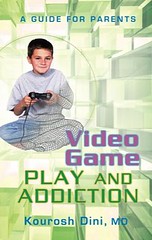 Dr. Kourosh Dini is a Chicago-based adolescent and adult psychiatrist who has just published a new book entitled, Video Game Play and Addiction: A Guide for Parents. [You can learn more about him and his many talents and interests at his blog, “Mind, Music and Technology.“] Dini’s book arrives fresh on the heels of the fine book, “Grand Theft Childhood: The Surprising Truth About Violent Video Games and What Parents Can Do,” by Drs. Lawrence Kutner and Cheryl K. Olson. [See my review of that book here.]
Like Kutner & Olson’s book, Dini’s provides a refreshingly balanced and open-minded look at the impact of video games on our kids. One of the things I liked about it is how Dr. Dini tells us right up front that he has been a gamer his entire life and explains how that has helped him frame the issues he discusses in his book. “I have played games both online and off since I was about six years of age, and I have also been involved in child psychiatry, so I felt that I would be in a good position to discuss some inherent positives and negatives associated with playing games,” he says. Dini goes into greater detail about his gaming habits later in the book and it makes it clear that he still enjoys games very much.
Some may find Dini’s gaming background less relevant than his academic credentials, but I think it is important if for no other reason than it shows how we are seeing more and more life-long gamers attain positions of prominence in various professions and writing about these issues using a sensible frame of reference that begins with their own personal experiences. For far too long now, nearly every book and article I have read about video games and their impact on society at some point includes a line like, “I’ve never really played many games” or even “I don’t much care for video games,” but then–without missing a breath–the author or analyst goes on to tell us how imminently qualified they are to be discussing the impact of video games on kids or culture. Whenever I read or hear things like that, I’m reminded of the famous line from an old TV commercial: “I’m not a doctor, but I play one on TV.” Seriously, why is it that we should continue to listen to those critics who denounce video games but who have never picked up a controller in their lives? It’s really quite insulting. Would you take automotive advice from someone who’s never tinkered with cars in their lives but instead based their opinions merely upon watching them pass by on the road? I think not.
Continue reading →
I have just released a new PFF white paper on “The Perils of Mandatory Parental Controls and Restrictive Defaults.” It points out the dangers of government mandating that parental controls be defaulted to their most restrictive position. I’ve gone ahead and just pasted the entire text below (but without the footnotes):
During ongoing debates about parental controls, ratings, and online child safety, there have occasionally been rumblings about the possibility of requiring that media, computing and communications devices: (1) be shipped to market with parental controls embedded, and possibly, (2) those controls being defaulted to their most restrictive position, forcing users to opt out of the controls later if they wanted to consume media rated above a certain threshold.
Imagine, for example, a law requiring that every television, TV set-top box, and video game console be shipped with on-board screening technologies that were set to block any content rated above “G” for movies, “TV-Y” for television, or “E” for video games, which are the most restrictive rating designations for each type of media. Similarly, all personal computers or portable media devices sold to the public could be forced to have filters embedded that were set to block all “objectionable” content, however defined.
If “default” requirements such as this were mandated by law, parents would be forced to opt out of the restrictions by granting their children selective permission to media content or online services. In theory, this might help limit underage access to objectionable media or online content. Such a mandate might be viewed as less intrusive than direct government censorship and, therefore, less likely to run afoul of the constitution.
For these reasons, such a proposal would likely have great appeal among some policymakers, “family” groups, child safety advocates, and parents. But mandating parental controls and restrictive defaults is a dangerous and elitist idea that must be rejected because it will have many unintended consequences and not likely achieve the goal of better protecting our kids.
Continue reading →
Today and tomorrow I am attending a terrific conference at Penn State University called, “Playing to Win: The Business and Social Frontiers of Videogames.” It features panel discussions about various legal and business issues facing the video game industry, as well as discussions about how video games are used to aid teaching and learning. There are also panels on multiplayer online worlds and virtual reality environments and the issues surrounding both. [They will apparently be posting videos from the conference on their site shortly.]
 The folks at PSU were kind enough to invite me to deliver the luncheon keynote on Day 1 and I decided to provide a broad overview of the policy issues facing video games that I have covered in some of my past work. My presentation was entitled, “Video Games, Ratings, Parental Controls, & Public Policy: Where Do We Stand?” and the entire 36-slide presentation is now available online here. Down below, I thought I would just outline a couple of the key themes I touched upon in my presentation.
Continue reading →
Everybody loves to blame the media for the woes of the world. Is your candidate losing? Blame the media. Is the war in Iraq not going the way you want? Blame the media. Is the economy slowing down and heading into recession? Blame the media.
Indeed, one of the entertaining things about being a media policy analyst is that you get to hear various media critics say the most outlandish things about the role of media in our society. And that’s not just the case for news; it’s even truer for culture and entertainment, of course. There’s never been a shortage of self-appointed culture cops in our society who want to tell us that they–or at least some benevolent ruling class acting on their behalf–are in the best position to dictate standards of decency and quality entertainment. And sometimes the antics of such critics are as entertaining as they are outrageous.
Take this recent press released by Concerned Women for America entitled, “Oh, Be Careful Little Eyes What You See: The Influx of Broadcast Indecency.” So desperate are they to expand the scope of government regulation over media that they’ve now resorted to equating broadcasters to murderers and thieves: “If we allow the networks to set the standards of public decency, isn’t that like allowing the criminal to decide what’s illegal?”
Seems a bit over-the-top to me, but let’s try to answer that question by answering another question CWA sets forth in their press release: “Who decides the standards by which we protect our children and ourselves from indecent broadcasts over the public airwaves?”
That is an excellent question, and one that I have devoted much of my life’s work to answering. What CWA is implying in that question is that if the government does not set “standards” to protect society from “indecent broadcasts,” then society will essentially descend into a nihilistic moral abyss. Only by empowering regulators to police “the public airwaves” can we restore and defend moral order.
This assertion is incorrect on multiple counts. I could focus on the constitutional challenges associated with defining “indecent” and “moral” content in a pluralistic society such as ours. Or I could focus on the practical considerations of regulating broadcasters uniquely in our multi-media, multi-platform world. But I would rather focus on that “Who Decides?” question set forth by CWA in their essay, because that’s what is really at the center of all these debates. And here’s the way I counter that logic in my book on “Parental Controls & Online Child Protection”:
Continue reading →

 The Technology Liberation Front is the tech policy blog dedicated to keeping politicians' hands off the 'net and everything else related to technology.