Yesterday, the Senate passed S. 602, “The Child Safe Viewing Act of 2007,” which was introduced by Sen. Mark Pryor (D-AR) in February 2007. The bill requires the Federal Communications Commission (FCC) to study the market for “advance blocking technologies” (i.e., parental controls and rating systems) that parents can use to protect their kids from inappropriate content from various sources and platforms. On the surface, the measure seems harmless enough, but in practice, it could have some troubling long-term free speech implications if it leads to more government meddling with parental controls and ratings systems.
The measure requires the FCC to initiate a notice of inquiry to consider measures to examine:
- the existence and availability of advanced blocking technologies that are compatible with various communications devices or platforms;
- methods of encouraging the development, deployment, and use of such technology by parents that do not affect the packaging or pricing of a content provider’s offering; and
- the existence, availability, and use of parental empowerment tools and initiatives already in the market.
That all sounds harmless enough. Indeed, such a study could produce some useful information about the state of the parental controls marketplace. (Of course, I could save them some taxpayer dollars and just send copies of my big
Parental Controls & Online Child Safety report to all FCC officials!)
But it’s what comes next in the bill that causes me some heartburn. As part of the review mandated by the bill, S. 602 commands the FCC to “consider advanced blocking technologies that”:
Continue reading →
 I’m pleased to announce the publication of A Manifesto for Media Freedom, which I co-authored with Brian C. Anderson of the Manhattan Institute. Brian serves as editor of Manhattan Institute’s excellent City Journal and he is the author of best-selling books like South Park Conservatives and Democratic Capitalism and Its Discontents.
In this little manifesto, we highlight one of the central ironies of the Information Age. Namely, that despite “the breathtaking abundance of new and old media outlets for obtaining news, information, and entertainment…”
many people hate this profusion, and never more than when it involves political speech. The current media market, they charge, doesn’t represent true diversity, or isn’t fair, or is subject to manipulation by a small and shrinking group of media barons. They want the government to regulate it into better shape, which just happens to be a shape that benefits them. Doing so… would be a disaster, a kind of soft or not-so-soft tyranny that would wipe out whole sectors of media, curtailing free speech and impoverishing our democracy.
In other words, instead of celebrating the unprecedented cornucopia of media choices at our collective disposal, many policymakers and media critics are calling for just as much media regulation as ever. We itemize these threats in our chapters and they include: efforts to revive the “Fairness Doctrine”, media ownership regulations, “localism” requirements, Net neutrality mandates, a la carte regulations, cable and satellite censorship, video game censorship, regulation of social networking sites, campaign finance-related speech restrictions, and so on.
In each case, we advance a pro-freedom paradigm to counter the advocates of media control. What do we mean by the “media freedom” that we advocate as the alternative to these new regulatory crusades? Here’s how we put it in the book:
Continue reading →
This week, I have been up at Harvard University participating in another meeting of the Internet Safety Technical Task Force (ISTTF), of which I am a member. The ISTTF was organized earlier this year pursuant to an agreement between 49 state attorneys general (AGs) and social networking giant MySpace.com. A group of experts from academia, non-profit organizations, and industry were appointed to the Task Force, which is charged with evaluating the market for online child safety tools and methods and issuing a report on the matter to the AGs at the end of this year. ISTTF members have been meeting privately and publicly in both Cambridge, MA and Washington, D.C. The Task Force has been very ably chaired by John Palfrey, co-director of Harvard’s Berkman Center for Internet & Society.
Although the ISTTF is looking at a wide variety of tools and methods associated with online child protection (ex: filters, monitoring tools, educational campaigns, etc.), many of the AGs who crafted the agreement with MySpace that led to the Task Force’s formation have made it clear that they are
most interested in having the ISTTF evaluate age verification / online verification technologies. In fact, at the start of this week’s session at Harvard Law School, AGs Martha Coakely of Massachusetts and Richard Blumenthal of Connecticut both spoke and made it abundantly clear they expect the Task Force to develop age and identify-verification tools for social networking sites (SNS). AG Blumenthal said we need to deal with “the dangers of anonymity” and repeated his standard line about online age verification: “If we can put a man on the moon, we can make the Internet safe.” [Of course, putting a man on the moon took hundreds of billions of dollars and a decade to accomplish, but never mind that fact! Moreover, one could also argue that if we can put a man on the moon we can cure hunger, AIDS, and the common cold, but some things are obviously easier said than done. Finally, putting a man on the moon didn’t require all Americans or their kids to give up their anonymity or privacy rights in order to accomplish the feat!]
On many occasions here before, I have outlined various questions and reservations about proposals to mandate online age verification. Last year, I also published a lengthy white paper on the issue and hosted a lively debate on Capitol Hill [transcript here] about this. I also have discussed age verification in my book on parental controls and online child safety. [Braden Cox also talked about his experiences up at Harvard this week here, and CNet’s Chris Soghoian had a brutal assessment of this week’s proposals on his “Surveillance State” blog.]
In this essay, I will discuss the new fault lines in the debate over online age verification and outline where I think we are heading next on this front. I will argue:
- There is now widespread understanding that it is extraordinarily difficult to verify the ages and identities of minors online using the methods we typically use to verify adults. Because of this, age verification proponents are increasingly proposing two alternative models of verifying kids before they go online or visit SNS…
- First, for those who continue to believe that we must do whatever we can to verify kids themselves, schools and school records are increasingly being viewed as the primary mechanism to facilitate that. This raises two serious questions: Do we want schools to serve as DMVs for our children? And, do we want more school records or information about our kids being accessed or put online?
- Second, for those who are uncomfortable with the idea of verifying kids or using schools, or school records, to accomplish that task, parental permission-based forms of authentication are becoming the preferred regulatory approach. Under this scheme, which might build upon the regulatory model found in the Children’s Online Privacy Protection Act of 1998 (COPPA), parents or guardians would be verified somehow and then would vouch for their children before they were allowed on a SNS, however defined. But how do we establish a clear link between parents and kids? And will parents be willing to surrender a great deal more information (about themselves and their kids) before their kids can go online? And, is it sensible to use a law that was meant to protect the privacy and personal information of children to potentially gather a great deal more information about them, and their parents?
- It remains very unclear how either of those two verification methods would make children safer online. Indeed, that could actually make kids less safe by compromising their personal information and creating a false sense of security online for them and their parents.
- It is highly unlikely the Internet Safety Technical Task Force will be able to reach consensus on this complicated, controversial issue. A small camp will likely flock to the sort of proposals mentioned above. Another, larger camp (including me) will flock to education-based approaches to child safety as well increased reliance on other parental empowerment tools and strategies, industry self-regulatory efforts, social norms, and better intervention strategies for troubled youth. But the age verification debate will go on and, as was the case over the past two years, the legal battleground will be state capitals across America, with AGs likely pushing for age verification mandates regardless of what the Task Force concludes.
Continue reading if you are interested in the details.
Continue reading →
By Berin Szoka & Adam Thierer
Progress Snapshot 4.19 (PDF)
Since the fall of 2008, a debate has raged in Washington over “targeted online advertising,” an ominous-sounding shorthand for the customization of Internet ads to match the interests of users. Not only are these ads more relevant and therefore less annoying to Internet users than untargeted ads, they are more cost-effective to advertisers and more profitable to websites that sell ad space. While such “smarter” online advertising scares some—prompting comparisons to a corporate “Big Brother” spying on Internet users—it is also expected to fuel the rapid growth of Internet advertising revenues from $21.7 billion in 2007 to $50.3 billion in 2011-an annual growth rate of more than 24%. Since this growing revenue stream ultimately funds the free content and services that Internet users increasingly take for granted, policymakers should think very carefully about what’s really best for consumers before rushing to regulate an industry that has thrived for over a decade under a layered approach that combines technological “self-help” by privacy-wary consumers, consumer education, industry self-regulation, existing state privacy tort laws, and Federal Trade Commission (FTC) enforcement of corporate privacy policies.
In an upcoming PFF
Special Report, we will address the many technical, economic, and legal aspects of this complicated policy issue-especially the possibility that regulation may unintentionally thwart market responses to the growing phenomenon of users blocking online ads.
We will also issue a three-part challenge to those who call for regulation of online advertising practices:
- Identify the harm or market failure that requires government intervention.
- Prove that there is no less restrictive alternative to regulation.
- Explain how the benefits of regulation outweigh its costs.
Continue reading →
I posted an essay last month about some possible non-regulatory solutions to the problem of porn on planes that I predicted might develop once airlines started rolling out in-flight Internet access. Some respondants to that essay argued this was likely a non-problem because few people would actually view porn in public. Unfortunately, a few incidents have apparently already created controversy.
Frankly, I am shocked that legislation hasn’t already been floated on this issue, but I am sure that someone in Congress will be firing off something soon. Again, like I said in that previous essay, before things get ugly and bills start flying up on the Hill, the airlines need to think about crafting some constructive solutions to this problem. We don’t want the FCC to become the censors of the sky, as some lawmakers will no doubt propose eventually.
Writing at Slate, Tim Wu tries to make Obama out to be the real Big Government candidate on media policy, who will deliver “if not a chicken in every pot, a fiber-optic cable in every home.” By contrast, Wu implies that McCain is just another pro-big business lackey who doesn’t understand “that the media and information industries are special—that like the transportation, energy, or financial industries, they are deeply entwined with the public interest.” Wu goes on to say:
Ultimately, most of the difference in Obama’s and McCain’s media policies boils down to questions about whether the media is special and a dispute over how much to trust the private sector. Camp McCain would tend to leave the private sector alone, with faith that it will deliver to most Americans what they want and deserve. The Obama camp would probably administer a more frequent kick in the pants, in the belief that good behavior just isn’t always natural.
First, as a factual matter, Wu is just wrong about McCain being some sort of a radical hands-off, pro-market liberalizer on media policy issues. Oh, if only that were true! But for those of us who have been in DC covering telecom and media policy for many years, it is widely understood there is no nailing down John McCain on any tech, telecom or media policy issue. He’s been all over the board. While he has sponsored or supported
some deregulatory initiatives on the telecom front in the past, he’s also been a supporter of other regulatory causes. His battles with broadcasters and cable, for example, are well-known. Most recently, McCain has been leading the effort to impose a la carte mandates on cable and satellite operators.
Continue reading →
John Markoff had an interesting article in the New York Times this weekend entitled “Internet Traffic Begins to Bypass the U.S..” In the piece, Markoff notes that “The era of the American Internet is ending” since “data is increasingly flowing around the United States,” instead of all flowing though our country, as it once did. Markoff focuses on how that “may have intelligence — and conceivably military — consequences.”
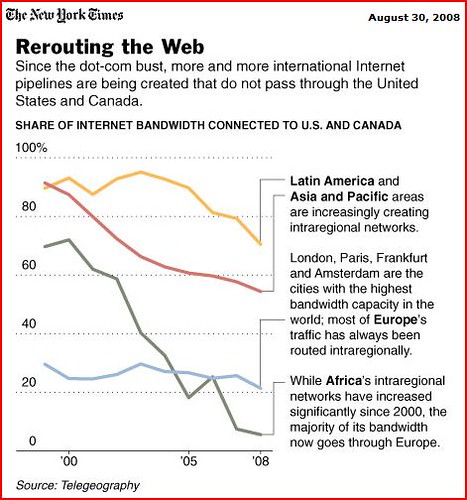 Indeed, it may. But what I also found interesting about this fact is the implications it will have for the future of content regulation. As Harvard’s Yochai Benkler told the
Times, “This is one of many dimensions on which we’ll have to adjust to a reduction in American ability to dictate terms of core interests of ours.” Content controls are one way that lawmakers enforce what they perceive to be a country’s “core interests.” As less and less Internet traffic flows through the U.S., it could become increasingly difficult for American lawmakers to impose their particular vision or morality on the Internet.
Indeed, it may. But what I also found interesting about this fact is the implications it will have for the future of content regulation. As Harvard’s Yochai Benkler told the
Times, “This is one of many dimensions on which we’ll have to adjust to a reduction in American ability to dictate terms of core interests of ours.” Content controls are one way that lawmakers enforce what they perceive to be a country’s “core interests.” As less and less Internet traffic flows through the U.S., it could become increasingly difficult for American lawmakers to impose their particular vision or morality on the Internet.
And that’s both good and bad news.
Continue reading →
 In-flight Internet access is finally starting to be rolled out by some carriers, and as they do so the inevitable question of what to do about objectionable material is already being debated. Surprisingly, many airlines have decided to not filter in-flight Internet access but instead rely on “peer pressure and the presence of flight attendants,” according to Tim Maxwell, Vice President of Marketing for Aircell, the company providing American’s broadband service.
But others are wondering if that’ll be enough. I share that concern. I can only imagine how ugly things will get on a flight once somebody starts streaming porn from their aisle seat. Flight attendants are going to become “fight” attendants once that happens. And you better believe that somebody in Congress is already cooking up legislation with some snappy title like “The Family Friendly Flights Act” to impose a regulatory solution. (Oh wait, a bill with that title was already introduced last year!! I wrote about it here. But that bill was just for violent movies, not Net access. So expect another measure soon mandating in-flight Net censorship).
Before things get ugly and bills start flying up on the Hill, the airlines need to think about crafting some constructive solutions to this problem. Here are three possibilities:
Continue reading →
 Having covered free speech and media policy issues for many years now, one of the arguments I hear a lot is that we moderns have an unnatural fascination with murder, mayhem, and violence as well as gossip and celebrities. Social critics and proponents of media content regulation often wax nostalgic about the supposed “good ol’ days” when all we thought and talked about was enlightened and enriching topics.
It’s all complete nonsense. Anyone who has seriously studied our nation’s history — or, for that matter, the history of any country or civilization — knows that we humans have
always been fascinated by the morbid and tales of debauchery, especially when those tales involve public officials or celebrities.
I was reminded of this again today when reading two articles in the
Washington Post.
Continue reading →
Over at Reason’s “Hit and Run” blog, Matt Welch has penned a piece pointing out how it is impossible to make the anti-media activists happy. Welch notes that radical activist groups like Free Press go around demonizing media moguls like Rupert Murdoch because he supposedly symbolizes the fact that will live in an age of media monopolists who puppeteer all our news and entertainment from on high. It’s all 100% B.S., of course, as we have shown here again and again.
But even when confronted by the rise of alternative owners and ownership models, the Free Press fanatics show their true colors by saying that won’t work for them either. Walsh notes, for example, that the skake-up of the old Tribune empire and the emergence of Sam Zell as an independent owner of the Trib — and an owner hellbent on downsizing the old empire, no less — should be exactly what Free Press wants:
Continue reading →

 The Technology Liberation Front is the tech policy blog dedicated to keeping politicians' hands off the 'net and everything else related to technology.