My new article on “FCC v. Fox and the Future of the First Amendment” has just been published in the February 2009 edition of Engage, the journal of the Federalist Society. Here’s how it begins:
On November 4th, 2008, the Supreme Court heard oral arguments in the potentially historic free speech case of Federal Communications Commission v. Fox Television Stations, Inc. This case, which originated in the Second Circuit Court of Appeals, deals with the FCC’s new policy for “fleeting expletives” on broadcast television. The FCC lost and appealed to the Supreme Court. By contrast, the so-called “Janet Jackson case” — CBS v. FCC — was heard in the Third Circuit Court of Appeals. The FCC also lost that case and has also petitioned the Supreme Court to review the lower court’s ruling.
These two cases reflect an old and odd tension in American media policy and First Amendment jurisprudence. Words and images presented over one medium-in this case broadcast television-are regulated differently than when transmitted through any other media platform (such as newspapers, cable TV, DVDs, or the Internet). Various rationales have been put forward in support of this asymmetrical regulatory standard. Those rationales have always been weak, however. Worse yet, they have opened the door to an array of other regulatory shenanigans, such as the so-called Fairness Doctrine, and many other media marketplace restrictions.
Whatever sense this arrangement made in the past, technological and marketplace developments are now calling into question the wisdom and efficacy of the traditional broadcast industry regulatory paradigm. This article will explore both the old and new rationales for differential First Amendment treatment of broadcast television and radio operators and conclude that those rationales: (1) have never been justified, and (2) cannot, and should not, survive in our new era of media abundance and technological convergence.
I go on in the piece to make the case against the those rationales and the call for the Supreme Court to use the
Fox and CBS cases to end this historical First Amendment anomaly of differential treatment of broadcast platforms relative to all other media providers.
This article can be downloaded as a PDF here, or viewed down below the fold in the Scribd reader.
Continue reading →
David Margolick has penned a lengthy piece for Portfolio.com about the AutoAdmit case, which has important ramifications for the future of Section 230 and online speech in general. Very brief background: AutoAdmit is a discussion board for students looking to enter, or just discuss, law schools. Some threads on the site have included ugly — insanely ugly — insults about some women. A couple of those women sued to reveal the identities of their attackers and hold them liable for supposedly wronging them. The case has been slowly moving through the courts ever since. Again, read Margolick’s article for all the details. The important point here is that the women could not sue AutoAdmit directly for defamation or harassment because Section 230 of the Communications Decency Act of 1996 immunizes websites from liability for the actions of their users. Consequently, those looking to sue must go after the actual individuals behind the comments which (supposedly) caused the harm in question.
I am big defender of Section 230 and have argued that it has been the cornerstone of Internet freedom. Keeping online intermediaries free from burdensome policing requirements and liability threats has created the vibrant marketplace of expression and commerce that we enjoy today. If not for Sec. 230, we would likely live in a very different world today.
Sec. 230 has come under attack, however, from those who believe online intermediaries should “do more” to address various concerns, including cyber-bullying, defamation, or other problems. For those of us who believe passionately in the importance of Sec. 230, the better approach is to preserve immunity for intermediaries and instead encourage more
voluntary policing and self-regulation by intermediaries, increased public pressure on those sites that turn a blind eye to such behavior to encourage them to change their ways, more efforts to establish “community policing” by users such that they can report or counter abusive language, and so on.
Of course, those efforts will never be fool proof and a handful of bad apples will still be able to cause a lot of grief for some users on certain discussion boards, blogs, and so on. In those extreme cases where legal action is necessary, it would be optimal if every effort was exhausted to go after the actual end-user who is causing the problem before tossing Sec. 230 and current online immunity norms to the wind in an effort to force the intermediaries to police speech. After all, how do the intermediaries know what is defamatory? Why should they be forced to sit in judgment of such things? If, under threat of lawsuit, they are petitioned by countless users to remove content or comments that those individuals find objectionable, the result will be a massive chilling effect on online free speech since those intermediaries would likely play is safe most of the time and just take everything down. Continue reading →

Statue at FTC Headquarters: “Man Controlling Trade” (We’re rooting for the horse!)
Adam Thierer and I have just released a new PFF paper entitled “Targeted Online Advertising: What’s the Harm & Where Are We Heading?” (PDF) about the FTC’s new “Self-Regulatory Principles for Online Behavioral Advertising.” Adam lampooned some of the attitudes at play in this debate in a great rant yesterday.
But we give the FTC credit for resisting calls to abandon self-regulation, and for its thoughtful consideration of the danger in stifling advertising-the economic engine that has supported a flowering of creative expression and innovation online content and services. That said, we continue to have our doubts about the FTC’s approach, however-well intentioned:
- Where is this approach heading? Will a good faith effort to suggest best practices eventually morph into outright government regulation of the online advertising marketplace?
- What, concretely, is the harm we’re trying to address? We have asked this question several times before and have yet to see a compelling answer.
- What will creeping “co-regulation” mean for the future of “free” Internet services? Is the mother’s milk of the Internet-advertising-about to be choked off by onerous privacy mandates?
We stand at an important crossroads in the debate over the online marketplace and the future of a “free and open” Internet. Many of those who celebrate that goal focus on concepts like “net neutrality” at the distribution layer, but what really keeps the Internet so “free and open” is the economic engine of online advertising at the applications and content layers. If misguided government regulation chokes off the Internet’s growth or evolution, we would be killing the goose that laid the golden eggs.
The dangers of regulation to the health of the Internet are real, but the ease with which government could disrupt the economic motor of the Internet (advertising) is not widely understood-and therein lies the true danger in this debate. The advocates of regulation pay lip service to the importance of advertising in funding online content and services but don’t seem to understand that this quid pro quo is a fragile one: Tipping the balance, even slightly, could have major consequences for continued online creativity and innovation.
Continue reading →
 Caroline Kennedy has abruptly dropped her bid for Hillary Clinton’s Senate seat. Her father, of course, probably ties with Andrew Mellon and Ronald Reagan as one of the greatest supply-side tax-cutters of all time. The economic boom JFK unleashed probably makes up for whatever damage—personal or national—done by the Kennedy clan over the years.
But whatever one thinks of Caroline in particular or the Kennedys in general, her departure from the “race” to succeed Clinton may go down in history as a catastrophe for Internet freedom, since it likely means that NY Attorney General Andrew Cuomo will take the seat.
Cuomo has cast himself as a hero fighting to protect children by strong-arming ISPs into shutting down Usenets, as Ryan has explained. Jim correctly points out the “shake down” nature of Cuomo’s operation. And Adam has explained that this is all part of a broader assault on online free speech. While few are willing to discuss this taboo subject, it’s fair to ask whether the “solutions” Cuomo are really the most effective way to deal with the scourge of child pornography.
I’ll bet good money that if Cuomo makes it into the Senate, he’ll continue this fight on a broader scale—perhaps by pushing for legislation to mandate network-level filtering
a la Cleanfeed.
Update: Gov. Paterson has decided to appoint Rep. Kirsten Gillibrand to this seat rather than Cuomo. That’s the good news. The bad news is that this bully is still Attorney General of the Empire State. I have no doubt he’ll continue his war on free speech in his current position.
 It appears that the long legal saga of the Child Online Protection Act of 1998 (COPA) has finally come to a close. This morning, according to AP, the U.S. Supreme Court rejected the government’s latest request to revive the law, which was stuck down as an unconstitutional violation of the First Amendment by lower courts and never went into effect.
COPA was an effort by Congress to modify the Communications Decency Act of 1996 (CDA) in response to the Supreme Court’s decision in Reno v. ACLU finding that the CDA was unconstitutionally over-broad. COPA sought to narrow the scope of regulation and protect minors from sexual material on the Internet by making it a crime for someone to “knowingly” place materials online that were “harmful to minors.” The law provided an affirmative defense from prosecution, however, to those parties who made a “good faith” effort to “restrict[ ] access by minors to material that is harmful to minors” using credit cards or age verification schemes. Although narrower than the CDA, COPA was immediately challenged and also blocked by lower courts because it was still too sweeping in effect. Moreover, the courts found there were other “less restrictive means” that parents could use to deal with objectionable content — such as Internet filters.
Following the initial challenge, COPA then became the subject of an epic, decade-long legal battle that finally concluded today when the U.S. Supreme Court refused to revisit the law. COPA had already been reviewed by the Supreme Court twice before — in 2002 and 2004. Thus, a third visit to the Supreme Court by COPA would have been something of a historical development in the world of First Amendment jurisprudence. But with the Supreme Court’s rejection of the government’s appeal today, lower court rulings stand and COPA will remain unconstitutional and unenforceable.
The key recent legal battle occurred in the Third Circuit Court of Appeals, which upheld a lower court ruling striking down COPA. The Third Circuit’s full decision is here. And I penned a 3-part series on the lower court ruling by Judge Lowell Reed Jr., senior judge of the U.S. District Court for the Eastern District of Pennsylvania, here, here, and here. Also make sure to check out this summary of COPA’s legal journey that Alex Harris penned last November.
While COPA is now dead and buried, it would be foolish to think this is the end of efforts to legislate on this front. Although it remains unclear what the legislative response will look like during a time of Democratic rule, I am certain that legislation will be floated in short order (i.e., “Son of COPA”) to try to get around the constitutional issues and regulate objectionable online content. If legislators were smart, they’d avoid legally risky solutions like more centralized filtering mandates or age verification requirements. They’d be on safer ground to consider going the subsidy route and finding a way to get parental control tools in the hands of more families and institutions. I’m not saying that I favor such subsidies, merely that such an approach would almostly certainly pass legal muster and probably wouldn’t even be challenged in court. They might also consider more public education / PSA-driven approached to online safety. Those approaches may end up finding more support in a Democratic Congress and administration anyway.
[More coverage at NYT, Reuters, CNet and Ars.]
Gamepolitics.com reports on a new South Carolina bill that proposes to outlaw public profanity. The measure, S. 56, stipulates that:
It is unlawful for a person in a public forum or place of public accommodation wilfully and knowingly to publish orally or in writing, exhibit, or otherwise make available material containing words, language, or actions of a profane, vulgar, lewd, lascivious, or indecent nature. A person who violates the provisions of this section is guilty of a felony and, upon conviction, must be fined not more than five thousand dollars or imprisoned not more than five years, or both.
Let’s ignore the free speech issues in play here — although they are numerous — and ask the 3 questions I increasingly put front and center in everything I write about modern censorship efforts: (1) How do they plan to enforce it? (2) Is there really any chance of such a law being even remotely successful? (3) How onerous or intrusive will it be to attempt to do so?
We can imagine a few examples of where such a law could create serious challenges. For example, how would law enforcement officials deal with public swearing at ball games and other sporting events? And not just in the crowd but from the players. Have you ever heard Tiger Woods after he misses a close putt? Wow. He might want to avoid the next tournament in South Carolina! But how about profanities uttered in other public places, like hospitals during painful procedures? Man, you should have heard the profanities my wife was letting loose when our two kids were arriving in this world. Would have made George Carlin blush! And how about the halls of Congress? Oh my, now there is an education in sailor talk, although perhaps less so with VP Cheney departing. I’m sure that more than a few choice profanities have been tossed about down in the South Carolina statehouse at times. And there are lots of other cases where enforcement would be challenging: bars, concerts, comedy shows, political protests, etc.
Bottom line: We are talking about a lot of fines and jail time down in the Palmetto State!
Look, I’m as uncomfortable with excessive public profanity as anyone else when my kids are around. But I talk to them about it because I know it will never go away.When we are surrounded by foul-mouthed hooligans at ballgames, I frequently remind my kids that it’s not appropriate to say such things and that only “stupid people use stupid words.” Of course, Dad has been known to use his share of “stupid words” at home at times, too. My daughter recently threatened to “tell Mommy” on me when I hit my thumb with a hammer and let a choice word fly. Hey, it happens. It’s not the end of the world. We can try to change our habits and teach our kids better manners. But I doubt laws like the one South Carolina is considering will really make much of a difference.
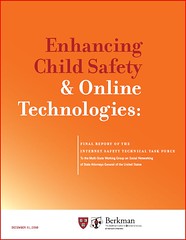 The Internet Safety Technical Task Force (ISTTF), which was formed a year ago to study online safety concerns and technologies, today issued its final report to the U.S. Attorneys General who authorized its creation. It was a great honor for me to serve as a member of the ISTTF and I believe this Task Force and its report represent a major step forward in the discussion about online child safety in this country.
The ISTTF was very ably chaired by John Palfrey, co-director of Harvard University’s Berkman Center for Internet & Society, and I just want to express my profound thanks here to John and his team at Harvard for doing a great job herding cats and overseeing a very challenging process. I encourage everyone to examine the full ISTTF report and all the submissions, presentations, and academic literature that we collected. [It’s all here.] It was a comprehensive undertaking that left no stone unturned.
Importantly, the ISTTF convened (1) a Research Advisory Board (RAB),which brought together some of the best and brightest academic researchers in the field of child safety and child development and (2) a Technical Advisory Board (TAB), which included some of America’s leading technologists, who reviewed child safety technologies submitted to the ISTTF. I strongly recommend you closely examine the RAB literature review and TAB assessment of technologies because those reports provide very detailed assessments of the issues. They both represent amazing achievements in their respective arenas.
There are a couple of key takeaways from the ISTTF’s research and final 278-page report that I want to highlight here. Most importantly, like past blue-ribbon commissions that have studied this issue, the ISTTF has generally concluded
there is no silver-bullet technical solution to online child safety concerns. The better way forward is a “layered approach” to online child protection. Here’s how we put it on page 6 of the final report:
The Task Force remains optimistic about the development of technologies to enhance protections for minors online and to support institutions and individuals involved in protecting minors, but cautions against overreliance on technology in isolation or on a single technological approach. Technology can play a helpful role, but there is no one technological solution or specific combination of technological solutions to the problem of online safety for minors. Instead, a combination of technologies, in concert with parental oversight, education, social services, law enforcement, and sound policies by social network sites and service providers may assist in addressing specific problems that minors face online. All stakeholders must continue to work in a cooperative and collaborative manner, sharing information and ideas to achieve the common goal of making the Internet as safe as possible for minors.
Continue reading →
Over at Ars, Matt Lasar has a piece about the need for better FCC indecency complaint statistics. He has been monitoring the wild fluctuations in indecency complaint tallies in recent years and wonders:
whether the agency’s indecency/obscenity statistics reflect spontaneous viewer response to the level of erotic/linguistic friskiness on TV or solely on the power of coordinated campaigns launched by groups like the Parents Television Council.
Indeed, PTC is the primary culprit. As I noted in my big 2005 PFF report “Examining the FCC’s Complaint-Driven Broadcast Indecency Enforcement Process”, “The PTC’s increasingly effective use of computer-generated campaigns against specific TV programs is a leading factor in explaining the large jump in indecency complaints in recent years.” The PTC has even taken credit for it themselves, as I noted in the paper.
How did the FCC’s indecency process get so screwy, and how did the PTC come to influence it so greatly? As I noted in that paper (as well as a Supreme Court filing with my friends at CDT), in recent years the FCC has quietly and without major notice made two methodological changes to its tallying of broadcast indecency complaints, both changes urged upon the FCC by a single advocacy group — the PTC — targeting broadcast indecency:
Continue reading →
 President-elect Barack Obama will soon be naming Cass Sunstein, an old friend of his from their University of Chicago Law School days together, the new head the White House Office of Information and Regulatory Affairs (OIRA). OIRA oversees regulation throughout the U.S. government. Basically, Sunstein’s position is the equivalent of the federal regulatory czar.
Sunstein certainly possess excellent qualifications for the job. During his time at the University of Chicago and Harvard Law School, Sunstein has established himself as a leading liberal thinker in the field of law and economics. And, as I have joked in writing about him before, he is so insanely prolific that it seems every time I finish reading one of his new books a new title by him lands on my desk. I am quite convinced that both he and Richard Posner are actually cyborgs. I just don’t understand how two humans can compose words so rapidly!
Anyway, Professor Sunstein’s new position as head of OIRA gives him the ability influence federal regulatory decisions in both a procedural and substantive way. In terms of substance, it gives him an important platform to subtly “nudge” the regulatory philosophy and direction of the Obama Administration on many matters, including Internet policy. So, what has Professor Sunstein had to say about Internet policy in his recent work? Sunstein has developed his thinking about these issues primarily in his two recent books: Republic.com (2000) and Infotopia: How Many Minds Produce Knowledge (2006). But he’s also had a few relevant things to say about Internet issues in his recent book with Richard Thaler, Nudge: Improving Decisions About Health, Wealth, and Happiness
(2008).
There are 3 Internet policy-related things from his work that I’d like to focus on here because I find them all quite troubling. Continue reading →
Before commenting on Lawrence Lessig’s latest call to abolish the Federal Communications Commission (he issued a similar call for the FCC’s abolition earlier this year, which I commented on here), let’s recall what Tim Lee posted yesterday about “Real Regulators“:
Too many advocates of regulation seem to have never considered the possibility that the FCC bureaucrats in charge of making these decisions at any point in time might be lazy, incompetent, technically confused, or biased in favor of industry incumbents. That’s often what “real regulators” are like, and it’s important that when policy makers are crafting regulatory scheme, they assume that some of the people administering the law will have these kinds of flaws, rather than imagining that the rules they write will be applied by infallible philosopher-kings.
Ironically, Prof. Lessig — who typically defends many forms of high-tech regulation like Net neutrality and online content labeling — is essentially agreeing with Tim’s critique of bureaucracy. But Lessig seems to ignore the underlying logic of Tim’s critique and instead imagines that we need only reinvent bureaucracy in order to save it. But I’m getting ahead of myself. First, let’s hear what Lessig proposes.
In a
Newsweek column this week entitled “Reboot the FCC,” Lessig argues that the FCC is beyond saving because, instead of protecting innovation, the agency has succumb to an “almost irresistible urge to protect the most powerful instead.” Consequently, he continues:
The solution here is not tinkering. You can’t fix DNA. You have to bury it. President Obama should get Congress to shut down the FCC and similar vestigial regulators, which put stability and special interests above the public good. In their place, Congress should create something we could call the Innovation Environment Protection Agency (iEPA), charged with a simple founding mission: “minimal intervention to maximize innovation.” The iEPA’s core purpose would be to protect innovation from its two historical enemies–excessive government favors, and excessive private monopoly power.
As was the case with his earlier call to “blow up the FCC,” I am tickled to hear Lessig call for shutting down an agency that many of us have been fighting against for the last few decades. (Here’s a 1995 blueprint for abolishing the FCC that I contributed to, and here’s PFF’s recent “DACA” project to comprehensively reform and downsize the agency.)
But is Lessig really calling for the same sort of sweeping regulatory reform and downsizing that others have been calling for? And has he identified the real source of the problem that he hopes to correct? I don’t think so. There are 3 basic problems with the argument Lessig is putting forward in his essay. I will address each in turn.
Continue reading →

 The Technology Liberation Front is the tech policy blog dedicated to keeping politicians' hands off the 'net and everything else related to technology.