Posts tagged as:

In response to my essay last night about this new Free Press campaign to layer price controls on the Internet by banning metered prices via Rep. Massa’s new bill (the “Broadband Internet Fairness Act“), George Ou and Richard Bennett reminded me of some of the contradictory statements that the (Un)Free Press crew have made on this issue.  Indeed, if you look back at what Free Press and their chairman have said about the matter over just the past 18 months, they seem to be whistling two very different tunes.

For example, George Ou reminded me of what Free Press had to say in its November 2007 filing in the FCC’s Comcast-Bit Torrent proceeding:

“More importantly, if Comcast is concerned that the collective set of users running P2P applications are affecting quality of service for other users on a cable loop… they could also charge by usage.” (p. 29) […] “Indeed, in many nations, network providers do meter, and bill their customers on the basis of amount used. So the transaction costs of doing so must not be prohibitively high. Indeed, a network provider can apparently meter cheaply because, in most networks, users’ traffic to and from the Internet passes through a single gateway, the network access server.” (p. 31)

And Richard Bennett reminded me of what Tim Wu, chairman of the Free Press, had to say about metering to the Washington Post just one year ago:

“I don’t quite see [metering] as an outrage, and in fact is probably the fairest system going — though of course the psychology of knowing that you’re paying for bandwidth may change behavior.”

So, what gives?  Will the real Free Press please stand up? Does the Free Press believe in pricing freedom or price controls for the Internet?


You really have to hand it to the folks over at the (Un)Free Press with their endlessly shameful attempts to use doublespeak to remake the entire media, communications, and Internet landscape in their preferred Big Government image.  Their latest bit of charlatanism is the so-called “Stop the Internet Rip-Off of 2009” campaign.  It’s another one of their computerized “stuff-the-FCC-and Congressional-complaint-box-with-electronic-form-letters” efforts that involves getting their merry band of radical reformistas to encourage lawmakers to sign on to Rep. Eric Massa’s (D-NY) newly-introducedBroadband Internet Fairness Act.”

Ah yes, “Internet fairness.”  Who can possibly be against it?  Well, before you rush to click send on that UnFree Press form letter, let’s be clear what this effort is really all about.  Free Press claims that the Massa bill is needed because “phone and cable giants [are] weighing schemes to hike prices, shut down the free-flowing Web and keep user innovation in check.”  How are those companies doing that?  Tiered pricing!   Rep. Massa says that, “Time Warner has announced an ill-conceived plan to charge residential and business broadband fees based on the amount of data they download.”  Oh my God, no… you mean some people might be charged for the costs they impose?  What’s next?  Are we going to force people to pay for their own energy use by metering gasoline, electricity, or water?  Think of the horror!  (This is sarcasm, folks.  All those things are metered currently. And yet, somehow, the Earth hasn’t spun off its axis.)

Like all the other propaganda produced at the Free Press techno-spin factory, their latest crusade is based on a combination of outright lies and blatant economic ignorance.  Metering broadband access is not an effort “to restrict Internet use,” as Free Press claims. Rather, like every other metered system under the sun, it’s an effort to price a scarce resource in such a way so as to maximize use.  Broadband operators don’t sit around all day scheming to find ways to decrease network usage.  They wouldn’t make any money that way!!  They need to find business models that encourage increased uptake while also investing in and growing their networks to meet new demand and competitive challenges.

Moreover, there are other pro-consumer reasons for companies to consider metering options.  Unless it is your goal to allow some particularly aggressive users to be subsidized by all other users, it is sometimes sensible to price usage based on demand.  If you don’t, you potentially create a perverse incentive for a small handful of over-grazers to to be feeding at the trough at everyone else’s expense. As economist Russell Roberts aptly noted in the title of a famous 1995 Wall Street Journal editorial, “If You’re Paying, I’ll Have Top Sirloin.”  Thus, you would never want to make the “all-you-can-eat” pricing model the only option for the provision of a scarce resource. Even if you choose not to deploy it, it is useful to have the metered pricing model available in case you need to charge the over-grazers at some point.

Continue reading →

Howard Stern swore off free broadcast radio in 2004 in part because of federally mandated decency rules. The self-annointed “king of all media” may have stepped off the throne in doing so. Them’s the breaks in the competitive media marketplace, contorted as it is by government speech controls.

Some would argue that a new king of all media is seeking the mantle of power now that the Obama administration is ensconced and friendly majorities hold the House and Senate. The new pretender is the federal government.

And some would argue that the Free PressChanging Media Summit” held yesterday here in Washington laid the groundwork for a new federal takeover of media and communications.

That person is not me. But I am concerned by the enthusiasm of many groups in Washington to “improve” media (by their reckoning) with government intervention.

Free Press issued a report yesterday entitled Dismantling Digital Deregulation. Even the title is a lot to swallow – Have communications and media been deregulated in any meaningful sense? (The title itself prioritizes alliteration over logic – evidence of what may come within.)

Opening the conference, Josh Silver, executive director of Free Press harkened to Thomas Jefferson – well and good – but public subsidies for printers and a government-run postal system model his hopes for U.S. government policies to come.

It’s helpful to note what policies found their way into Jefferson’s constitution as absolutes and what were merely permissive. The absolute is found in Amendment I: “Congress shall make no law . . . abridging the freedom of speech, or of the press . . . .”

Among the permissive is the Article I power “to establish Post Offices and post Roads.” There’s no mandate to do it and the scope and extent of any law is subject to Congress’ discretion, just like the power to create patents and copyrights which immediately follows.

I won’t label Free Press and all their efforts a collectivist plot and dismiss it as such – there are some issues on which we probably have common cause – but a crisper expression of “dismantling deregulation” is “re-regulation.”

It’s a very friendly environment for a government takeover of modern-day printing presses: Internet service providers, cable companies, phone companies, broadcasters, and so on.

The Cato Unbound online debate about the 10th anniversary of Lawrence Lessig’s Code and Other Laws of Cyberspace continues today with my response to Declan McCullagh’s opening essay, “What Larry Didn’t Get,” as well as Jonathan Zittrain’s follow-up.

In my response, “Code, Pessimism, and the Illusion of ‘Perfect Control,'” I begin by arguing that:

The problem with peddling tales of a pending techno-apocalypse is that, at some point, you may have to account for your prophecies — or false prophecies as the case may be. Hence, the problem for Lawrence Lessig ten years after the publication of his seminal book, Code and Other Laws of Cyberspace.

I go on to argue that:

Lessig’s lugubrious predictions proved largely unwarranted. Code has not become the great regulator of markets or enslaver of man; it has been a liberator of both. Indeed, the story of the past digital decade has been the exact opposite of the one Lessig envisioned in Code.

After providing several examples of just how wrong Lessig’s predictions were, I then ask:

[W]hy have Lessig’s predictions proven so off the mark? Lessig failed to appreciate that markets are evolutionary and dynamic, and when those markets are built upon code, the pace and nature of change becomes unrelenting and utterly unpredictable. With the exception of some of the problems identified above, a largely unfettered cyberspace has left digital denizens better off in terms of the information they can access as well as the goods and services from which they can choose. Oh, and did I mention it’s all pretty much free-of-charge? Say what you want about our cyber-existence, but you can’t argue with the price!

Continue reading →

I’ve got a new essay up over at the City Journal about John Nichols and Robert McChesney’s proposal to have the government heavily subsidize failing media enterprises to “save journalism.” It follows below:


Socializing Media in Order to Save It by Adam D. Thierer

City Journal March 27, 2009

With proposals to nationalize or heavily subsidize various segments of our economy more in vogue than ever, it was probably only a matter of time before someone suggested that America’s media marketplace should be brought into the government fold. John Nichols of The Nation and the prolific neo-Marxist media theorist Robert W. McChesney have now provided the road map for media’s march to serfdom. The cost to the American taxpayer would be at least $60 billion, but the cost for the First Amendment and our democracy would be incalculable.

Nichols and McChesney have coauthored several books and essays about media policy that view the world through the prism of class struggle, “manufactured consent” (á la Noam Chomsky), and the rest of the typical Marxoid tripe about history and economics. In their view, private, for-profit media cannot be trusted. As they stated in their 2003 call to arms, Our Media, Not Theirs: The Democratic Struggle Against Corporate Media, media-reform efforts must begin with “the need to promote an understanding of the urgency to assert public control over the media.” “Our claim,” they continue, “is simply that the media system produces vastly less of quality than it would if corporate and commercial pressures were lessened.”

In a new Nation essay, “The Death and Life of Great American Newspapers,” the authors bring their earlier work to its logical conclusion. Saving journalism, they argue, essentially requires that media become an appendage of the state. Journalism, they claim, is a “public good,” which—like education and defense—requires constant government oversight and support: “A moment has arrived at which we must recognize the need to invest tax dollars to create and maintain news gathering, reporting and writing with the purpose of informing all our citizens.” They propose that government devote $60 billion to “subscription subsidies, postal reforms, youth media and investment in public broadcasting.” Think of it as a “free press ‘infrastructure project,’” they say. “It would keep the press system alive. And it has the added benefit of providing an economic stimulus.” (Isn’t it amazing how everything stimulates the economy these days?)

Continue reading →

TombstoneWhen the history books are finally written documenting America’s failed experiment with broadcast industry content regulation, this past week may go down as a critical moment in the story.  The obvious reason this week was so important was the Senate’s 87-11 vote on Thursday to prevent the Federal Communications Commission (FCC) from reinstating the Fairness Doctrine.  But an equally important development this past week was the release of a new white paper by the radical Leftist activist group Free Press.

The Free Press, which was founded by the socialist media theorist Robert McChesney, doesn’t typically publish many things admitting to the failures of coercive government regulation. Nonetheless, in “The Fairness Doctrine Distraction,” a paper by Josh Silver and Marvin Ammori, the media reformistas at Free Press told their Big Government comrades in Congress and academia that it was finally OK to let go of at least this one old pet project of theirs.  In their paper, Silver and Ammori note that, “The Fairness Doctrine put the federal government in the position of judging content and controlling speech” and “Reinstating the Doctrine will not result in greater viewpoint diversity in broadcasting.”  They continue:

The Fairness Doctrine, while originally well-intentioned, is not wise public policy. [T]he Doctrine places the FCC in charge of determining what is fair in political speech — a difficult task in the best of circumstances. Placing the government in the role of monitoring and judging political speech will inevitably produce controversy that is impossible to resolve.

I applaud the Free Press for finally fessing up to the Fairness Doctrine’s many failings.  This First Amendment-violating abomination should have never been allowed to be enforced by the FCC to begin with, but at least we can now all finally agree it should stay off the books for good.

Of course, the radicals at the (Un)Free Press weren’t about to let one of the Left’s old favorite regulations go so away without asking for something in return.  One of the reasons that Silver and Ammori are suddenly willing to give their blessing to the Doctrine’s burial is because they want to get on with the more far-reaching agenda of micro-managing media markets using a variety of less visible regulations.

Continue reading →

Matt Lasar of Ars tells us not to worry about the Fairness Doctrine being revived, only to go on and cite several lawmakers who have said they’d like to revive it. Meanwhile, over at the American Spectator, somebody called “The Prowler” seems to have all sorts of unnamed sources on the Hill telling him the Fairness Doctrine will be revived any day now.

Who knows what to believe. But let’s keep our eye on the real issue here. The danger is not that the Fairness Doctrine gets back on the books in the same form; it’s that versions of it sneak in through the back door via other regulatory initiatives. As Cord Blomquist pointed out here last April, “localism is the new Fairness Doctrine.”  There are a lot of people are running around Washington today insisting that government must intervene in the marketplace to “save media localism” and “strengthen the public interest obligations” of local TV and radio broadcasters.  There’s been an FCC proceeding open on this issue for some time, and everything about it reeks of the Fairness Doctrine in drag.

This effort is being spearheaded by the media reformistas whose short-term goal is to reinvigorate the amorphous “public interest standard” such that the FCC has open-ended powers to regulate everything under the sun going forward. That’s why a key part of the “localism” battle is their effort to breathe new life into “ascertainment rules,” which used to be more formal and required broadcasters to strictly report everything they aired and did in their communities. There’s lots of talk of ensuring more “accountability” from broadcasters regarding how they serve their local communities, and there’s even rumblings of “local community boards” who will sit as mini-free speech Star Chambers and pass judgment on whether local media outlets are doing their job.  Again, it’s all just the Fairness Doctrine by another name. Continue reading →

Some sensible thinking here about broadband pork stimulus plans from Saul Hansell of the New York Times. In his piece on the NYT Bits blog this week, “Does Broadband Need a Stimulus?” he argues that people should stop grumbling about the “relatively small sum” of $6 billion that the new administration has proposed for wiring rural areas and urban centers. Hansell argues:

This also seems to be a rather sound policy choice because, as I look at it, the noise about a broadband gap is hooey. With new cable modem technology becoming available, 19 out of 20 American homes eventually will be able to have Internet service that is faster than any available now anywhere in the world. And that’s without one new cable being laid. That fact hasn’t prevented a lot of folks involved in telecommunications policy from calling for a lot of money to be spent on backhoes and cable riggers. For example, the Communications Workers of America and the Telecommunications Industry Association called for $25 billion in subsidies to network providers as well as tax breaks. The Free Press, a group that advocates for media diversity, recommended spending $44 billion, with an emphasis on subsidizing companies to compete with existing cable and phone companies. Running a new fiber-optic cable to every American home may well increase competition in broadband providers, but it isn’t needed to deliver high-speed Internet service. Current cable modems use just one of the more than 100 channels on a typical cable system and can often offer speeds of 16 megabits per second or more. The next generation of modems, using a technology called Docsis 3, allows several of those video channels to be combined to offer what ultimately can be Internet service as fast as 1 gigabit per second — 10 times faster than is offered in Japan, which generally is regarded as having the fastest broadband infrastructure.

Continue reading →

[This represents a bit of a departure from the traditional format of my ongoing “Media Deconsolidiation Series,” but you will see how it ties in…]

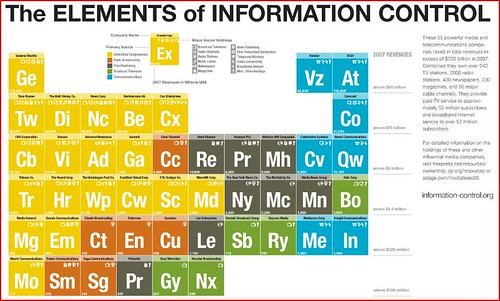
So, some guy from the (Un)Free Press — the activist group that wants to regulate every facet of the media and broadband universe — has created a scary looking chart about “Information Control” [seen below]. It’s based loosely on the Periodic Table of Elements, you know, to give it the aura of science and fact. In reality, it’s just another silly scare tactic that tells us very little about the true nature of our modern media marketplace. infocontrolBS

The chart is accompanied by the typical Free Press gloom-and-doom rhetoric about the unfolding media apocalypse. “Nearly everything you see, hear and read that isn’t from a friend — whether on TV, the radio, or even on the Web — comes from a for-profit gatekeeper.”  And then comes the obligatory A.J. Liebling quote about how “Freedom of the press belongs to those who own one,” followed quickly by the typical punch line about how just a handful of companies (in this case 55 of ’em) are puppeteering all our thoughts in America today:

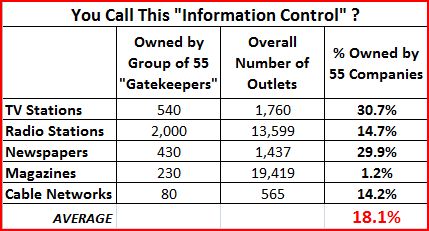
Combined, these 55 powerful media and telecommunications companies raked in total revenues in excess of $700 billion in 2007. Together they own over 540 TV stations, 2000 radio stations, 430 newspapers, 230 magazines, and 80 major cable channels in the United States. They provide paid TV service to approximately 52 million subscribers and broadband Internet service to over 57 million subscribers. They’re the bottlenecks through which our news, our entertainment, and our political discourse must travel. What they want to promote becomes prominent; what they suppress stays out of the mainstream. As such, these companies are the elements of information control.

Oh my God! We are all just brainwashed sheep!

Except we’re not. It amazes me how these “information control” and “media monopoly” myths keep getting widespread circulation. But the first thing to note is how the media reformistas can’t get even their story straight when it comes to how many “monopolists” are supposedly out there today. As I noted in my 2005 book, Media Myths: Making Sense of the Debate over Media Ownership, the critics seem to just pull their numbers out of a hat. Some say as few as 3 companies control everything. Others says 5 or 6. Still others say it might be a few dozen. And now this guy says its 55. Hey, that’s progress that even the Free Press should love!

Regardless of the number, does this really represent the totality of our modern media universe? Do those 55 companies really “own most of the 21st-century presses in America” as the “Info Control” website states? Answer: NOT. EVEN. CLOSE.  Here are the facts. [I happened to have compiled them for a PFF special report entitled Media Metrics: The True State of the Modern Media Marketplace to debunk myths just like this.]

Info Control Debunked

Continue reading →

This is just a listing of the installments of my ongoing “Media Deconsolidation Series.” I needed to create a single repository of all the essays so I could point back to them in future articles and papers. For those not familiar with it, this series represents an effort to set the record straight regarding the many myths surrounding the media marketplace. These myths are usually propagated by a group of radical anti-media regulatory activists who I call the “media reformistas.” Sadly, however, many policymakers, journalists, and members of the public are buying into some of these myths, too.

In particular, I have spent much time here debunking the notion that rampant consolidation is taking place and that media operators are only growing larger and devouring more and more companies. In fact, nothing could be further from the truth. Over the past several years, traditional media operators and sectors have been coming apart at the seams in the face of unprecedented innovation and competition. The volume of divestiture activity has been quite intense, and most traditional media operators have been getting smaller, not bigger. As a result, America’s media marketplace is growing more fragmented and atomistic with each passing day.

Anyway, here’s the series so far…

Continue reading →