Posts tagged as:
hugo-like-the-Free-Press-plan-300x211

[cross-posted from BigGovernment.com]

In the battle over media and communications freedom, no group poses a more serious threat to a free and independent press than the insultingly misnamed regulatory activist group Free Press. Along with their founders, the prolific neo-Marxist media theorist Robert W. McChesney and Nation correspondent John Nichols, Free Press has engaged in relentless agitation for a truly radical media and communications policy agenda, and their influence is now spreading throughout the Obama Administration.

The Free Press-McChesney blueprint for media “reform” reads more like a script for State servitude. On the regulatory side, they call for media ownership restrictions, “localism” mandates, “Net neutrality” regulations, price controls on broadband, advertising and copyright restrictions, and layers of additional regulatory edicts.  Once all that red tape smothers the life out the independent press and private communications providers, they plan to have the State step in become the primary benefactor of the Fourth Estate and high-tech infrastructure. For starters, McChesney and Nichols advocate a $35 billion annual “public works” program for the press modeled after the Works Progress Administration of the New Deal era. Their media WPA would include a “News AmeriCorps” for out-of-work journalists, a “Citizenship News Voucher” to funnel taxpayer support to struggling media entities, a significant expansion of postal subsidies, a massive new subsidy for journalism schools, corporate welfare for newspapers sufficient to pay 50 percent of the salaries of all “journalistic employees,” municipal government ownership of press and infrastructure, and many more bureaucratic programs. Continue reading →

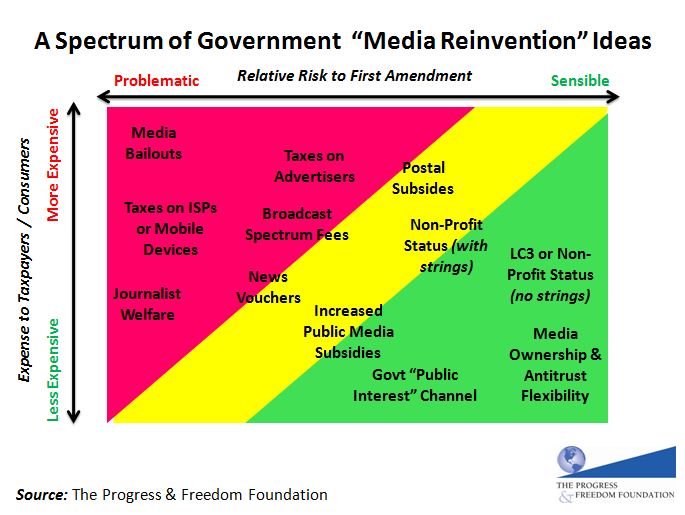
As I’ve noted here before, the Federal Trade Commission (FTC) has an ongoing proceeding asking “How Will Journalism Survive the Internet Age?” The agency has hosted two workshops on the issue and a third is scheduled for June 15th at the National Press Club. Recently, the FTC released a 47-page staff discussion draft entitled “Potential Policy Recommendations to Support the Reinvention of Journalism,” which outlines dozens of proposals that have been set forth in recent years to “save journalism,” “reinvent media,” or support various forms of so-called “public interest programming.”  [I’ve embedded the document down below.] Although the FTC makes it very clear on the first page of the discussion draft that it “does not represent final conclusions or recommendations by the Commission or FTC staff [and] it is solely for purposes of discussion,” the document is drawing scrutiny and raising concern since it might foreshadow where the FTC (and Obama Administration) could be heading on this front.

Some of those raising a stink about the FTC draft include: Jeff Jarvis (“FTC Protects Journalism’s Past“); Rob Port (“Federal Government Considering “iPad Tax” To Subsidize Journalism“); Mark Tapscott: “(Will Journalists Wake up in Time to Save Journalism from Obama’s FTC?”); and Andrew Malcolm of the Los Angeles Times (“Obama’s FTC Plan to Reinvent America’s News Media“), who says, “this FTC study is rated R for anyone who thinks the federal government, the object of copious news coverage itself, has no business deciding which sectors of the private media business survive and thrive through its support, subsidies and encouragement with things like tax incentives. Yet that’s what this Obama administration paper is suggesting as another of the ex-community organizer’s galactic reform plans.”   Ouch!

Continue reading →

In the wake of yesterday’s ruling in the D.C. Circuit that the FCC had exceeded its authority in attempting to regulate access to the Internet, I did a number of radio interviews and a radio debate with Derek Turner of Free Press, a leading advocate of Internet regulation.

The debate was a brief, fair exchange of views. I was struck, though, to hear Turner refer to the situation as a “crisis.” Sure enough, in a Free Press release, Turner says three times that the ruling creates a “crisis.”

Recall that in 2007 Comcast degraded the service it provided to a tiny group of customers using a bandwidth-hogging protocol called BitTorrent. Recall also that before the FCC acted, Comcast had stopped doing this, relenting to customer complaints, negative attention in news stories, and such.

In the wake of the D.C. Circuit ruling and the crisis it has created, Internet users can expect the following changes to their Internet service:
None.

Wow. With crises like these, who needs tranquility?

“As a result of this decision, the FCC has virtually no power to stop Comcast from blocking Web sites,” the release intones.

That would be worrisome, though still not much of a crisis—except that Comcast would be undercutting its own business by doing that. Did you know also that no federal regulation bars people from burning their furniture in the backyard? That’s the same kind of problem.

As Tim Lee points out in his paper, “The Durable Internet,” consumer pressures are likely in almost all cases to rein in undesirable ISP practices. Computer scientist Lee presents examples of how ownership of communications platforms does not imply control. If an ISP persists in maintaining a harmful practice contrary to consumer demand—and consumers can’t express their desires by switching to another service—we can talk then.

In the meantime, this “crisis” has me slightly drowsy and eager to go outside and enjoy the spring weather.

John Schwartz of The New York Times called me two weeks ago and asked for comment about a potential controversy involving mobile phone provider Sprint and the charitable organization Catholic Relief Services (CRS). The facts were pretty sketchy at the time, but Schwartz told me that CRS was accusing Sprint of blocking Mobile Commons, the company that connects CRS and 100 other nonprofit organizations with text messaging networks, from getting a short code to create a charitable mobile donation program in the wake of the Haiti earthquake. Here’s the basic background that appeared in Schwartz’s March 24th article, Catholic Charity and Sprint Tangle Over Texting“:

[CRS] wanted to try a twist on the technology: when people sent a text message to donate, they got a reply offering to connect them via phone to the charity’s call center. The group hoped that the calls could build a stronger bond with donors, and garner larger contributions as well. But just three days into the effort after the Jan. 12 earthquake, the charity got word that Sprint Nextel was demanding that the “text-to-call” effort be shut down. The charity had 40 days to abandon the feature or lose access to millions of Sprint customers.  Sprint’s original motivations are murky; it said that an intermediary company had failed to properly fill out a form to verify that it was dealing with a legitimate charity.

It didn’t take long for the regulatory activists at Free Press and Public Knowledge to pounce and claim the Federal Communications Commission (FCC) had to intervene to save our souls from the nefarious scum at Sprint. After all, you do know that Sprint hates Haitians, right?  The company obviously wanted to see Haitians starve and not receive any support from charitable organizations.

No, seriously, come on!  How asinine is this storyline?! Continue reading →

Steve Forbes has an entertaining essay out today about the agenda of Free Press and its founder, the Marxist media scholar Robert McChesney. Forbes notes that McChesney has expressed a great deal of sympathy for the Venezuelan dictator Hugo Chavez and has even defended some of his tactics to control the press. This leads to his fear that McChesney and Free Press will convince the Obama Administration to use similar tactics here in the U.S.:

Once the federal government starts subsidizing our own free press, how long until the feds start revoking broadcast licenses of government opponents and bringing pesky reporters up on charges of say, “corruption” or “subversion”? According to McChesney and the Free Press folks, it apparently can’t happen soon enough.

To be fair, I haven’t heard anyone from Free Press defending Hugo Chavez or his tactics. But I do wonder why the organization continues to associate itself with such a radioactive figure like Mr. McChesney. After all, Forbes isn’t making up anything about McChesney, who is an outspoken, and self-described, Marxist media theorist. McChesney really has expressed sympathy for Chavez and said that, “If [Venezuelan broadcaster] RCTV were broadcasting in the United States, its license would have been revoked years ago. In fact its owners would likely have been tried for criminal offenses, including treason.” Far more troubling are Mr. McChesney’s views regarding how to reform media going forward, which I’ve documented in past essays in more detail. (See, “Free Press, Robert McChesney & the “Struggle” for Media,” “What the Media Reformistas Really Want,” and “Socializing Media in Order to Save It,.”) One need look no further than this lengthy interview with McChesney that appeared in an online newsletter called “The Bullet” produced by the Canada-based “Socialist Project.”

The whole thing is quite troubling to read, but here are a couple of jaw-droppers that make it clear just how radical Mr. McChesney’s worldview and agenda are:

Continue reading →

Couple of media clips here regarding my thoughts about the FCC’s National Broadband Plan:

Also see my essays:”5 Regulatory Hot Potatoes That Could Derail the FCC National Broadband Plan,” “Will the FCC’s National Broadband Plan Really Be Costless?” and “The Best Quote in the FCC National Broadband Report.”

We’re from government and we’re here to help save journalism.”

That seems to be the hot new meme in media policy circles these days. Last week, it was the Federal Communications Commission (FCC) kicking off their “Future of Media” effort with a workshop on “Serving the Public Interest in the Digital Era.” This week, it’s the Federal Trade Commission’s (FTC) turn as they host the second in their series of workshops on How Will Journalism Survive the Internet Age? Meanwhile, the Senate has already held hearings about “the future of journalism,” and Senator Benjamin L. Cardin (D-MD) recently introduced the “Newspaper Revitalization Act,” which would allow newspapers to become nonprofit organizations in an effort to help them stay afloat.

I have no doubt that many of the public policymakers behind these efforts have the best of intentions and really are concerned about what many believe to be a crisis in the field of journalism. But here are my three primary concerns with Washington’s sudden interest in “saving journalism”: Continue reading →

Yesterday I engaged in a lively luncheon debate about Net neutrality regulation with Ben Scott of Free Press at a Catholic University Law School event on “Implementing the National Broadband Plan.” To open the debate, I made a very quick 5-Part Case against Net Neutrality Regulation. I argued that the the objections to a Net neutrality regulatory regime can be grouped into 5 major categories: (1) Legal; (2) Economic; (3) Engineering; (4) Practical; and (5) Philosophical / Principled. Down below you will find my working notes to see how I then elaborated on each objection in a bit more detail. And then Ben and I engaged in some spirited banter for the next 45 minutes.

Unfortunately, it doesn’t appear that the video of our debate is online just yet, but once it is I will post it here. However, the folks from NextGenWeb asked me to shoot a short 2 1/2 min video clip after the debate summarizing my remarks. If you can stand the sight of my big fat head in your browser for that long, here ya go:

http://blip.tv/play/gYh4gci5IQI%2Em4v

The 5-Part Case against Net Neutrality Regulation

The objections to a Net neutrality regulatory regime can be grouped into 5 major categories: (1) Legal; (2) Economic; (3) Engineering; (4) Practical; and (5) Philosophical / Principled. Each objection will be briefly summarized below: Continue reading →

I know, I know… do we really need to listen to another debate over Net neutrality?!   I too have grown a bit tired of the issue, which has crowded out so many other important issues in the Internet policy world these days. Net neutrality simply sucks all the oxygen out of the room no matter what topic is being discussed. And it is so highly charged that it has become the equivalent of the abortion issue of the high-tech world; intellectual combatants can get so worked up over the topic that seemingly no rational debate can take place at times.

That being said, I do want to encourage everyone to check out this dynamite debate about “Demystifying Net Neutrality,” a Diffusion Group webinar which took place last week. It’s a very level-headed discussion of the issue that features my colleague Barbara Esbin, a PFF Senior Fellow and the Director of PFF’s Center for Communications and Competition Policy, and Chris Riley, a Policy Counsel at Free Press.  You can now download and listen to the debate now from the Diffusion Group website. Barbara also wrote about the discussion over the PFF blog and walks the reader through the discussion. And you won’t be surprised to hear me say I think Barbara gets the better of Chris Riley in the debate!

One thing I found quite interesting in the debate was how Riley struggled to distinguish between “the Internet” versus “Internet access services” for purposes of delineating the proper confines of Net neutrality regulation. Like many other defenders of Net neutrality regulation, (see, most recently, for example, Rob Frieden, “Why the FCC’s Proposed Openness Principles Cannot and Should Not Apply to Internet Application and Content Providers“), Riley and Free Press want us to believe that this distinction is clear-cut and that regulation won’t have unintended consequences.  Of course, such distinctions are always easier in theory than reality, and as Berin Szoka and I argued in our recently paper on “high-tech mutually assured destruction,” regulation always spreads. The march of regulation can sometimes be glacial, but it is, sadly, almost inevitable: Regulatory regimes grow but almost never contract.

Anyway, listen to the entire webinar discussion. It’s worth your time.

The Annenberg School at the University of Southern California recently released a paper by Geoffrey Cowan and David Westphal entitled, “Public Policy and Funding the News.” In it, Cowan and Westphal join the growing chorus of voices advocating a substantial role of government in propping up struggling media entities or investing in news production going forward.

I can’t say that I disagree with everything in the report, especially the contention that many traditional news-gathering institutions face serious challenges to their survival. But as I have noted here before, there are three big problems with recommendations to greatly expand the role of government in the media sector or journalistic profession as a solution:

  1. While public media & subsidies may have a role, that role should be tightly limited and focused on filling specific niches or unfilled needs within certain communities. Public subsidies should not be viewed as a replacement for traditional private media sources. Moreover, public subsidies will not begin to make up the shortfall from traditional private funding source, unless we plan on having Congress spend hundreds of billions of dollars (like the radical regulatory advocates at Free Press advocates) to subsidize news.
  2. If we do end up taking that path, it will raise profound fairness questions since it will leave taxpayers footing the bill for things they might not want or could find objectionable, even offensive. (Conservatives wouldn’t like funding Bill Moyers, and liberals wouldn’t be too keen on supporting Rush Limbaugh).
  3. Any plan to have government step up its role in supporting journalism will raise profound questions about press independence and threaten core First Amendment values. Putting journalists on the public dole is a serious threat to the integrity of the profession.

Continue reading →