By Adam Thierer & Berin Szoka
In a series of upcoming essays, we will be examining proposals being put forward today that would have the government play a greater role in sustaining struggling media enterprises, “saving journalism,” or promoting more “public interest” content. The reason we’re working up this multi-part series is because, with many traditional media operators struggling, and questions being raised about how journalism in particular will be supported in the future, Washington policymakers are currently considering what role government can and should play in helping media providers reinvent themselves in the face of tumultuous technological change wrought by the Digital Revolution.
For example, the Federal Communications Commission (FCC) recently kicked off a new “Future of Media” effort with a workshop on “Serving the Public Interest in the Digital Era.” (The filing deadline for the FCC’s “Future of Media” proceeding is May 7th). Likewise, the Federal Trade Commission (FTC) has hosted two workshops asking “How Will Journalism Survive the Internet Age?” Meanwhile, the Senate has already held hearings about “the future of journalism,” and Senator Benjamin L. Cardin (D-MD) recently introduced the “Newspaper Revitalization Act,” which would allow newspapers to become tax-exempt non-profits in an effort to help them stay afloat.
Thus, in light of Washington’s sudden interest in the future of media and journalism, we will be taking a hard look at several issues and proposals that are being floated today, including:
- Taxes on media devices, mobile phones, or broadband bills to channel money to media enterprises / content;
- Taxes / fees on broadcasters to funnel support to their public sector competitors or to public interest programs;
- “News vouchers” or “public interest vouchers” that would encourage citizens to channel support to media providers;
- Taxes on private advertising to subsidize non-commercial / public media content;
- Expanded postal subsidies for media mail; and
- Targeted welfare programs for out-of-work journalists or corporate welfare in the form of bailouts for failing media enterprises.
You won’t be surprised to hear that we are generally quite skeptical of most of these ideas, but we promise to give each one serious consideration. We’ll kick things off tomorrow with our essay on why taxing media devices or distribution systems to fund media content is not a particularly good idea.
“We’re from government and we’re here to help save journalism.”
 That seems to be the hot new meme in media policy circles these days. Last week, it was the Federal Communications Commission (FCC) kicking off their “Future of Media” effort with a workshop on “Serving the Public Interest in the Digital Era.” This week, it’s the Federal Trade Commission’s (FTC) turn as they host the second in their series of workshops on How Will Journalism Survive the Internet Age? Meanwhile, the Senate has already held hearings about “the future of journalism,” and Senator Benjamin L. Cardin (D-MD) recently introduced the “Newspaper Revitalization Act,” which would allow newspapers to become nonprofit organizations in an effort to help them stay afloat.
I have no doubt that many of the public policymakers behind these efforts have the best of intentions and really are concerned about what many believe to be a crisis in the field of journalism. But here are my three primary concerns with Washington’s sudden interest in “saving journalism”: Continue reading →
Today I am testifying at an FCC hearing on “Serving the Public Interest in the Digital Era.” [Speaker lineup here.] The purpose of the workshop is to explore:
- A brief history and overview of policies involving “public interest” requirements for commercial media and telecommunications companies;
- The state of local commercial broadcast TV and radio news and information; and
- The impact of media convergence and the emergence of the Internet, mobile technologies, and digital media on FCC media policy.
In my remarks, I focused on “Why Expansion of the FCC’s Public Interest Regulatory Regime is Unwise, Unneeded, Unconstitutional, and Unenforceable.” Down below I have attached my written remarks. Continue reading →
Yesterday I engaged in a lively luncheon debate about Net neutrality regulation with Ben Scott of Free Press at a Catholic University Law School event on “Implementing the National Broadband Plan.” To open the debate, I made a very quick 5-Part Case against Net Neutrality Regulation. I argued that the the objections to a Net neutrality regulatory regime can be grouped into 5 major categories: (1) Legal; (2) Economic; (3) Engineering; (4) Practical; and (5) Philosophical / Principled. Down below you will find my working notes to see how I then elaborated on each objection in a bit more detail. And then Ben and I engaged in some spirited banter for the next 45 minutes.
Unfortunately, it doesn’t appear that the video of our debate is online just yet, but once it is I will post it here. However, the folks from NextGenWeb asked me to shoot a short 2 1/2 min video clip after the debate summarizing my remarks. If you can stand the sight of my big fat head in your browser for that long, here ya go:
http://blip.tv/play/gYh4gci5IQI%2Em4v
The 5-Part Case against Net Neutrality Regulation
The objections to a Net neutrality regulatory regime can be grouped into 5 major categories: (1) Legal; (2) Economic; (3) Engineering; (4) Practical; and (5) Philosophical / Principled. Each objection will be briefly summarized below: Continue reading →
The Annenberg School at the University of Southern California recently released a paper by Geoffrey Cowan and David Westphal entitled, “Public Policy and Funding the News.” In it, Cowan and Westphal join the growing chorus of voices advocating a substantial role of government in propping up struggling media entities or investing in news production going forward.
I can’t say that I disagree with everything in the report, especially the contention that many traditional news-gathering institutions face serious challenges to their survival. But as I have noted here before, there are three big problems with recommendations to greatly expand the role of government in the media sector or journalistic profession as a solution:
- While public media & subsidies may have a role, that role should be tightly limited and focused on filling specific niches or unfilled needs within certain communities. Public subsidies should not be viewed as a replacement for traditional private media sources. Moreover, public subsidies will not begin to make up the shortfall from traditional private funding source, unless we plan on having Congress spend hundreds of billions of dollars (like the radical regulatory advocates at Free Press advocates) to subsidize news.
- If we do end up taking that path, it will raise profound fairness questions since it will leave taxpayers footing the bill for things they might not want or could find objectionable, even offensive. (Conservatives wouldn’t like funding Bill Moyers, and liberals wouldn’t be too keen on supporting Rush Limbaugh).
- Any plan to have government step up its role in supporting journalism will raise profound questions about press independence and threaten core First Amendment values. Putting journalists on the public dole is a serious threat to the integrity of the profession.
Continue reading →
Yesterday’s Supreme Court decision in Citizens United v. FEC essentially stands for the proposition that free speech is free speech regardless of the speaker. The 5-4 majority for the Court ruled that “We find no basis for the proposition that, in the context of political speech, the Government may impose restrictions on certain disfavored speakers. Both history and logic lead us to this conclusion.” (at 25) Echoing its early decision in Bellotti, the Court noted that “Political speech is ‘indispensable to decisionmaking in a democracy, and this is no less true because the speech comes from a corporation rather than an individual.’” (at 33) “All speakers, including individuals and the media, use money amassed from the economic marketplace to fund their speech. The First Amendment protects the resulting speech, even if it was enabled by economic transactions with persons or entities who disagree with the speaker’s ideas.” (at 35) “There is simply no support for the view that the First Amendment, as originally understood, would permit the suppression of political speech by media corporations.” (at 37)
Somehow this has proven controversial, even radical, to some. But, as George Will correctly notes, “This was radical only because after nearly four decades of such ‘reform’ the First Amendment has come to seem radical. Which, indeed, it is. The Supreme Court on Thursday restored First Amendment protection to the core speech that it was designed to protect — political speech.” Essentially, the decision gets Congress out of the game of picking who, or what platform, deserves full First Amendment protection when it comes to uttering political speech. And there’s nothing radical about that.
Indeed, as Justice Kennedy noted for the majority, there is nothing surprising about this reasoning once you realize that almost every other type legislative or regulatory speech restriction has been struck down as a violation of the First Amendment. “The law before us is an outright ban [on political speech], backed by criminal sanctions,” Kennedy noted (at 20). “If the First Amendment has any force, it prohibits Congress from fining or jailing citizens, or associations of citizens, for simply engaging in political speech.” (at 33) Think about this for a second: Criminal sanctions or jail time for political speech! How in the world did we get to the point in this nation where criminalizing political speech became acceptable to our legislators? Ignoring the obvious answer—it’s all about protecting incumbents—what is really “radical” here is not that the Supreme Court setting us back on the right path, but that our legislative branch has veered so far off of it.
Continue reading →
2009 was not as big of a year for Internet and information technology (“info-tech”) policy books as 2008 was, but there were still some notable titles released that offered interesting perspectives about the future of the Net and the impact the Digital Revolution is having on our lives, culture, and economy. So, like last year, I figured I would throw together my list of the 10 most important info-tech policy books of the year.
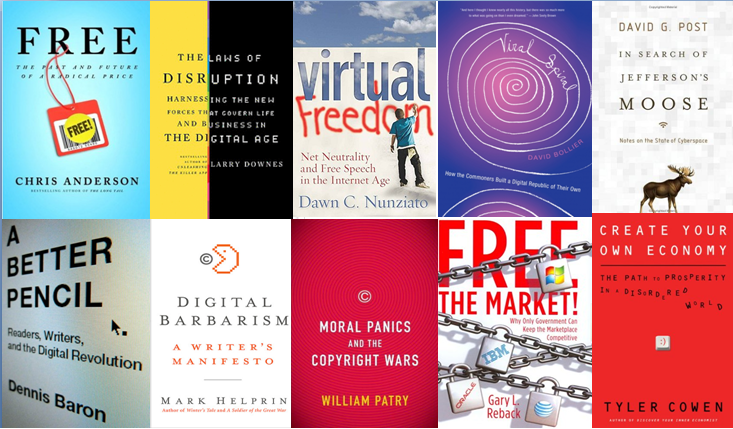 First, let me repeat a few of the same caveats and disclaimers that I set forth last year. What qualifies as an “important” info-tech policy book? Simply put, it’s a title that many people are currently discussing and that we will likely be referencing for many years to come. However, I want to be clear that merely because a book appears on my list it does not necessarily mean I agree with everything said in it. In fact, as was the case in previous years, I found much with which to disagree in my picks for the most important books of 2009 and I find that the cyber-libertarianism I subscribe to has very few fans out there.
Another caveat: Narrowly-focused titles lose a few points on my list. For example, if a book deals mostly with privacy issues, copyright law, or antitrust policy, it does not exactly qualify as the same sort of “tech policy book” as other titles found on this list since it is a narrow exploration of just one set of issues with a bearing on technology policy.
With those caveats in mind, here are my choices for the Most Important Info-Tech Policy Books of 2009. Continue reading →
 As I noted here a few days ago, the Federal Communications Commission held a workshop on Tuesday about “Speech, Democratic Engagement, and the Open Internet.” It was a shockingly one-sided affair with the deck being stacked almost entirely in favor of advocates of Net neutrality regulation. Worse yet, those advocates shamelessly made up spooky stories about a future of “private censorship” that could only be remedied by using the First Amendment as a club to beat private players into submission. The token opposition at this Chicken Little circus was Robert Corn-Revere, a Partner at the law firm of Davis Wright Tremaine LLP in Washington, D.C. Bob set the record straight–both in terms of baseless accusations that were flying that day as well as the revisionist histories of the First Amendment that were being put forward. I’m happy to report that Bob allowed PFF to reprint his remarks as a new white paper entitled, “The First Amendment, the Internet & Net Neutrality: Be Careful What You Wish For.”
In his essay, Corn-Revere discusses the relationship between the First Amendment and regulatory policy, particularly the treatment of new communications technologies, and he warns that government regulation of broadband networks could “provide the vehicle for advancing new First Amendment theories for media regulation” and online speech and expression more generally. “It should not be forgotten,” he argues, “that the federal government’s initial impulse was to censor the Internet and to subject it to a far lower level of First Amendment protection. It pursued this agenda for more than a decade but was blocked by a series of First Amendment rulings.” The Communications Decency Act and the Child Online Protection Act are just two notable examples. Luckily, the courts determined that “the open Internet would be at great risk if the government is allowed to exercise such power,” he notes, and they struck down such laws.
Continue reading →
Today I visited the Federal Communications Commission meeting room to attend a workshop on “Speech, Democratic Engagement, and the Open Internet.” Honestly, I think I was stuck in the Twilight Zone, because from what the speakers at this ridiculously one-sided panel had to say: (1) the First Amendment means something entirely different than what the Constitution says; and (2) the whole Internet world is set to go to hell unless government intervenes and saves us a litany of corporate conspiracies to “silence” us.
Seriously, I thought the FCC was trying to make their broadband workshops and Net neutrality proceeding “balanced” and “evidence-based.” This one was neither. One speaker after another regaled us with spooky stories and asked us to imagine how their particular group or service would be “blocked” or “silenced” unless Net neutrality regulations were put on the books. But no evidence was offered supporting their scary tales.
By the time Michele Combs of the Christian Coalition got done breathlessly delivering her conspiratorial rant, for example, I half expected her to ask “What would Jesus do?” about Internet regulation. She really laid it on thick, suggesting that ISPs were hell-bent (excuse the pun) on blocking Christian messaging across multiple platforms. Yeah, cause it would be a brilliant business strategy to piss off tens of millions of Christians in this country. Sure, that makes a lot of sense.
Continue reading →
One of the more troubling aspects of the contentious debate over Net neutrality regulation is the way some proponents have sought to cast Net neutrality as “the Internet’s First Amendment.” As a die-hard free speech advocate, I find this truly outrageous and a complete contortion of the true purpose of the First Amendment. As I have argued here before, it is incredibly dangerous thinking that puts our real First Amendment liberties at stake by empowering a regulatory agency with more means of controlling online speech and expression. Simply stated, the Internet’s First Amendment is the First Amendment, not some new, top-down, heavy-handed regulatory regime that puts the Federal Communications Commission in control of the Digital Economy.
On this point, I wanted to bring two things to your attention. The first is an outstanding address delivered today by Kyle McSlarrow, President & CEO of the National Cable & Telecommunications Association, at a Media Institute event here in Washington, DC. And the second is this new paper by my PFF colleague Barbara Esbin.
McSlarrow’s speech was entitled, “Net Neutrality: First Amendment Rhetoric in Search of the Constitution” and it squarely addressed the fundamental fallacy set forth by the Net neutralitistas when it comes to the First Amendment. “Whatever our present-day policy disagreements about net neutrality, or even differing politics, let’s not forget that the First Amendment is framed as a shield for citizens, not a sword for government,” he argued. “By its plain terms and history, the First Amendment is a limitation on government power, not an empowerment of government,” McSlarrow said. “And… if there’s one thing the Supreme Court has made clear, it’s that rules that directly restrict protected speech cannot be justified by a government interest that is merely hypothetical.”
Absolutely correct. And these views are buttressed by the comments of Barbara Esbin in her new paper, in which she argues that “Net Neutrality is not the First Amendment for the Internet.” She continues: Continue reading →

 The Technology Liberation Front is the tech policy blog dedicated to keeping politicians' hands off the 'net and everything else related to technology.