As part of its excellent “Room for Debate” series, the New York Times has an interesting new online symposium up now asking, “Will Networks Go Wild, With No Decency Rules?” It was in response to last week’s Second Circuit decision, which again slapped down an effort by the Federal Communications Commission to defend the agency’s indecency enforcement regime. I was honored to be asked to contribute a short essay on the subject. Here are the other contributors and their essays. Take the time to check them out:
I was particularly interested in former FCC’s Chairman Michael Powell’s admission that “The [FCC’s] fleeting expletive policy was a mistake,” and that “the real problem is the now-flawed constitutional foundation on which the law is built.” Powell goes on to argue that, “We cannot have one First Amendment for broadcasting and another one for every other medium. This vestige of a bygone era provides fertile ground for mischief — culture wars, political agenda and moral mandates. It’s high time for the high court to bring our laws into the 21st century.”
I wholeheartedly agree, and I wrote a lengthy law review article on just that topic back in 2007 entitled,“
Why Regulate Broadcasting: Toward a Consistent First Amendment Standard for the Information Age.” If you find it too boring, just watch this video I made summarizing the key points, which I called “America’s First Amendment Twilight Zone.”
 Better late than never, I’ve finally given a close read to the Notice of Inquiry issued by the FCC on June 17th. (See my earlier comments, “FCC Votes for Reclassification, Dog Bites Man”.) In some sense there was no surprise to the contents; the Commission’s legal counsel and Chairman Julius Genachowski had both published comments over a month before the NOI that laid out the regulatory scheme the Commission now has in mind for broadband Internet access.
Chairman Genachowski’s “Third Way” comments proposed an option that he hoped would satisfy both extremes. The FCC would abandon efforts to find new ways to meet its regulatory goals using “ancillary jurisdiction” under Title I (an avenue the D.C. Circuit had wounded, but hadn’t actually exterminated, in the Comcast decision), but at the same time would not go as far as some advocates urged and put broadband Internet completely under the telephone rules of Title II.
Continue reading →
 I was interviewed yesterday for the local Fox affiliate on Cal. SB 1411, which criminalizes online impersonations (or “e-personation”) under certain circumstances.
On paper, of course, this sounds like a fine idea. As Palo Alto State Senator Joe Simitian, the bill’s sponsor, put it, “The Internet makes many things easier. One of those, unfortunately, is pretending to be someone else. When that happens with the intent of causing harm, folks need a law they can turn to.”
Or do they?
The Problem with New Laws for New Technology
SB1411 would make a great exam question of short paper assignment for an information law course. It’s short, is loaded with good intentions, and on first blush looks perfectly reasonable—just extending existing harassment, intimidation and fraud laws to the modern context of online activity. Unfortunately, a careful read reveals all sorts of potential problems and unintended consequences.
Continue reading →
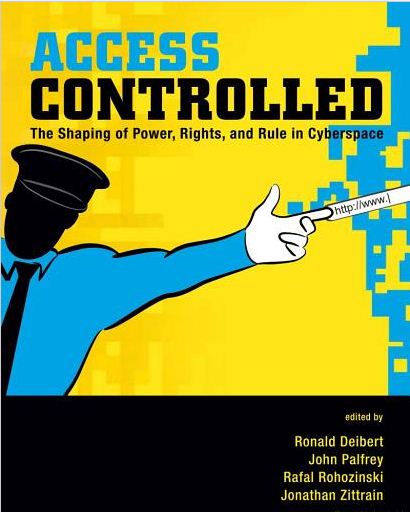
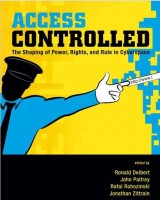 Faithful readers know of my geeky love for tech policy books. I read lots of ’em. There’s a steady stream of Amazon.com boxes that piles up on my doorstop some days because my mailman can’t fit them all in my mailbox. But I go pretty hard on all the books I review. It’s rare for me pen a glowing review. Occasionally, however, a book will come along that I think is both worthy of your time and which demands a place on your bookshelf because it is such an indispensable resource. Access Controlled: The Shaping of Power, Rights, and Rule in Cyberspace is one of those books.
Smartly organized and edited by Ronald J. Deibert, John G. Palfrey, Rafal Rohozinski, and Jonathan Zittrain, Access Controlled is essential reading for anyone studying the methods governments are using globally to stifle online expression and dissent. As I noted of their previous edition, Access Denied: The Practice and Policy of Global Internet Filtering, there is simply no other resource out there like this; it should be required reading in every cyberlaw or information policy program.
The book, which is a project of the OpenNet Initiative (ONI), is divided into two parts. Part 1 of the book includes six chapters on “Theory and Analysis.” They are terrifically informative essays, and the editors have made them all available online here (I’ve listed them down below with links embedded). The beefy second part of the book provides a whopping 480 pages(!) of detailed regional and country-by-country overviews of the global state of online speech controls and discuss the long-term ramifications of increasing government meddling with online networks.
In their interesting chapter on “Control and Subversion in Russian Cyberspace,” Deibert and Rohozinski create a useful taxonomy to illustrate the three general types of speech and information controls that states are deploying today. What I find most interesting is how, throughout the book, various authors document the increasing movement away from “first generation controls,” which are epitomized by “Great Firewall of China”-like filtering methods, and toward second- and third-generation controls, which are more refined and difficult to monitor. Here’s how Deibert and Rohozinski define those three classes (or “generations”) of controls: Continue reading →
PFF today released the fifth installment in our ongoing series on “The Wrong Way to Reinvent Media.” This series of papers explores various tax and regulatory proposals that would have government play an expanded role in supporting the press, journalism, or other media content. In the latest essay, Berin Szoka, Ken Ferree, and I discuss proposals for direct subsidies for failing media outlets and out-of-work journalists.
We argue taxpayer support for failing outlets and unemployed journalists implicates significant First Amendment concerns. On the whole, subsidies can make “journalists and media operators more dependent upon the State; compromise press independence and diminish public trust in the free press; and result in government discrimination in the politically inescapable dilemma of determining eligibility for subsidies.” Such an agenda would also entail huge cost to taxpayers—initially about $35 billion per year according to advocates—and would represent “a massive wealth transfer from one class of speakers to another…”
We warn that calls for seemingly beneficent bailouts “to save” the media and journalism may actually be driven by those who have something more nefarious in mind: a “post-corporate” world shorn of media capitalists, and “such radicalism must be rejected if we hope to sustain a truly free press and uphold America’s proud tradition of keeping a high and tight wall of separation between Press and State.”
The ideas within these and other essays in the series will be worked into a major PFF filing in the Federal Communications Commission’s (FCC) proceeding on the “Future of Media” on May 7. The paper may be viewed online here and I’ve attached it down below in a Scribd reader.
Continue reading →
The Supreme Court announced today that it will review a California law regulating the sale of violently-themed video games to minors. The case is Schwarzenegger v. Entertainment Merchants and I have written about it here before. This will be the first major First Amendment case regarding video game speech rights heard by our nation’s highest court. This afternoon, I issued the following press statement about the case and its importance:
“I hope the Supreme Court is taking this case to affirm the free speech rights of game creators and users, and not to overturn ten years of solid, sensible lower court decisions granting video games the same First Amendment protections as books, film, music and other forms of entertainment. Government regulation of game content is unnecessary because parents have been empowered with sophisticated video game parental controls and a highly descriptive ratings system that is widely recognized and easy to use. Lawmakers should focus their efforts on making sure parents are better aware of existing tools and ratings instead of trying to censor game content in such a plainly unconstitutional fashion. Let’s hope the Supreme Court affirms that educational approach and Ninth Circuit’s decision at the same time.”
Several reporters have already asked me if its a bad sign that the Court took the case at all and wondered if this meant that there are 5 votes for overturning the lower court decision. It’s impossible to read the tea leaves on things like this, but I would generally agree that it’s not a good sign. But I just don’t understand how the Supreme Court could uphold a law like this in light of all their recent Internet jurisprudence (CDA, COPA, etc) which held against the government when various “harm to minors” statutes were tested and found to be unconstitutional. If the Supreme Court goes the opposite direction here, it will mean that our “First Amendment jurisprudential Twilight Zone” will become even more confusing and contorted. Let’s hope that’s not the case.
As I’ve mentioned here previously, PFF has been rolling out a new series of essays examining proposals that would have the government play a greater role in sustaining struggling media enterprises, “saving journalism,” or promoting more “public interest” content. We’re releasing these as we get ready to submit a big filing in the FCC’s “Future of Media” proceeding (deadline is May 7th). Here’s a podcast Berin Szoka and I did providing an overview of the series and what the FCC is doing.
In the first installment of the series, Berin and I critiqued an old idea that’s suddenly gained new currency: taxing media devices or distribution systems to fund media content. In the second installment, I took a hard look at proposals to impose fees on broadcast spectrum licenses and channeling the proceeds to a “public square channel” or some other type of public media or “public interest” content.
In our latest essay, “The Wrong Way to Reinvent Media, Part 3: Media Vouchers,” Berin and I consider whether it is possible to steer citizens toward so-called “hard news” and get them to financially support it through the use of “news vouchers” or “public interest vouchers”? We argue that using the tax code to “nudge” people to support media — while less problematic than direct subsidies for the press — will likely raise serious issues regarding eligibility and be prone to political meddling. Moreover, it’s unlikely the scheme will actually encourage people to direct more resources to hard news but instead just become a method of subsidizing other content they already consume.
I’ve attached the entire essay down below.
Continue reading →
By Adam Thierer & Berin Szoka
As we mentioned yesterday, in a new series of essays, we will be examining proposals being put forward today that would have the government play a greater role in sustaining struggling media enterprises, “saving journalism,” or promoting more “public interest” content. With many traditional media operators struggling, and questions being raised about how journalism in particular will be supported in the future, Washington policymakers are currently considering what role government can and should play in helping media providers reinvent themselves in the face of tumultuous technological change wrought by the Digital Revolution. We will be releasing 6 or 7 essays on this topic leading up to our big filing in the FCC’s “Future of Media” proceeding (deadline is May 7th).
In the first installment of our series, we will critique an old idea that’s suddenly gained new currency: taxing media devices or distribution systems to fund media content. We argue that such media income redistribution is fundamentally inconsistent with American press traditions, highly problematic under the First Amendment, difficult to implement in a world of media abundance and platform convergence, and likely to cause serious negative side effects. Bottom line: Don’t tax our iPhones or broadband to subsidize media!
We’ve attached the entire text of the piece below. (Installment #2, on broadcast spectrum taxes to subsidize public media, will be released next week.)
Continue reading →
 I had a long interview this morning with the Christian Science Monitor. Like many of the interviews I’ve had this year, the subject was Google. At the increasingly congested intersection of technology and the law, Google seems to be involved in most of the accidents.
Just to name a few of the more recent pileups, consider the Google books deal, net neutrality and the National Broadband Plan, Viacom’s lawsuit against YouTube for copyright infringement, Google’s very public battle with the nation of China, today’s ruling from the European Court of Justice regarding trademarks, adwords, and counterfeit goods, the convictions of Google executives in Italy over a user-posted video, and the reaction of privacy advocates to the less-than-immaculate conception of Buzz.
In some ways, it should come as no surprise to Google’s legal counsel that the company is involved in increasingly serious matters of regulation and litigation. After all, Google’s corporate goal is the collection, analysis, and distribution of as much of the world’s information as possible, or, as the company puts it,” to organize the world’s information and make it universally accessible and useful.” That’s a goal it has been wildly successful at in its brief history, whether you measure success by use (91 million searches a day) or market capitalization ($174 billion).
As the world’s economy moves from one based on physical goods to one driven by information flow, the mismatch between industrial law and information behavior has become acute, and Google finds itself a frequent proxy in the conflicts.
Continue reading →



 The Technology Liberation Front is the tech policy blog dedicated to keeping politicians' hands off the 'net and everything else related to technology.