On Forbes
this morning, I analyze the legislative and judicial challenges to last year’s FCC Open Internet rules, the so-called net neutrality order.
Despite the urgency of Friday’s budget machinations, the House took time out to pass House Joint Resolution 37, which “disapproves” the FCC’s December rulemaking. If passed by the Senate and not vetoed by President Obama, HJR 37 would effectively nullify the net neutrality rules, and ensure the FCC cannot pass alternate versions of them absent new authority to do so from Congress.
Most commentators believe that the House action was merely symbolic. Passage in the Senate requires only a simple majority, but the neutrality fight has turned violently partisan since the mid-term elections and getting a few Democratic Senators on-board may be hard. More to the point, the White House last week pre-emptively threatened to veto the resolution.
Continue reading →
I’ve posted a long article on Forbes.com this morning on the Global Network Initiative. A non-profit group aimed at improving human rights though the agency of information technology companies, GNI has never really gotten off the ground.
Since its formal launch in 2008, following two years of negotiations among tech companies, human rights groups and academics, not a single company has agreed to join beyond the original members–Google, Yahoo and Microsoft.
This despite considerable pressure from supporters of GNI, including Senator Richard Durbin (D-IL), Chair of the Senate Judiciary’s Subcommittee on Human Rights. Indeed, in the wake of uprisings in Tunisia, Egypt, Libya and elsewhere and the seminal role played by social media and other IT, a full-court press has been launched against Facebook and Twitter in particular for failing to sign up. Continue reading →
Here’s an interesting SmartPlanet interview with Paul Ohm, associate professor of law at the University of Colorado Law School, in which he discusses his concerns about “reidentification” as it relates to privacy issues. “Reidentification” and “de-anonymization” fears have been set forth by Ohm and other computer scientists and privacy theorists, who suggest that because the slim possibility exists of some individuals in certain data sets being re-identified even after their data is anonymized, that fear should trump all other considerations and public policy should be adjusted accordingly (specifically, in the direction of stricter privacy regulation / tighter information controls).
I won’t spend any time here on that particular issue since I am still waiting for Ohm and other “reidentification” theorists to address the cogent critique offered up by Jane Yakowitz in an important new study that I discussed here last week. Once they do, I might have more to say on that point. Instead, I just wanted to make some brief comments on one particular passage from the Ohm interview in which he outlines a bold new standard for privacy regulation:
We have 100 years of regulating privacy by focusing on the information a particular person has. But real privacy harm will come not from the information they have but the inferences they can draw from the data they have. No law I have ever seen regulates inferences. So maybe in the future we may regulate inferences in a really different way; it seems strange to say you can have all this data but you can’t take this next step. But I think that’s what the law has to do.
This is a rather astonishing new legal standard and there are two simple reasons why, as Ohm suggests, “no law… regulates inferences” and why, in my opinion, no law should. Continue reading →
In the latest example of big government run amok, several politicians think they ought to be in charge of which applications you should be able to install on your smartphone.
On March 22, four U.S. Senators sent a letter to Apple, Google, and Research in Motion urging the companies to disable access to mobile device applications that enable users to locate DUI checkpoints in real time. Unsurprisingly, in their zeal to score political points, the Senators—Harry Reid, Chuck Schumer, Frank Lautenberg, and Tom Udall—got it dead wrong.
Had the Senators done some basic fact-checking before firing off their missive, they would have realized that the apps they targeted actually
enhance the effectiveness
of DUI checkpoints while reducing their intrusiveness. And had the Senators glanced at the Constitution – you know, that document they swore an oath to support and defend – they would have seen that sobriety checkpoint apps are almost certainly protected by the First Amendment.

While Apple has stayed mum on the issue so far, Research in Motion quickly yanked the apps in question. This is understandable; perhaps RIM doesn’t wish to incur the wrath of powerful politicians who are notorious for making a public spectacle of going after companies that have the temerity to stand up for what is right.
Google has refused to pull the DUI checkpoint finder apps from the Android app store, reports Digital Trends. Google’s steadfastness on this matter reflects well on its stated commitment to free expression and openness. Not that Google’s track record is perfect on this front – it’s made mistakes from time to time – but it’s certainly a cut above several of its competitors when it comes to defending Internet freedom. Continue reading →
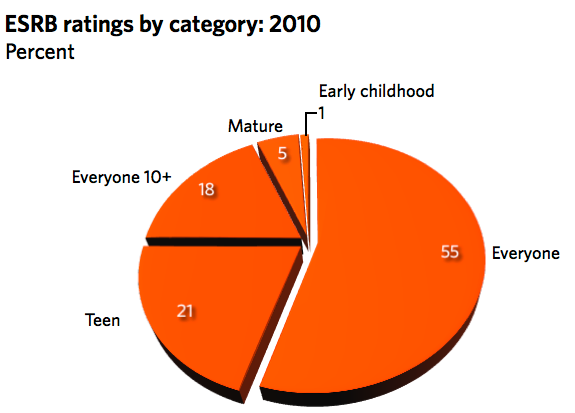
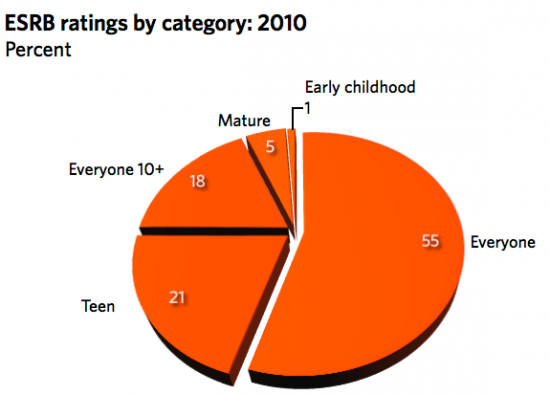 Five years ago this month, I penned a white paper on “Fact and Fiction in the Debate over Video Game Regulation” that I have been meaning to update ever since but just never seem to get around to it. One of the myths I aimed to debunk in the paper was the belief that most video games contain intense depictions of violence or sexuality. This argument drives many of the crusades to regulate video games. In my old study, I aggregated several years worth of data about video game ratings and showed that the exact opposite was the case: the majority of games sold each year were rating “E” for everyone or “E10+” (Everyone 10 and over) by the Entertainment Software Rating Board (ESRB).
Thanks to this new article by Ars Technica‘s Ben Kuchera, we know that this trend continues. Kuchera reports that out of 1,638 games rated by the ESRB in 2010, only 5% were rated “M” for Mature. As a percentage of top sellers, the percentage of “M”-rated games is a bit higher, coming in at 29%. But that’s hardly surprising since there are always a few big “M”-rated titles that are the power-sellers among young adults each year. Still, most of the best sellers don’t contain extreme violence or sexuality.
Continue reading →
Nate Anderson of Ars Technica has posted an interview with Sen. Al Franken (D-MN) about Defining Internet “Freedom”. Neither Sen. Franken nor Mr. Anderson ever get around to defining that term in their exchange, but the clear implication from the piece is that “freedom” means freedom for the government to plan more and for policymakers to more closely monitor and control the Internet economy. The clearest indication of this comes when Sen. Franken repeats the old saw that net neutrality regulation is “the First Amendment issue of our time.”
As a lover of liberty, I find this corruption of language and continued debasement of the term “freedom” to be extremely troubling. The thinking we see at work here reflects the ongoing effort by many cyber-progressives (or “cyber-collectivists,” as I prefer to call them) to redefine Internet freedom as liberation from the supposed tyranny of the marketplace and the corresponding empowerment of techno-cratic philosopher kings to guide us toward a more enlightened and noble state of affairs. We are asked to ignore our history lessons, which teach us that centralized planning and bureaucracy all too often lead to massively inefficient outcomes, myriad unforeseen unintended consequences, bureaucratic waste, and regulatory capture. Instead, we are asked to believe that high-tech entrepreneurs are the true threat to human progress and liberty. They are cast as nefarious villains and their innovations, we are told, represent threats to our “freedom.” We even hear silly comparisons likening innovators like Apple to something out of George Orwell’s 1984. Continue reading →
My essay last week for Slate.com (the title I proposed is above, but it must have been too “punny” for the editors) generated a lot of feedback, for which I’m always grateful, even when it’s hostile and ad hominem. Which much of it was.
The piece argues generally that when it comes to the Internet, a disruptive technology if ever there was one, the best course of action for traditional, terrestrial governments intent on “saving” or otherwise regulating digital life is to try as much as possible to restrain themselves. Or as they say to new interns in the operating room, “Don’t just do something. Stand there.”
This is not an argument in favor of anarchy, or even more generally for social Darwinism. I have something much more practical in mind. Disruptive technologies, by definition, do not operate within the “normal science” of those areas of life they impact. Its problems can’t be solved by reference to existing systems and institutions. In the case of the Internet, that’s pretty much all aspects of life, including regulation. Continue reading →

In Part I of this analysis of the FCC’s Report and Order on “Preserving the Open Internet,” I reviewed the Commission’s justification for regulating broadband providers. In Part II, I looked at the likely costs of the order, in particular the hidden costs of enforcement. In this part, I compare the text of the final rules with earlier versions. Next, I’ll look at some of the exceptions and caveats to the rules—and what they say about the true purpose of the regulations
In the end, the FCC voted to approve three new rules that apply to broadband Internet providers. One (§8.3) requires broadband access providers to disclose their network management practices to consumers. The second One (§8.4) prohibits blocking of content, applications, services, and non-harmful devices. The third One (§8.5) forbids fixed broadband providers (cable and telephone, e.g.) from “unreasonable” discrimination in transmitting lawful network traffic to a consumer.
There has of course been a great deal of commentary and criticism of the final rules, much of it reaching fevered pitch before the text was even made public. At one extreme, advocates for stronger rules have rejected the new rules as meaningless, as “fake net neutrality,” “not neutrality,” or the latest evidence that the FCC has been captured by the industries it regulates. On the other end, critics decry the new rules as a government takeover of the Internet, censorship, and a dangerous and unnecessary interference with a healthy digital economy. (I agree with that last one.)
One thing that has not been seriously discussed, however, is just how little the final text differs from the rules originally proposed by the FCC in October, 2009. Indeed, many of those critical of the weakness of the final rules seem to forget their enthusiasm for the initial draft, which in key respects has not changed at all in the intervening year of comments, conferences, hearings, and litigation. Continue reading →
Back in 2007 I penned a law review article, “Why Regulate Broadcasting: Toward a Consistent First Amendment Standard for the Information Age” in which I argued that “If America is to have a consistent First Amendment in the Information Age, efforts to extend the broadcast regulatory regime must be halted and that regime must be relegated to the ash heap of history.” I made that argument based not only upon the fundamental bankruptcy of the rationales supporting the old broadcast regulatory regime, or its unfairness to broadcasters relative to other media competitors, but also because such asymmetrical regulations no longer make sense — and are increasingly impractical to enforce — in an age of technological convergence and media abundance.
The good news is that, slowly but surely, the courts are coming around to this logic, at least as it pertains to speech controls. We saw that again today with a ruling by the Second Circuit Court of Appeals that held as unconstitutional $1.2 million in fines that the Federal Communications Commission (FCC) levied on ABC broadcast affiliates seven years ago for airing a brief glimpse of Charlotte Ross’ bare buttocks on the cop drama “NYPD Blue.” As the Wall Street Journal’s
Amy Schatz notes, “Broadcasters have now won a series of court victories against government efforts to police airwaves and fine stations for airing risqué content. The Supreme Court could soon get a chance to review the issue. In the meantime, the FCC’s campaign to enforce indecency rules has ground to a halt.”
It remains to be seen whether the Supreme Court will throw the whole regime out, but I can’t help but think that’s where we are headed. Continue reading →
 Amazon made headlines last week when it abruptly cut off service to Wikileaks, allegedly on the grounds that the site had violated Amazon’s terms of acceptable use. However, Amazon’s supposedly “voluntary” decision came less than 24 hours after Amazon received a phone call from Senate Homeland Security Committee staff (at the behest of Sen. Joe Lieberman) inquiring about the firm’s relationship with Wikileaks. According to a report in The Guardian, Amazon’s decision to terminate service to Wikileaks was a “reaction to heavy political pressure.”
That’s not all. Glenn Greenwald reported last week on Salon.com that another Internet company, Tableau Software, also decided to disable service to Wikileaks because of pressure from Joe Lieberman. Unlike Amazon, Tableau admitted that its decision was directly prompted by pressure from Lieberman. From Tableau’s statement:
Our decision to remove the data from our servers came in response to a public request by Senator Joe Lieberman, who chairs the Senate Homeland Security Committee, when he called for organizations hosting WikiLeaks to terminate their relationship with the website.
It’s difficult to see Joe Lieberman’s “public request” as anything but a thinly-veiled threat. Case in point: In addition to his staffers’ phone calls, Lieberman went on MSNBC last week, stating bluntly, “we’ve got to put pressure on any companies … which provide access to the Internet to Wikileaks.”
As Chairman of the Senate Homeland Security Committee, Lieberman is in a uniquely powerful position to push for legislation that might harm private firms like Amazon. He can also hold Congressional hearings, which frequently turn into public spectacles and garner massive media coverage. A company’s CEO enduring a congressional grilling on Capitol Hill can significantly impact that firm’s public image — and, in some cases, its stock price as well. While no individual Senator has the power to enact laws, promulgate rules, or enforce regulations, a single crusading politician can arguably cause cognizable harm to any U.S. company that pushes back against “requests” to suppress unfavorable content.
How does this implicate the First Amendment? As EFF’s Rainey Reitman and Marcia Hofmann pointed out on the DeepLinks blog, “The First Amendment to the Constitution guarantees freedom of expression against government encroachment — but that doesn’t help if the censorship doesn’t come from the government.”
Continue reading →

 The Technology Liberation Front is the tech policy blog dedicated to keeping politicians' hands off the 'net and everything else related to technology.